


Standing at a restaurant terminal in Paris or an ATM in Bangkok, many travelers now see the same unexpected question: pay in local currency or in your home currency. The choice looks harmless, even helpful, but it can quietly add several percent to every bill. Understanding what is really happening on these screens is one of the fastest ways to cut the cost of spending overseas.
Get the latest updates straight to your inbox!
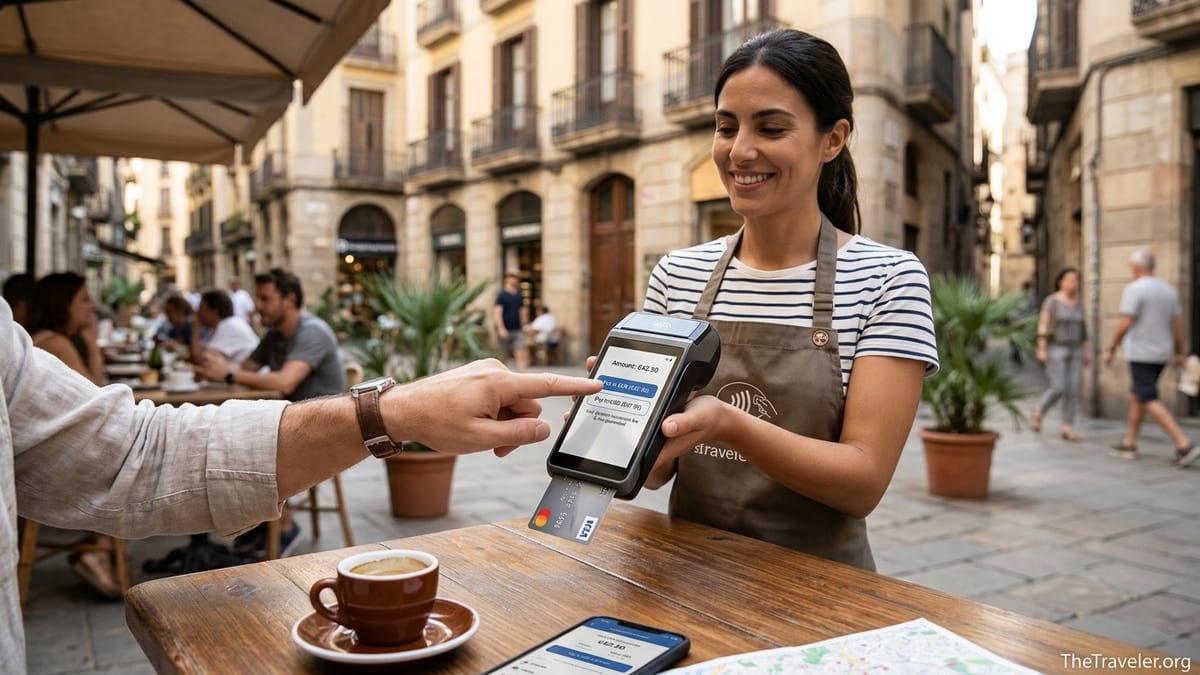
The golden rule: choose local currency almost every time
When a card terminal or ATM abroad offers you a choice between paying in the local currency or in your home currency, the financially better answer is usually simple: choose the local currency and decline the conversion. In practice that means choosing euros for a restaurant in France, yen for a hotel in Japan, or baht at an ATM in Thailand. This allows your card network, such as Visa or Mastercard, to handle the currency conversion at its own wholesale-based exchange rate, which is normally very close to the mid-market rate you would see on financial news sites.
The alternative is a service called dynamic currency conversion, often shortened to DCC. With DCC, the merchant or ATM operator converts the price into your home currency on the spot and shows you the total in dollars, pounds or another familiar currency. The screen may even mention that it offers “rate guaranteed” or “no surprises.” The catch is that the DCC exchange rate can include a markup on top of the underlying card network rate. Industry examples and consumer reports frequently show DCC markups in the range of roughly 3 to 8 percent, and sometimes higher, which is pure extra cost to the cardholder.
There are limited situations where the comparison becomes more complicated. Some cards, especially in the United States, still charge foreign transaction fees, commonly around 3 percent of the transaction amount when the purchase is processed in a foreign currency. A traveler using such a card might see a DCC offer that looks close to the network rate but still faces that foreign fee if they choose local currency. Even then, the combination of network rate plus the card’s foreign fee usually beats a DCC rate carrying a 5 to 8 percent markup. Only in unusual cases, such as a card with a very high foreign fee or a promotional merchant rate, would DCC come close to matching or beating the cost of simply choosing local currency.
What dynamic currency conversion actually is and who sets the rate
Dynamic currency conversion is a service that allows a transaction in one currency to be converted at the point of sale into another currency chosen by the cardholder. For example, a hotel in Madrid can run a 200 euro bill through a card terminal that offers to convert the charge into US dollars before sending it for processing. The important detail is that the exchange rate used for this conversion is not set by Visa or Mastercard, and not by your bank at home. It is set by the DCC provider, usually working with the merchant’s payment processor or the ATM operator.
The markup built into that exchange rate is separate from any foreign transaction fee that your card issuer may charge. A foreign transaction fee is a charge from your bank or card issuer for processing a transaction involving a foreign currency or a foreign country, often stated as a percentage on your statement. By contrast, the DCC markup is embedded inside the exchange rate itself. If the mid-market rate is 1 euro equal to about 1.07 US dollars on a given day, and a DCC provider offers to convert at 1 euro equal to 1.12 dollars, that extra 0.05 dollars per euro is the fee for the conversion service.
Visa and Mastercard publish their indicative exchange rates on their own websites and explain that these rates are used when the transaction is processed in the local currency and converted by the network. The card network rate already includes a small spread relative to the interbank market, but for consumer cardholders it is usually competitive. When DCC is used, this network conversion step is bypassed because the transaction reaches the network already denominated in the cardholder’s home currency. That is why DCC can never be improved by a better rate from the network: the network no longer performs the conversion.
Both Visa and Mastercard state that merchants and ATM operators offering DCC must disclose the exchange rate and any margin or commission and must allow the cardholder to choose whether to accept or reject the conversion. Regulators in several markets, including the European Union and the United Kingdom, also require clear disclosure of DCC terms. These rules exist because the DCC provider’s financial incentive is to encourage acceptance of the conversion, even when it is more expensive for the traveler.
How payment terminals and ATMs phrase the currency choice
In real life, the DCC question rarely appears as a neutral mathematical comparison. Card terminals and ATMs around the world use different wording, and some are much clearer than others. A restaurant in Rome might present a screen with two lines: “Amount in EUR” and “Amount in USD,” with the cardholder asked to pick one. A hotel in Berlin might show “Accept conversion” alongside the USD amount, and “Decline conversion” next to the EUR amount. An ATM in Bangkok can display the converted amount in Australian dollars with a large green button to “Accept conversion” and a smaller grey button to “Continue without conversion.”
These phrases all describe the same choice framed in different ways. “Pay in euros versus dollars” is the most straightforward, but many screens emphasize the supposed safety of the DCC option. They might mention that the home currency amount is “guaranteed” or that there will be “no further exchange rate risk.” The implication is that saying yes to DCC protects you from future exchange-rate movements, even though the transaction is about to settle within days and any currency risk over that short window is usually minor compared with the DCC markup itself.
Crucially, declining conversion does not mean declining the transaction or refusing to pay. On properly configured terminals, choosing to decline or bypass conversion simply instructs the system to send the transaction in the local currency to your card network instead of routing it through the DCC provider. The purchase still goes through, the merchant still gets paid, and you still owe the money. Confusion arises because some screens phrase the option as “Decline transaction” or show a red button next to declining conversion, even though the transaction will continue in the local currency. If a terminal appears to cancel the transaction entirely when you try to refuse DCC, you are entitled to ask the merchant to rerun the payment correctly.
Travelers can prepare by learning the common formulations. At a European hotel, watch for “Continue without conversion” or “Bill in EUR” as the safer local-currency options. In Asia, ATMs often place the converted home-currency offer on the default button, with a smaller text option such as “Charge in THB only” or “Decline conversion.” The key is to look beyond the color and size of the buttons and read which choice keeps the transaction in the local currency.
Three real-world examples comparing costs with and without DCC
To see how DCC changes the bill, it helps to run the numbers with realistic amounts and dated exchange rates. Consider a US tourist checking out of a hotel in Barcelona with a 200 euro bill in October 2026. On a recent late-October date, the euro traded at roughly 1 euro equal to 1.07 US dollars according to card network and market data. If the traveler chooses to pay in euros and lets the Visa or Mastercard rate apply, the base converted amount would be about 214 US dollars before any card-specific fees. If the card charges no foreign transaction fee, that is close to the final amount on the statement.
Now imagine the same terminal offers DCC into US dollars. A 3 percent markup on the exchange rate would move the effective rate to about 1 euro equal to 1.10 dollars and produce a hotel charge around 220 dollars. A 5 percent markup would lift the rate to roughly 1.12 dollars per euro, or about 224 dollars for the same 200 euro stay. An 8 percent markup would drive the rate to close to 1.16 dollars per euro, and the traveler would see a charge near 232 dollars. Across a two-week European vacation with four similar hotel bills, the difference between consistently choosing DCC with an 8 percent markup and consistently paying in euros could be around 72 dollars or more, just on accommodation.
Next, take a British traveler in Tokyo settling a 30,000 yen restaurant bill in November 2026. Around that time, one British pound bought roughly 180 Japanese yen on major card network rate tables. Without DCC, paying in yen would convert to about 167 pounds before fees. If a DCC offer converts the bill into pounds with a 3 percent markup, the effective rate might fall to around 175 yen per pound, inflating the bill to about 171 pounds. With a 5 percent markup, the implied rate could be approximately 171 yen per pound, making the bill about 175 pounds. At 8 percent, the DCC rate might slide to about 166 yen per pound, and the diner would pay near 181 pounds. For someone eating out most nights over a two-week trip, routinely accepting such conversions on restaurant and bar tabs can quietly add the cost of an extra meal or more.
A third example involves an Australian visitor withdrawing cash from an ATM in Bangkok. Suppose in early November 2026 they withdraw 8,000 Thai baht. Around that period, one Australian dollar bought close to 24 baht at card-network rates. If the traveler declines DCC and allows the withdrawal to be processed in baht, the base converted amount would be around 333 Australian dollars, plus any cash-advance fee or foreign ATM charge their bank imposes. If the ATM instead applies DCC with a 3 percent markup built into an effective rate of about 23.3 baht per dollar, the withdrawal becomes roughly 343 dollars. A 5 percent markup, with around 22.9 baht per dollar, raises the cost to about 349 dollars, and an 8 percent markup, at roughly 22.2 baht per dollar, pushes it toward 360 dollars. If the traveler makes several similar withdrawals across a two-week holiday, habitually accepting DCC at 8 percent could increase the total cost of cash access by more than 80 Australian dollars.
These examples also illustrate how bank fees stack on top of the exchange-rate question. A US card that charges a 3 percent foreign transaction fee will apply that fee to the converted amount when the transaction is processed in local currency and converted by the network, but some banks also treat DCC transactions as foreign and still levy the same percentage fee. A traveler needs to check their card terms to see both the network conversion route and the fee structure to understand the full cost.
Credit cards, debit withdrawals, prepaid cards and multi-currency accounts
Dynamic currency conversion can affect almost every kind of plastic in your wallet. With a credit card, DCC usually appears at card terminals in hotels, restaurants and shops, and sometimes on online booking platforms that detect your billing address and preselect home-currency billing. For debit cards, DCC is most commonly seen at foreign ATMs and in some point-of-sale terminals that treat debit cards similarly to credit. Prepaid travel cards, particularly those issued in a single currency like US dollars, can still be subject to DCC when used outside that card’s base currency region.
Multi-currency accounts add an extra layer of complexity but also offer potential savings. Digital banks and fintech services now allow customers to hold balances in several currencies at once, for example US dollars, euros and British pounds, and to pay directly from the currency that matches the transaction. If you are an American who has preloaded euros into such an account and then pay a 50 euro restaurant bill in Paris, your provider may simply deduct 50 euros from your euro balance with no conversion at all. In that situation, you would still want to refuse any DCC offer and keep the transaction in euros, otherwise the merchant or ATM would convert into your home currency and defeat the purpose of holding a local-currency balance.
The transaction currency matching the account’s held balance is the ideal scenario. For a British traveler with a account holding both pounds and yen, spending in Japan in yen will typically draw down the yen balance first, sidestepping conversion. If the yen balance is insufficient, the provider may automatically convert from pounds at its own rate and fee schedule, which the traveler should compare with card-network based cards back home. DCC can still intervene at the point of sale, which is why the habit of always choosing the local currency remains useful even for sophisticated multi-currency users.
Travelers should also be aware that some prepaid and debit products include their own internal markups on foreign exchange when a transaction hits a currency the card does not hold. Even when DCC is refused, the provider’s spread plus any foreign transaction fee determine the final cost. Reading the issuer’s fee schedule and looking for notes about “cross-border fees,” “international service assessment” charges and “markups over the wholesale rate” can help identify which cards are most efficient for foreign use.
When quotes and charges use different currencies or default to DCC
Accommodation and travel bookings can create confusion when the quoted price and the charged currency differ. For example, a hotel website might show nightly rates in US dollars for a property in Prague but note in the small print that billing is in euros at check-out. At the front desk, the property might then present a terminal that defaults to converting the euro bill back into US dollars with DCC, resulting in two layers of effective currency handling. A careful traveler should check the reservation confirmation to see the actual billing currency and at check-out insist on being charged in that local currency, bypassing any in-person DCC offer.
Online booking platforms can also use preselected home-currency billing. A British user browsing a global travel website from London may see options to pay a Japanese hotel either in yen or in pounds. Choosing to pay in pounds through the website is functionally similar to accepting DCC, as the platform or its payment processor sets the exchange rate rather than the card network. If the platform’s rate is significantly weaker than the card network’s published rate for that day, paying in the hotel’s local currency and letting the card handle conversion may be cheaper, provided the card’s foreign fees are modest.
There are also cases where ATM and terminal screens make rejection of conversion confusing. Some ATMs warn that declining the conversion means “you may be charged fees by your bank” or that “the final amount is not known,” which can sound alarming. In reality, these messages reflect the fact that your bank’s final conversion rate and any fees will only be determined when the transaction settles, not that something unusual or unsafe will happen. If a screen genuinely appears to give no way to continue without conversion, travelers can cancel, find another ATM or merchant, or in a hotel context ask staff to print the bill and settle it at a different terminal or at the main desk.
Recognizing misleading exchange-rate presentations often comes down to comparing the offered rate or home-currency total with an independent reference. While traveling, many people quickly check a currency-conversion app showing mid-market rates to see whether a DCC offer looks reasonable. If the home-currency total on the screen is several percent higher than what the app suggests, that gap is the price of the convenience. Knowing this helps travelers make deliberate choices rather than reacting to reassuring words on a payment screen.
Receipts, disputes and when a conversion can be challenged
Keeping receipts remains one of the most effective protections against unwanted DCC. At hotels and larger restaurants, ask for an itemized bill that clearly shows the transaction currency and, if DCC was used, the exchange rate and the converted amount. If you see a receipt that shows your home currency even though you do not remember choosing that option, question it on the spot. In many cases staff can void the transaction and rerun it correctly in the local currency before you leave.
If you only notice the issue later, when your card statement arrives, you can still raise a dispute with your card issuer. Card networks state in their operating rules that DCC must be offered transparently and that the cardholder must consent to it. If a merchant has processed DCC without offering a choice, or if the screen was misleading or not in a language the cardholder could reasonably understand, some issuers treat this as grounds for a chargeback request. The success of such disputes varies, but they are more likely to succeed when you can supply documentation, such as a receipt or photos of the terminal screens taken at the time of payment.
It is important to distinguish between unauthorized or improperly disclosed conversion and a conversion you voluntarily accepted after clear disclosure. If a London shopper sees a point-of-sale receipt that plainly shows the amount in euros, the exchange rate and the converted amount in pounds, and signs to accept it, challenging that conversion later because the rate was expensive is unlikely to succeed. On the other hand, if the receipt contains no mention of the conversion even though the transaction reached the statement in the shopper’s home currency, or if staff overrode the customer’s expressed preference, the cardholder has a stronger case that DCC was applied without proper consent.
Some regulators have also issued guidance or penalties against misleading DCC practices. Consumer-protection agencies in parts of Europe and Asia, for example, have reminded financial institutions and merchants that stating or implying that DCC is mandatory or safer than local-currency billing can be unfair. While a traveler cannot rely on enforcement in every situation, knowing that regulators have expressed concerns can lend weight when raised politely with a bank’s dispute team.
Quick-reference checklists and advice for different traveler types
At ATMs abroad, a practical mental checklist helps. First, confirm that the withdrawal amount on the screen is shown in the local currency, such as euros, baht or pesos. Second, watch for a screen that offers to convert into your home currency and look carefully at the buttons. Phrases like “Accept conversion,” “Bill in USD,” or “With conversion” usually represent the DCC option, while lines such as “Continue without conversion,” “Bill in EUR,” or “Charge in local currency” are the safer choices. Third, remember that declining conversion does not cancel the cash withdrawal; it simply lets your own bank and card network handle the rate.
At card terminals in shops, restaurants and hotels, a similar routine works. When the staff hand you a terminal, ask them to charge you in the local currency. If the screen still offers a home-currency option, read the fine print before pressing any buttons. In Europe you might see “Amount in EUR” against one button and “Amount in GBP” against another. In Asia or Latin America, the converted amount in your home currency might be bold and highlighted, while a smaller option lets you bypass it. Taking a few seconds to choose local currency here can save meaningful amounts over the length of a trip.
Tourists on a single annual vacation benefit the most from using at least one card without foreign transaction fees and building the habit of rejecting DCC. Frequent travelers, such as business visitors rotating through several countries each month, might go further and maintain a multi-currency account to hold balances in currencies they use regularly, always insisting on local-currency billing so those balances can be spent directly. People managing multiple currency accounts need to pay particular attention to which account a card draws from for each transaction and to ensure that DCC is not redirecting spending back into the home currency against their intentions.
In every case, the core logic remains firm. Local-currency billing lets your card network and bank apply their own rates and fees, which you can compare and choose in advance. Dynamic currency conversion hands that power to a third-party provider whose interests are not aligned with yours. By understanding how the choice is framed and what it costs in real numbers, travelers can confidently press the right button at the terminal and keep more of their money for the journey itself.