


More news on this day
Singapore Airlines is sharpening its focus on high-end leisure and premium corporate travel in the Asia Pacific region, rolling out Airbus A380 “mega flights” across a powerful Singapore–Dubai–Australia corridor that is rapidly emerging as one of the most influential long-haul networks in the southern hemisphere.
Get the latest news straight to your inbox!
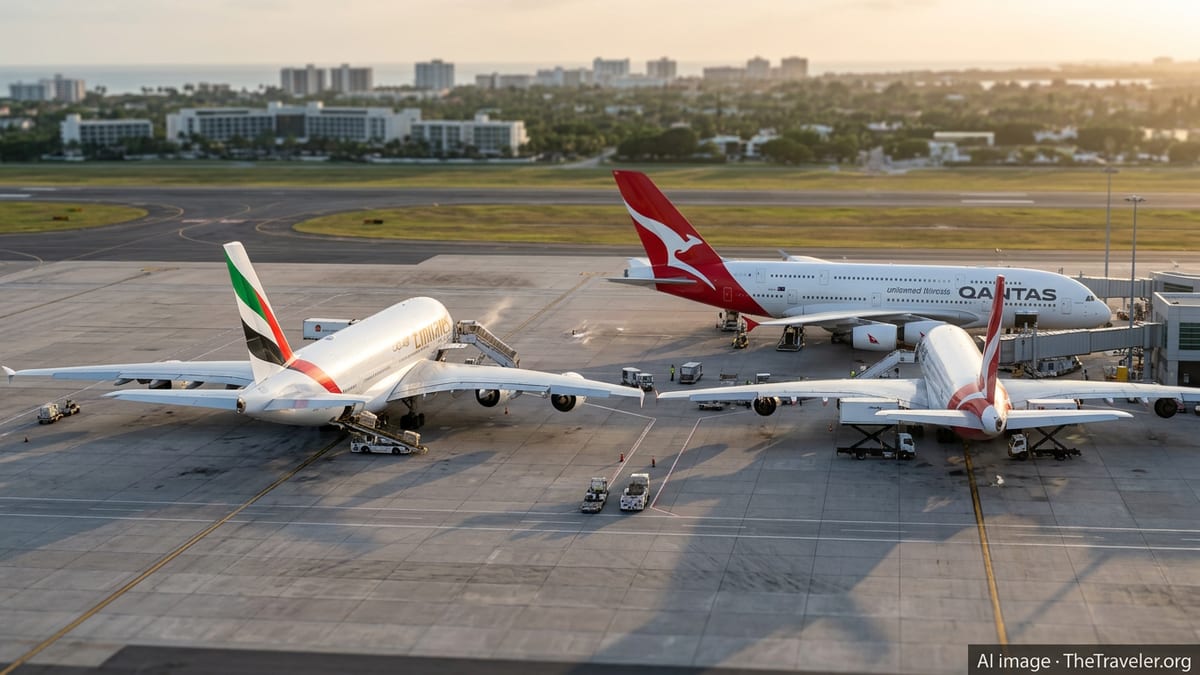
A380 Returns to Asia Pacific Power Route
Publicly available schedules and recent network updates show Singapore Airlines positioning the double-decker Airbus A380 at the heart of its 2026 northern summer operations, particularly on the Singapore–Dubai trunk and onward connections into Australia. The move places one of the world’s largest passenger aircraft back on a route that links key financial centers with major tourism gateways, reinforcing Singapore’s role as a premium hub between Europe, the Middle East and the Asia Pacific.
From late March 2026, the airline is set to roster the A380 daily on Singapore–Dubai services for the entire northern summer season, replacing Boeing 777-300ER aircraft and significantly lifting capacity in premium cabins. According to published schedules and corporate releases, this will give travelers in West Asia direct access to the carrier’s flagship product suite, including the latest-generation Suites and Business Class cabins on selected aircraft.
The Dubai deployment is designed to plug directly into an expanding web of A380-operated flights between Singapore and major cities in Australia and North Asia. These routes, which already include Sydney and seasonal services to destinations such as Melbourne, Shanghai and Hong Kong, are being marketed by aviation analysts as a “power route” network for high-yield traffic spanning three continents.
Industry observers note that the concentration of A380s along this corridor signals confidence in sustained demand for large aircraft on dense, premium-heavy city pairs, even as many airlines elsewhere pivot to smaller long-range twins. For travelers, it also cements the Asia Pacific as one of the last strongholds of ultra-large, high-luxury commercial aviation.
Year-Round Superjumbo Service to Australia
The strengthening of this power route is particularly evident in the Australia market. Recent coverage from aviation-focused outlets indicates that Singapore Airlines will maintain year-round A380 service on the Singapore–Melbourne route from the start of the northern winter 2026/27 season, marking the first full winter of continuous superjumbo service to Melbourne since before the pandemic.
The year-round commitment is expected to increase capacity on the busy Singapore–Melbourne corridor by more than three quarters compared with previous aircraft types, dramatically expanding the supply of premium and upper-deck economy seats on a route that feeds both leisure holidaymakers and corporate travelers. This sits alongside existing A380 operations to Sydney, already one of the most intensively served A380 destinations in the world, to create a high-capacity southern leg of the wider Asia Pacific network.
Travel analysts point out that this sustained A380 presence gives Australia-based passengers more opportunities to pair long-haul itineraries with multiple A380 sectors, for example traveling Melbourne–Singapore–Dubai–Europe entirely on superjumbo services where schedules permit. That prospect is seen as particularly appealing to frequent flyers and points collectors looking to maximize time in premium cabins or experience the airline’s signature Suites product on shorter segments.
The strategy also responds to strong post-pandemic pent-up demand between Australia and Europe, often routed via Singapore. With peak-season services regularly operating close to capacity, the additional A380 seats provide a safety valve that may ease fare pressure on some dates while supporting higher overall traffic volumes.
Short-Haul Taste of Ultra-Luxury Cabins
Alongside the long-haul trunk links, Singapore Airlines is continuing to sprinkle A380 operations on select regional routes, allowing Asia-based travelers to sample top-tier products without booking an ultra-long flight. In recent months and upcoming seasons, the carrier has scheduled the A380 on routes such as Singapore–Shanghai and Singapore–Hong Kong for limited periods, often aligned with peak holiday or business demand.
These deployments are typically measured in weeks or a few months at a time, but they generate considerable interest among aviation enthusiasts and premium travelers. Reports indicate that when the A380 appears on these regional sectors, demand for the sought-after Suites cabins spikes, as passengers seek a “bucket-list” experience at a lower mileage or cash cost than a full intercontinental journey.
The tactic fits into a broader trend across the region, where large hubs deploy widebody aircraft on high-density short- and medium-haul sectors to optimize fleet utilization. For Singapore Airlines, rotating the A380 through North Asia routes provides operational flexibility while reinforcing the brand’s image as a leader in in-flight luxury across the entire Asia Pacific rather than solely on Europe and North America services.
For travelers within the region, these shorter A380 hops turn routine business trips or family visits into a higher-end experience, with access to spacious onboard lounges on some configurations, expansive inflight entertainment and generous seat dimensions even in economy cabins.
Technology, Comfort and Competitive Positioning
The renewed emphasis on the A380 coincides with wider investment in passenger experience across the Singapore Airlines fleet. Public information released in May 2026 indicates that the airline intends to introduce next-generation Starlink satellite connectivity on its A380 and A350-900 long-haul aircraft from 2027, offering higher-speed inflight broadband designed to support streaming, gaming and real-time collaboration tools.
While the connectivity upgrades will take time to roll out, their planned integration on the A380 underscores the airline’s view of the type as a long-term flagship, even as production of the aircraft has ended. Coupled with previously disclosed retrofit programs that installed the latest Suites, Business, Premium Economy and Economy cabins on much of the A380 fleet, the connectivity announcement positions the superjumbo as a testbed for the carrier’s most advanced onboard offerings.
In competitive terms, the expanded A380 deployment strengthens Singapore Airlines against both full-service rivals in the Gulf and Asia and against emerging premium products from low-cost long-haul operators in the region. Aviation analysts highlight that in markets where airport slots are constrained but demand is robust, the A380’s size still delivers an advantage, allowing the airline to grow without securing additional frequencies.
For passengers, the combination of large-cabin spaciousness, high-end suites, upgraded digital services and strong hub connectivity at Changi Airport creates a proposition that is difficult to replicate with smaller aircraft. The Asia Pacific power route built around the A380 effectively becomes a showcase for the next generation of long-haul luxury travel.
Shifting Aircraft Across a Dynamic Network
The redeployment of A380s onto Asia Pacific power routes has knock-on effects elsewhere in the Singapore Airlines network. Industry trackers have observed adjustments on European services, including reductions or aircraft swaps on some Frankfurt operations in favor of sending the flagship to higher-demand markets such as Auckland and Dubai.
Network data and specialist reporting show that the airline now uses a smaller number of A380 frames across a tighter set of high-yield destinations than before the pandemic. This “fewer, but stronger” approach prioritizes routes where the combination of demand, slot constraints and brand visibility makes the superjumbo most valuable.
Looking ahead to the remainder of 2026 and into 2027, the Asia Pacific corridor anchored on Singapore, Dubai and Australia is likely to remain a focal point for the airline’s widebody strategy. The sustained presence of the A380 on these links suggests that, even in an era dominated by more efficient twin-engine jets, there is still room at the top of the market for very large aircraft tailored to travelers seeking both capacity and spectacle.
For the broader region, the decision to double down on the Airbus A380 reinforces Asia Pacific’s position as the global center of gravity for superjumbo operations. As other carriers retire or downsize their fleets, Singapore Airlines’ mega flights on this power route ensure that sky-high adventure and big-aircraft glamour remain part of the travel landscape for years to come.