


More news on this day
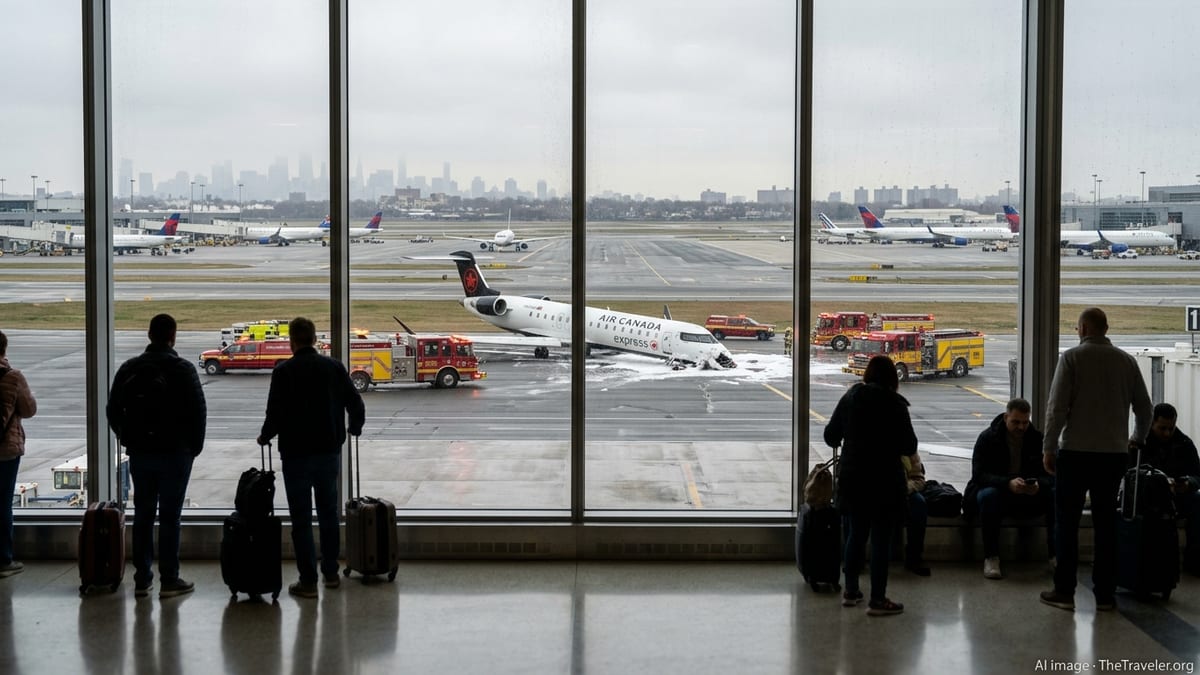
Flights at New York’s LaGuardia Airport faced heavy disruption after a sinkhole discovered near a primary runway coincided with strong thunderstorms in the region, triggering widespread delays and cancellations across the busy Northeast air corridor.
Get the latest news straight to your inbox!
Runway Closure Follows Sinkhole Discovery
Publicly available information indicates that airfield crews at LaGuardia identified a sinkhole near Runway 4/22 during a routine inspection on Wednesday, May 20. The affected runway is one of the airport’s main departure and arrival corridors, and the discovery prompted an immediate closure while engineers assessed the damage and stability of the surrounding pavement.
Reports from aviation and local news outlets describe the sinkhole as forming adjacent to the runway surface rather than along the main centerline, but close enough to raise concerns about aircraft weight loads and subsurface integrity. Out of caution, operations were consolidated onto the remaining active runway, sharply reducing capacity at one of the country’s most congested airports at the height of the afternoon rush.
Coverage from multiple outlets notes that LaGuardia routinely operates near its practical limits in clear weather, so the loss of a single runway quickly translated into long departure queues and aircraft holding patterns. Ground resources, including maintenance teams and engineering specialists, shifted focus to evaluating the affected area and planning repairs while traffic managers attempted to meter flights through the constrained system.
Preliminary accounts suggest that, despite the dramatic nature of the incident, there were no injuries and no aircraft were directly involved with the sinkhole. The disruption stemmed from the runway closure itself and the cascading schedule effects that followed.
Thunderstorms Compound an Already Strained Operation
As crews worked around the sinkhole, strong afternoon and evening thunderstorms moved over the New York metropolitan area, further restricting operations. According to publicly available weather alerts, a severe thunderstorm watch covered New York City and surrounding states through the late afternoon and evening, bringing lightning, low clouds and gusty winds to a corridor that is already one of the most delay prone in the United States.
Thunderstorms can significantly cut arrival and departure rates at LaGuardia, particularly when convective cells sit along approach paths over Long Island Sound or the Flushing Bay shoreline. Under those conditions, air traffic controllers increase spacing between flights, introduce ground stops, or reroute traffic around storm cells, all of which mean fewer aircraft can land or take off in a given hour.
On a day when one runway was already offline due to the sinkhole, the arrival of active thunderstorms created a dual constraint on capacity. Industry trackers reported departure holds, diversions to other New York area airports and extended taxi times for aircraft that did make it to the gate. Passengers described being held at origin airports or waiting on board as crews awaited updated slot times into LaGuardia’s restricted airspace.
By the evening, delay metrics published through federal aviation channels showed average departure waits from LaGuardia stretching past an hour in some periods, with knock on effects at connecting hubs across the country. The combination of infrastructure damage and convective weather produced a textbook example of how quickly the system can seize when multiple stressors align.
Delays, Cancellations and a Widening Ripple Effect
According to airline status boards and flight tracking services, the combination of the runway closure and thunderstorms resulted in hundreds of delays and a significant number of cancellations at LaGuardia and at outstation airports on Thursday, May 21. Carriers reduced schedules into the airport, consolidated lightly booked departures and, in some cases, rebooked customers through John F. Kennedy International or Newark Liberty International to keep them moving.
Published coverage from travel and aviation outlets shows the impact extending well beyond New York. Flights from major hubs such as Chicago, Atlanta and Dallas experienced cancellations or rolling delays as aircraft scheduled to operate LaGuardia legs were either stuck on the ground or diverted elsewhere. With many aircraft and crews tied to tight rotations, a missed segment at LaGuardia often translated into disruptions for subsequent flights in entirely different regions.
Travelers arriving at LaGuardia reported crowded terminals, long customer service lines and limited same day rebooking options as airlines worked through backlogs. With hotels around the airport quickly filling, some passengers arranged last minute ground transportation to reach alternate New York area airports where seats were still available.
Industry analysts following the situation noted that disruption of this scale can take at least a full operating day to unwind, particularly when thunderstorms continue to flare through the region. Even as repairs on the runway progress, schedules may remain fragile, with crews out of position and aircraft scattered away from their normal routes.
Infrastructure Vulnerabilities at a Congested Airport
LaGuardia’s geography and history add context to the sinkhole incident. The airport occupies reclaimed shoreline in Queens, built on fill along Flushing Bay. Engineering studies and local commentary have long pointed out that maintaining stable pavement in such an environment requires continuous monitoring of drainage, subsurface conditions and utility corridors.
Recent reporting on the sinkhole suggests that heavy rains and complex underground infrastructure may have contributed to the ground depression near Runway 4/22, although a definitive cause has not yet been established. Investigators typically examine factors such as water infiltration, soil settlement and potential leaks from buried pipes when assessing these types of failures on airfields.
Operationally, LaGuardia has little redundancy. With only a small number of runways and no easy way to expand onto adjacent neighborhoods or waterways, any long term restriction can have outsized consequences compared with larger airports that have more pavement and space to spare. The episode has renewed discussion in aviation circles about the resilience of aging infrastructure at legacy airports that handle millions of passengers annually.
Publicly available planning documents for LaGuardia emphasize the need for rigorous runway inspections and maintenance cycles to minimize the risk of surface failures. The swift discovery of the sinkhole during a routine sweep aligns with those protocols, but the magnitude of the resulting disruption illustrates how narrow the margin can be when operations are already running near their limits.
What Travelers Should Expect in the Coming Days
As of Thursday, schedules and airport status feeds show improving but still fragile conditions at LaGuardia. Some flights have returned to more typical departure intervals, yet residual congestion remains as airlines work through stranded passengers and reposition aircraft back into the New York market.
Travel industry advisories urge passengers with near term trips into or out of LaGuardia to monitor their flight status frequently, make use of airline mobile apps and consider flexible options such as earlier departures or routings through alternate airports. Many carriers have introduced temporary travel waivers that allow customers to change itineraries without additional fees when flying to, from or through the New York area on affected dates.
Analysts caution that even after the sinkhole is repaired and the runway is fully back in service, summer thunderstorm patterns could continue to drive intermittent delays at LaGuardia. Travelers connecting through the airport, especially in late afternoon and evening banks, may wish to build extra time into itineraries to account for potential weather related slowdowns.
For now, the incident stands as a reminder of how intertwined infrastructure reliability and weather resilience have become for the nation’s air transportation system. A localized pavement failure on a single runway, when combined with a few hours of severe thunderstorms, was enough to disrupt travel plans for thousands of passengers across multiple time zones.