


More news on this day
New York’s LaGuardia Airport is grappling with a fresh operational crisis after a sinkhole discovered near a primary runway forced its closure, triggering more than 400 flight cancellations and widespread delays across the U.S. air network.
Get the latest news straight to your inbox!
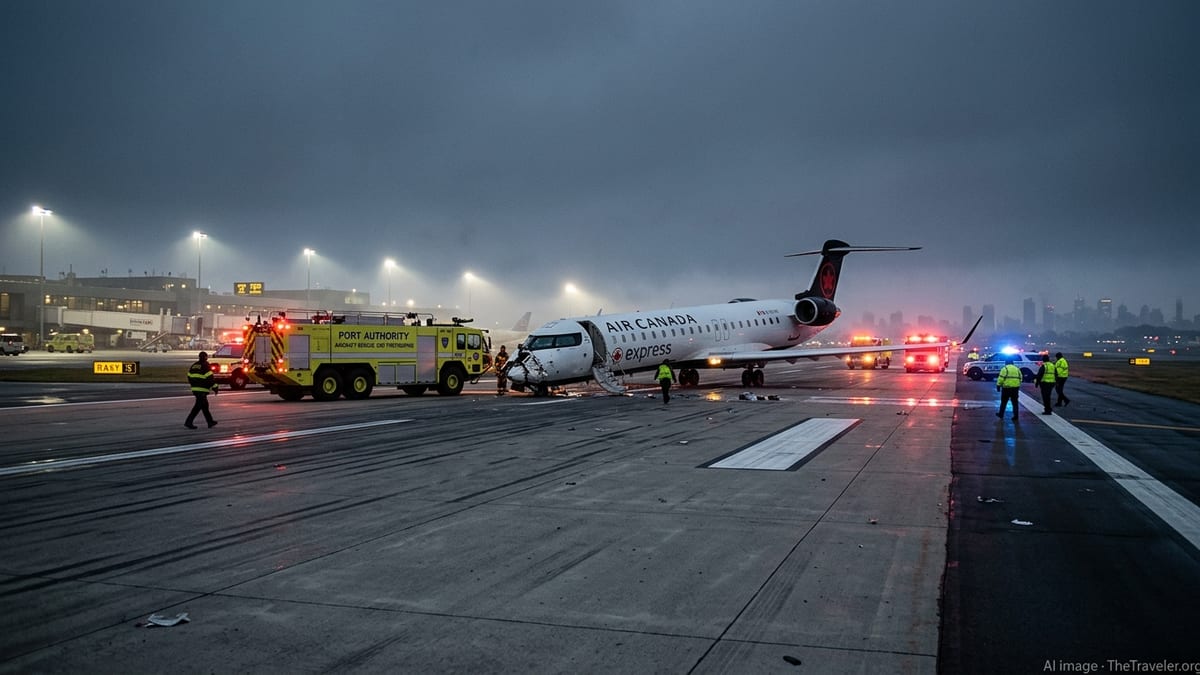
Runway 4/22 Pulled From Service After Inspection Discovery
According to published coverage, airfield crews identified the sinkhole late Wednesday morning during a routine daily inspection near Runway 4/22, one of LaGuardia’s two main airstrips. The depression was found adjacent to the pavement, close enough to raise immediate safety concerns for aircraft movements.
Publicly available information indicates that the runway was taken out of service at once so engineers could assess the underlying damage, stabilize the subgrade and begin emergency repairs. Images circulating in news reports show construction vehicles clustered around a cordoned-off section of the airfield as crews work to expose and secure the affected area.
The timing could hardly be worse for an airport that already runs near its operational limits on a normal day. With only one primary runway available, LaGuardia’s capacity was effectively cut in half, forcing air-traffic managers and airlines to thin out schedules and slow arrival rates.
Data cited in multiple outlets show that federal air-traffic managers also imposed flow restrictions into the New York terminal area, attributing delays to a combination of the runway outage and unsettled weather in the region.
More Than 400 Flights Canceled as Delays Ripple Nationwide
By early Thursday, flight-tracking tallies referenced in news reports pointed to more than 400 cancellations linked to the LaGuardia disruption, along with hundreds of additional delays. Many of the scrapped flights involved short-haul services that typically use LaGuardia as a key business-travel gateway for the Northeast and Mid-Atlantic.
Published coverage notes that carriers trimmed schedules not only at LaGuardia but also at downstream hubs including Chicago, Atlanta and Dallas as aircraft and crews fell out of position. With LaGuardia operating on a single runway, airlines faced a constrained number of takeoff and landing slots, making it impossible to preserve the full day’s timetable.
Passengers reported missed connections and unscheduled overnight stays around the network, as aircraft originating at LaGuardia failed to reach their next assignments. Social media posts and local reports described long lines at customer-service counters, gate changes with little notice and last-minute cancellations as thunderstorms threatened to compound the backlog.
Publicly available airline advisories show that several major carriers introduced flexible rebooking policies for travelers headed to or from LaGuardia over the next few days, in some cases waiving change fees and fare differences for customers willing to shift dates or reroute through other airports.
Infrastructure Strain at a Rebuilt but Vulnerable Airport
The incident has renewed attention on the physical foundations beneath one of the country’s most heavily used urban airports. Background information on LaGuardia’s history notes that the airfield sits on layers of fill and former tidal wetlands along the Queens shoreline, a geology that can be prone to settlement and water-related erosion.
While the airport has recently undergone an extensive multi-year modernization, including new terminals and upgraded taxiways, the latest runway disruption underscores the challenges of maintaining aging core infrastructure on constrained land. Engineering specialists cited in prior analyses of East Coast airports have long warned that subsurface voids or unstable soil can open unexpectedly, especially in areas with extensive buried utilities and decades of patchwork repairs.
Reports from aviation and infrastructure outlets highlight that full inspection and stabilization of a sinkhole can take time, even when the surface opening appears modest. Crews typically must excavate around the void, trace its boundaries, evaluate drainage and utility lines, and rebuild the base layers before repaving and reopening the surface to heavy jet traffic.
Until that work is complete and safety thresholds are met, publicly available statements indicate that authorities intend to keep Runway 4/22 closed, forcing LaGuardia to rely on its remaining runway configuration and leaving little margin for additional weather or operational shocks.
Travelers Diverted to JFK, Newark and Alternate Options
With LaGuardia’s operations constrained, nearby airports have quickly absorbed some of the spillover. Published coverage notes that airlines are rebooking affected passengers onto flights at John F. Kennedy International and Newark Liberty International, where capacity and runway layouts offer more flexibility during irregular operations.
Advisories from airlines and airport channels urge travelers with upcoming itineraries touching LaGuardia to monitor their flight status closely and to sign up for real-time alerts. Many carriers are recommending that passengers consider alternate New York–area airports when booking new trips, particularly for time-sensitive travel over the next several days.
On the ground, some stranded travelers are pivoting to intercity rail and long-distance bus services along the busy Northeast Corridor, according to regional transportation coverage. With rail links between New York, Boston, Washington and Philadelphia operating normally, those options offer a degree of predictability that air travel to and from LaGuardia currently lacks.
Travel advisers quoted in consumer-facing reports emphasize the value of flexible tickets, travel insurance that covers infrastructure-related disruptions, and a willingness to route through secondary hubs when a major airport faces sudden capacity constraints.
Questions Over Resilience as LaGuardia Faces Another Setback
The sinkhole closure comes as LaGuardia continues to recover from recent high-profile disruptions, including an earlier runway collision and severe-weather events that snarled operations this spring. For travelers, the cumulative effect is a sense that routine reliability at the airport remains fragile despite its glossy new terminals.
Industry analysts writing in aviation journals suggest that the LaGuardia incident will likely feed into a broader national conversation about infrastructure resilience at aging airports, particularly those built on reclaimed land or hemmed in by dense urban development. The challenge, they note, lies in carrying out deep structural work without crippling day-to-day operations in already congested airspace.
In the near term, attention is fixed on repair crews working around the clock at Runway 4/22 and on scheduling teams trying to thread an overbooked day’s worth of traffic through a single active runway. Publicly available information indicates that no firm timeline has yet been given for a full reopening, leaving airlines to update passengers one schedule revision at a time.
For now, travelers bound to or from New York are confronting an all-too-familiar calculus: build in extra time, brace for abrupt changes and hope that a small hole in the tarmac does not continue to cast an outsized shadow over the region’s air travel plans.