


Just 45 minutes by ferry from Dubrovnik, Šipan feels a world away from the cruise-ship crowds. The largest of the Elafiti Islands is still a lived-in place first and a holiday spot second, with stone villages, working olive groves and vineyards, and a pace that runs on fishing boats and church bells rather than resort entertainment. This guide looks at Šipan through a slow-travel lens, focusing on Suđurađ and Šipanska Luka, the rural interior, local food, simple beaches and why the island remains one of Dalmatia’s least showy escapes.
Get the latest updates straight to your inbox!
Why Šipan Suits Slow Travelers
Šipan is the largest of the Elafiti Islands but still only around 16 square kilometres, with two main villages and a rural valley in between. There are no big resorts, no nightclubs, and limited car traffic. Ferries bring in day trippers, but many head to neighbouring Lopud for its famous sandy beach instead, leaving Šipan quieter and more rooted in local routines. You see it as soon as you step off the boat in Suđurađ or Šipanska Luka: fishing nets drying on the quay, chilled crates of local wine being unloaded from small trucks, and schoolchildren biking along the waterfront.
The island’s economy still leans on olive oil, wine and small-scale fishing as much as tourism. Šipan holds a Guinness World Record for the number of olive trees relative to its size and population, and the valley between the two villages is patterned with dry-stone walls, small plots of vines and citrus groves rather than hotels. Many visitors come for the day and walk or cycle across the island, then leave on an afternoon ferry. Stay for a few nights, however, and you begin to recognise the same fishermen, bakers and restaurant owners, which is where the slow-travel experience really starts.
Compared with Dubrovnik’s walled city, where prices and menus often cater to international expectations, Šipan’s restaurants and cafes tend to be simpler and more locally focused. Portions are generous, grilled fish is usually whatever came off the boat that morning, and house wines are often produced on the island or the nearby Pelješac Peninsula. You may still pay coastal Croatia prices on a July evening, but in shoulder months like May, June, September or early October it is common to find a waterfront dinner of grilled sardines, salad and a glass of local white wine for less than you would pay for a pizza in central Dubrovnik.
For slow travelers, the island’s appeal lies in the absence of big must-see sights. There are no queues or ticket offices. Instead, days fill themselves with walks between the villages, quiet swims off stone quays, sunset drinks in small konobas, and impromptu conversations with guesthouse owners bringing in crates of figs from their gardens. It is the sort of place where your best memories are as likely to be a long coffee in a harbour cafe watching the Jadrolinija ferry dock as they are any single viewpoint.
Suđurađ: Ferries, Palaces and First Impressions
Most visitors arrive in Suđurađ, Šipan’s main ferry port. Jadrolinija’s line from Dubrovnik typically takes around 45 minutes, stopping at Koločep and Lopud before pulling into the small stone harbour. Schedules change by season, but there are usually several departures per day in summer, often including an early morning sailing from Dubrovnik and afternoon or evening returns, which makes Suđurađ a practical base for travellers without a car who still want to make a day trip back to the mainland.
Suđurađ itself is a compact fishing village wrapped around a sheltered bay. The dominant building is the fortified Renaissance villa and tower of the Stjepović-Skočibuha family, a 16th-century summer residence that once had to double as a defensive structure against pirate raids. Today it forms part of the village’s waterfront silhouette, its pale stone walls rising above terracotta roofs and small boats moored beneath. Walking the short stretch of harbourfront you can still see fragments of other old summer houses built by Dubrovnik’s merchant families, some restored as private homes or accommodation, others still quietly fading.
On a practical level, Suđurađ is where you will find the island’s main bus stop, a small grocery shop, a bakery that often sells still-warm burek and simple pastries in the morning, and a handful of cafes and konobas facing the sea. Prices are generally a little lower than on Lopud or in central Dubrovnik; an espresso on the harbour terrace often costs similar to prices in residential parts of Dubrovnik rather than its old town, and a plate of fried calamari with potatoes is usually comparable to what locals themselves are ordering at the next table.
Suđurađ is also a pleasant place simply to wander. Beyond the harbour, narrow lanes climb between stone houses where vines trail over doorways and potted geraniums line staircases. A small gravel town beach sits just beyond the wharf, useful for a quick dip while waiting for the ferry. Walk northeast along the bay and you will find other rocky access points to the sea where locals spread towels on concrete platforms and swim before breakfast or at sunset, sharing the space with only a few visitors who have strayed from the main quay.
Šipanska Luka: Harbourside Life at the End of the Road
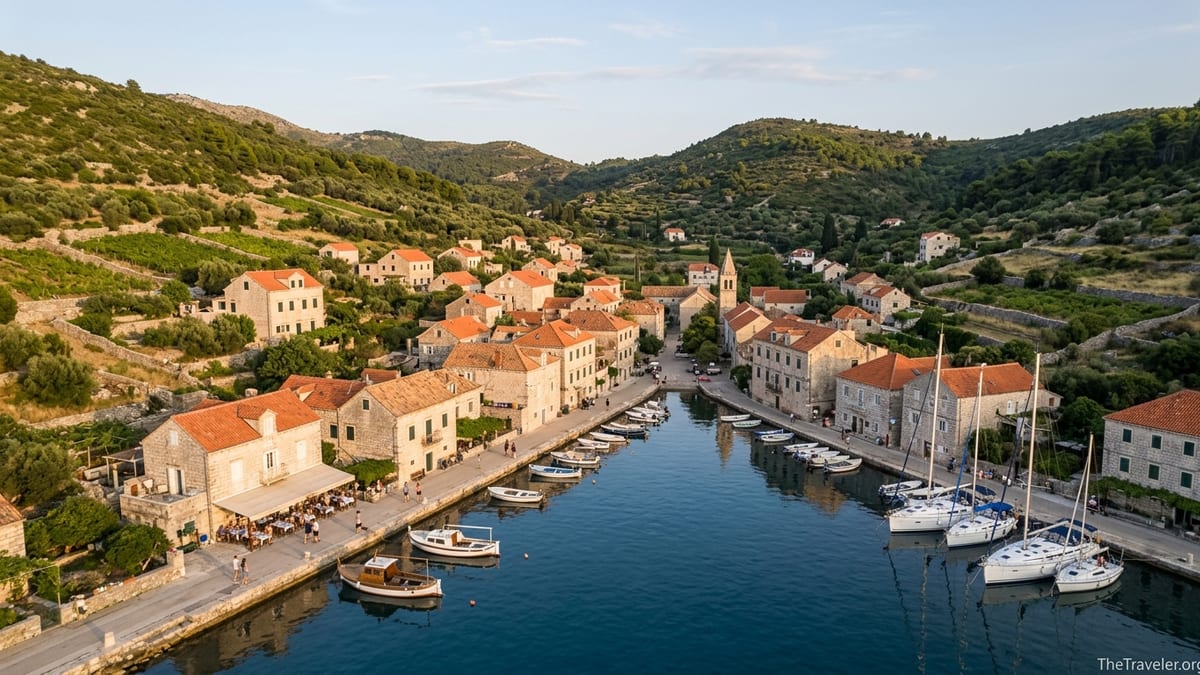
Šipanska Luka, at the far western end of the island, is the larger of Šipan’s two villages and a more natural choice for longer stays. The village lines a deep inlet framed by hills, so the harbour feels sheltered and calm even when winds pick up offshore. Small stone jetties and boat houses line the water, with palm trees and a church tower giving the village its classic Dalmatian profile. Fishing and leisure boats bob just offshore, and in summer charter yachts sometimes anchor in the bay, their passengers tendering ashore for dinner.
The harbourfront is essentially the village’s main street. Here you will find a row of restaurants, cafes and small hotels, many occupying former stone merchant houses. A typical summer evening in Šipanska Luka involves choosing a table practically at sea level, watching children race bikes along the promenade while plates of grilled sea bream, octopus salad and black risotto pass to and from the kitchen. Restaurants such as Kod Marka and others of similar style are known among sailors and repeat visitors for serving straightforward but carefully cooked seafood, often paired with carafes of Pošip or Malvasija from nearby Pelješac or the Konavle region rather than big international labels.
There is a small pebble and concrete beach just outside the centre of Šipanska Luka, an easy walk from the harbour. The water is usually clear and calm, with enough depth off the stone quays for confident swimmers to dive straight in. Unlike more famous Croatian beaches, you are unlikely to find rows of loungers or loud music here. Instead, expect locals arriving on scooters with rolled-up towels, visitors reading paperbacks in the shade of tamarisk trees, and perhaps a simple beach bar selling coffee, beer and basic snacks at prices not far from those in the village cafes.
Services in Šipanska Luka are modest but sufficient for a slow-stay base: a small market for everyday groceries, an ATM during the main season, and several guesthouses and small hotels ranging from renovated stone villas with air-conditioning to older rooms above family homes. Accommodation prices typically spike in July and August, but travellers who visit in late spring or early autumn often report finding rooms at rates noticeably lower than comparable waterfront stays in Dubrovnik’s suburbs or on nearby islands with more developed tourism.
Between the Villages: Olive Groves, Vineyards and Old Villas
The 4 to 5 kilometre road linking Suđurađ and Šipanska Luka is the backbone of island life and the highlight of any slow-travel visit. Whether you walk, cycle or take the local bus, this route gives you the clearest sense that Šipan is more than its two harbours. Leaving Suđurađ, the road climbs gently and then levels out into a fertile valley patterned with olive terraces, vineyards, fig trees and citrus orchards. Low dry-stone walls line the way, punctuated by small stone sheds, wells and chapels that speak to centuries of agricultural use.
On foot, the walk between the villages usually takes around 60 to 90 minutes at an easy pace, more if you stop to photograph old stone villas partly hidden behind pines or to watch farmers tending vines. In late spring and early summer you might see locals pruning olives or checking irrigation lines; in September, small tractors and trailers carry crates of grapes to family presses. It is not unusual to pass workers greeting one another by name from opposite sides of the road, a reminder that this is a working landscape rather than a scenic backdrop created for visitors.
The valley also contains the ruins and remains of numerous summer residences built by Dubrovnik’s nobility in the time of the Republic. Some are no more than weathered facades, their windows framing views of the sky; others have been converted into private homes or rural accommodation. You might see old family coats of arms carved above doorways, and exterior staircases leading up to loggias that once hosted summer gatherings. These buildings add a quiet sense of layered history to what might otherwise be just another pretty agricultural valley.
For slow travelers, one of the most rewarding experiences is accepting that not every gate is open and not every villa can be toured. Instead, the pleasure lies in tracing the route at different times of day: early in the morning when the valley is cool and full of birdsong, midday when the heat presses down and makes the shade of olive trees valuable, and late afternoon when long shadows stretch across the stone walls. Each pass you notice another detail, from the pattern of roof tiles on an abandoned farmhouse to the way a particular vineyard lines up with the bell tower of Šipanska Luka in the distance.
Olive Oil, Wine and Local Food Culture
Šipan’s reputation for olives is not just a marketing line. Historically the island cultivated many thousands of trees, and even today, you will see gnarled trunks on terraces that have clearly been pruned and cared for across generations. Some families still produce olive oil primarily for their own use, while others bottle small quantities for sale in village shops or directly to visitors. It is common to see unlabelled or simply labelled bottles for sale at guesthouses or small stands, with owners explaining whether they harvested early for a greener, more peppery oil or a little later for a softer flavour.
Vineyards play a quieter but still important role. The valley between Suđurađ and Šipanska Luka holds small plots of local grape varieties, often mixed plantings where different grapes share the same narrow terraces. Wineries here are small-scale, and much of the wine is consumed locally in households or poured as house wine in island konobas. When you order a carafe of white or red in a restaurant in Šipanska Luka, it may well have travelled only a few kilometres. Ask staff where the wine comes from and you are likely to hear not just a place name but a family story.
Seafood is central to menus in both villages. Fishermen moor right in the harbours, offloading boxes of sardines, squid, scorpionfish and other catches directly onto the quay or into refrigerated vans. Simple dishes such as grilled fish with blitva (Swiss chard and potatoes), octopus salad dressed with local olive oil and lemon, or pasta with prawns are common. Prices vary by species and season, but compared to Dubrovnik’s busiest streets, you are often paying more for the fish itself and less for the location. Visitors who pay attention will notice that on windy days when boats cannot go out, menus lean more towards meat and pasta.
Slow travel on Šipan means tuning into these rhythms. Visit the same cafe every morning and you will see how conversations track the state of the sea and the ferry timetable. Shop at the small market in Suđurađ or Šipanska Luka and you will notice which vegetables are grown on the island and which are brought in. In late summer, figs and grapes appear in abundance; in winter, citrus towers in crates. Many guesthouse owners offer homemade jams, liqueurs or dried herbs as part of breakfast, giving you a literal taste of how closely tied daily life remains to the land and water.
Beaches, Swimming Spots and the Joy of Doing Very Little
Šipan is not a classic beach destination in the sense of long sandy stretches with organised facilities. Instead, it offers a series of small pebble beaches, concrete platforms and rocky coves, each with clear water and views back to stone houses or out towards the open sea. For many visitors, this quieter, more informal setup is part of the charm and dovetails naturally with a slow-travel approach focused on swimming, reading and unhurried meals rather than ticking off attractions.
In Suđurađ, the main town beach is a small gravel strip adjacent to the ferry wharf, convenient for a quick dip before or after a sailing. Walking northeast along the bay reveals other spots where low walls or natural rock shelves provide access to the water. These are the places where you are likely to see older residents swimming lengths parallel to the shore each morning, leaving their towels draped over railings and chatting with neighbours before heading home for lunch. There may be no lifeguards or loungers, but the sea is typically calm and inviting on summer days.
Šipanska Luka’s swimming spots are slightly more developed but still far from crowded. A small beach area just outside the harbour has a mix of pebbles and concrete, with enough space to spread towels under scattered trees. From the quays lining the harbour itself, confident swimmers can simply walk down ladders into deep water. The bay’s narrow entrance and sheltered position mean the surface is often glassy in the early morning and at sunset, ideal times for a peaceful swim when the only sounds are church bells and the clink of halyards on yacht masts.
Because Šipan’s beaches lack big facilities, you will often bring what you need with you: water, snacks, a sun hat and reef-safe sunscreen. This simplicity encourages a slower rhythm. Many visitors adopt a loose daily pattern of a morning walk or bike ride, midday swim and quiet afternoon rest, returning to the beach again in the early evening when the heat eases. Unlike more built-up resorts where loud music and organised activities fill the day, here the main entertainment is the sea itself and the gentle coming and going of boats in the harbour.
Cycling, Walking and Exploring Without a Car
Šipan’s small size and relatively gentle terrain make it well suited to exploring on foot or by bicycle. The central road between Suđurađ and Šipanska Luka is paved, reasonably quiet, and mostly flat once you are above the initial climb out of each village. Side tracks and paths branch off towards hamlets, chapels and hilltop viewpoints, some paved and others gravel or dirt. Because distances are short, you can combine active exploration with long cafe stops without feeling rushed.
Bicycles are usually available to rent in both villages during the main season, either from small rental outfits, hotels or through your guesthouse. Daily rental prices often fall into the range typical for Croatian coastal islands, with simple city bikes at the lower end and mountain bikes or e-bikes higher. On a typical slow-travel day you might rent a bike in Suđurađ after breakfast, cycle through the valley, stop to photograph old villas and olive trees, swim at Šipanska Luka, enjoy a long harbour lunch, then cycle back in the late afternoon when the light becomes softer.
For walkers, there are several signposted or locally known paths leading up into the hills and along old tracks. Some routes climb to chapels or ruins with broad views over the Elafiti archipelago and back towards the Croatian mainland. Even without detailed hiking maps, it is possible to follow obvious tracks from the valley up towards ridgelines, provided you carry water, wear good shoes and pay attention to the sun. Many visitors who return to Šipan year after year say that these slow, unspectacular walks are what make the island feel like home; they have a favourite olive tree to rest under, or a particular corner where they always stop to watch the sunset.
Public transport on the island is limited to a modest local bus service that shuttles between the two villages, often timed loosely around ferry arrivals and departures. Schedules can change by season, so it is wise to check times posted at the stops in Suđurađ and Šipanska Luka once you arrive. Even if you rarely use it, knowing there is a bus provides a safety net if you find yourself tired after a long walk in the heat or want to stay later over dinner in one village and not cycle back in the dark.
Why Šipan Feels Less Touristy than Other Adriatic Islands
Part of Šipan’s quieter character comes from simple logistics. The main public ferry from Dubrovnik stops first at Koločep and Lopud, which are closer and better known among casual visitors. Many people seeking a quick island fix choose those options and never continue to Šipan, even though the onward sailing time is relatively short. Fast catamarans run less frequently and usually dock at different times from the big cruise excursions, which further limits the number of very short-stay visitors on the island at any one time.
The absence of a sandy, heavily photographed flagship beach also keeps mass tourism pressure lower. While nearby Lopud’s Šunj Beach appears often in travel marketing, Šipan’s beaches are understated and scattered. Travellers who select Šipan usually do so knowingly, often seeking somewhere to read, swim and walk rather than to party. This self-selecting effect means that on a July afternoon you may see every table full at a harbourside restaurant, but the crowd is more likely to be families, couples and sailors lingering over long meals than large groups on package holidays.
Local life likewise continues year-round in a way that helps ground the visitor experience. Residents work in agriculture, fishing, schools and local services, and many of the people managing guesthouses or konobas are also tending olive trees or vines in the valley. In the off-season, when ferries run less often and the sea is too cold for casual swimming, the villages do not close down completely. Children still go to school, the post office still opens, and the island prepares for the next olive or wine harvest. Even if most visitors see only a slice of this rhythm in late spring or early autumn, its presence shapes the island’s atmosphere.
Infrastructure has developed more slowly than on some Croatian islands that positioned themselves as major resort destinations. There are no large marinas with rows of luxury boutiques, no branded beach clubs with high entrance fees, and very limited nightlife beyond bars serving drinks to restaurant diners. Lighting along some paths is minimal, and you will still find unrenovated houses in prime harbourfront locations. For some travellers this can feel rustic or even inconvenient; for others it is precisely what makes Šipan feel like it still belongs foremost to its residents.
The Takeaway
Šipan rewards travellers willing to slow down and let small details stand in for big sights. It is an island of two quiet harbours, a fertile valley of olives and vines, and a handful of old villas that hint at former glory without being carefully packaged as attractions. Instead of showpiece beaches and nightlife, you get stone quays where locals swim before breakfast, waterfront konobas serving whatever came off the boats, and walking and cycling routes that still feel like part of daily life rather than an outdoor museum.
If your idea of a Croatian island holiday involves hopping between bars until late, Šipan will likely feel too subdued. But if you are happy with mornings spent walking between Suđurađ and Šipanska Luka, afternoons reading by the water, and evenings talking with guesthouse owners about olive harvests, the island makes an ideal base for a few unhurried days or a full week. The proximity to Dubrovnik means you can still dip into the city’s history and bustle, then retreat to an island where the loudest sound at night is the creak of mooring ropes.
In a region where tourism is reshaping many coastal communities, Šipan stands out not because it resists visitors but because it has yet to let visitor expectations completely rewrite daily life. For now, at least, the island feels more like a small agricultural and fishing community that welcomes guests than a purpose-built resort. Approached with patience and respect for that balance, it offers one of the most quietly rewarding slow-travel experiences within easy reach of Dubrovnik.
FAQ
Q1. How do I get to Šipan from Dubrovnik?
Regular ferries operated by Croatian companies link Dubrovnik with Suđurađ on Šipan, usually via Koločep and Lopud. The journey typically takes around 45 minutes to one hour depending on stops. In high season there are often several sailings a day, including morning and late afternoon departures, but it is important to check current timetables locally or online before travel because times can change by season.
Q2. Which village should I stay in, Suđurađ or Šipanska Luka?
Suđurađ is more convenient for ferry arrivals and departures and has a compact fishing-village feel, while Šipanska Luka has a slightly larger waterfront, more restaurant options and easier access to sheltered swimming spots. For very short stays or if you plan to make day trips back to Dubrovnik, Suđurađ can be practical. For longer, more relaxed stays focused on evenings by the harbour and swimming, many travelers prefer Šipanska Luka.
Q3. Do I need a car on Šipan?
Most visitors find a car unnecessary. The island is small, with a single main road of about 4 to 5 kilometres linking Suđurađ and Šipanska Luka. You can walk, cycle or use the local bus to move between the villages. Bicycles are widely available for rent in season, and walking paths cover many of the most scenic routes. If you are bringing a car as part of a longer Croatian road trip, check in advance which ferry services carry vehicles and whether reservations are required.
Q4. What time of year is best for a slow-travel stay on Šipan?
Late spring (May and early June) and early autumn (September and early October) are ideal for slow travel. Temperatures are warm but not extreme, the sea is usually pleasant for swimming, and restaurants and guesthouses are open without the peak-season pressure of July and August. In midsummer the island is busier and hotter, though still quieter than many other Adriatic destinations. In winter, ferries run less frequently and some tourist services close, but the island remains a lived-in community.
Q5. Are there sandy beaches on Šipan?
Šipan is better known for small pebble beaches, concrete swimming platforms and rocky coves than for sandy beaches. The main swimming areas in Suđurađ and Šipanska Luka are pebbly or built-up with steps and ladders into the water. If you specifically want a sandy beach, nearby Lopud Island has one of the region’s best-known sandy bays, which you can visit as a day trip from Dubrovnik or as a separate stop in an island-hopping itinerary.
Q6. How expensive is Šipan compared with Dubrovnik?
Šipan is not a budget destination by regional standards, but many visitors find it slightly better value than Dubrovnik’s historic centre. Harbourfront restaurants still price seafood according to daily market rates, and accommodation costs rise in high season, yet you often pay less for coffee, simple meals and mid-range rooms than in the most touristic parts of the city. Visiting in shoulder seasons and choosing local guesthouses over full-service hotels can keep costs moderate while supporting island residents directly.
Q7. Is Šipan suitable for families with children?
Šipan can work very well for families who enjoy a quieter pace. The harbours are small and relatively easy to navigate, swimming spots are close to village centres, and the main road through the valley is calm enough for supervised cycling. There are no large playgrounds or water parks, so children who need constant organised entertainment may be happier elsewhere, but for those content with swimming, exploring lanes and watching boats, the island is a gentle, low-stress setting.
Q8. Can I explore other Elafiti Islands from Šipan?
Yes, although schedules require some planning. Public ferries and fast boats connect Dubrovnik with Koločep, Lopud and Šipan, and in high season some excursion boats include multiple islands in one day. From Šipan, many visitors take a morning ferry back towards Dubrovnik and hop off at Lopud for a few hours before continuing or returning. It is wise to check return times carefully and allow a margin in case of weather-related changes.
Q9. What should I pack for a slow-travel trip to Šipan?
Pack light, breathable clothing, good walking shoes or sandals suitable for stone paths, swimwear, a hat and reef-safe sunscreen. Because evenings by the water can occasionally feel fresh outside peak summer, a light layer or windbreaker is useful. Reusable water bottles help minimise plastic waste, and a small daypack makes it easier to combine walks, swims and cafe stops without returning to your accommodation. If you plan to cycle, padded shorts or gloves can add comfort on longer rides.
Q10. How can I be a respectful visitor on Šipan?
Respect the fact that Šipan is a working island, not just a holiday setting. Keep noise low at night, especially near residential lanes; dress modestly when away from the beach; and ask before entering fields or photographing people closely. Support local businesses by eating in family-run konobas, buying produce or olive oil directly from small shops where possible, and following any local guidance on water use or fire safety in dry periods. Moving slowly, greeting people, and showing patience with limited infrastructure all contribute to keeping Šipan’s balance between tourism and everyday life healthy.