


More news on this day
Passengers across the United States faced a new wave of air travel disruption as 381 SkyWest-operated flights were delayed and nine canceled, stranding travelers and unraveling connections at major hubs in Chicago, Minneapolis, Dallas, Los Angeles, and New York, according to publicly available flight-tracking data compiled on Sunday.
Get the latest news straight to your inbox!
Regional Disruptions Ripple Through National Networks
SkyWest Airlines operates as a regional carrier for major U.S. brands including Delta Connection, United Express, American Eagle, and Alaska, feeding smaller cities into large hub airports. Industry data and published operational statistics indicate that when SkyWest’s schedule is disrupted, the effects are often felt well beyond the regional markets it serves, particularly for passengers relying on tight connections through major hubs.
On the day of the latest disruption, aggregated flight-tracking tallies showed 381 SkyWest-operated departures and arrivals marked as delayed and nine listed as canceled. While these represent a fraction of total U.S. air traffic, the concentration of affected flights at key connection points amplified the impact on passengers trying to reach onward flights in Chicago, Minneapolis, Dallas, Los Angeles, and New York.
Because many regional routes operate only a few times per day, even a single cancellation can leave travelers with limited same-day alternatives. Reports from recent disruption events across the U.S. suggest that travelers on smaller regional jets often face longer rebooking windows than those on high-frequency trunk routes between large cities.
Recent months have already seen multiple multi-airline disruption days linked to severe weather and congestion at major hubs, creating a backdrop in which even modest new irregular operations quickly cascade through the system. Industry reporting on Department of Transportation statistics has also highlighted that schedule reliability remains under pressure in early 2026 compared with a year earlier.
Major Hubs Struggle to Absorb Missed Connections
On Sunday, the brunt of the SkyWest-related disruption was felt at large connecting airports where the carrier operates regional feed for its mainline partners. Flight boards at Chicago, Minneapolis, Dallas, Los Angeles, and New York area airports showed clusters of late regional arrivals and departures, affecting passengers booked on both domestic and international itineraries.
In Chicago and Minneapolis, publicly available delay maps showed late-arriving regional jets from smaller Midwestern and Great Plains cities arriving after their scheduled connection windows. For travelers continuing to other U.S. destinations or onward to Europe, this meant missed evening departures and unexpected overnight stays near the airport.
Dallas, Los Angeles, and New York experienced similar patterns, with delayed inbound regional flights disrupting onward connections to the West Coast, Mountain West, and transcontinental routes. Published travel coverage on recent weather-related events has noted that once mid-afternoon banks of flights begin to slip, schedule recovery can take until late night or even the following day, particularly at already-busy hubs.
Because SkyWest operates under the brands of larger airlines, passengers often interface primarily with the mainline carrier’s app, call center, and gate staff when things go wrong. Operationally, however, those mainline airlines must coordinate recovery options within the constraints of regional aircraft availability, crew duty limits, and airport curfews, all of which can limit same-day rebooking choices.
Contributing Factors: Weather, Congestion, and Tight Schedules
In recent weeks, U.S. air travel has been repeatedly affected by severe weather, crowded airspace, and what analysts describe as tight schedules throughout airline networks. Travel-industry reporting has documented storm-driven disruption days when several thousand flights nationwide were delayed and hundreds canceled, with SkyWest among the carriers experiencing elevated interruption levels.
Operational statistics for the regional segment show that many flights run with narrow turnaround times and minimal slack in aircraft and crew rotations. When thunderstorms, air traffic control initiatives, or ground stops occur at a hub, regional operators can quickly find aircraft out of position and crews approaching federally mandated duty-time limits. Once that happens, delays build across the day even if conditions improve.
In addition, the reliance on smaller regional jets into secondary cities increases vulnerability. Routes that operate once or twice daily provide essential connectivity for business travelers, students, and residents of smaller communities, but they leave little room for recovery if a morning flight is heavily delayed or canceled. Published accounts of earlier disruption events this year have highlighted passengers waiting until the next day for the next available seat on these lower-frequency routes.
SkyWest’s own public filings emphasize that its operational performance is closely tied to scheduling decisions by its major airline partners, as well as to broader factors such as weather and air traffic control constraints. Under its capacity-purchase agreements, the regional carrier typically operates flights determined by its partners, meaning that widespread network issues affecting one mainline brand can quickly spill over onto SkyWest-branded operations.
Passenger Experience: Long Lines, Hotel Scrambles and Missed Events
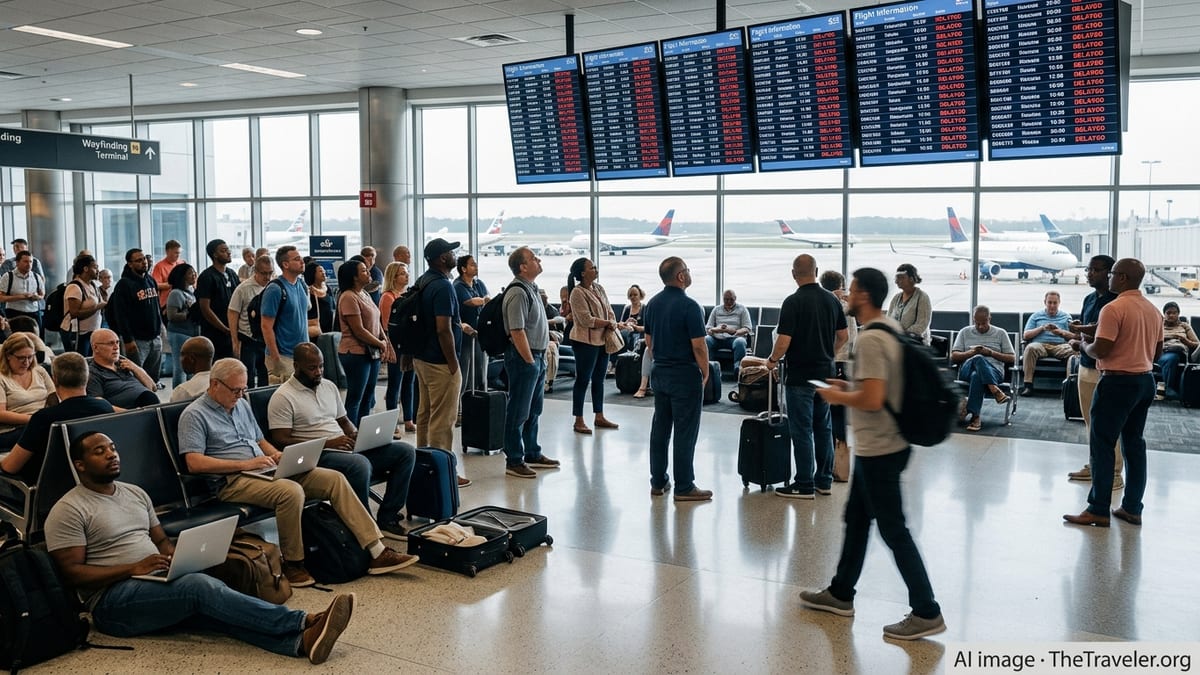
For travelers caught in Sunday’s wave of delays and cancellations, the operational statistics translated into long waits at gates and service counters, extended phone and chat sessions with airline customer service, and last-minute searches for hotel rooms near hub airports. Social media posts and prior coverage of similar events depict crowded concourses with passengers clustered around departure screens, looking for updated departure times and alternative routings.
Passengers with connections through Chicago, Minneapolis, Dallas, Los Angeles, and New York were especially vulnerable. Missed onward flights often meant losing seats on already full departures later in the evening, leaving only next-morning options. This is particularly problematic for travelers connecting to early transatlantic departures or last flights of the day to smaller regional cities.
Families and leisure travelers reported in previous disruption episodes that they faced unexpected expenses for meals, ground transportation, and overnight stays when itineraries fell apart late in the day. Business travelers frequently cited missed meetings, conferences, and client visits when their carefully timed connections did not hold. While some passengers were rebooked on alternate routings through secondary hubs, many others simply had to wait for the next available seat on the original routing.
Travel-rights organizations and consumer advocates regularly remind passengers in these situations to keep receipts and documentation of all additional costs, as some expenses may be recoverable under airline policies or applicable regulations, depending on the cause of the disruption and the operating carrier’s contract of carriage.
Guidance for Travelers Facing Ongoing Irregular Operations
With early 2026 already marked by multiple nationwide disruption days affecting carriers across the industry, travel guidance from consumer publications and aviation analysts has converged around a few consistent recommendations. Travelers are widely encouraged to monitor flight status regularly through airline apps and airport information screens, particularly in the 24 hours before departure, and to sign up for text or push notifications to receive rapid updates.
Building extra time into itineraries has become increasingly important. For domestic connections through congested hubs such as Chicago, Dallas, Los Angeles, Minneapolis, and New York, travel experts commonly suggest longer layovers than in past years to account for rolling delays. Early-morning departures are often recommended as they tend to be less affected by the knock-on effects of earlier disruptions.
When delays start to accumulate, passengers are frequently advised to use digital self-service tools where possible rather than waiting in long airport lines. Many airlines now allow customers to rebook onto alternative flights, join standby lists, or request electronic meal and hotel vouchers via apps or websites. Public travel resources also note that travelers should review the operating carrier on each flight segment, since regional partners like SkyWest may have different rebooking and compensation practices than the mainline brand on the ticket.
Given the likelihood of further disruption events as the busy summer travel period approaches, passengers flying on regional connections into large hubs may benefit from contingency planning, such as packing essential items in carry-on bags, considering travel insurance options that cover delays and missed connections, and having backup ground transportation or overnight arrangements in mind if schedules unravel unexpectedly.