


More news on this day
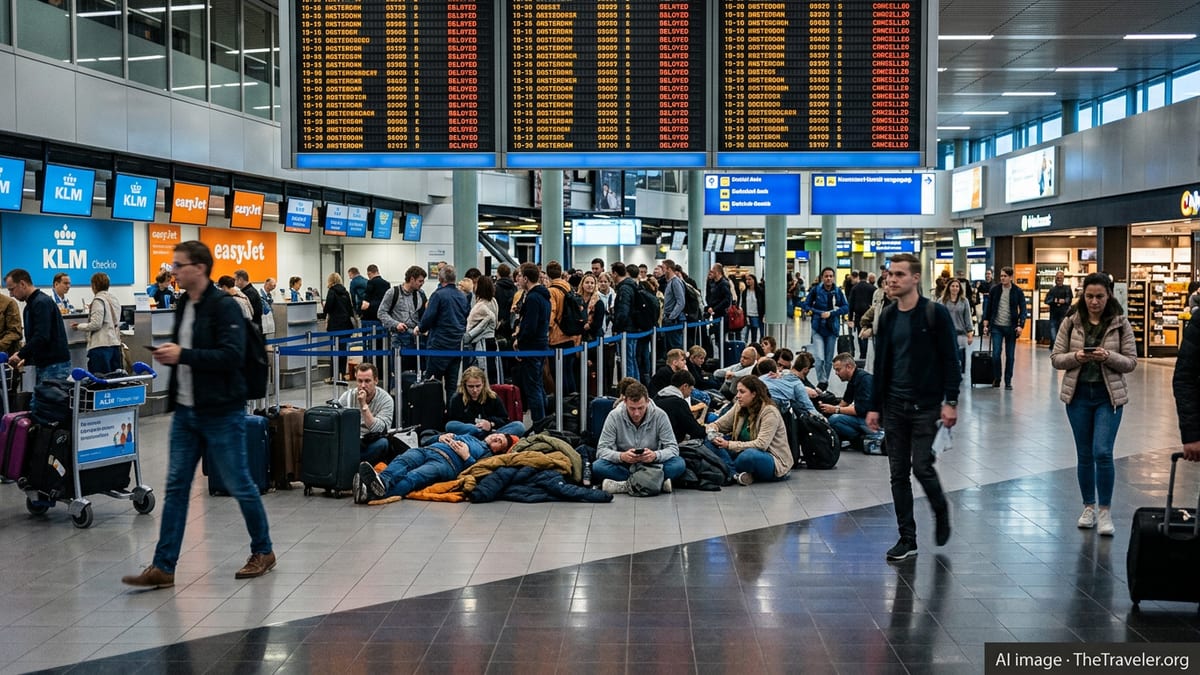
Hundreds of passengers were left stranded at Amsterdam Schiphol Airport after a fresh spell of disruption led easyJet, United Airlines and KLM to cancel six flights bound for London, Bristol, Washington, Houston, Southampton and Rome, disrupting both European and transatlantic travel corridors.
Get the latest news straight to your inbox!
Wave of Cancellations Hits Major Routes
Operational data from public flight-tracking platforms and European aviation dashboards indicates that a cluster of cancellations at Schiphol affected a mix of short haul and long haul routes, hitting both leisure and business travellers. Services to London and Southampton in the United Kingdom, Bristol in southwest England, Rome in Italy, and the United States cities of Washington and Houston were among those withdrawn from departure boards, forcing travellers to scramble for alternatives.
The disruption involved aircraft operated or marketed by easyJet, United Airlines and KLM, three carriers that together handle a significant share of Schiphol’s European and intercontinental traffic. London and Rome are among Amsterdam’s most heavily travelled city pairs, while Washington and Houston serve as important North American gateways, amplifying the knock-on effect through connecting banks on both sides of the Atlantic.
Published coverage and passenger accounts on public platforms describe long queues at customer service desks, crowded departure halls and confusion as rolling updates filtered through airline apps and airport screens. Many travellers reported learning of the cancellations only after arriving at the airport, leaving limited time to secure new routings at reasonable fares.
According to publicly available operational snapshots, the six affected services formed part of a broader pattern of schedule trimming and day-of-operations changes at several European hubs, but Schiphol once again emerged as a flashpoint because of its role as a major transfer node.
Knock-on Effects Across European and Transatlantic Networks
Disruption on routes linking Amsterdam to London, Rome and key US hubs has outsized consequences because these flights feed extensive connecting networks. Amsterdam to London supports both point to point traffic and onward links to regional UK airports, while flights to Rome and southern Europe underpin leisure flows and cruise-season demand. Cancellations on these sectors can therefore cause missed connections deep into airline networks.
Connections to Washington and Houston are particularly important for corporate travellers, government traffic and the energy sector. When long haul flights are withdrawn at short notice, passengers are often left with only a handful of same day alternatives via Paris, Frankfurt, London or other hubs, many of which quickly sell out. Publicly available rebooking data from recent disruption days in Europe shows that transatlantic seats are among the first to disappear once cancellations start to stack up.
Reports from aviation analytics services indicate that schedule adjustments at Schiphol in recent months have already reduced resilience across some banks of flights. When a single wave of cancellations hits a tightly timed morning or evening departure window, the result is a cascade of missed onward services, crew displacements and aircraft out of position, with effects that can echo for 24 hours or more.
This latest incident follows a broader period in which European carriers have periodically trimmed flying programs from Amsterdam in response to airport capacity constraints, higher operating costs and seasonal weather issues. The newly cancelled departures to London, Bristol, Rome, Washington, Houston and Southampton fit into a pattern of operators prioritising core frequencies while cutting marginal rotations on congested days.
Passengers Face Long Waits, Limited Options and Extra Costs
Publicly shared passenger experiences from Schiphol describe a familiar pattern when multiple flights are cancelled at once. Travellers report struggling to secure live assistance, with many encouraged to use airline apps or self service tools for rebooking, even as remaining seats quickly disappear. Those with checked baggage face further uncertainty, with some accounts noting that bags remained airside for extended periods after flights were scrubbed.
For many stranded passengers, the immediate concern is accommodation and basic necessities. When several flights on overlapping routes are cancelled on the same day, nearby hotels around Amsterdam Airport can quickly sell out or raise rates. Travellers posting on social platforms in recent disruption episodes have described sleeping in terminal seating or on camp beds, buying additional clothing and toiletries, and paying out of pocket for meals while they waited for new itineraries.
Airline policy pages for easyJet, United and KLM outline varying levels of support, typically including rebooking on the next available flight and, in some cases, hotel and meal coverage where required by local regulations or carrier rules. However, passengers often report that the practical reality at the airport depends on the timing of the disruption, the underlying cause and the availability of staff and accommodation. When bad weather or air traffic constraints ripple across several hubs at once, support resources can be stretched thin.
Consumer advocacy groups that track flight disruptions in Europe note that, even where statutory rights exist, travellers must frequently document their expenses carefully and submit claims after the fact. For those caught by this latest cluster of cancellations at Schiphol, the costs of extra nights in Amsterdam, last minute alternative tickets and lost work time are likely to add up quickly.
Questions Over Resilience at Amsterdam Schiphol
The latest cancellations are renewing scrutiny of the resilience of operations at Amsterdam Schiphol, which has faced recurring episodes of disruption in recent seasons. Public analysis of flight data shows that the airport has periodically been hit by capacity caps, security bottlenecks, winter weather and air traffic control restrictions, affecting both home carriers and foreign airlines.
Aviation commentators have pointed out that hub airports serving a dense portfolio of short haul and long haul flights are particularly vulnerable when even a small portion of the schedule is cut. With aircraft and crew often planned to tight rotations, the loss of a single rotation to London, Rome or a US gateway can strand equipment and staff, making it much harder to recover the program the following day.
Recent policy debates in the Netherlands about noise limits, nighttime flying and environmental constraints have also played into decisions by airlines to adjust their schedules and build in more operational buffers. Some carriers have responded by consolidating frequencies, which can help reduce congestion in normal conditions but leaves fewer options when disruption does occur.
For passengers, these structural issues are largely invisible until they materialise in the form of cancelled flights and missed connections. The six flights scrubbed to London, Bristol, Washington, Houston, Southampton and Rome highlight the continued sensitivity of Schiphol’s role as a transfer hub and raise further questions about how airlines and airport operators can protect key routes while managing external pressures.
What Travellers Can Do When Stranded at Schiphol
Travel experts and consumer organisations that monitor disruption events in Europe typically advise passengers to act quickly when a cancellation is announced. Using airline mobile apps and websites to search for alternative routings can sometimes yield faster results than waiting in physical queues, particularly at hubs such as Amsterdam where multiple flights depart within short windows.
Public guidance from airlines indicates that travellers are often entitled to be rebooked on the next available service, including on partner carriers in some cases. Where capacity is tight, passengers may need to consider alternative routings via other European hubs, regional airports or even rail links to reach London or other nearby cities. Making flexible arrangements for accommodation in the Amsterdam area, and retaining all receipts, can be important if reimbursement is sought later.
Specialist passenger rights platforms and national consumer bodies provide checklists explaining how to document cancellations, what compensation may be available under European regulations, and how to escalate complaints if initial claims are rejected. Observers note that awareness of these tools remains uneven, and that travellers stranded at Schiphol during this latest disruption will likely face a complex and lengthy process to recover their costs.
As easyJet, United and KLM work to re accommodate affected travellers and normalise schedules, attention is turning once more to how Europe’s major hubs can better shield passengers from the sharpest impacts of operational stress. For now, those routed through Amsterdam on busy days are being reminded that even flagship connections to London, Rome and key US cities are not immune to sudden disruption.