


More news on this day
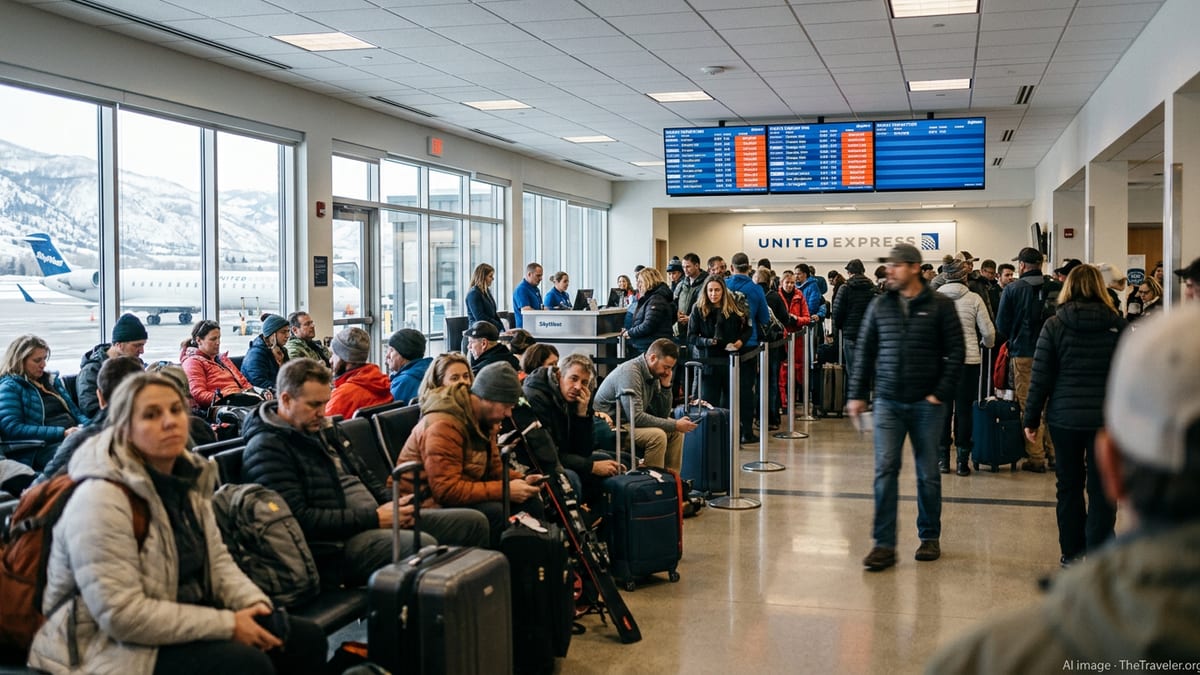
A United Express flight operated by SkyWest and scheduled to fly from Houston to Aspen diverted to Grand Junction, Colorado, prompting questions from travelers about why the Embraer E175LL regional jet could not continue into the popular mountain resort airport.
Get the latest news straight to your inbox!
What Is Known About SkyWest Flight SKW5814
Publicly available flight-tracking data and social media posts indicate that SkyWest flight SKW5814, operating for United Airlines from Houston George Bush Intercontinental Airport to Aspen, departed normally before diverting west to Grand Junction Regional Airport instead of continuing into Aspen.
The aircraft involved is described as an Embraer E175LL, a stretched-wing variant of the E175 that SkyWest uses extensively across its United Express network. The jet seats around 76 passengers in a dual-class configuration and has been progressively introduced on mountain routes serving Aspen in recent seasons, replacing older regional jets on several United-affiliated services.
While specific operational details for SKW5814 were not immediately listed in official bulletins at the time of writing, the available track suggests a routine en route segment followed by a decision to divert before the final approach into Aspen. The diversion concluded with a landing at Grand Junction, a larger Western Slope airport with more favorable weather and terrain conditions for holding passengers and arranging onward transport.
Initial online discussion among aviation enthusiasts points to weather and approach conditions at Aspen as the most likely catalyst for the diversion, consistent with long-standing patterns on this route during periods of reduced visibility, gusty winds or rapidly changing mountain weather.
Why Aspen Is One of the Most Challenging Airports in the Network
Aspen/Pitkin County Airport sits at an elevation of roughly 7,800 feet above sea level, surrounded by steep terrain in nearly every direction. Published analyses of Aspen operations note that aircraft performance margins are tighter at such altitudes because thin air reduces engine thrust and wing lift, particularly during takeoff and go-around maneuvers.
Airlines and regional operators serving Aspen must comply with strict performance, weight and approach criteria. Industry and airport documents describe limitations on aircraft types, runway-use procedures and missed-approach profiles designed to ensure safe climb gradients away from nearby mountains. Only specific regional jets that meet these requirements, including configured variants of the Embraer 175, are routinely scheduled into Aspen.
Even when aircraft meet the technical standards, seasonal factors can quickly complicate operations. Winter storms, low ceilings, snow, tailwinds and turbulence all influence whether an arriving flight can safely complete a stabilized approach to the single-runway field. When conditions fall outside company or airport limits during the arrival window, flight crews are trained to divert rather than attempt multiple approaches.
This combination of high altitude, surrounding terrain and fast-changing weather makes Aspen one of the most diversion-prone destinations in the United States, particularly for regional jets operating under tight schedule windows from hubs such as Houston, Denver, Los Angeles and San Francisco.
Weather and Operational Factors That Can Trigger a Diversion
Although precise cockpit decision-making on SKW5814 has not been detailed in public summaries, historical patterns into Aspen suggest several likely contributing factors. Low visibility from snow or clouds can limit pilots’ ability to see the runway at required decision points, while strong tailwinds or crosswinds may place the aircraft outside company limits for a safe landing.
Reports and traveler experiences shared over multiple seasons describe flights diverting from Aspen to alternate airports such as Grand Junction or Montrose when cloud ceilings drop, winds exceed thresholds or turbulence becomes excessive on final approach. In some cases, crews may initiate an approach and then abandon it if winds shift or if a stabilized profile cannot be maintained, leading to a go-around and subsequent diversion.
For regional jets like the E175LL, weight considerations also play a role. On marginal days, operators may restrict passenger loads or baggage to ensure adequate climb performance during a potential missed approach. When conditions degrade further while a flight is en route from a distant hub such as Houston, the safest course can be to proceed directly to an alternate airport where terrain is less demanding and air traffic control can accommodate holding or extended ground times.
Grand Junction’s lower elevation, longer runway and less constrained terrain make it a preferred diversion point. Once on the ground there, passengers can typically be rebooked onto later flights or moved by ground transport toward Aspen if and when weather improves.
The Role of the Embraer E175LL on Mountain Routes
The Embraer E175 has become a workhorse of regional flying in the United States, and SkyWest has added modified long-wing variants to meet performance targets at challenging airports. Public airport planning documents and aviation commentary note that SkyWest and manufacturers worked together to qualify the E175 for Aspen operations, focusing on climb performance, braking capability and approach procedures tailored to high-altitude environments.
Compared with older 50-seat regional jets, the E175 offers more modern avionics, a smoother ride in turbulent air and a cabin closer in feel to a mainline narrowbody, which has proved popular with travelers headed to Aspen’s year-round tourist attractions. The long-wing configuration used by SkyWest provides additional aerodynamic efficiency and lift, helping the aircraft achieve required climb gradients in thin mountain air when dispatched within specified weight limits.
However, even these performance improvements cannot overcome the fundamental constraints of terrain and weather. When ceilings, visibility or wind components are outside predefined limits, regulatory frameworks and company procedures require crews to divert regardless of aircraft type. The E175LL’s capabilities therefore reduce, but do not eliminate, the probability of a diversion on marginal days.
For passengers, this means that flying on a modern regional jet can improve comfort and reliability on average, yet trips to mountain airports such as Aspen still carry a higher chance of last-minute changes than flights into lower-elevation hubs.
What a Diversion to Grand Junction Means for Travelers
For those on board SKW5814, the diversion would have added an unplanned stop to what is already a relatively long regional flight from Houston to Aspen. Once an aircraft lands at Grand Junction, airline teams typically focus on arranging gate space, coordinating with ground handling providers and determining whether the aircraft can later reposition to Aspen or return to a hub.
Past accounts from travelers on diverted Aspen flights describe a mix of outcomes, including ground transfers by chartered bus over the mountains to Aspen and rebooking onto later flights, depending on the time of day and the persistence of adverse conditions at the destination. In some cases, if weather is expected to remain unfavorable for an extended period, passengers may be offered hotel accommodations and travel the following day.
While diversions can be frustrating, aviation safety practices emphasize conservative decision-making when approaching terrain-limited airports. Industry guidance stresses that the safest option is to avoid repeated approaches when conditions are near or outside limits, even if alternate airports are some distance away. That framework helps explain why Grand Junction, despite being several hours from Aspen by road, frequently appears as the chosen alternate.
For future travelers planning trips to Aspen, particularly during the snow season, the experience of SKW5814 underscores the value of allowing extra travel time, keeping essential items in carry-on baggage and remaining prepared for route changes that reflect the complex interplay of weather, terrain and aircraft performance in Colorado’s high country.