


More news on this day
A SkyWest Airlines flight operating as United Express from Denver to Helena diverted to Great Falls International Airport on July 30, 2026, after a route change over Montana led the Embraer E175 to land short of its planned destination.
Get the latest news straight to your inbox!
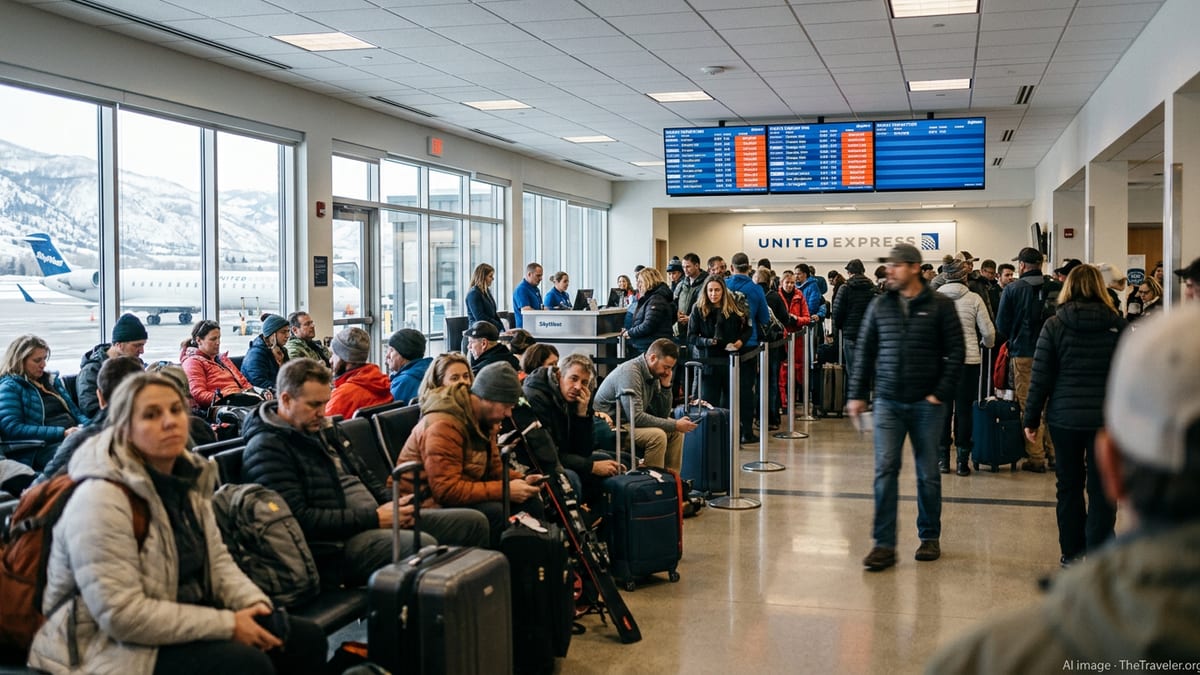
Regional United Express Service Experiences Unscheduled Stop
Publicly available flight-tracking information indicates that SkyWest Airlines flight SKW4705, operating as United Express on an Embraer E175, departed Denver International Airport on July 30 on a regularly scheduled regional service toward Helena, Montana. En route, the aircraft altered course and proceeded instead to Great Falls International Airport, where it landed without further incident.
Data visible on aviation tracking platforms shows the jet completing its climb from Denver and following a generally north-northwest routing consistent with typical paths into central Montana. At a point north of Helena’s vicinity, the aircraft track shifted toward Great Falls, a larger regional facility with longer runways and more extensive ground services than many smaller mountain airports in the northern Rockies.
There were no immediate public reports of injuries among passengers or crew, and no indications from open data sources of emergency procedures such as a mayday call or deployment of emergency response vehicles beyond standard precautions taken for an unexpected arrival.
The Embraer E175 is a common regional jet in United Express operations, often used on medium-distance routes from Denver into the Mountain West. Its performance profile allows for operations into a variety of high-altitude and cold-weather airports, giving dispatchers options when diversions become necessary.
Why Flights Divert Across the Mountain West
While specific circumstances behind the SKW4705 diversion have not been formally detailed in public statements at the time of writing, aviation operations in the Mountain West are routinely affected by a mix of weather, air traffic flow programs, and airport constraints. Thunderstorms building along the Front Range, rapidly changing winds, or reduced visibility in valley airports can all contribute to route adjustments or alternate landings.
Industry guidance and safety practices emphasize pre-planned alternates on regional flights into terrain-limited airports. Dispatchers typically file one or more alternates that offer longer runways, more instrument-approach options, and a broader range of ground support. Great Falls, with its role as a regional hub for northern Montana, fits that profile and is frequently listed as an alternate for flights heading to smaller regional cities in the area.
Aviation safety literature highlights that diversions are often precautionary rather than a sign of imminent danger. Crews are trained to evaluate weather developments, aircraft system messages, and fuel considerations, and to opt for an alternate field when any combination of those factors narrows the safety margin at the intended destination. Passengers generally experience such events as inconvenience and delay, even though the underlying decision is a conservative measure designed to keep risk low.
In this case, available information points to a controlled arrival at Great Falls with the aircraft taxiing to a gate or stand for standard ground handling. Subsequent arrangements for passengers, such as rebooking or onward transit to Helena, typically follow airline procedures for irregular operations.
Great Falls and Helena: Linked but Distinct Air Markets
Great Falls International Airport serves as one of Montana’s key commercial aviation gateways, with multiple daily connections to larger hubs and facilities capable of accommodating a range of aircraft sizes. Its location on relatively open terrain and its runway length make it a frequent operational choice for diversions when conditions at nearby airports become less favorable.
Helena, while the state capital, is a smaller market and has more limited airline schedules and infrastructure than Great Falls. Flights from Denver into Helena often operate with regional jets like the Embraer E175, which can handle the altitude and terrain but still benefit from the more robust alternate options available nearby.
For passengers, the proximity between Helena and Great Falls can ease the disruption posed by a diversion. The two cities are separated by a manageable overland journey, which can sometimes be bridged by ground transportation arranged by the airline or left to travelers depending on the scale of the disruption and subsequent scheduling.
The July 30 diversion underscores how Montana’s airports, while serving distinct local communities, often function as an interconnected system in day-to-day airline operations. When one field is constrained, another can temporarily absorb traffic, keeping regional connectivity intact.
SkyWest’s Role Within the United Express Network
SkyWest Airlines operates one of the largest regional fleets in North America, flying under several major-brand banners including United Express. The Embraer E175 used on flight SKW4705 is part of a newer-generation regional jet family that has become central to United’s strategy on short and medium-haul routes from hubs such as Denver.
Company filings and industry data describe a business model in which SkyWest operates flights under capacity-purchase agreements with mainline carriers. Under this framework, the major airline handles scheduling, reservations, and ticketing, while the regional operator provides the aircraft, crew, and day-to-day flight operations under shared branding.
This arrangement means that irregular events such as diversions are navigated within a combined framework of regional-airline flight operations and mainline carrier customer-service policies. While the regional operator manages the immediate operational response, the marketing carrier typically oversees rebooking, compensation policies, and onward itinerary solutions.
Over the last decade, the growth of regional jets such as the E175 has allowed carriers like United and SkyWest to maintain or expand service to smaller communities, including destinations in Montana and the broader northern Rockies. Diversions, while disruptive on the day they occur, are also a byproduct of this extended reach into locations where weather and terrain can be more challenging than in larger coastal or midwestern markets.
What the Diversion Means for Summer Travelers
The SKW4705 diversion came during the height of the summer travel season, a period when weather patterns around the Rockies frequently combine with heavy traffic flows to produce delays and reroutings across the network. Travelers on regional routes from Denver are particularly familiar with afternoon thunderstorms and shifting winds that can alter plans with little warning.
Analyses of past summer operations show that regional jets tend to shoulder a disproportionate share of diversions and weather-related adjustments, in part because they serve airports with more limited infrastructure, and in part because their schedules are tightly interwoven with hub operations. A single diversion can cascade into later delays if the aircraft or crew is required elsewhere in the network.
For passengers, industry guidance often emphasizes building additional buffer time into connections during peak seasons and being prepared for itinerary changes on routes into mountain and small-city airports. Although diversions like that of SKW4705 are statistically rare compared with the volume of flights completed each day, they highlight the operational realities of flying into regions where weather, geography, and high demand intersect.
The July 30 event involving the SkyWest-operated United Express flight from Denver to Helena serves as another reminder that, even in a highly automated and scheduled system, flexibility remains central to airline operations, especially when safety, terrain, and meteorological uncertainty intersect in the northern Rockies.