


Spain’s public transport system is a critical factor for relocation decisions, particularly for professionals who expect to commute without relying on a private car. The country combines extensive metropolitan networks in major cities with one of the most developed high speed rail systems in the world. This briefing evaluates the quality, reliability, coverage and usability of public transport in Spain for individuals and families considering a move.
Overview of Spain’s Public Transport Landscape
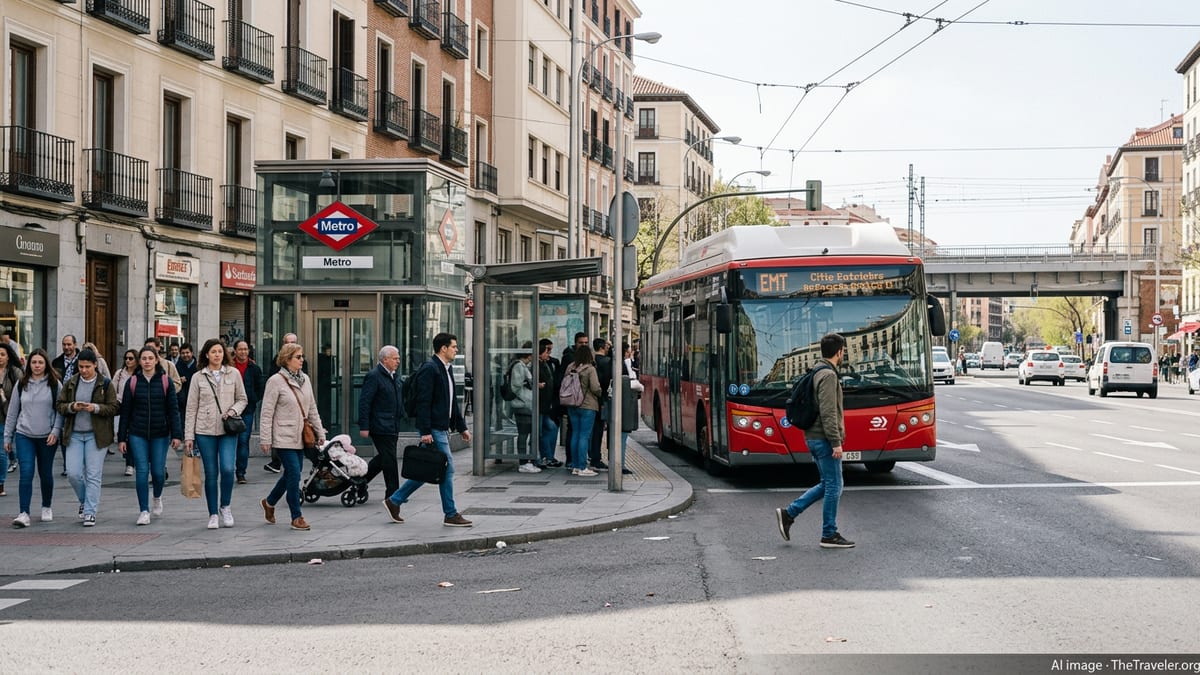
Spain offers a multi layered public transport ecosystem, ranging from local metro, tram and bus networks in large cities to regional and high speed rail links between major urban centers. The system is strongly rail oriented on intercity corridors while urban mobility relies on a combination of metro, commuter rail, tram and buses. For many urban residents, daily life is possible without a private car, particularly in Madrid, Barcelona and several regional capitals.
At the national level, Spain has the longest high speed rail network in Europe, with close to 4,000 kilometers of dedicated lines in operation as of 2026, connecting Madrid with much of the country’s major cities. High speed services carried around 40 million passengers in 2024 across all operators, with demand growing significantly compared with pre pandemic levels, indicating strong public acceptance and reliability for medium and long distance travel.
Within metropolitan areas, demand indicators show intensive use of public transport. The Madrid Metro handles on the order of 700 million journeys per year, while Barcelona’s integrated public transport area recorded about 1.17 billion trips in 2024, both above pre pandemic benchmarks. This sustained growth suggests that capacity, frequency and service quality are generally adequate for everyday commuting, even though localized crowding and reliability issues remain.
Relocating professionals should understand that public transport quality is uneven across the country. Large metropolitan areas and intercity corridors are very well served, while smaller towns and rural zones may offer limited service frequencies and coverage, making car ownership more practical outside major urban regions.
Urban Rail and Metro Networks in Major Cities
Urban rail is the backbone of public transport quality in Spain’s two largest metropolitan areas. Madrid Metro, with almost 300 kilometers of route length and extensive network coverage, is among the largest metro systems in Europe. Annual ridership exceeded 700 million journeys in 2024, supported by relatively high frequencies, dense station spacing in the central area and good integration with suburban commuter rail and bus services.
Barcelona’s metro and tram system, operated largely by Transports Metropolitans de Barcelona and other regional operators, has also reached record usage. The wider Barcelona integrated transport area registered approximately 1.165 billion public transport trips in 2024, with metro being the most used mode at over 1.2 million weekday trips. Surveys from the regional transport authority show that around 60 percent of residents in the metropolitan area consider themselves regular public transport users, indicating a high degree of system penetration into daily mobility.
Regional capitals such as Valencia, Bilbao, Seville and Zaragoza typically offer some combination of metro style lines, light rail, trams or dense urban and suburban rail services. While smaller than Madrid or Barcelona, these networks usually provide sufficient coverage for inner city commuting, although frequencies and operating hours can be more limited, especially late at night. For relocators planning to live in these cities without a car, proximity to a metro, tram or commuter rail station remains a key housing selection factor.
Service quality for urban rail is generally high in terms of rolling stock condition, station cleanliness and basic safety. Recent investment programs, such as Barcelona’s purchase of new metro trains and modernization of signaling, are aimed at increasing capacity and reducing congestion at peak times. However, during rush hours, especially on key radial lines in both Madrid and Barcelona, standing room only conditions are common and can be an adjustment for newcomers used to less crowded systems.
High Speed and Intercity Rail: National Connectivity
Spain’s high speed rail network is a major strength of the country’s public transport offer, particularly for relocators expecting to travel regularly between cities for work or family reasons. By 2023 Spain operated approximately 3,200 kilometers of high speed lines and by 2026 this network had expanded to nearly 4,000 kilometers, confirming its status as the largest high speed rail system in Europe and one of the largest globally. This extensive network connects Madrid with cities such as Barcelona, Valencia, Seville, Malaga, Alicante, Zaragoza and others, often with journey times that are competitive with air travel when station access and security time are included.
Market liberalization has introduced new operators alongside the incumbent Renfe, leading to increased competition and, in many corridors, higher frequencies and more varied fare levels. High speed services carried roughly 40 million passengers in 2024, about one fifth higher than the previous year and well above pre pandemic levels. This reflects a combination of improved service offer, competitive ticket pricing and public confidence in the speed and reliability of the system.
For relocators, high speed rail quality translates into practical benefits: predictable travel times, modern trains with comfortable seating, and relatively high punctuality compared with long distance road or air alternatives. However, incidents can occur. Occasional large scale disruptions have been reported, for example due to technical failures, power issues or external events such as cable theft, which caused significant delays for thousands of passengers on at least one occasion. While these events are exceptional rather than routine, they demonstrate that even a mature system is not entirely immune to reliability shocks.
Regional and conventional intercity rail quality is more variable. Some routes have been modernized with improved signaling and rolling stock, while others still rely on older infrastructure and face lower frequencies or delays. For residents in medium sized cities not located directly on high speed corridors, the quality of rail connectivity may depend heavily on regional investment priorities and timetable design, so route specific checks remain advisable before assuming rail can fully substitute air or road travel.
Bus, Tram and Regional Coverage
Urban and interurban bus networks fill important coverage gaps in Spain, particularly in peripheral neighborhoods, smaller cities and rural areas. National and regional statistics for 2023 and 2024 show that bus passenger volumes have recovered or exceeded pre pandemic levels, supported in part by temporary national fare discounts and regional promotions that made public transport more attractive. Intercity bus services have been specifically noted as surpassing 2019 supply levels, indicating a strong network of medium distance coach connections between towns and regional centers.
In metropolitan areas such as Barcelona, recent data show strong growth in bus demand, with intercity and metropolitan buses recording double digit percentage increases in 2024 compared to the previous year. This has led operators to add capacity on critical corridors and introduce modern ticketing and passenger information systems that simplify boarding, reduce dwell times and enhance reliability.
Tram and light rail systems are present in several Spanish cities, including Barcelona, Valencia, Zaragoza, Alicante and Tenerife. These modes offer high quality, accessible services with level boarding and good reliability, and are generally perceived as more comfortable and legible for new users than bus networks. However, spatial coverage of tram systems is limited to specific corridors, so many relocators will still rely on bus feeder services or walking to reach tram stops.
Outside major urban areas, coverage and frequency can decline markedly. Many smaller municipalities rely on a limited number of daily regional buses, and services may be reduced on weekends or during off peak seasons. For individuals relocating to rural areas, coastal villages or dispersed suburbs, public transport may be suitable for occasional trips but could be insufficient for daily commuting needs, making car ownership or car sharing arrangements more practical.
Reliability, Punctuality and Capacity Constraints
Spain’s public transport system generally performs well on punctuality and reliability metrics, especially on high speed rail and metro networks. High speed services typically operate at high levels of on time performance under normal conditions, supported by modern signaling and dedicated infrastructure. In urban contexts, metro systems in Madrid and Barcelona deliver high frequencies that buffer minor delays, resulting in predictable waiting times for passengers.
However, there are recognized pressure points. In Barcelona, several metro lines have experienced sustained growth in ridership, with some lines reporting passenger increases of around 20 percent over a five year period. To respond, operators have added trains and increased capacity by roughly 15 to 20 percent on the most congested sections, but crowding during peak hours remains a recurrent issue. Similar patterns exist in Madrid, where central segments of major lines can become extremely crowded at commuting peaks.
On the rail side, Spain’s overall safety record is relatively strong in international comparison, but isolated serious accidents or disruptive events do occasionally occur and receive substantial media coverage. Incidents such as infrastructure faults, signaling problems or extreme weather can temporarily suspend high speed or regional services, causing extended delays and the need for bus replacement services. While these events are not the norm, frequent intercity travelers should plan some buffer time for critical journeys.
Bus reliability varies more by region and operator. In large metropolitan areas, dedicated bus lanes, priority at traffic signals and real time passenger information have improved schedule adherence, though congestion can still cause irregularities at peak times. In smaller cities and rural zones, punctuality can be affected by road conditions and the limited number of available vehicles, which reduces flexibility when mechanical or staffing problems arise.
Ticketing, Affordability and User Experience
Spain has invested heavily in integrated ticketing and digital tools that simplify public transport use for residents and newcomers. Major metropolitan areas offer unified fare systems across metro, tram, commuter rail and bus networks, allowing users to travel using contactless smartcards or mobile applications. Zonal fare structures are common, with prices increasing as journeys extend outward from the city center, but transfers between modes are typically included or discounted within a fixed time window.
In recent years the national government has implemented temporary fare reduction schemes and promotional passes, including significant discounts for frequent rail users and capped fares on some regional and commuter services. These initiatives have contributed to demand recovery and have made public transport particularly attractive compared with private car use in many corridors. While the exact discount levels and pass schemes can change year by year, the overall policy direction favors maintaining public transport as a competitively priced option.
User experience is generally positive in terms of wayfinding, information and comfort, especially on newer lines and refurbished rolling stock. Most urban systems provide clear signage, bilingual or multilingual information in key hubs, and real time departure boards. Mobile applications for journey planning and real time updates are widely available. Stations and vehicles in major cities are usually well maintained, although graffiti and minor vandalism can be visible on some suburban routes.
Accessibility has improved across much of the network, but it is not yet universal. Many metro and rail stations offer lifts, ramps and tactile paving, and low floor buses and trams are standard in large cities. However, certain older stations, particularly on legacy commuter rail lines or in smaller towns, may still lack full step free access. Relocators with mobility impairments should carefully verify station level accessibility for their likely routes.
Regional Disparities and Strategic Considerations for Relocators
The quality of public transport in Spain is strongly location dependent. For relocators who plan to live and work in Madrid, Barcelona or another major urban center, public transport is usually sufficient for daily commuting, regional trips and even national travel, allowing many households to limit car use or avoid ownership entirely. High frequencies, multiple mode options and integrated ticketing reduce dependence on private vehicles and can significantly lower mobility related stress.
In mid sized regional capitals with some urban rail or tram infrastructure, public transport quality is often adequate for inner city commuting but may be less convenient for cross suburban trips or late night travel. Here, a mixed strategy is common: primary commuting by public transport, supplemented by occasional car use, ride hailing or cycling. Prospective residents should assess specific commutes, including door to door travel times and late evening options, rather than assuming uniform service standards.
Outside the main metropolitan and regional centers, the picture changes. Many smaller municipalities are connected by regional buses or infrequent rail services, which may work for planned trips but are rarely a full substitute for a car. Families relocating to peri urban or rural areas for lifestyle reasons should plan on car ownership if daily commuting, school runs or frequent healthcare visits are required, as public transport may not offer sufficient flexibility or frequency.
Strategically, relocators should map their likely activity patterns against the transport network: workplace location, schools, childcare, and regular intercity trips. Living within walking distance of a metro, tram or commuter rail station in Spain can transform mobility options, reduce travel times and increase resilience against congestion or fuel price volatility. Conversely, choosing a more distant location based only on housing cost without considering transport accessibility can significantly erode quality of life.
The Takeaway
Spain offers a generally high standard of public transport, especially in its largest metropolitan areas and along key intercity corridors. The combination of extensive metro systems, dense bus and tram networks, and a continent leading high speed rail system provides a strong foundation for car light or car free lifestyles in many urban contexts. Record ridership figures in recent years demonstrate that residents view public transport as a viable and often preferred option for daily mobility.
However, quality and practicality are not uniform. Major cities provide robust, frequent and integrated services, albeit with peak hour crowding and occasional disruptions. Mid sized cities typically deliver acceptable service for central commuting but may present gaps in cross suburban and late night coverage. Rural and small town areas often rely on sparse bus or rail links that are insufficient for everyday needs without a private vehicle.
For individuals and families evaluating relocation to Spain, public transport quality should be assessed at the corridor and neighborhood level rather than only at the national scale. Where housing, employment and education can be aligned with strong metro, rail or tram accessibility, public transport can significantly enhance daily life. Where this alignment is not possible, retaining access to a car remains an important complement to the transport system.
FAQ
Q1. Is it realistic to live in Spain without a car if I rely on public transport?
It is realistic in major cities such as Madrid and Barcelona, and in some regional capitals with robust networks. In smaller towns and rural areas, limited frequencies and coverage usually make a car necessary for daily activities.
Q2. How reliable are Spain’s high speed trains for business travel between cities?
High speed trains are generally punctual and reliable, with journey times that are competitive with air travel on many routes. While occasional disruptions occur, for example due to technical incidents or external factors, the system is considered dependable for regular business travel.
Q3. Are metro and tram systems in Spain safe for daily commuting?
Metro and tram systems in Spain are broadly regarded as safe, with a visible security presence and well lit stations. As in other large cities, pickpocketing can occur in crowded areas, so standard personal security precautions are advisable.
Q4. How crowded is public transport during peak hours?
Peak hour crowding is significant in Madrid and Barcelona, particularly on primary metro lines and central sections of commuter rail. Standing is normal during rush hour, and trains can be very full, though high frequencies help limit waiting times.
Q5. Is public transport in Spain accessible for people with reduced mobility?
Accessibility has improved substantially, with many stations offering lifts, ramps and tactile paving, and with low floor buses and trams in major cities. However, some older stations and regional lines still lack full step free access, so route specific checks are recommended.
Q6. How integrated are ticketing systems between different modes of transport?
In most large metropolitan areas, ticketing is integrated across metro, bus, tram and commuter rail, using zonal fares and smartcards or mobile tickets. This allows relatively seamless transfers between modes within a defined time period.
Q7. Are there late night public transport options in Spanish cities?
Large cities provide some late night or weekend night services, including night buses and extended metro hours on certain days. However, coverage and frequency decrease compared with daytime service, and schedules vary by city, so late night options may be more limited than in daytime.
Q8. How does the cost of public transport compare with other European countries?
Exact comparisons depend on city and ticket type, but Spain is generally considered moderately priced by Western European standards, especially when including available subscriptions, multi trip passes and recent discount schemes.
Q9. What is the quality of intercity bus services compared with trains?
Intercity buses offer extensive coverage and are often cheaper than trains, with modern coaches and reasonable comfort. Trains, particularly high speed services, usually provide faster journey times and higher reliability on main corridors, while buses cover more secondary routes.
Q10. Should public transport quality be a deciding factor in choosing where to live in Spain?
Yes. Proximity to metro, tram or commuter rail significantly affects daily commute times and flexibility. In areas with strong public transport, many residents can avoid car ownership, while in less served areas mobility will depend heavily on access to a private vehicle.