


Public transport quality is a critical factor for people considering relocation to Portugal. While the country offers reasonably comprehensive rail, metro and bus networks in major urban areas and along the coast, performance varies significantly by mode and region. The following briefing evaluates Portugal’s trains, metro systems and urban buses from a relocation perspective, focusing on network coverage, reliability, service levels, ticketing integration and accessibility for daily commuting.
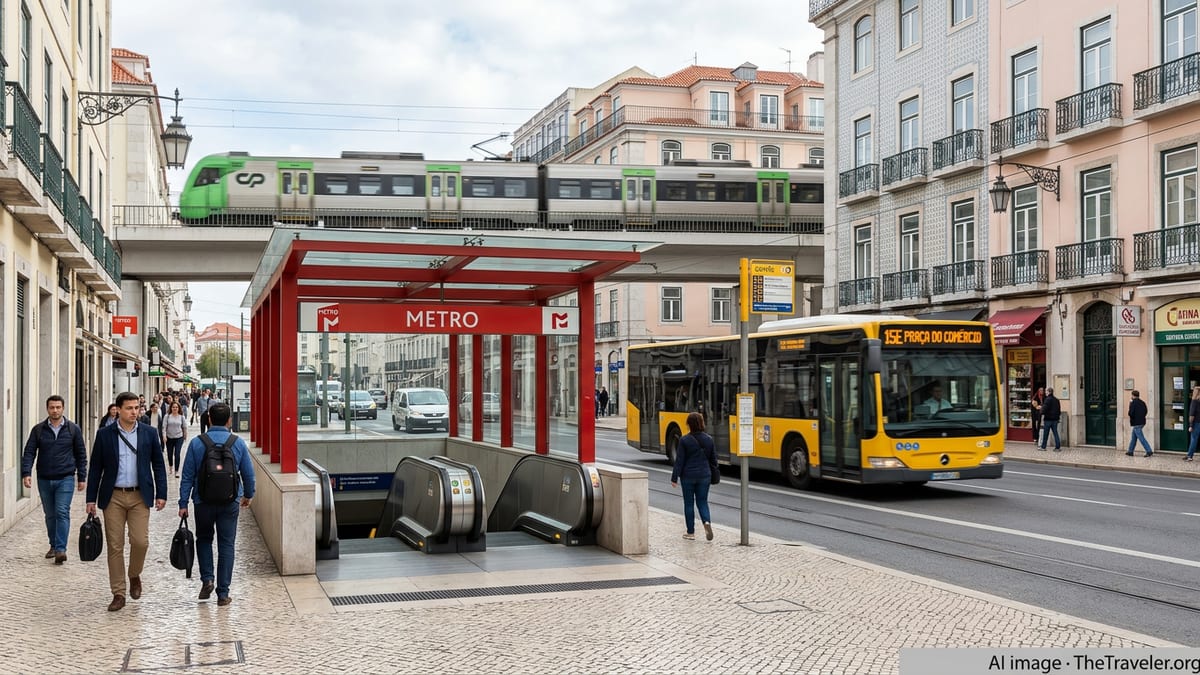
Overview of Portugal’s Public Transport Framework
Portugal’s public transport is structured around three main pillars: the national rail operator Comboios de Portugal (CP) for intercity and regional trains, high-capacity metro systems in Lisbon and Porto, and municipal or regional bus operators in urban and suburban areas. Together these modes provide a broad but uneven network, strongest in the Lisbon and Porto metropolitan areas and along the main north south corridor between Braga, Porto, Coimbra and Lisbon.
Rail coverage stretches across most of the country, but significant inland areas, smaller towns and many coastal communities in the Algarve and Alentejo remain weakly served or are reliant on infrequent regional trains or buses. CP notes that it covers the entire national territory with urban, regional, intercity and long distance services, with depots and facilities in multiple cities, but also acknowledges ongoing investment needs to modernise rolling stock and infrastructure.
Metro networks exist only in Lisbon and Porto. Lisbon’s metro carries close to half a million to around six hundred thousand passengers on an average weekday and consists of four lines and more than 40 kilometres of track, forming the backbone of the capital’s public transport. Porto’s Metro do Porto is a light rail system covering over a million inhabitants in eight municipalities around Porto through six lines and more than 60 kilometres of track, operating largely on dedicated right of way.
Bus systems, operated by entities such as Carris in Lisbon and STCP in Porto alongside private and municipal companies, fill in most of the coverage gaps, particularly in neighbourhoods and suburbs beyond rail and metro reach. Quality and reliability of bus services vary more sharply than rail or metro between cities and even between routes, which is important for relocation planning outside the two main metropolitan regions.
Trains: Coverage, Service Levels and Reliability
CP’s network connects the principal cities of Portugal, including the Lisbon Porto axis, and offers additional links to Braga, Guimarães, Aveiro, Coimbra, Évora, Faro and some border points with Spain. Services are structured into urban (suburban), regional, Intercidades (Intercity) and Alfa Pendular (higher speed) categories. This provides a functional backbone for medium and long distance travel, particularly for those locating along the main corridors.
For relocation decisions, service frequency is central. On core routes such as Lisbon Porto there are regular Intercidades and Alfa Pendular services throughout the day, often at intervals of approximately one to two hours in daytime. Urban services around Lisbon and Porto operate more frequently, supporting suburban commuting. However, regional lines away from the main axis may see gaps of several hours between trains, and some rural lines run only a handful of services daily. Prospective residents who expect to live outside metropolitan areas should not assume frequent rail service without checking specific timetables for their intended location.
Reliability is a known weak point of Portugal’s railway system. Infrastructure reports indicate that in recent years around four fifths of trains arrived within five minutes of schedule, implying roughly one in five services exceeding that threshold when measured across passenger and freight operations combined. Media reporting on 2024 performance highlighted that Alfa Pendular and Intercidades services recorded particularly poor punctuality, with less than half of these long distance trains arriving with under five minutes delay on average, and even lower shares for some premium services.
Operational disruptions are attributed to aging rolling stock, infrastructure constraints, maintenance issues, staff shortages and occasional industrial action. Prospective residents relying heavily on intercity rail commuting should therefore factor in a non-trivial risk of delays and cancellations, particularly in peak periods or during adverse weather. On the positive side, urban rail around Lisbon and Porto tends to perform somewhat better than long distance services, though still with a lower reliability profile than benchmark northern European networks.
Metro Systems in Lisbon and Porto
Lisbon Metro is the most developed heavy metro in Portugal, operating four lines (Blue, Yellow, Green and Red) over roughly 44 to 45 kilometres with more than 50 stations. The system runs from approximately 6:30 in the morning until around 1:00 at night, with peak headways typically in the range of 3 to 4 minutes on central sections and longer intervals off peak. Daily average ridership is estimated in the high hundreds of thousands. Independent assessments in 2024 ranked Lisbon Metro among the stronger metro systems in Europe in terms of overall quality and user experience compared with other capitals.
From a relocation standpoint, Lisbon Metro offers a relatively fast, predictable mode for cross city commuting where coverage exists, especially for central and northern districts and parts of the western suburbs. However, the network does not yet cover all high density residential areas. Certain municipalities on the urban fringe, such as Loures, still lack direct metro access and rely on buses or suburban rail. Crowding can be intense at peak hours, particularly on segments where only three car trains are operating and where the system has yet to return fully to pre 2019 capacity levels.
Porto’s Metro do Porto is a modern light rail system with six operational lines and around 80 stations serving the wider metropolitan area. It runs largely on the surface with some underground sections in central Porto and operates from approximately 6:00 to 1:00, with frequencies varying from around 3.5 to 4 minutes on the busiest common sections at peak to up to 10 to 15 minutes on peripheral branches and off peak periods. Key interchanges at Trindade and Campanhã connect the metro to multiple lines and to CP’s mainline rail services.
Service quality on Metro do Porto is generally viewed as high by regional standards. The system offers step free access in most stations, integrated ticketing using the Andante smartcard, and relatively reliable operations. Nonetheless, light rail characteristics mean slower speeds and less capacity than heavy metros in central tunnels. Certain dense neighbourhoods remain better served by buses, and parts of the network have been affected by construction works associated with expansion projects, which can temporarily disrupt surface traffic and interchange conditions.
Urban and Suburban Buses
Urban buses play a decisive role in Portugal’s public transport, especially for residents outside direct metro and rail catchments. In Lisbon, Carris operates the majority of city buses and trams, with suburban services provided by other operators under the metropolitan authority. In Porto, STCP and contracted operators handle core bus services, complemented by private and municipal lines across the metropolitan municipalities.
Coverage within city boundaries is generally dense, with numerous routes feeding major metro and rail hubs and serving residential districts, hospitals, universities and employment clusters. However, service levels by route are uneven. Primary corridors often enjoy high frequency, with buses every few minutes during peak times, while secondary or peripheral routes may see intervals of 20 to 30 minutes or longer. Weeknight and weekend evening frequencies are commonly reduced, which is relevant for shift workers and those with non standard schedules.
Reliability and adherence to timetables are frequent complaints among residents, particularly in Lisbon. Users report buses bunching, sudden cancellations and long gaps relative to published schedules, especially during traffic congestion or resource constraints. Unlike rail, where infrastructure largely insulates services from road traffic, buses share lanes with private cars in many areas and are affected by congestion, despite the existence of some dedicated bus lanes. Newcomers should anticipate variability in door to door journey times on bus only commutes in peak hours.
For suburban and interurban connections, bus quality and frequency vary widely by region and operator. Some corridors into Lisbon and Porto are well served by modern fleets and integrated fare systems, while other towns may have aging vehicles, limited weekend service and poorly coordinated schedules with rail. Before choosing residential locations far from metros or rail stations, it is advisable to examine specific bus timetables and route maps to assess practical commuting feasibility.
Ticketing Integration, Fares and Accessibility
Portugal has made meaningful progress in integrating ticketing across modes in its major metropolitan areas. In Lisbon, combined tickets and transport passes allow travel across metro, buses and trams within defined time windows or zones, reducing friction for multi stage journeys. In Porto, the Andante system offers zonal smartcard based fares valid on metro, buses and some suburban trains, enabling relatively seamless transfers within the network.
Monthly passes for residents are generally regarded as affordable by Western European standards and are an important factor for relocation cost calculations, particularly for commuters using multiple modes daily. While specific fare values are periodically revised, metropolitan passes usually provide significant discounts compared with paying for each trip individually, and there are reduced fares for students, seniors and low income users defined by regional policy.
Accessibility standards are mixed. Newer metro and light rail stations in Lisbon and Porto typically include lifts, ramps and level boarding platforms, though outages of elevators can affect daily usability for passengers with reduced mobility. Older heavy rail stations may still have limited step free access between platforms, especially in smaller towns, and regional trains can have high floor boarding. Modern low floor buses are increasingly common in cities, but legacy fleets persist in some areas.
Information systems, including real time displays and mobile apps, are improving but are not uniformly reliable. Metro systems offer clear signage and regular public announcements, while bus stop information in smaller municipalities can be sparse or outdated. English language information is widely available in the metros and on mainline trains, which can ease the transition for new international residents, but is less consistent on local buses outside tourist centres.
Regional Differences and Practical Relocation Implications
The quality and usability of public transport in Portugal depend heavily on location. Lisbon and Porto metropolitan areas offer the most realistic scenarios for car free or car light living, thanks to the combination of metro, suburban rail and buses. Even there, however, reliability issues on trains and buses and crowding on metro lines in peak times mean that commuters often budget additional time for journeys.
In medium sized cities such as Coimbra, Braga or Faro, urban buses and regional trains provide some mobility, but networks are less dense and frequencies lower. Residents commonly rely on private cars for part of their journeys, especially for cross town travel not aligned with existing corridors. For rural areas and small towns, public transport is often limited to infrequent regional trains or bus services, sometimes oriented toward school hours rather than standard office schedules.
For professionals considering regular intercity commuting by train, such as weekly travel between Porto and Lisbon, the rail network offers a viable option but with notable caveats about punctuality and occasional cancellations. It is realistic to plan regular use of CP services for such journeys, but less realistic to depend on them for tightly timed same day meetings without contingency time built in.
For families and individuals planning daily commuting within the Lisbon or Porto urban area, proximity to a metro or suburban rail station is a strong positive factor. Locations that depend solely on buses can still be workable but expose residents to greater variability in travel times and may require detailed analysis of specific routes and peak hour conditions. For those relocating to areas without high capacity public transport, car ownership or car sharing is likely to remain essential for reliable daily mobility.
The Takeaway
Portugal offers a functional and in some corridors extensive public transport system, anchored by CP’s rail network and metro systems in Lisbon and Porto, and complemented by dense bus services in major cities. For relocation decisions, the key differentiator is geography: central districts and rail served suburbs of Lisbon and Porto benefit from the strongest combination of modes, while inland and peripheral regions are more weakly served and often require car dependency.
From a quality standpoint, metros in Lisbon and Porto perform relatively well in an international context, providing frequent, generally safe and predictable services where coverage exists. Mainline rail offers reasonable comfort and coverage along principal routes but is hampered by chronic punctuality and reliability issues, particularly on long distance services. Buses provide critical coverage but with widely varying reliability and frequency by route.
Prospective residents who prioritise using public transport should therefore focus their housing search on areas with direct access to metro or suburban rail, treat intercity rail commuting as workable but imperfect, and approach bus dependent locations with careful timetable and route analysis. With these caveats understood, public transport in Portugal can support a practical, if sometimes imperfect, car light lifestyle in the country’s main urban regions.
FAQ
Q1. Is it realistic to live in Lisbon or Porto without a car using only public transport?
Yes, in central Lisbon and Porto and in rail or metro served suburbs it is generally realistic to live without a car, though crowding and occasional disruptions mean journeys may require extra time, and some peripheral districts still depend heavily on buses.
Q2. How reliable are long distance trains in Portugal for daily commuting?
Long distance Alfa Pendular and Intercidades services provide good coverage but have relatively high rates of delays compared with some other European countries, so they are better suited to occasional or flexible commuting than to tightly timed daily trips.
Q3. Are Portugal’s metro systems accessible for passengers with reduced mobility?
Most Lisbon and Porto metro stations have lifts, ramps and level boarding, offering reasonable accessibility, but older stations and occasional elevator outages mean that passengers with reduced mobility should verify station by station conditions for regular journeys.
Q4. How frequent are metro services during peak hours?
In both Lisbon and Porto, peak hour headways in central sections are typically around 3 to 4 minutes, with longer intervals on branch sections and during late evenings and weekends.
Q5. Do buses in Portugal generally follow their published timetables?
In practice, adherence to timetables varies: some high frequency urban routes operate close to schedule, while others, particularly in congested corridors or less resourced areas, experience bunching, gaps and occasional cancellations.
Q6. Is public transport outside Lisbon and Porto adequate for daily commuting?
In medium sized cities some residents can rely on buses and regional trains, but services are less frequent and less integrated than in the main metropolitan areas, and in many small towns public transport alone is often insufficient for predictable daily commuting.
Q7. Are public transport fares in Portugal affordable for regular users?
Metropolitan monthly passes that cover metro, buses and some suburban trains are generally considered affordable relative to incomes and significantly reduce per trip costs for regular commuters.
Q8. How integrated are tickets between trains, metro and buses?
In Lisbon and Porto, integrated ticketing systems allow the use of a single pass or smartcard across metro, buses and, in some cases, suburban rail, while in smaller cities integration is more limited and separate tickets may be required.
Q9. What are typical operating hours for public transport in major cities?
Metros in Lisbon and Porto usually operate from early morning around 6:00 to 6:30 until about 1:00 the next day, with urban buses starting early and running into late evening, though exact hours and frequencies vary by route.
Q10. How do strikes affect public transport in Portugal?
Occasional strikes by rail or urban transport workers can lead to reduced services, cancellations and crowding; minimum services are usually maintained, but residents dependent on public transport should monitor local news and plan alternatives during announced strike periods.