


More news on this day
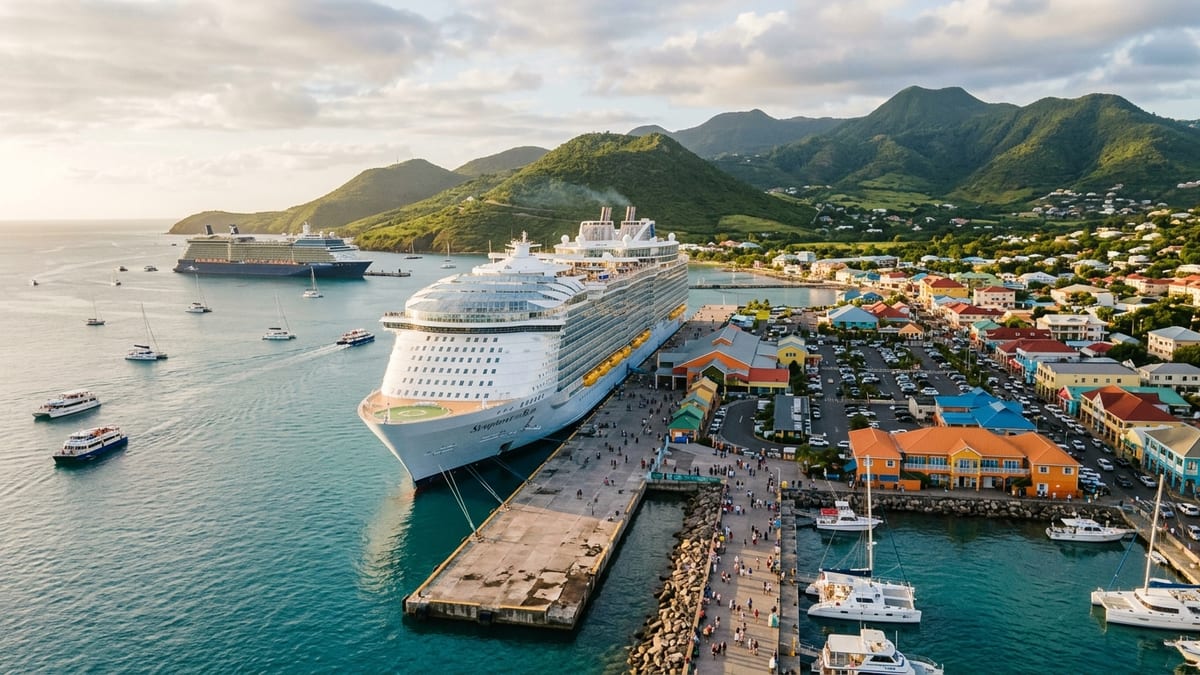
St. Kitts and Nevis has surged past one million cruise passengers so far in 2026, a symbolic threshold that signals a renewed era for Basseterre as a growing Caribbean cruise hub.
Get the latest news straight to your inbox!
A Post-Pandemic Milestone for Cruise Tourism
Publicly available reporting indicates that St. Kitts has welcomed more than one million cruise passengers this year, surpassing the benchmark for the first time since before the COVID-19 pandemic and underscoring the strength of the destination’s cruise rebound.
Coverage from local media describes the one-million mark as a key psychological and economic milestone for the federation, restoring volumes that had fallen sharply during the global shutdown and the slow restart that followed. The achievement follows several seasons of steady rebuilding in which cruise arrivals climbed back toward pre-2020 levels.
Regional tourism data show that St. Kitts and Nevis was already on an upward trajectory in 2023 and 2024, with cruise traffic rising as major lines reinstated full itineraries and deployed larger vessels in the Eastern Caribbean. According to official statistics, cruise passenger totals reached roughly 1.23 million in 2024, providing a platform for the latest surge in volumes.
The one-million-passenger threshold in 2026 reinforces the federation’s position among the more prominent cruise stops in the Eastern Caribbean. Industry analyses place St. Kitts alongside destinations such as St. Maarten, Antigua and the U.S. Virgin Islands as ports where cruise tourism accounts for a substantial share of visitor arrivals and onshore spending.
Basseterre and Port Zante Enter a New Phase
The capital Basseterre sits at the center of this growth, with cruise operations concentrated at Port Zante, the purpose-built terminal on the city’s waterfront. Basseterre already serves as the country’s primary maritime gateway, and Port Zante has evolved into a modern complex with multiple berths, duty-free shopping, and direct access to excursions across St. Kitts and neighboring Nevis.
Information published by the St. Christopher Air and Sea Ports Authority notes that Port Zante is part of a wider cluster of transport assets in and around Basseterre, including the deep-water cargo port, inter-island ferry facilities, and the nearby Robert L. Bradshaw International Airport. This concentration of infrastructure has helped the capital transition from a traditional commercial harbor to a diversified logistics and tourism hub.
The port’s layout, with dedicated cruise berths separate from cargo operations, has enabled Basseterre to handle larger ships and multiple calls on the same day. Observers point to the growing frequency of port days with three or more vessels alongside, reflecting the destination’s inclusion in a broad range of itineraries operated by North American and European cruise brands.
Beyond the terminal itself, the expansion of visitor services in Basseterre has been crucial to the port’s evolution. Retail outlets, restaurants, tour operators, and transport providers clustered around Port Zante have steadily increased capacity to capture higher per-passenger spending, which international studies identify as a significant contributor to the local economy.
New Cruise Terminal and Home-Porting Ambitions
In July 2026, the government broke ground on a new cruise terminal development at Port Zante, a project that publicly available information describes as central to a strategy of shifting St. Kitts from a pure port-of-call to a regional home-porting destination.
According to official releases, the new facility is being purpose-built to support turnaround operations, allowing passengers to begin and end their voyages in Basseterre rather than simply visiting for a day. The design is expected to incorporate expanded check-in, baggage handling, security screening and passenger circulation areas tailored to the requirements of home-porting.
The development aligns with earlier announcements that P&O Cruises plans to launch home-porting operations in St. Kitts from late 2027, using Basseterre as an embarkation point for select Caribbean itineraries. Industry commentary suggests that this could gradually reshape the federation’s cruise profile, with more visitors flying into St. Kitts to join ships and extending their stays on island before or after their voyages.
Home-porting is typically associated with higher economic impact per visitor, as passengers spend more on local hotels, restaurants, transfers and tours than day visitors who remain on a ship-centric schedule. For Basseterre, the shift toward home-port capability is seen as a way to deepen the value of cruise tourism and spread benefits beyond the immediate port district.
Economic Impact and Regional Context
Analyses produced for the Florida-Caribbean Cruise Association have highlighted the significance of cruise tourism for St. Kitts and Nevis, estimating tens of millions of dollars in direct annual spending by passengers, crew, and cruise lines in recent seasons. This includes expenditures on shore excursions, food and beverages, retail purchases, and port services.
Budget documents from the federation’s Ministry of Finance indicate that growth in cruise passenger arrivals has contributed to increases in sea transport activity and related services. The latest figures point to cruise tourism as a key driver of foreign exchange earnings, employment in transport and hospitality, and tax revenues associated with visitor spending.
Within the wider Caribbean context, data compiled by regional tourism bodies show that St. Kitts and Nevis ranks among the destinations with some of the fastest cruise passenger growth in the post-pandemic period. A surge in arrivals during 2024 and 2025 placed the country in a group of islands registering double-digit percentage increases as cruise travel returned to full scale.
This upswing has also been reflected in airlift, with additional flight capacity into Robert L. Bradshaw International Airport helping to support both stay-over tourism and the emerging home-porting profile. For Basseterre, the interconnection between air and sea gateways strengthens its role as a regional node for passenger movement and tourism logistics.
Managing Growth and Enhancing the Visitor Experience
While the one-million passenger milestone is celebrated as a success, public discussions around Basseterre’s transformation also highlight the importance of managing growth sustainably. The concentration of visitors on peak cruise days presents familiar challenges around congestion, infrastructure strain, and the protection of cultural and natural assets.
Planning documents and policy statements emphasize the need for improved traffic management in and around the port, investments in utilities and public spaces, and the careful regulation of excursions into sensitive coastal and heritage sites. Efforts are also under way to spread cruise-derived benefits more widely across communities on St. Kitts and Nevis, encouraging visitors to explore beyond the immediate port zone.
Industry-focused events scheduled in Basseterre, including a major travel advisor showcase, are framed as opportunities to reposition the federation’s tourism product at a higher-value segment of the market. Organizers aim to expose travel sellers to a broader range of experiences across the two islands, from hiking and heritage to boutique accommodations and culinary offerings.
As cruise arrivals move beyond the one-million threshold and new home-porting infrastructure takes shape, Basseterre appears to be entering a new era in which volume, value, and visitor experience are being rebalanced. The trajectory of St. Kitts and Nevis in the coming years will likely depend on how effectively the destination converts record cruise numbers into long-term, sustainable gains for its economy and communities.
St. Kitts surpasses one million cruise visitors in post-pandemic milestone
New Cruise Terminal Development Project at Port Zante
St. Kitts and Nevis on track for over 1 million cruise passengers in 2024/2025