


More news on this day
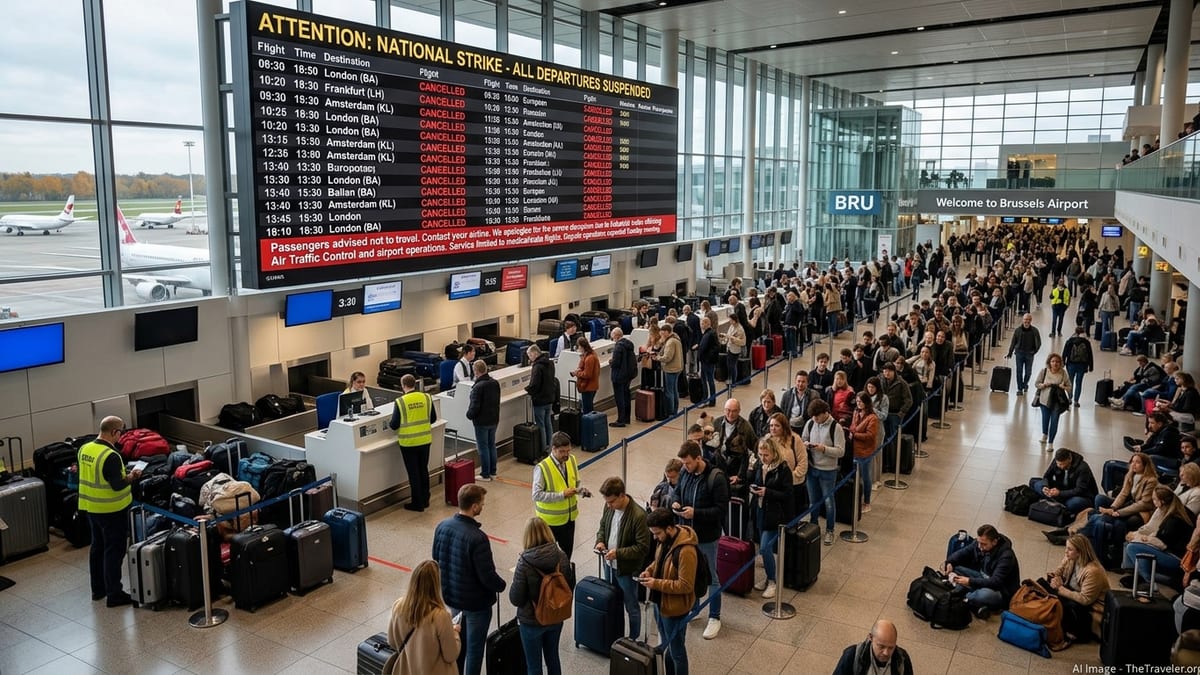
Brussels Airport cancelled almost all passenger flights on Monday 23 November 2026 after a nationwide strike by Belgian air traffic controllers and other unions severely restricted Belgian airspace, leaving thousands of travellers facing last‑minute disruption and forcing airlines to scrap or reroute services across Europe.
Get the latest news straight to your inbox!
What happened at Brussels Airport on 23 November
Belgium’s largest airport, Brussels Airport (BRU) in Zaventem, suspended virtually its entire passenger flight schedule between 07:00 and 21:00 local time on Monday 23 November 2026 in response to a national strike affecting air traffic control and other transport sectors. The airport announced over the weekend that “most” or “all” departing and arriving passenger flights were expected to be cancelled during the 14‑hour period, advising passengers not to travel to the airport unless specifically instructed to do so by their airline.
The stoppage was triggered by a nationwide day of industrial action called by Belgian trade unions against federal government austerity and labour reforms. Belgium’s air navigation service provider Skeyes warned that it would not be able to guarantee normal air traffic services on 23 November after some of its air traffic controllers declared their intention to join the walkout. With staffing levels uncertain and airspace safety at risk, slot restrictions and pre‑emptive cancellations were put in place.
In practice, operations at Brussels Airport were almost entirely halted for scheduled passenger traffic during the strike window. Several sources tracking operations at the airport reported that hundreds of flights were removed from the timetable, while only a small number of exempt services, such as certain medical, state or diverted flights, were able to operate. Normal commercial passenger operations began to ramp up again only after the end of the declared action period on Monday evening.
Scale of cancellations and impact on airlines
Preliminary tallies from aviation and passenger‑rights monitoring services indicate that the strike led to the cancellation of a very high proportion of Brussels Airport’s scheduled flights for 23 November. One disruption database recorded 404 cancelled passenger flights linked to the Brussels airspace restrictions that day, while a separate tracker that logs November cancellations at the airport identified 126 cancellations concentrated on 23 November alone, significantly above a typical day’s figures for Zaventem.
The difference between reported totals reflects how each system counts flights, routes and operating carriers, but both confirm that Monday’s disruption was exceptional in scale for a single‑day event at a major European hub. For most travellers with flights booked to depart or arrive during the 07:00 to 21:00 local window, services were either cancelled outright or rebooked to operate before or after the strike period, or via alternative airports in Belgium or neighbouring countries.
All airlines using Brussels Airport were affected to some degree, including home carrier Brussels Airlines, leisure operator TUI fly Belgium, low‑cost carriers such as Ryanair and Wizz Air on selected routes, and a broad range of European and intercontinental network airlines. Some foreign carriers chose to reroute long‑haul flights to nearby hubs such as Amsterdam, Paris or Frankfurt, while others cancelled Brussels rotations entirely and focused on reaccommodating passengers on later dates.
Why Belgian airspace and ground operations were disrupted
The core of Monday’s disruption lay in the interaction between air traffic control staffing and airport‑side industrial action. Skeyes, which provides air navigation services in Belgian airspace, communicated that it could not ensure normal service levels due to controllers taking part in the national strike. That uncertainty limited the number of flights that could safely operate. Brussels Airport in turn stated that its own operational capacity would be “very seriously reduced” and that it anticipated that the vast majority of scheduled flights would have to be cancelled.
The nationwide character of the strike meant that other Belgian airports also faced disruption, although on a smaller scale than the near‑shutdown at Brussels. Information services tracking European travel disruptions noted that Charleroi and Liège airports experienced heavily reduced schedules and delays, but they did not report the complete suspension of passenger flights for a set block of hours that was implemented at Brussels Airport. Rail and local public transport in parts of Belgium were also affected, complicating alternative travel options for passengers attempting to leave or reach the country by land.
Weather did not appear to be a principal factor in the 23 November cancellations at Brussels, in contrast to other European airports where fog and winter conditions were reported around the same period. Aviation weather summaries for the region pointed instead to staffing‑related air traffic flow restrictions as the trigger for Monday’s capacity cut. The interruption followed a separate wave of disruption at European airports earlier in November linked to winter schedule reductions and isolated weather‑related problems, but those issues were distinct from the Belgian strike.
How passengers have been affected and what support is available
The sudden loss of capacity at Brussels Airport on 23 November stranded many passengers who had already begun their journeys into the Belgian capital or were relying on connecting flights via Zaventem. Media reports from the day highlighted travellers arriving from long‑haul destinations such as Beijing only to find their onward European connections cancelled and limited assistance available at transfer desks, particularly at the peak of the strike window when large crowds built up around airline service counters.
Under European air passenger regulations, the assistance and financial rights of affected travellers depend on the circumstances of each flight. Where the cancellation involved an airline based in the European Union or a flight departing from an EU airport, carriers were generally obliged to offer the choice between a refund of the unused ticket portion and re‑routing at the earliest opportunity under comparable conditions. However, because the strike related to air traffic control and wider national industrial action rather than decisions within airlines’ direct control, many cancellations will fall into the category of extraordinary circumstances, limiting eligibility for fixed cash compensation even where short‑notice disruption occurred.
Airlines nevertheless remained responsible for providing care during the disruption, which can include meals, refreshments and accommodation in certain cases, depending on delay length, flight distance and the specifics of European and, where relevant, UK regulations. In practice, the level of support has varied by carrier and by how easily passengers could be moved to flights outside the strike window or onto services from nearby airports. With neighbouring hubs such as Amsterdam, Paris Charles de Gaulle and Frankfurt operating normally, some travellers reported being rebooked overland to these airports to continue their trips, adding significant time but allowing journeys to continue.
Operational recovery and what travellers should check next
By the morning of Tuesday 24 November, Brussels Airport and flight‑tracking services indicated that operations were resuming across most airlines, with regular schedules largely restored outside the strike period. There were, however, residual delays and some remaining cancellations as aircraft and crews were repositioned and airlines worked through backlogs of disrupted passengers. Travel monitoring bulletins published on 24 November continued to flag Brussels as an airport with knock‑on effects from the previous day’s industrial action, although there was no indication of fresh large‑scale cancellations linked to air traffic control for Tuesday itself.
Travellers scheduled to fly to, from or through Brussels in the days immediately following the strike are being advised by airports, airlines and travel management companies to check their booking status frequently. Even where flights now appear as operating, some departure and arrival times have been adjusted to accommodate aircraft rotations and crew duty limits after the previous day’s upheaval. Passengers who had previously accepted rebooking onto later dates should also verify that their new itineraries remain confirmed and that any necessary changes to accommodation or ground transport are in place.
Looking beyond Brussels, travel‑watch services on 24 November highlighted several unrelated disruptions around Europe that may affect itineraries involving multiple stops. These included regional rail and bus strikes in the Netherlands, a temporary runway capacity restriction at Barcelona Airport through 26 November, and a complete closure of Naples Airport to passengers until 30 November for separate operational reasons. Travellers planning near‑term journeys in Europe, particularly those involving connections or less flexible tickets, are therefore encouraged to monitor both their specific flights and broader transport advisories in the region.
At the time of writing, Belgian unions and authorities had not announced a firm date for a follow‑up national strike of comparable scale affecting air traffic control. However, given that Monday’s events followed earlier industrial action days in Belgium in October that also triggered significant aviation disruption, travellers booking new itineraries involving Brussels in the coming weeks may wish to pay close attention to fare conditions and flexibility options. Checking for updates directly from Brussels Airport, Skeyes and individual airlines in the days before travel remains the most reliable way to confirm whether schedules are operating as planned or subject to renewed capacity limits.