


More news on this day
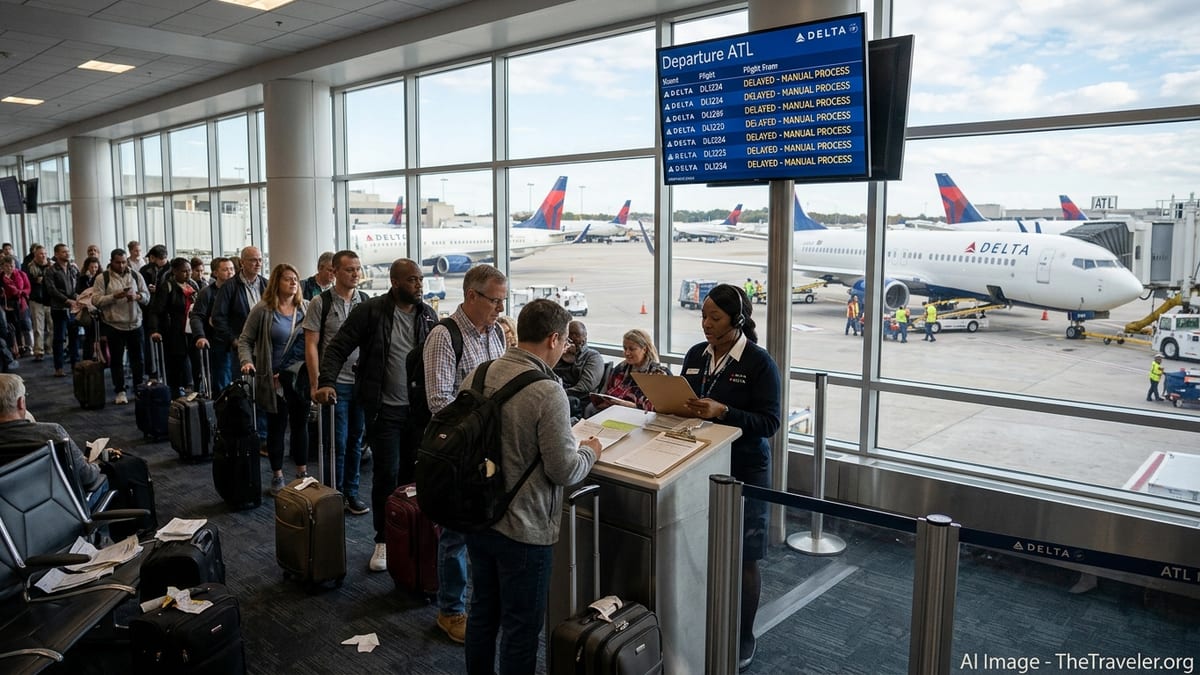
Delta Air Lines experienced widespread delays on Sunday, November 22, after an outage in its automated weight-and-balance system disrupted operations at its main hub in Atlanta and across the United States, delaying more than 1,600 flights at the start of the busy Thanksgiving travel period.
Get the latest news straight to your inbox!
What happened to Delta’s operations on November 22
On Sunday, November 22, Delta Air Lines reported a technical outage affecting one of the automated systems it uses to calculate aircraft weight and balance before departure. The malfunction primarily impacted flights departing from Hartsfield–Jackson Atlanta International Airport, the carrier’s largest hub, but the knock-on effects were felt across Delta’s domestic network. According to the airline, more than 1,600 of its flights nationwide were delayed that day, with internal figures indicating that roughly 49% of all Delta flights operated on Sunday arrived at least 15 minutes behind schedule.
Weight-and-balance calculations are a standard safety requirement before every commercial flight. Airlines use specialized software to combine passenger counts, baggage, cargo, fuel loads and seating distribution to confirm that an aircraft remains within its certified weight limits and that its center of gravity is within an approved range. On November 22, the automated system Delta normally uses for that task was intermittently unavailable, forcing crews and operations teams to rely on manual procedures.
As the problem emerged early Sunday, Delta requested that the Federal Aviation Administration briefly halt its flights bound for Atlanta while the scope of the outage was assessed. The FAA issued a short-term ground stop for Delta flights to Hartsfield–Jackson and then converted that restriction into a ground delay program, with average delays of about an hour for affected arrivals. The FAA noted that the disruption was specific to Delta’s systems and not related to any wider air traffic control or communications issues.
Scale of the disruption and where delays were worst
The weight-and-balance system outage led to delays across much of Delta’s network, but Atlanta was the clear focal point. Delta controls a large majority of traffic at Hartsfield–Jackson, and when departures there slow down, the impact quickly reverberates through the airline’s schedule. Flight-tracking data and airline statements indicate that a significant share of the more than 1,600 delays on November 22 involved flights into or out of Atlanta. Other Delta stations, including large coastal hubs and key spoke cities, also reported departures held at the gate while weight-and-balance paperwork was processed manually.
As the day progressed, the scale of disruption increased. By Sunday evening, third-party tracking services were indicating that around 58% of Delta flights had operated late at some point during the day, equating to about 2,000 individual delayed flights. Delta’s own summary cited more than 1,600 delays when counting flights that departed at least 15 minutes behind schedule, highlighting that the precise number varies depending on the specific cutoff used to classify a delay. Regardless of methodology, the outage produced one of the largest single-day operational disruptions for a major U.S. carrier so far this Thanksgiving travel period.
The disruption was not limited to Delta’s mainline services from Atlanta. Passengers reported delays on domestic departures from cities including Seattle, Boston, Jacksonville, Boise and several Midwestern airports on flights bound for Atlanta or connecting into Delta’s broader network. Because aircraft and crews operate multiple legs per day, an early-morning delay from a smaller station into Atlanta could cascade into late departures on subsequent segments, including flights that did not themselves require manual weight-and-balance calculations by the time they operated.
How Delta handled flights while the system was down
Delta emphasized throughout Sunday that flight safety remained the priority and that the outage affected only the way weight-and-balance data was produced, not the underlying safety limits or aircraft performance. With the automated tool unavailable or unreliable, dispatchers and pilots reverted to established manual procedures for verifying weight and balance before pushback. That process typically involves reconciling passenger counts, baggage and cargo manifests, and standard weight tables, then obtaining dispatch approval before departure. While safe, these workarounds are significantly more time-consuming than automated calculations, particularly at a hub the size of Atlanta where dozens of flights may be scheduled to depart within the same 30-minute window.
By Sunday afternoon, Delta stated that the affected automation had been restored and that the system responsible for calculating weight and balance was back in normal operation. The airline said there was no indication the incident was caused by a cyberattack or unauthorized intrusion, characterizing it instead as a technical equipment problem within its own systems. However, getting the software back online did not instantly reset the airline’s schedule. Aircraft and crews were out of position after hours of earlier delays, and some later flights operated with lingering knock-on effects into Sunday night and Monday morning as Delta worked to realign aircraft rotations and crew duty times.
Delta said it was rebooking affected customers onto the next available itineraries and that it was offering hotel rooms and meal vouchers where overnight stays or long layovers became necessary because of the disruption. The airline also confirmed that passengers whose flights were canceled and who chose not to travel could request refunds. While the carrier did not publicly provide a breakdown of cancellations tied directly to the outage, passenger accounts from Atlanta and other airports described both extended gate holds and a smaller number of flights ultimately canceled after long delays, in some cases when aircraft or crews were no longer available within regulatory working limits.
Why weight-and-balance systems matter for safety
The system at the center of Sunday’s outage performs a technical but critical role. Every commercial aircraft is certified to operate within specific weight and center-of-gravity limits. These restrictions are designed to ensure that the aircraft’s structure is not overstressed and that it can safely take off, climb, cruise and land under expected conditions. Exceeding maximum takeoff weight can reduce required performance margins, while an improper center of gravity that is too far forward or too far aft can make the aircraft difficult or impossible to control in some phases of flight.
In normal operations, airlines use automated weight-and-balance software that integrates data from passenger check-in systems, baggage handling, cargo bookings and fueling to produce a final load sheet or electronic message confirming that a flight is within its allowable envelope. Pilots review and accept this information as part of their preflight checks. If the system that generates these calculations becomes unavailable, airlines must revert to manual procedures, which are accurate but slower. Those procedures often require multiple cross-checks between dispatch, ramp workers and cockpit crews, leading to cumulative delays when repeated across hundreds of flights in a short period.
Although Sunday’s outage caused significant inconvenience, there have been no reports of safety incidents linked to the malfunction itself. Authorities reiterated that the disruption did not affect aircraft already in the air and that only departing flights waiting for weight-and-balance clearance were impacted. For travelers, the episode is a reminder that behind the familiar experience of boarding a flight, there are numerous interdependent technical systems whose failure can quickly ripple across an airline’s entire schedule even without any issues in air traffic control or weather.
Timing with Thanksgiving travel and what passengers should do next
The outage came at a particularly sensitive moment on the U.S. travel calendar. The Sunday before Thanksgiving marks the start of one of the busiest travel weeks of the year, with passenger volumes building steadily into the holiday and remaining high through the following weekend. Industry data from recent years show that delays during this period can be especially disruptive because flights often operate close to full, leaving fewer open seats to rebook disrupted passengers on the same day. In this context, a technical problem that pushes nearly half of a major carrier’s schedule behind can quickly lead to crowded terminals, missed connections and overnight stays.
By Monday, November 23, Delta said its operations had largely stabilized, with delay levels returning closer to typical ranges for the season even as the airline continued to work through residual disruptions from the day before. Nonetheless, passengers traveling with Delta in the days surrounding Thanksgiving were advised to monitor their flight status frequently, arrive at the airport with extra time and be prepared for longer lines at check-in and customer service counters. Even after the underlying technical issue is fixed, it can take several scheduling cycles for aircraft and crew positioning to fully normalize following a large, systemwide disruption.
Travelers with upcoming Delta flights should use the airline’s official app or website to check real-time departure and arrival information and to manage rebooking options if their flight is significantly delayed or canceled. Those who experienced substantial delays or cancellations on November 22 and 23 can review Delta’s published customer service commitments and, where applicable, request refunds, vouchers or additional assistance in line with the airline’s policies. For passengers connecting through Atlanta in the days ahead, allowing longer connection windows than usual may reduce the risk of missed onward flights if further schedule adjustments occur as the busy holiday week continues.