


More news on this day
Delta Air Lines says operations are stabilizing after a failure of its automated system for calculating aircraft weight and balance triggered widespread delays to and from Atlanta on Sunday, complicating travel for thousands of passengers in the busy run-up to Thanksgiving.
Get the latest news straight to your inbox!
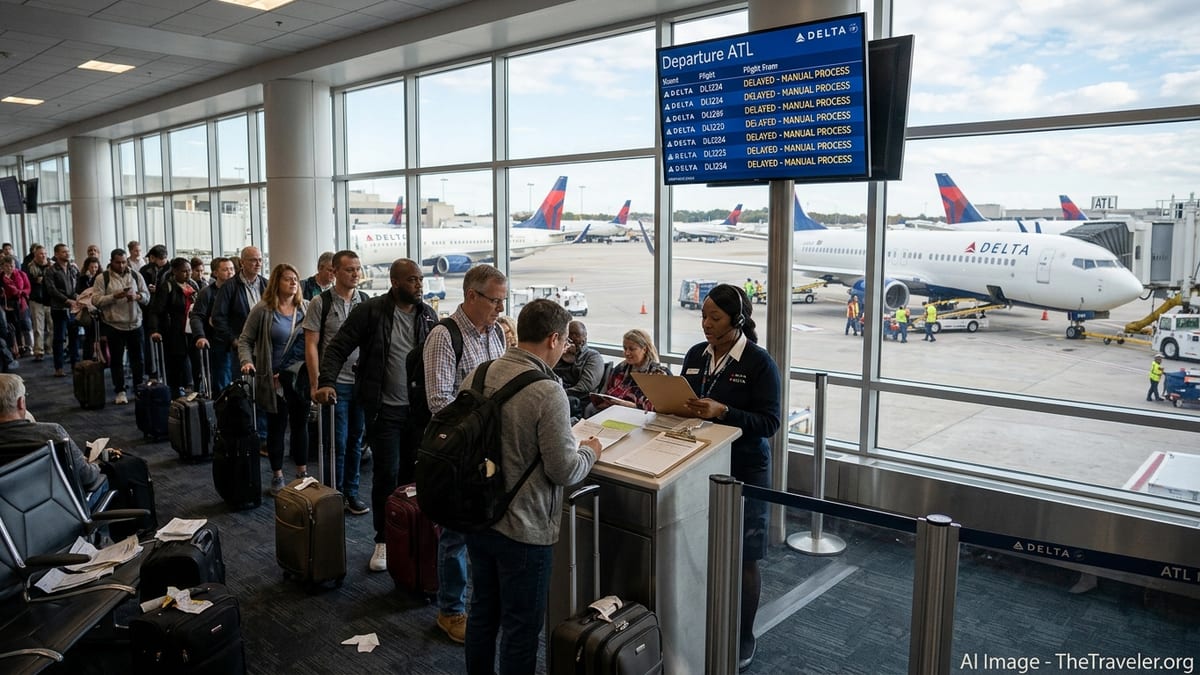
What happened to Delta’s system on Sunday
On Sunday 22 November 2026, Delta Air Lines experienced an outage in the automated system it uses to calculate departing aircraft weight and balance, a mandatory step before every takeoff. The problem began in the morning and affected flights across the carrier’s network, centering on its main hub at Hartsfield-Jackson Atlanta International Airport. Delta confirmed that its automation for these calculations was unavailable and that dispatch and flight crews reverted to manual workarounds while technicians worked to restore normal operations.
The outage coincided with one of the busiest travel periods of the year, as U.S. travelers headed out for the Thanksgiving holiday. According to flight-tracking data cited by multiple outlets, more than 1,000 Delta flights were delayed on Sunday, with disruption spreading from Atlanta to major airports including New York LaGuardia, Newark, Washington Reagan National, Dulles, Boston, Baltimore, Miami, Minneapolis, Nashville, San Antonio and Birmingham. Several reports indicated that at one point late Sunday afternoon, hundreds of flights in and out of Atlanta were running behind schedule across all airlines combined.
By Sunday afternoon, the Federal Aviation Administration had issued a ground stop for certain Delta flights bound for Atlanta, later easing this to a ground delay program. The restrictions were designed to ease congestion at the carrier’s hub while departure flows were slowed by manual procedures. The FAA stressed that its own air traffic control systems were not at fault, and Delta similarly said the technical issue was internal to its weight-and-balance automation rather than part of a broader FAA outage.
Impact on flights, hubs and passengers
The immediate operational effect was a sharp increase in departure times for Delta flights. With crews needing to calculate and verify weight and balance manually and coordinate with dispatch, many departures pushed back from the gate later than planned or held at the gate awaiting completed paperwork. Because arrivals depend on open gates, delayed departures in Atlanta created a knock-on shortage of available parking positions, which in turn slowed the arrival of inbound flights and caused further delays for connecting passengers.
The delay ripple spread beyond Delta’s own operations. As the ground stop and ground delay program limited arrivals into Atlanta, flights operated by other airlines heading to the world’s busiest airport also encountered hold times and schedule changes. Passengers posted throughout Sunday about extended waits onboard aircraft, missed connections and unscheduled overnight stays as the system backlog grew. While Delta has not released a detailed breakdown, reports based on FlightAware data indicated that a significant share of the carrier’s global schedule experienced some level of disruption.
Delta said in public statements that about 70 percent of its delays and cancellations reported on Sunday were attributable to the automation problem, with the remainder caused by weather and related air traffic control programs affecting New York City and the broader Northeast. The airline emphasized that safety procedures were followed throughout and that flights departed only once required weight-and-balance checks were completed, whether automatically or by manual methods. There have been no reports of safety incidents tied to the outage.
Why weight and balance calculations matter
Every commercial flight must comply with strict weight and balance limitations set out in the aircraft’s certification and the airline’s operating manuals. These limits cover not only the total weight of the aircraft at takeoff but also how that weight is distributed along the fuselage and wings. Regulators such as the Federal Aviation Administration say exceeding these limits or miscalculating the center of gravity can affect an aircraft’s performance during critical phases of flight, potentially reducing controllability or compromising structural margins.
To manage this, airlines use software systems that combine passenger counts and standard or actual passenger weights, checked and carry-on baggage, cargo, fuel and aircraft configuration details to produce final load sheets for each departure. These systems have become deeply embedded in daily operations, allowing airlines to produce accurate calculations quickly at scale. When automation fails, dispatchers and flight crews can revert to manual methods using approved tables, forms and checklists, but that process is inherently slower, especially when thousands of flights are scheduled across a global network.
Sunday’s outage underlined how dependent modern flight operations are on these tools. Although airlines are required to maintain safe backup processes, running them across much of a carrier’s schedule at short notice strains both staffing and airport infrastructure. At Atlanta, one of the world’s busiest hubs, even modest additional time for each departure translated into a queue of aircraft waiting for gates, knock-on delays for inbound flights and missed onward connections, particularly for travelers relying on tight layovers ahead of the holiday.
Delta’s response and current operational status
Delta said on Sunday evening that the affected automated system had been restored and that it was working to clear remaining delays. By Monday 23 November, the airline and local media in Atlanta reported that operations at Hartsfield-Jackson were “returning to normal,” although some flights were still recovering from the previous day’s disruption. Flight tracking data on Monday showed a significantly reduced number of delays compared with Sunday’s peak, and Delta said its focus had shifted to operating its full schedule in the days leading up to Thanksgiving.
The airline has apologized to customers affected by Sunday’s outage. Delta has said that it is rebooking passengers onto the next available itineraries, providing hotel accommodation and meal vouchers where necessary, and offering refunds to travelers whose flights were canceled and who chose not to travel. As with similar disruptions, specific entitlements can vary by ticket type and routing, but the carrier has signaled that customers who experienced lengthy delays should contact its reservations channels or use digital tools to explore rebooking and compensation options.
Delta has not publicly detailed the precise technical cause of the weight-and-balance automation failure, nor has it indicated whether the issue originated with internal systems or with a third-party provider. There is no indication at this stage that customer data were compromised or that the outage involved a cyberattack; available statements describe a system malfunction affecting operational calculations. The airline has also not announced any schedule cuts or long-term changes as a direct result of Sunday’s events, describing the disruption as a short-term operational problem that has now been resolved.
Context: earlier nationwide ground stop and busy holiday travel
Sunday’s Delta-specific outage came just days after a separate, rare nationwide FAA ground stop that disrupted flights across the United States. That earlier event, which regulators have linked to a problem in systems used for air traffic control and situational awareness, was widely reported as the most extensive nationwide halt to U.S. departures in roughly a quarter-century. At Atlanta, airport general manager Ricky Smith described the nationwide ground stop as a “big test” for the hub as it prepares to handle millions of passengers over the Thanksgiving period.
Hartsfield-Jackson Atlanta International Airport is expected to process around 4 million travelers over the Thanksgiving travel window, according to airport projections. In that context, even short-lived operational incidents can have outsized effects. Following the nationwide ground stop, Atlanta officials said the airport was “approaching normalcy” by midweek, only to see new pressure on Sunday as Delta’s automation issue added carrier-specific delays just as outbound holiday traffic increased again.
Industry and government figures suggest that Thanksgiving 2026 will be another very busy holiday for U.S. air travel, with airlines planning schedules close to or above last year’s levels. The combination of dense schedules, winter weather risks and heightened sensitivity to technology failures after this month’s nationwide ground stop has put reliability in the spotlight. For travelers, the Delta outage is a reminder that even well-established carriers can face sudden IT problems that temporarily overwhelm backup processes, especially at major hub airports with tight turnaround times.
What travelers should know and do next
For travelers booked with Delta in the days following the outage, available evidence suggests that operations have largely returned to normal, with no ongoing system failure reported as of Tuesday 24 November. However, residual disruption can persist after such events as aircraft and crew return to their planned positions. Passengers with connections through Atlanta or other major Delta hubs should pay close attention to their flight status on the day of travel and allow extra time for tight connections, especially ahead of the peak Thanksgiving departure days.
Customers whose flights were canceled on Sunday, or who experienced lengthy delays, can review options for refunds or travel credits. Delta has publicly said that passengers whose flights were canceled and who decided not to travel are eligible for refunds, while those who still wish to travel can work with the airline to be rebooked on the next available itineraries. Travelers may wish to retain documentation of delay lengths and out-of-pocket expenses such as hotels and meals, in case the airline offers expense reimbursement or as supporting material for any travel insurance claims.
Looking ahead, regulators and airlines are likely to face further scrutiny of both technology resilience and contingency planning, given the close timing of the nationwide ground stop and Delta’s weight-and-balance issue. For now, there is no official indication of new restrictions or schedule changes tied specifically to Sunday’s outage. Travelers planning to pass through Atlanta or fly Delta during the remainder of the Thanksgiving period should continue to monitor airline communications, weather forecasts and airport advisories so they can adjust plans if conditions or schedules change at short notice.