


More news on this day
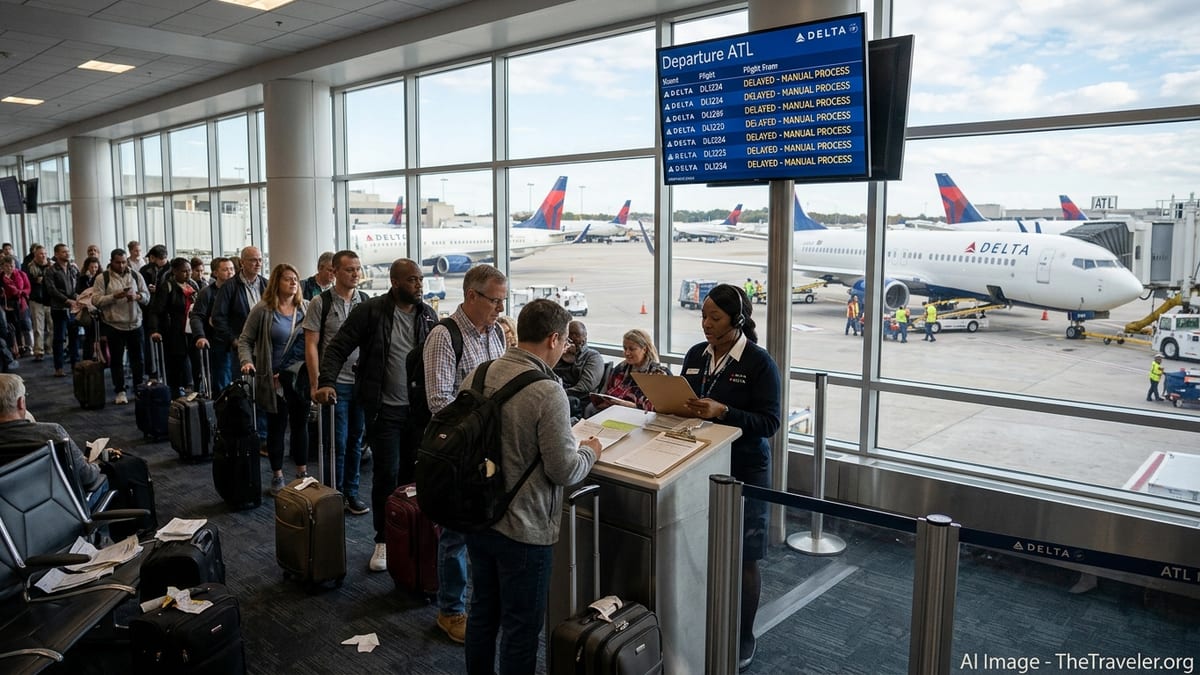
Delta Air Lines says it has restored an automated system used to calculate aircraft weight and balance after a technology outage on November 22 triggered widespread flight delays at its Atlanta hub and across the United States just days before the busy Thanksgiving travel period.
Get the latest news straight to your inbox!
What happened to Delta’s weight and balance system
The disruption began on Sunday, November 22, when Delta reported problems with the automated platform it uses to calculate weight and balance data for departing flights. The system supports a critical pre-departure process that determines how passengers, baggage, cargo and fuel are distributed on board and confirms that each aircraft remains within certified limits.
As the outage unfolded, Delta asked the Federal Aviation Administration to impose a ground stop on its flights bound for Hartsfield-Jackson Atlanta International Airport, its largest hub. FAA advisories later downgraded the order to a ground delay program that held some departures on the ground for close to an hour before takeoff while crews waited for paperwork to be produced manually or by central dispatch.
Delta said the outage was isolated to its own systems and not related to FAA air traffic control technology. The airline emphasized that it continued operating under standard safety procedures by reverting to manual weight and balance calculations and dispatch support when the automated tools were unavailable.
Scale of the disruption in Atlanta and nationwide
The timing of the technical problem meant its impact was felt quickly. Flight-tracking data on Sunday showed that by early evening nearly 1,250 flights in and out of Hartsfield-Jackson Atlanta International Airport across all airlines were delayed, with Delta and its regional affiliates accounting for a significant share. Delta said about 70% of the delays and cancellations recorded for the carrier on FlightAware were directly linked to the automation issue, with the remainder attributed to weather and related air traffic control measures in the Northeast.
At different points on Sunday, hundreds of Delta mainline and Delta Connection flights were delayed nationwide as crews waited for updated load sheets and final weight and balance figures. Airports where passengers reported disruptions included major hubs and focus cities such as Atlanta, Newark, New York LaGuardia, Washington Reagan National, Washington Dulles, Boston, Baltimore, Miami, Minneapolis, Nashville, San Antonio and Birmingham.
The knock-on effects extended beyond passengers still waiting to depart. Because aircraft were slower to push back from gates while crews completed manual calculations, fewer gates were available for arriving flights, which compounded congestion on the ground. Some travelers reported extended time on board waiting for paperwork to be completed, while others faced missed connections as tightly timed itineraries unraveled.
Delta’s response and current operating status
By late Sunday, Delta said its automated weight and balance system had been restored and that it was working to complete the remaining flights scheduled for the day. The airline indicated that cancellations were being used only as a last resort when crews could not reasonably operate flights within duty time limits or where aircraft and crews were no longer in position.
Delta has apologized publicly for the disruption and said customers on affected flights are being rebooked on the next available itinerary. The carrier is providing meal vouchers and hotel accommodation where required, particularly for travelers who became stranded overnight. For passengers whose flights were canceled and who chose not to travel, Delta is offering refunds rather than only credits.
Operations on Monday, November 23, showed a significant reduction in disruption, although some residual delays persisted as aircraft and crews were repositioned. Tracking data indicated that the number of same-day cancellations at Delta had fallen sharply compared with Sunday, when more than a thousand of the airline’s flights were delayed and more than a hundred were canceled as a direct or indirect result of the outage.
Safety and why weight and balance matters
Weight and balance calculations are a standard part of airline operations on every commercial flight. Before departure, crews and dispatchers must confirm that total aircraft weight is within certified limits and that the load is properly distributed around the center of gravity. Regulators, including the FAA, highlight that exceeding these limits or miscalculating balance can affect an aircraft’s structural margins and its ability to climb and maneuver safely.
Large airlines such as Delta use automated systems to streamline this process, taking inputs from reservations, check-in, cargo systems and fueling records to produce final numbers. These tools are designed to reduce the risk of human error and enable complex networks to run on tight schedules, but outages can quickly translate into delays when staff switch to manual procedures that are slower and often require additional verification.
In Sunday’s incident, Delta said that at no point were aircraft dispatched without confirmed weight and balance data. Instead, many flights were held until new calculations could be completed, leading to the significant operational disruption. No safety incidents linked to the outage had been reported as of November 24, and regulators have not indicated any broader concerns beyond the immediate need to manage delays.
Context: a second major disruption in one week
Sunday’s problems at Delta came on the heels of a separate, nationwide ground stop earlier in November that affected all U.S. airlines. That earlier event, which federal officials have described as the longest nationwide halt to flights in roughly a quarter-century, was tied to issues in an FAA system and not to any individual carrier. Airports and airlines were still working through the consequences of that disruption when Delta’s own technology issue emerged.
Atlanta airport officials have characterized the earlier nationwide ground stop as a significant stress test for their operations in the run-up to Thanksgiving, traditionally one of the busiest travel periods of the year. Hartsfield-Jackson is the world’s busiest airport by passenger volume and is heavily dependent on Delta’s hub schedule, which means that any disruption to the airline’s operations can quickly ripple through connecting flights across the country.
The Delta outage also followed separate technology problems at other U.S. airlines in recent months, including an incident involving another carrier’s weight and balance system that led to large numbers of delays and cancellations in 2025. While each case has had a distinct cause, together they have intensified scrutiny of how airlines and aviation authorities manage aging and complex technology that underpins modern air travel.
What travelers should know and do next
For passengers traveling with Delta in the days surrounding the outage, the most practical effect is the potential for residual delays as the carrier rebalances aircraft and crews. Schedules published for Thanksgiving week remain in place, but travelers with connections through Atlanta and other large hubs may encounter minor timing adjustments as the airline works through remaining knock-on effects.
Delta is urging customers to monitor their flight status through the airline’s mobile app or website rather than relying on printed itineraries issued before November 22. Same-day schedule changes, gate swaps and equipment substitutions are more likely in the aftermath of a system outage as dispatchers look for opportunities to recover lost time. Passengers whose flights were significantly delayed or canceled should retain documentation of their original and revised itineraries, which can assist with refund and reimbursement requests.
Given the proximity to Thanksgiving, travelers who have flexibility may wish to allow longer connection times or choose earlier departures on critical travel days, particularly through Atlanta and other large connecting airports. Those with fixed plans should allow extra time at the airport for check-in, security and boarding, especially in the morning and early afternoon peaks. While Delta’s weight and balance system is now reported to be functioning normally, airlines and regulators have acknowledged that the combination of heavy holiday traffic and a recent series of technology failures could still produce localized delays if further problems occur.