


More news on this day
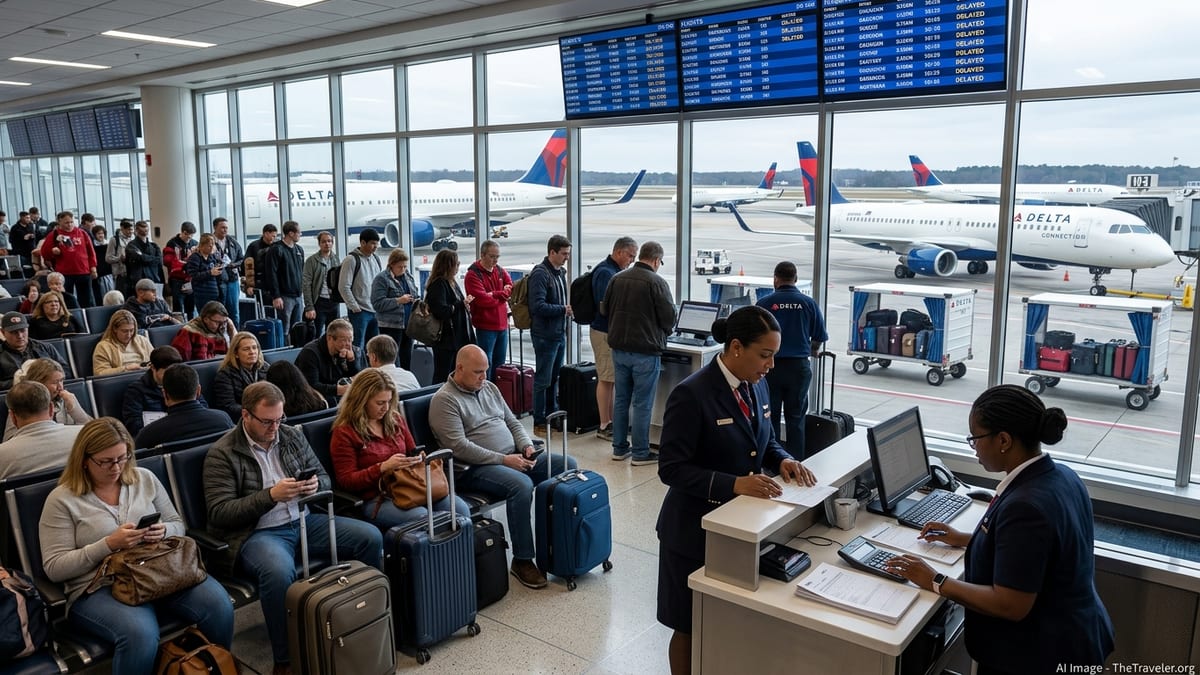
Delta Air Lines says the automated system it uses to calculate aircraft weight and balance is back online after an outage on Sunday, November 22, 2026, triggered a brief ground stop into its Atlanta hub and caused thousands of delays nationwide at the start of the busy Thanksgiving travel period.
Get the latest news straight to your inbox!
What happened to Delta’s weight-and-balance system
Delta confirmed that an internal problem with the automation used for flight weight and balance calculations began affecting departures on Sunday morning, November 22. The carrier relies on this system to combine data on passengers, baggage, cargo and fuel into a final load sheet that must be verified before every takeoff. When that system stopped functioning normally, Delta shifted to manual procedures and asked the Federal Aviation Administration to implement a ground stop for its flights headed to Hartsfield-Jackson Atlanta International Airport.
According to the FAA’s advisories, the initial ground stop for certain Delta flights into Atlanta began on Sunday morning and lasted for around an hour before being downgraded to a ground delay program. During a ground delay, flights are held at their departure airports and released into the hub on a staggered schedule to avoid gate and taxiway congestion. The FAA stressed that the disruption was confined to Delta and that there were no concurrent problems with federal air traffic control systems.
As the automation issue spread through Delta’s network, crews at airports across the United States reported that they were waiting for revised weight-and-balance clearances or performing the calculations manually. Passengers on affected flights described being boarded but unable to depart while bags were counted and loadsheets verified, and some captains advised travelers that the problem was affecting Delta flights systemwide, not just operations in Atlanta.
Scale of disruption across Delta’s network
Flight-tracking data compiled on Sunday indicated that Delta and its regional Delta Connection partners had just over 5,000 flights scheduled for the day. By the evening, thousands of those flights had been delayed and a smaller but still significant number had been canceled. The airline has stated that about 70 percent of its delays and cancellations recorded by independent trackers such as FlightAware were related directly to the weight-and-balance automation issue, with the remainder attributed to adverse weather and follow-on air traffic control flow programs in New York and other parts of the northeastern United States.
The disruption was most visible at Atlanta, Delta’s primary hub and one of the world’s busiest airports by passenger traffic. With arriving aircraft unable to depart on time, gates filled quickly, forcing additional arrivals to wait on taxiways or at their origin airports until space became available. Travelers at other large Delta stations, including New York, Detroit, Minneapolis and Los Angeles, also reported extended gate holds and departure delays as dispatchers worked through manual calculations for each outbound flight.
Because the outage occurred on the Sunday leading into the Thanksgiving holiday week, its effects were magnified by high passenger volumes. Airports were already busy with early holiday travelers as well as returning weekend passengers, leaving fewer empty seats to accommodate same-day rebookings. Although the most severe operational impact was concentrated on Sunday, some customers continued to report knock-on delays and isolated cancellations into Monday as Delta repositioned aircraft and crews and cleared backlogs at busy airports.
System restored and current operational status
By the early hours of Monday, November 23, Delta said the automation used for its weight-and-balance program had been restored and that operations were stabilizing. Local news outlets in Atlanta reported that the airline’s software was again generating load calculations and that crews were gradually shifting away from the manual workarounds used throughout Sunday. Delta indicated that it was focused on completing the remainder of its schedule and clearing any residual disruptions.
Several airport authorities and local media in other Delta markets also reported that departures were moving more normally on Monday, though some flights continued to experience moderate delays as the airline worked through the aftermath of the previous day’s outage. Travelers at a few airports still encountered individual flights where captains cited ongoing manual weight-and-balance checks or slower-than-usual dispatch processing, but these appeared to be exceptions rather than a continuation of Sunday’s broad network impact.
Delta has not publicly detailed the precise technical cause of the automation failure beyond describing it as a problem with the system that handles weight and balance calculations. Industry reports suggest that the malfunction affected the software responsible for processing passenger and baggage data into final load instructions for each aircraft. The airline has not yet indicated whether it expects any additional maintenance windows or system changes that could further affect operations, and at this stage regulators have not announced any separate investigation focused specifically on Delta’s internal systems beyond routine oversight of airline safety and reliability.
Why weight and balance calculations matter for flight safety
Weight-and-balance calculations are a critical step in every commercial flight and are tightly regulated by the FAA. Before departure, airlines must verify that an aircraft’s total weight does not exceed structural or runway limits and that the distribution of that weight keeps the center of gravity within an approved envelope. Flying outside those limits can affect aircraft performance during takeoff and landing and, in extreme cases, compromise safety. For that reason, airlines use standardized procedures and increasingly rely on automation to manage the large volumes of data involved, particularly at major hubs with high flight frequencies.
In normal operations, Delta’s automated systems pull together data from reservations, check-in records, baggage handling and cargo manifests, then generate a final load sheet for each flight. This document is reviewed by dispatchers, ground staff and the flight crew before the aircraft pushes back from the gate. When the automation is unavailable, the same process can be performed by hand or with simplified tools, but it takes significantly longer and is more prone to bottlenecks. On Sunday, that manual process appears to have been the primary reason departures slowed even after the FAA ground stop ended.
Delta and other airlines train dispatchers and flight crews to revert to manual weight-and-balance methods specifically for situations like this one, where primary systems fail or data feeds become unreliable. Safety regulators emphasize that flights are not permitted to depart until these checks are complete, regardless of schedule pressure. The decision to request a ground stop into Atlanta allowed Delta to reduce the number of additional flights arriving in an already congested hub while manual calculations were underway for aircraft waiting to depart.
How Delta is rebooking and compensating affected travelers
Delta has said that it is automatically rebooking many affected passengers onto the next available flights and providing hotel rooms and meal vouchers where required, prioritizing travelers who were stranded overnight or facing significant missed connections. The airline has not announced a separate, systemwide waiver specific to the weight-and-balance outage, but it is handling disrupted customers according to its existing policies for irregular operations, which can include same-day changes without additional fare collection when the delay or cancellation is within the airline’s control.
Customers whose flights were canceled and who no longer wish to travel are eligible for refunds rather than credits, in line with federal rules on cancellations initiated by the carrier. Travelers who experienced long delays but ultimately completed their trips may be able to request additional consideration directly from Delta, such as bonus miles or vouchers, though these are typically reviewed on a case-by-case basis and are not guaranteed. Because many flights over the holiday period are heavily booked, some passengers may find that alternative itineraries involve longer routings, earlier or later departures, or travel on subsequent days.
Given the scale of Sunday’s disruption, call centers and airport service desks have been busy, and Delta has encouraged customers to use its website or mobile app where possible to review rebooking options and confirm new itineraries. Some travelers with complex multi-city tickets or separate onward connections on other airlines may need to speak directly with an agent to coordinate changes. Hotel availability near large hubs such as Atlanta has also been tight during the holiday week, which may limit the accommodation choices available to stranded passengers, especially for same-night arrivals.
What travelers should do next
With Delta’s weight-and-balance automation now restored, the airline expects to operate its full schedule, but the lingering effects of the outage and the broader strain on the US aviation system ahead of Thanksgiving mean that travelers should plan for possible residual delays. Passengers scheduled to fly with Delta over the coming days should regularly check their flight status through the airline’s digital channels rather than relying solely on original confirmations. It is also advisable to allow extra time for connections, particularly through Atlanta and other major hubs that processed significant backlogs on Sunday and Monday.
Travelers whose flights on November 22 or 23 were delayed or canceled should review their trip history and keep records such as boarding passes, delay notifications and receipts for any out-of-pocket expenses. These documents can help support refund claims or requests for additional assistance from the airline. Those who believe they are entitled to a cash refund because Delta canceled their flight and they chose not to travel should verify that they receive money back to their original form of payment rather than a voucher, in line with US Department of Transportation guidance.
Because the weight-and-balance issue coincides with a broader period of strain on aviation technology and infrastructure, including a recent FAA network malfunction that produced a separate nationwide ground stop earlier in November, travelers in the United States may continue to experience irregular operations even once this specific problem is behind them. For now, however, Delta’s immediate focus is on running a stable schedule with its restored systems, moving stranded passengers to their destinations and preventing Sunday’s outage from cascading further into the Thanksgiving travel period.