


More news on this day
A national day of union action on Monday 23 November 2026 brought Belgium’s air traffic to a standstill for much of the day and sharply reduced public transport in Brussels, leaving many passengers scrambling to rebook flights, reroute journeys or abandon travel plans altogether.
Get the latest news straight to your inbox!
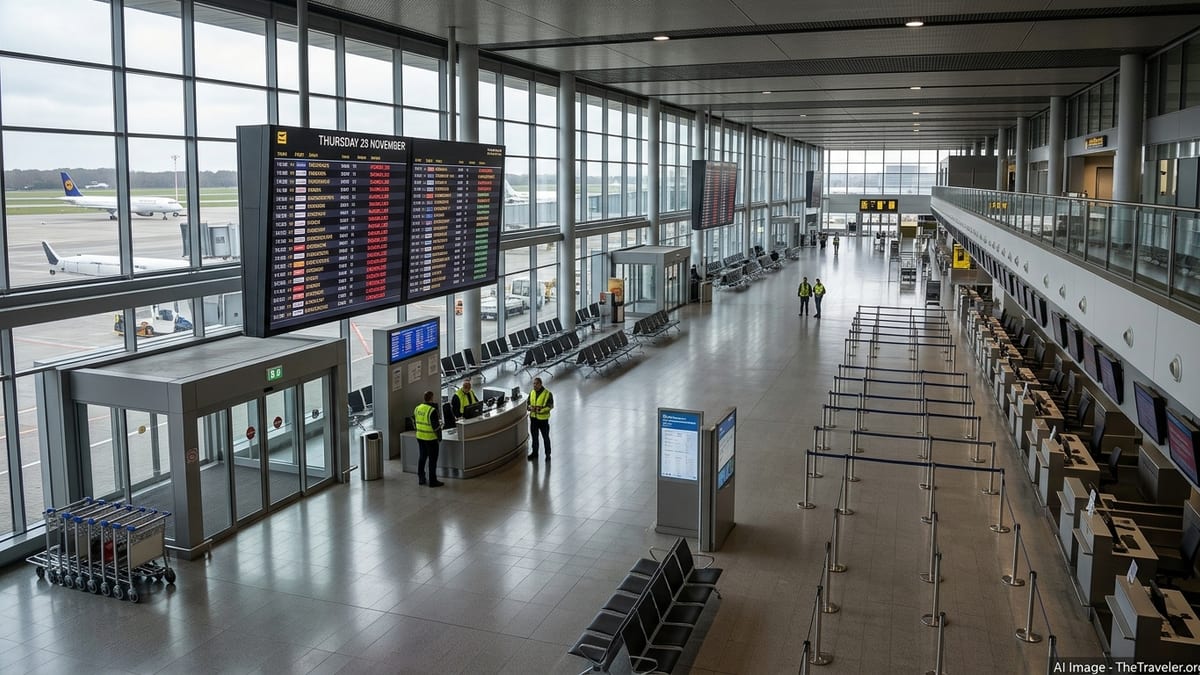
Air traffic across Belgium largely grounded on 23 November
The most immediate impact for travelers was in Belgian airspace, where air navigation service provider skeyes was unable to provide normal air traffic control between roughly 07:00 and 21:00 local time on 23 November. As a result, commercial traffic at Brussels Airport and Brussels South Charleroi Airport was effectively halted during this period, with only a very small number of flights able to operate outside the main shutdown window.
Brussels Airport had expected around 59,500 passengers on 429 passenger flights between early morning and late evening on the day of the strike, including more than 200 departures and a similar number of arrivals. Instead, most of that program was cancelled after the airport and airlines received confirmation that air traffic control services would be unavailable for extended hours. Several carriers advised passengers not to travel to the airport unless their flight status showed as operating, and some, including Brussels Airlines, preemptively cancelled their entire day’s schedule from the Belgian capital.
At Brussels South Charleroi Airport, which relies heavily on low cost traffic, the situation was even clearer for passengers. The airport announced in advance that no aircraft would be able to take off or land between 07:00 and 21:00 on 23 November because skeyes would not be able to provide air traffic control during the national action. Travelers were told not to come to the airport during that window unless their airline explicitly confirmed that a flight would operate, and in practice the airport indicated that it expected no commercial passenger flights at all during the core strike period.
What caused the national strike and how broad was the impact?
The disruption formed part of a wider national day of protest coordinated by Belgium’s main trade union federations. The action was directed at the federal government’s austerity and budget policies and has been described in local reporting as at least the eleventh national union action since the current coalition took office. The unions called on members across sectors to stop work and join a large march in Brussels, leading to widespread staffing shortages in transport and other services.
For aviation, the critical element was participation by staff at skeyes, the state-owned air navigation service provider responsible for managing Belgian airspace and operations at the country’s major airports. Without sufficient qualified controllers on duty, skeyes informed airports and airlines that it could not guarantee safe air traffic management across normal operating hours on 23 November. That in turn triggered large scale cancellations by airlines, as aircraft could not legally depart or arrive at Belgian airports during the shutdown periods, and only limited diversion options were available at neighboring airports in the Netherlands, Germany and France.
Beyond aviation, the strike also affected other modes of transport to varying degrees. While Belgium’s national railway SNCB/NMBS largely maintained service on its core network, regional bus and tram operators reported constrained timetables and some canceled routes where staff participated in the action. The most visible disruption for urban travelers was in the Brussels-Capital Region, where metro, tram and bus operations were sharply scaled back throughout the day, particularly during the morning and evening peaks when demand normally surges.
Severe disruption to Brussels metro, tram and bus services
In Brussels, the public transport operator STIB/MIVB warned in advance that its network would be heavily disrupted on Monday 23 November because of the national strike. The company advised passengers to plan alternative routes or allow significant extra time for journeys, and published real time updates as it became clearer which depots and lines would have sufficient staff to operate.
On the day itself, metro service was reduced to a skeleton network. Only a limited number of lines and sections ran, supported by lower frequencies than normal and longer waiting times at stations. Some stations remained closed, and connections between modes were unreliable as tram and bus services were also curtailed. STIB/MIVB issued disruption attestations confirming that the national demonstration had significant repercussions across the entire network for the whole day, a document some passengers may use to justify delays to employers or schools.
Travelers arriving or departing by train from Brussels’ mainline stations such as Brussels Midi, Central and Schuman therefore faced last minute changes to their onward journeys across the city. Taxis and private hire vehicles saw increased demand as commuters and air passengers looked for alternatives to public transport, and traffic congestion around the EU quarter and city center intensified as protesters and regular road users shared already busy routes.
How many travelers were affected and what are their rights?
Exact figures for the total number of passengers affected are not yet available, but the scale of the air traffic shutdown provides a sense of the impact. Brussels Airport’s expectation of nearly 60,000 passengers on the day indicates that tens of thousands of people experienced cancellations or significant delays at that airport alone. At Charleroi, where the airport indicated that no commercial passenger flights would operate during the main strike window, virtually all scheduled travelers during those hours faced cancellations or rebookings.
Under European air passenger rights rules, the national strike is likely to be treated as an extraordinary circumstance for most cancellations where the airline itself did not initiate industrial action. When air traffic control services or airport operations are halted by third party strikes, airlines must offer passengers a choice between a refund of the unused ticket and re-routing at the earliest opportunity or at a later date of the passenger’s choosing, subject to seat availability. However, in many cases financial compensation on top of rerouting or refund will not be owed if the airline can show that the disruption was caused by external industrial action outside its control.
Accommodation and care obligations can still apply even when compensation is not due. Airlines are generally required to provide reasonable meals, refreshments and, where necessary, hotel accommodation and transport between the airport and hotel while passengers wait for re-routed flights. In practice, some travelers stranded in Belgium on 23 November chose to make their own arrangements and later seek reimbursement, while others were rebooked onto alternative services from nearby airports such as Amsterdam or onto rail services departing from Brussels once connections could be arranged.
Ongoing implications and what travelers should check next
By Tuesday 24 November, major Belgian airports and public transport operators reported a return to normal or near normal service. There were no active strike notices affecting airports on that date, and schedules at Brussels Airport and Charleroi largely reflected regular timetables. Nonetheless, some residual disruption remained for passengers whose flights had been cancelled during the strike and who were still awaiting the next available rebooked services, particularly on heavily booked long haul routes and on days where aircraft and crew were out of original position.
Travelers with bookings in the days immediately after 23 November are advised to monitor booking portals, airline apps and airport departure and arrival boards for last minute adjustments, especially where aircraft rotations have been affected. Those planning to use Brussels public transport should also verify real time information from STIB/MIVB for the metro, tram and bus networks, as well as from regional operators in Flanders and Wallonia, although no further national action days have yet been formally announced for the coming days.
For future trips to or via Belgium, the experience of 23 November highlights the importance of checking for strike notices and national demonstration days before travel. While the latest national strike has now ended and services are resuming, unions have not excluded further action if their concerns over government policy remain unresolved. Until the political and social context becomes clearer, passengers booking flights to, from or over Belgium may wish to remain flexible with their plans, track operational updates closely and keep contact details up to date with airlines and rail operators so that any timetable changes can be communicated as early as possible.