


More news on this day
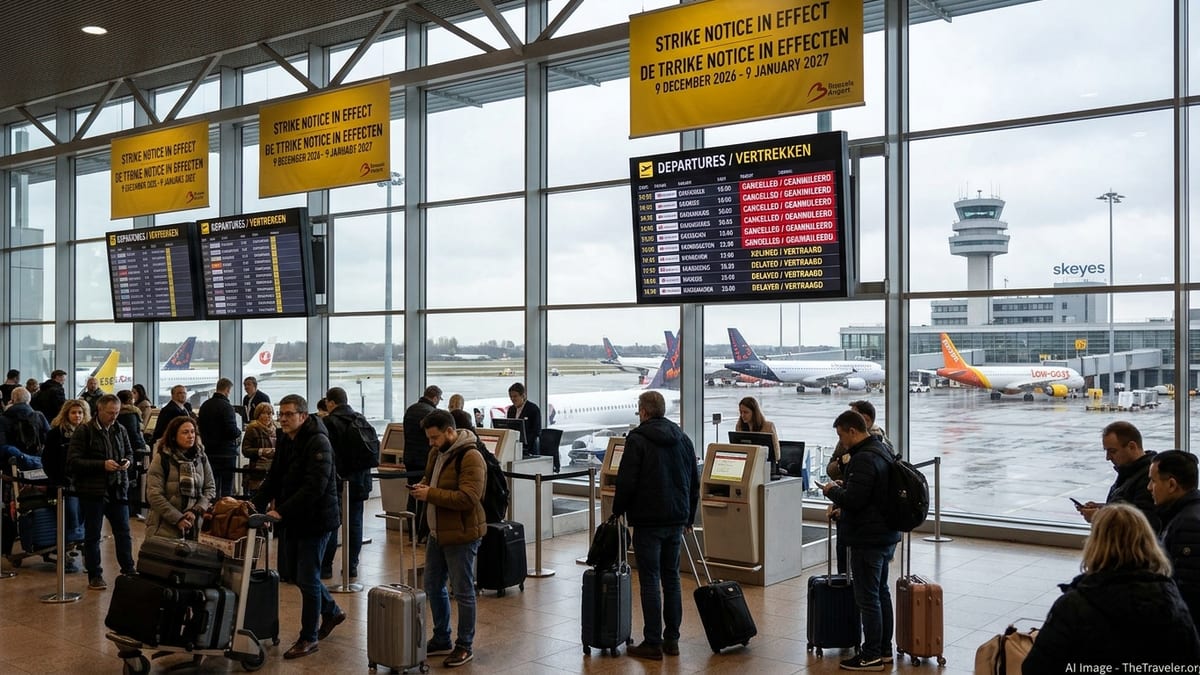
Belgium’s air navigation service provider skeyes faces a new strike notice covering 9 December 2026 to 9 January 2027, raising the risk of fresh air traffic disruption for passengers flying to, from or over Belgian airports during a key winter travel period, even though no specific strike dates have yet been announced.
Get the latest news straight to your inbox!
What The New Skeyes Strike Notice Actually Covers
Belgian trade unions ACV Transcom and VSOA have filed a fresh strike notice against skeyes, the public company that manages air traffic control in Belgian airspace. The notice opens a legal window for industrial action from Wednesday 9 December 2026 through Saturday 9 January 2027. Within that period, union members are allowed to walk out, stage work-to-rule protests or take other forms of action, but they are not obliged to do so. As of 24 November, neither the unions nor skeyes had confirmed any concrete strike dates.
The notice applies to all staff categories at skeyes, not only front-line air traffic controllers. That breadth matters because skeyes is responsible for managing most civil air traffic in Belgian airspace, including approach and tower services at Brussels Airport (BRU), Brussels South Charleroi (CRL), Liège, Ostend-Bruges and Antwerp. If there are not enough qualified controllers or support staff available, skeyes can restrict or suspend traffic for safety reasons, which in turn forces airlines and airports to cancel or sharply reduce schedules.
Union representatives quoted in Belgian media describe the notice as a warning step rather than a final decision to shut down the skies again. They say they hope negotiations with management will avert a new walkout, but filed the notice to maintain pressure after a period of heightened labour unrest at skeyes during 2026. For travelers, the important point is that disruption is now legally possible at short notice between 9 December and 9 January, even if it is not yet planned.
Unions Cite Rest, Schedules And Safety, Not Pay
The dispute behind the new notice is rooted in working conditions rather than pay levels. ACV Transcom and VSOA have highlighted long-running tensions over rosters, rest periods and end-of-career arrangements for controllers and other skeyes staff. Reports in Belgian outlets summarise staff complaints about fatigue, the pace of operational change at the company and frustration over social dialogue that workers feel has not delivered durable solutions.
Union officials have stressed that they view the issue primarily as one of safety and sustainable workloads. Air traffic control is a highly regulated safety-critical activity, and controllers argue that insufficient rest or unpredictable schedules make it harder to maintain the sustained concentration their job requires. By framing the conflict in this way, the unions signal that a simple financial offer is unlikely to resolve the dispute quickly if concerns about rosters and staffing levels remain unaddressed.
Skeyes management has publicly reacted with frustration to the new notice. Company spokespeople have said recent agreements were intended to stabilise relations and that they are surprised to face another strike threat so soon after the November national action day, when controllers joined a wider protest against federal austerity policies. Management insists it wants to continue talks, but warns that passengers and airlines risk becoming “collateral damage” if further walkouts go ahead within the new window.
Recent Shutdown Shows What A Walkout Can Mean For Travelers
The most concrete recent reference point for passengers is the national strike on Monday 23 November 2026. On that day, skeyes announced that it could not guarantee normal air traffic services between 07:00 and 21:00 local time because many controllers were joining a nationwide day of industrial action. In response, Brussels Airport confirmed that all passenger departures and arrivals in that 14-hour window would be cancelled, and other Belgian airports reported similar shutdowns.
That action led to a near standstill of commercial air traffic in Belgian airspace for much of the day, with tens of thousands of passengers affected. Airlines including Brussels Airlines and several low-cost carriers cancelled large parts of their programmes, and travellers who had already arrived in Belgium faced crowded alternative routes by rail and car. The episode underlined how central skeyes is to the country’s aviation system: without sufficient controllers on duty, both departing and overflying traffic must be curtailed or diverted for safety reasons.
A future walkout triggered under the new notice would not necessarily mirror the 23 November shutdown. The unions could choose a shorter action, limit it to certain shifts or locations, or pursue pressure tactics that slow operations without halting them completely. Equally, if talks with skeyes break down, they could call for a broader stoppage that again leads to mass cancellations for part of a day. At this stage, the length and form of any potential December or January action remain unknown, which is why observers treat the recent national strike as a worst-case example rather than a forecast.
How Airlines And Airports Are Responding So Far
Because the new notice does not specify dates or the type of action, Belgian airports and airlines have not yet changed published timetables for December and early January. Schedules for Brussels, Charleroi and the country’s regional airports still show normal flight operations over the holiday period, and ticket sales continue as usual. Carriers are instead preparing contingency plans and advising passengers to monitor communications closely as 9 December approaches.
Brussels Airport’s handling of the 23 November national strike offers a guide to how they may communicate if the unions name specific action days. Ahead of that strike, the airport issued warnings that it expected to cancel most or all flights in the strike window and urged passengers not to travel to the airport if their flight had been cancelled. It also emphasised that its online flight overview would only reflect cancellations once each airline had updated its systems, meaning a flight could still appear as scheduled even when it was certain not to operate. Similar staged communication can be expected again if skeyes confirms that it cannot provide normal services on any given day within the new notice period.
Airlines that are heavily dependent on Belgian airports, such as Brussels Airlines and several low-cost operators out of Charleroi, are likely to take decisions flight by flight based on the level of service skeyes can provide. In November, some carriers cancelled their entire daytime schedules from Belgium in advance, while others waited longer in the hope that limited operations would still be possible. For passengers, this means that information about individual flights is likely to come first from their airline rather than directly from skeyes or the unions.
Practical Advice For Planning Travel To And Through Belgium
For now, travel advisers generally see the new notice as a reason to seek flexibility rather than immediately cancel trips to Belgium or flights transiting its airports. If you have not yet booked, choosing fares that allow changes or refunds can make it easier to adjust plans if strike dates are later confirmed. This is particularly relevant for journeys scheduled between about 9 and 20 December and in the first week of January, when unions have indicated they might target days outside the core Christmas and New Year period.
Travellers who have already booked flights to or from Brussels or another Belgian airport during the notice window should make sure airline apps and contact details are up to date. Based on the November experience, many airlines will start sending push notifications, emails or text messages as soon as they decide to cancel or retime a flight. Checking the status of your trip the day before departure, and again on the morning of travel, is likely to offer the earliest practical warning of disruption.
Depending on your itinerary, it may also be worth identifying alternative routing options that avoid Belgian airspace or airports for the most exposed dates. Nearby hubs such as Amsterdam Schiphol, Paris Charles de Gaulle and Frankfurt were unaffected by the November action and can usually be reached from Belgium by train, including from Brussels Midi station. However, the national strike showed that ground transport can also be disrupted during major labour actions, so anyone planning to position by rail or road to another airport should allow extra time and check local transport updates if further protests are announced.
What Passenger Rights Apply If Flights Are Cancelled
Under European Union law, passengers whose flights are cancelled because of a strike by air traffic controllers generally retain the right to a choice between reimbursement and rerouting. That means the airline must either refund the unused portion of the ticket or offer an alternative itinerary to the final destination at the earliest opportunity, subject to seat availability. In practice, rerouting options can be limited during large-scale disruptions, as many flights are cancelled at once and remaining services fill quickly.
The question of additional cash compensation is more nuanced. EU rules distinguish between disruptions that are within an airline’s control and those caused by “extraordinary circumstances” such as airspace closures initiated by air traffic control authorities. Strikes by air traffic control providers such as skeyes are typically treated as extraordinary circumstances, which means airlines are usually not required to pay standard lump-sum compensation for cancellations or long delays, even though they must still refund or reroute affected passengers.
Travelers should also check the conditions of any separate travel insurance policies or credit card protections they hold. Some policies provide cover for additional accommodation, meals or replacement transport when industrial action disrupts a trip, while others exclude strikes or limit coverage to specific circumstances. Because the skeyes notice only creates a possibility of action at this stage, insurers are unlikely to treat it alone as a trigger for claims, but it may be relevant if later walkouts are formally announced and lead to concrete cancellations.
What To Watch For Next
The next significant development will be whether ACV Transcom and VSOA name specific strike dates inside the 9 December to 9 January window. Union leaders have indicated they do not intend to target the core Christmas holidays if they can avoid it, but that intention is not a binding guarantee and could change if talks with skeyes deteriorate. Any announcement of concrete dates is likely to be followed quickly by statements from skeyes, Belgian airports and major airlines detailing the expected operational impact.
In parallel, negotiations between skeyes management and union representatives will continue in the coming days. If they reach an agreement addressing the contested issues around work schedules, rest arrangements and late-career provisions, the unions could withdraw or narrow the strike notice, significantly reducing the risk of disruption. Conversely, if talks stall or break down entirely, the chance of a walkout in mid December or early January would rise.
For passengers planning winter travel involving Belgium, the practical steps are to keep bookings flexible where possible, monitor communications from airlines and airports from early December onwards and be prepared to adjust itineraries quickly if strike days are confirmed. Until that happens, flights remain scheduled to operate, but the new skeyes notice means that disruption during parts of the peak holiday season now has to be factored into travel planning.