


In the heart of Athens’ Ancient Agora, the long colonnaded Stoa of Attalos stands out as one of the few fully reconstructed ancient buildings in the city. Today it houses the Museum of the Ancient Agora, shelters visitors from the Attic sun, and offers some of the clearest views and explanations of how this once-bustling civic center actually worked. For many travelers, it is the key to making sense of the ruins scattered across the site outside.
Get the latest updates straight to your inbox!
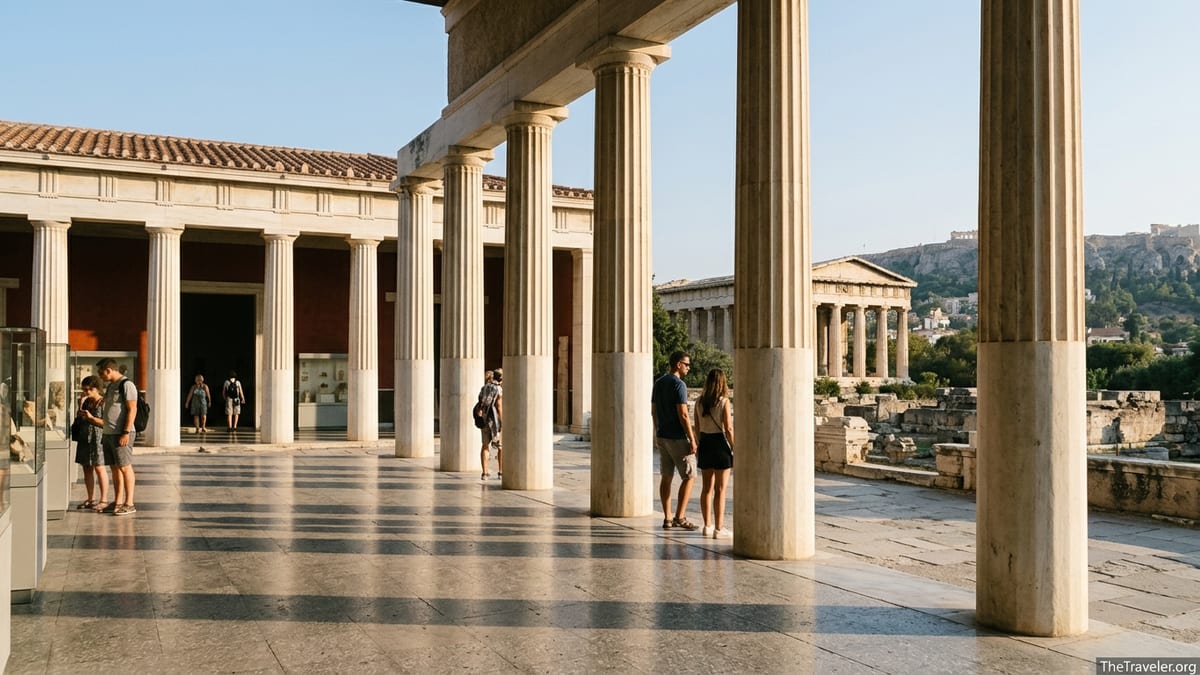
The Rebuilt Stoa: From Hellenistic Shopping Arcade to Modern Museum
The original Stoa of Attalos was a gift from Attalos II, a king of Pergamon, to Athens in the 2nd century BC. In antiquity, it functioned much like a long, elegant shopping and meeting arcade, running along the eastern edge of the Agora with two storeys of colonnades and rows of shops behind. What you see today, however, is a careful mid‑20th‑century reconstruction based on excavated foundations and ancient descriptions, completed in the 1950s to provide both a museum and a visual anchor for the site.
As you approach from the main entrance of the Ancient Agora, the Stoa’s long line of creamy marble columns immediately contrasts with the more ruined outlines of the Bouleuterion and the Tholos. The building’s scale can be surprising: about 115 meters long, with double colonnades that create deep, cool walkways on both levels. Knowing it is a reconstruction can initially feel jarring, but the benefit is that you can walk through a structure that closely matches its ancient form and imagine how the Agora once felt as a covered commercial and social hub.
The reconstruction was carried out in partnership with the American School of Classical Studies at Athens, which has been excavating the Agora for decades. Inside you will find not only artifacts but also plans, photos, and models explaining how archaeologists uncovered and interpreted the site. This is one reason the Stoa of Attalos is so valuable for visitors: it does not just display objects, it shows how the modern understanding of ancient Athens was pieced together.
For travelers doing a classic Athens circuit that includes the Acropolis and the Acropolis Museum, the Stoa provides an important missing piece. Where the Acropolis highlights temples and religion, the Agora Museum in the Stoa focuses on everyday life and democracy: law courts, elections, trade, and the daily business that made the city function. Spending 45 to 60 minutes inside before or after wandering the ruins outside can transform scattered stones into a coherent story.
The Museum of the Ancient Agora: What to Look for Inside
The museum occupies much of the ground floor and part of the upper floor of the Stoa. Exhibits span from early burials and pottery to Roman and Byzantine periods, but the heart of the collection concentrates on the 5th and 4th centuries BC, when Athenian democracy reached its peak. The displays are compact compared with the National Archaeological Museum, which makes them manageable for visitors who may already be saturated with statues and vases elsewhere in Greece.
One of the most instructive sections for understanding Athenian politics is the display of ostraka, small pottery sherds scratched with the names of citizens targeted for ostracism. You can see real fragments bearing famous names like Themistocles or Kimon, reminders that exile could be decided by thousands of ordinary Athenians voting in the Agora. These modest-looking pieces are among the most powerful artifacts in the museum, especially for visitors interested in the roots of democratic practice.
Nearby, bronze ballots and juror identification tokens shed light on the city’s enormous citizen juries. Travelers who have walked past the low stone platforms of the Heliaia court outside often remark that the court ruins make far more sense after seeing these small objects and reading their explanatory panels. For example, you can connect a simple bronze ballot with the experience of a juror who might have spent long days in the courts deciding cases that shaped Athenian law.
Do not miss the cases with domestic pottery, terracotta figurines, and tools from wells and houses unearthed around the Agora. These often appeal to visitors who are less interested in high art and more curious about daily life. A cracked black‑glaze drinking cup or a loom weight from a private home can be more evocative than a perfect marble statue, especially when you recall that people used and discarded them on the very ground you have just walked across outside.
Statues, Portraits and Architectural Fragments: Highlights for Art Lovers
Although the museum is relatively small, sculpture fans will find several memorable pieces. The ground floor includes statues and reliefs that once decorated stoas and shrines in and around the Agora, including fragments from the Stoa of Zeus and other public buildings. Look for the statue of a goddess, probably Aphrodite, from the early 4th century BC, which shows the smooth, idealized style often associated with the later Classical period.
Equally striking are the Roman portrait busts and statues that occupy part of the collection. These portraits, some now displayed on the upper floor colonnade when open, include emperors, local benefactors, and philosophers rendered with the realism characteristic of Roman portraiture. For travelers who have just come from the Roman Agora or Hadrian’s Library, these pieces offer a visual connection between the classical Greek civic center and the later Roman-controlled city.
Architectural fragments give a sense of the buildings that once framed the Agora. Capitals, column drums, and cornices from various stoas and temples are displayed with concise labels that explain where they were found. Standing next to a chunky Doric capital or a finely carved Ionic volute can help you visualize the original appearance of the low foundations you see out in the open air. Many visitors find that the next time they step into the colonnade of the reconstructed Stoa itself, they notice details like the profile of the capitals or the junction of marble and limestone much more keenly.
Because the museum curators have arranged the artifacts thematically rather than overwhelming visitors with rows of similar items, it is easy to focus on a few highlights. For art‑interested travelers doing a self‑guided tour, a simple approach is to pick one theme to follow: portraits and public honor, for example, or religious dedications. This can give your visit a narrative arc and prevent fatigue, especially if you are visiting in the summer heat and want to use the museum as both a cultural stop and a cool break from the sun.
Shade, Heat and Practical Visiting Tips
Athens summers are hot, and the Ancient Agora is more exposed than many first‑time visitors expect. Large areas of the site have very little tree cover, and by late morning in July or August the sun can feel relentless. The Stoa of Attalos quickly becomes one of the most appreciated spots on site because its long, deep colonnades provide consistent shade and, on most days, a bit of breeze flowing through the open ends of the building.
If you are visiting between late spring and early autumn, consider planning your Ancient Agora visit around the Stoa’s shelter. Many travelers enter the site mid‑morning, walk downhill past the Hephaisteion and the scattered ruins, and then retreat into the museum for 45 minutes when the sun is at its highest. Families with children in particular often use the museum as a reset point: kids can cool down, refill water bottles at the nearby fountains outside the entrance, and re‑engage with the exhibits before heading back into the site or on to Monastiraki.
Simple gear can make a real difference. A broad‑brimmed hat or a compact UV umbrella, light clothing that covers shoulders, and a refillable water bottle are more useful here than at heavily shaded sites. Visitors who come straight from the Acropolis often remark that the polished stones and lack of shade there are more intimidating, but the Agora can feel equally draining if you linger long on the exposed paths. The Stoa’s interior is not fully air‑conditioned like the Acropolis Museum, but the thick walls, tiled roof and shaded colonnades keep the temperature noticeably cooler than outside.
Tickets to the Ancient Agora, which include access to the Stoa of Attalos, are purchased for the site rather than for the building alone. As of recent seasons, the multi‑site combination ticket that once bundled the Acropolis, Agora and other ruins has been discontinued, so most visitors now buy separate timed tickets for each major site. Prices can change seasonally and between high and low season, so it is wise to check current information when you plan your day. What remains constant is that your Agora ticket covers a generous window of time, making it easy to pace yourself and duck into the Stoa whenever you need shade.
Photo Tips: Columns, Perspectives and Best Light
The Stoa of Attalos is one of the most photogenic structures in the Ancient Agora, both inside and out. Its long rhythm of columns invites perspective shots, while the elevated position offers views back across the site to the Temple of Hephaestus on one side and up to the Acropolis on the other. For travelers keen on photography, it is worth planning a visit around light and crowds rather than rushing through with a tour group.
Early morning, shortly after opening time, usually provides the softest light on the eastern façade. At this hour, the colonnade can glow a warm cream without harsh shadows cutting across the floor. Stand at one end of the stoa and shoot along the line of columns with a moderate focal length to compress the rhythm of the architecture. A 35 mm or 50 mm equivalent lens on a full‑frame camera works well for handheld shots, while smartphone users can use the standard lens rather than the ultra‑wide to avoid distortion.
Later in the afternoon, light shifts to highlight views outward from the Stoa. From the upper floor, when open to visitors, you can frame the Temple of Hephaestus between the columns or catch the Acropolis rising behind scattered ruins. These shots benefit from a slightly higher vantage point and can be especially atmospheric in late afternoon when the sun begins to drop behind the city. Try stepping back into the shade and allowing the columns to fall into gentle silhouette while keeping the background in brighter light.
Inside the museum, photography is generally permitted without flash, though policies can change and staff may restrict tripods. Low‑light interior shots are easier if you brace against a column or use a camera with good high‑ISO performance. Focus on details like inscriptions on ostraka, reliefs catching side light, or reflections on polished marble surfaces. Remember that other visitors are often close by in the relatively narrow gallery, so wait a few seconds for gaps rather than trying to stage photos in crowded spaces.
How the Stoa Helps You Read the Agora Outside
One of the main reasons to prioritize the Stoa of Attalos on an Agora visit is its explanatory power. The museum’s labels and models show how the buildings around you fit together into a functioning city center. Many travelers find that a circuit starting or ending in the Stoa turns a collection of disconnected ruins into a legible civic landscape.
For example, after studying the models and plans inside, you can stand on the terrace outside the Stoa and visually pick out the traces of the Bouleuterion, where the city council met, and the Tholos, where a group of officials dined and slept on duty. The museum’s exhibits on juries and ostracism then connect directly to the low, nondescript platforms and fenced‑off areas that once hosted courts and public assemblies. What looks like a random scatter of stones becomes evidence of a carefully organized democratic system.
The Stoa also highlights how the Agora changed over time. Inside, you will see artifacts from the Bronze Age through the Roman and Byzantine periods, including objects from wells and houses that show how the area shifted from burial ground to market to neighborhood. When you step back outside, you can look for traces of those layers: Roman paving stones crossing earlier Greek foundations, or late defensive walls slicing through earlier structures. The museum’s chronological displays provide the mental framework for recognizing these changes out in the open.
Families and independent travelers without a guide often treat the museum as their in‑house interpreter. After a walk among the ruins with a general audio guide or printed map, going into the Stoa and reading a focused panel about, say, Athenian coins or the water system can answer questions that arose outside. Travelers who combine the Stoa with a later visit to the Acropolis Museum frequently comment that they leave Athens with a much stronger sense of how religion, politics, and everyday life intertwined in the ancient city.
Planning Your Visit: Timing, Access and Combining with Nearby Sights
The Ancient Agora sits just a few minutes’ walk from Monastiraki Square and its metro station, which makes the Stoa of Attalos easy to combine with a day of exploring central Athens. Many visitors either start here in the cooler morning before climbing the Acropolis, or reverse the order and use the Stoa as a shaded afternoon stop after lunch in the nearby Plaka or Psyrri neighborhoods. Because the site is compact, it pairs well with coffee at one of the cafes along Adrianou Street, where you can look back at the colonnade from above the train line.
Site hours vary by season, with longer opening times in summer and reduced hours in winter, and special closures on some holidays. On peak‑season days the last entry is usually in the early evening. Because the museum is inside the archaeological site, its access follows the same timetable, so it is wise not to leave your Stoa visit to the final minutes before closing. If you are in Athens during a heatwave, consider an early morning or late afternoon slot, when the shaded colonnades are most comfortable and the light is more flattering for photography.
Accessibility has improved in recent years. The official Athens tourism information notes that the Museum of the Ancient Agora inside the Stoa is accessible to wheelchair users, with adapted routes on the ground floor and staff available to assist. Some surrounding paths in the wider Agora remain uneven or steep, however, so visitors with limited mobility may wish to focus their time inside the Stoa and on the main, smoother walkways rather than attempting every side path down to the lowest ruins.
Because the former combined ticket has been phased out, you will need to plan and budget for separate entry tickets to major sites such as the Acropolis, the Ancient Agora and the Acropolis Museum. In practice, many travelers now book timed entry to the Acropolis in advance for early morning, then purchase Agora tickets on site later the same day or the following day, when they can be more flexible. Whatever order you choose, setting aside at least one unhurried hour specifically for the Stoa of Attalos will pay off in a deeper understanding of everything else you see in classical Athens.
FAQ
Q1. Where is the Stoa of Attalos and how do I reach it?
The Stoa of Attalos stands along the eastern side of the Ancient Agora of Athens, a short walk from Monastiraki metro station and the central flea market area.
Q2. Do I need a separate ticket for the Stoa of Attalos museum?
No. Entry to the Stoa of Attalos and the Museum of the Ancient Agora is included in the general admission ticket to the Ancient Agora archaeological site.
Q3. How much time should I plan inside the Stoa of Attalos?
Most visitors spend 45 to 60 minutes exploring the museum and walking the colonnades, though history enthusiasts may easily stay longer to read every panel.
Q4. Is the Stoa of Attalos air‑conditioned?
The building benefits from thick walls and deep shade, keeping it cooler than the open site, but only some interior areas are climate‑controlled, so it is not as cool as a fully modern museum.
Q5. Are photos allowed inside the Agora Museum in the Stoa?
Photography without flash is typically allowed inside the museum, but tripods and flash are usually prohibited, and staff may ask visitors to respect any posted restrictions.
Q6. What are the best times of day for photography at the Stoa?
Early morning offers soft light on the façade, while late afternoon provides atmospheric views from the colonnades toward the Temple of Hephaestus and the Acropolis.
Q7. Is the Stoa of Attalos suitable for children?
Yes. Its shaded spaces, short exhibit labels and tangible objects like ostraka and coins often hold children’s attention better than more formal, larger museums.
Q8. Can visitors with limited mobility access the Stoa of Attalos?
The ground floor museum inside the Stoa is accessible via adapted routes and gentle ramps, though some paths elsewhere in the Ancient Agora remain uneven.
Q9. How does the Stoa of Attalos differ from the Acropolis Museum?
The Stoa’s Agora Museum focuses on daily life, democratic institutions and local finds from the Agora, while the Acropolis Museum highlights sculpture and artifacts from the Acropolis hill.
Q10. Why is visiting the Stoa of Attalos recommended even if I am short on time?
Because it combines shade, clear explanations and key artifacts, a visit to the Stoa of Attalos quickly makes the surrounding ruins more understandable and rewarding.