


The Ancient Agora of Athens is where everyday life in classical Athens unfolded: markets, political debates, court cases, and casual gossip all played out beneath the Acropolis. Today it is one of the most atmospheric archaeological sites in the city, a green valley of temples, colonnades and ruins that sits between the lively neighborhoods of Monastiraki and Thissio. This guide explains how to reach the Ancient Agora, what to see once inside, how it fits into a wider Athens itinerary, and how to make the most of nearby areas on the same outing.
Get the latest updates straight to your inbox!
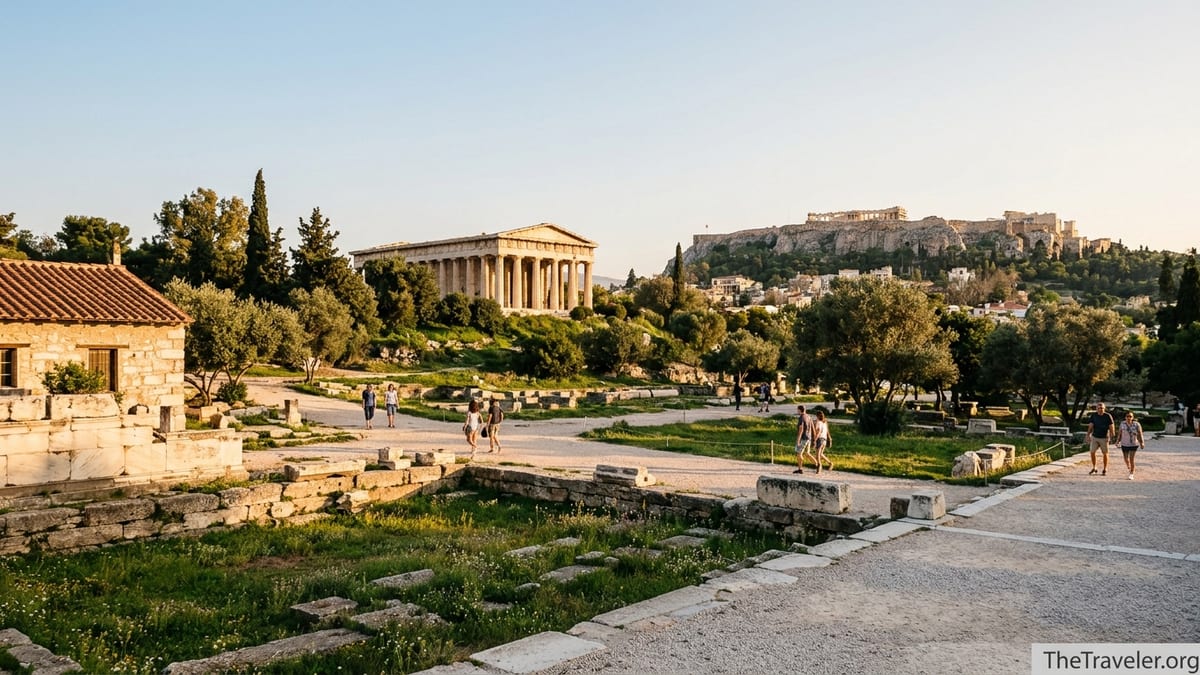
Where the Ancient Agora Is and Why It Matters
The Ancient Agora lies on the northwest slope below the Acropolis, between the neighborhoods of Monastiraki to the east and Thissio to the west. If you picture a map of central Athens, the Acropolis is the high rock in the middle, the hip bars of Psirri sit just north of Monastiraki Square, and the Ancient Agora stretches out as a green archaeological park just to the west of the metro tracks. This was the heart of the ancient city, where Athenians gathered daily to shop, debate, worship, and take part in early democratic institutions.
Historically, the Agora developed from the 6th century BCE onward as a multi-purpose civic center that included temples, stoas, law courts, and administrative buildings. It was here that Socrates questioned his fellow citizens and that Athenian democracy took shape in practice, not only in theory. Today, visitors can walk along the same broad paths, see the outlines of public buildings, and stand in front of one of the best preserved temples in Greece, all while the modern city of Athens hums just beyond the fence.
For modern travelers, the Agora offers a quieter, more spacious counterpart to the Acropolis. Where the Acropolis tends to feel crowded and monumental, the Agora feels like a park filled with ruins, with plenty of trees, benches, and shaded viewpoints. Many visitors find that they understand the Acropolis and classical Athens far better after spending a few hours here, because the Agora shows how everyday life actually worked.
Getting to the Ancient Agora from Monastiraki and Thissio
Most visitors reach the Ancient Agora on foot from either Monastiraki or Thissio, both served by the Athens Metro. Monastiraki station, on Lines 1 and 3, is directly beside the eastern side of the site; the station platforms run along the edge of the Agora. From Monastiraki Square, you simply walk south along the pedestrian section of Adrianou Street, passing souvenir stalls and cafés, for about 300 to 400 meters. Within around five minutes you reach the main eastern entrance to the Ancient Agora, marked by a ticket booth and turnstiles.
Coming from Thissio, you step out of Thissio station on Line 1 and are practically on the doorstep of the site’s northwest corner. From the station exit, walk toward the small park and turn left along the pedestrian promenade. The entrance on this side is slightly less busy than the Monastiraki gate and well placed if you are also walking the Apostolou Pavlou promenade around the Acropolis. The walk from Thissio station to the Agora entrance is roughly three minutes on flat pavement.
If you are staying elsewhere in Athens, it is usually easiest to take the Metro to either Monastiraki or Thissio and walk. Both stations are part of regular urban tickets, which in 2026 generally cost a few euros for a 90-minute ride including transfers. Taxis in central Athens are relatively affordable and can drop you at Monastiraki Square or along Adrianou Street, but traffic in the narrow streets can be slow at peak hours. Many travelers combine the Agora with a larger walking circuit: for example, starting in Syntagma Square, walking down Ermou Street to Monastiraki, visiting the Agora, then continuing along the pedestrian paths to Thissio and the Acropolis slopes.
Tickets, Opening Hours, and Practical Tips
As of spring 2026, the Ancient Agora and its museum typically open from around 08:00 to 19:30 in the main season, with earlier closing times in winter and occasional adjustments on public holidays. Official announcements from the Greek Ministry of Culture sometimes change hours, especially during heatwaves, so it is wise to check close to your travel dates or confirm with your hotel. Arriving within the first hour of opening or around two hours before closing usually means fewer tour groups and softer light for photos.
The Ancient Agora is included in the combined multi-site archaeological ticket for Athens, which runs for several days and also covers the Acropolis, the Roman Agora, Hadrian’s Library, the Temple of Olympian Zeus, Kerameikos, and Aristotle’s Lyceum. This pass costs in the few tens of euros range and represents good value if you plan to visit at least three of these sites. You can also buy a single-site ticket for the Ancient Agora alone at the entrance; this is cheaper but less flexible if you later decide to add more ruins to your schedule.
In high season, lines form mainly for the Acropolis rather than the Ancient Agora, but on busy summer mornings there can still be a short queue for tickets at the Agora’s main gate. Many travelers now buy e-tickets in advance and show the QR code on a phone at the turnstiles, which tends to speed things up. Inside the site, there is a small shop in the Stoa of Attalos selling guidebooks and postcards, and there are fountains where you can refill a bottle, but there is no full café. Given the sun exposure, it is sensible to bring water, a hat, and sunscreen, especially from May to September.
The terrain inside the Agora mixes gravel paths, some uneven stones, and gentle slopes. People with reduced mobility can reach many of the key highlights, especially the Stoa of Attalos museum and viewpoints near the Temple of Hephaestus, though some side paths and higher vantage points involve steps or rougher ground. Sturdy footwear is more comfortable than sandals for walking among the ruins. Most visits last between 1.5 and 3 hours, depending on how deeply you explore the museum and individual monuments.
What to See Inside: Temples, Stoas, and a Living Landscape
The standout monument of the Ancient Agora is the Temple of Hephaestus, often called the Theseion. It crowns a low hill at the western side of the site and is one of the best preserved ancient Greek temples anywhere. Its Doric columns and sculpted friezes are almost completely intact, giving visitors a vivid sense of what the Parthenon once looked like. Standing on the platform around the temple, you can look across the Agora with the Acropolis in the background, a view that many travelers rank among their favorite in Athens.
Another major structure is the Stoa of Attalos, a long, colonnaded building that was reconstructed in the 1950s based on its original Hellenistic design. Today it houses the Museum of the Ancient Agora. Inside, you will find artifacts that trace everyday Athenian life: pottery, coins, tools, inscriptions, and small objects like voting tokens used in the city’s legal system. The museum’s modest size makes it approachable, and many visitors appreciate how clearly it links specific artifacts to the ruins outside. For example, you can see ostraka, the pottery sherds on which citizens scratched the names of politicians they wanted to exile, then step out into the ruins where such votes were counted.
Near the eastern side, close to the Monastiraki entrance, stands the Church of the Holy Apostles, a small Byzantine church from around the 10th century. Its tiled dome and stone walls create a striking contrast with the classical ruins around it. Step inside if it is open and you will see restored frescoes and a cool, quiet interior that feels worlds away from the heat outside. Scattered across the site are the foundations of other important buildings, such as the Bouleuterion, where the city council met, and the Heliaia law court. While these are mostly low walls and platforms now, informative signage helps you imagine how they functioned.
What makes the Agora particularly appealing is the feeling of a living landscape rather than a sterile ruin field. Olive trees, wildflowers, and singing birds soften the archaeological remains. From many points you can see not only the Acropolis but also the modern city, including the green of Filopappou Hill and the rooftops of Plaka and Monastiraki. It is worth taking a slow loop around the main paths instead of rushing between highlights; sitting on a bench under a tree, you can almost imagine ancient Athenians doing the same, though their conversations might have been about trade routes or politics rather than metro lines and hotel reservations.
Monastiraki and Thissio: Neighborhoods on the Agora’s Doorstep
Monastiraki, on the eastern side of the Agora, is one of Athens’ busiest hubs. Monastiraki Square is framed by a small 18th-century mosque, a church, and a neoclassical station building, all set against a backdrop of the Acropolis. From here, narrow streets like Ifestou and Pandrossou form the core of the famous flea market area, where shops sell everything from leather sandals and olive wood souvenirs to vintage vinyl and budget T-shirts. Many travelers like to visit the Agora in the morning and then dive into Monastiraki’s shops, grabbing a quick souvlaki from one of the grill houses on Adrianou or Mitropoleos streets.
Just north of the square, the Psirri neighborhood spreads out with small bars, tavernas, and street art. This is a good place for dinner if you have spent the afternoon at the Agora and Acropolis: venues along Aghion Anargyron Street and the smaller squares in Psirri offer outdoor tables and live music in the evenings. You can easily walk back to Monastiraki Metro afterward for a late train back to your hotel elsewhere in the city.
On the western side of the Agora, Thissio feels more relaxed and residential than Monastiraki’s market bustle. The pedestrian promenade of Apostolou Pavlou runs past parks and cafes with front-row views of the Acropolis, especially around Thissio Square. On weekends, Athenians and visitors compete for terrace seats here to watch the sunset light up the Parthenon. Just behind the cafés, quiet side streets host neoclassical houses, small guesthouses, and low-key restaurants where you can dine away from the busiest tourist lanes while still staying central.
From Thissio you can also access several hills and viewpoints that pair well with an Agora visit. Short walks lead up to the Hill of the Nymphs and the National Observatory, to Pnyx Hill where early democratic assemblies met, and to Filopappou Hill with its panoramic view over Athens and the Saronic Gulf. Many visitors choose to spend their late afternoon or evening in Thissio after a morning at the Agora, lingering over coffee or dinner before climbing a nearby hill for sunset.
Fitting the Ancient Agora into Your Athens Itinerary
Because of its central location and moderate size, the Ancient Agora is easy to slot into an Athens itinerary of almost any length. For a one-day classic Athens overview, many travelers start with the Acropolis early in the morning to beat the crowds, then walk down via the south slopes to the perimeter path and into Thissio. From there it is a short stroll to the western entrance of the Agora. After two hours among the ruins and museum, you can exit toward Monastiraki for lunch and a wander through the flea market, finishing the day in Plaka or at the Acropolis Museum.
If you have two or three days in Athens, you can slow the pace. One option is to dedicate a morning purely to the Agora, arriving around opening time and taking a guided tour or a detailed self-guided walk. After a break at a café on Adrianou Street, use the same multi-site Pass to visit the nearby Roman Agora and Hadrian’s Library in the early afternoon, both only a few minutes’ walk away. Later, you might head back to your hotel for a rest before dinner in Thissio or Psirri. The Acropolis and its museum could then be the focus of a different day, reducing overload.
Travelers staying in Thissio or Monastiraki can treat the Agora almost like their local park, dipping in for an hour in the morning and returning another day to explore corners they missed. Families in particular may appreciate breaking the site into two shorter visits; children tend to enjoy exploring the paths and spotting lizards on the stones more when they are not exhausted from a long day of consecutive ruins. Because the combined ticket is valid for several days, you have flexibility to structure your visit around weather and energy levels.
The Agora also fits well into themed walking days. History enthusiasts often combine it with a visit to the National Archaeological Museum or the Acropolis Museum to see artifacts that originally came from the Agora and other ancient sites. Others design a “democracy walk” that links the Pnyx, the Agora’s political buildings, and modern civic spaces like Syntagma Square. Photographers might plan to arrive in the late afternoon for warm side light on the Temple of Hephaestus and lingering blue hour shots from the perimeter paths around Thissio.
When to Visit and How to Avoid Crowds and Heat
Athens can be intensely hot in July and August, with afternoon temperatures that make walking in open archaeological sites uncomfortable. If you visit in midsummer, aim for the earliest morning entry or the last two hours before closing. In the morning, the light falls gently on the ruins and the air is noticeably cooler. In the evening, the Temple of Hephaestus and the Acropolis beyond often glow in golden light, creating excellent conditions for photography and slow wandering.
Spring and autumn are particularly pleasant seasons at the Agora. In April and May, wildflowers dot the grass between ruins, and temperatures are usually mild enough for a comfortable full-morning visit. Late September and October offer similarly agreeable weather, with slightly fewer large tour groups than high summer. Winter days can be crisp and clear; while some facilities may operate with shorter hours, you may find that you share the site with only a handful of other visitors, which enhances the sense of stepping back in time.
To reduce crowding, try to avoid the late morning window when large coach tours are most common, especially on days when cruise ships call at the nearby port of Piraeus. If you notice a wave of groups entering as you arrive, consider starting in the far western part of the site at the Temple of Hephaestus and looping back via quieter side paths, saving the Stoa of Attalos museum for later. Food and drink stalls are plentiful in Monastiraki and along Apostolou Pavlou, so you can time your visit around a leisurely breakfast or coffee before entering, or reward yourself with a cold drink afterward while watching the flow of the city.
The Takeaway
The Ancient Agora of Athens is more than a checklist ruin; it is the place where the city’s history feels most tangible. Between the near-complete Temple of Hephaestus, the reconstructed Stoa of Attalos with its museum, and the traces of courts, council chambers, and shrines, you can piece together how Athenians actually lived and argued in the shadow of the Acropolis. Unlike the intense crowds on the sacred rock above, the Agora offers space, shade, and time to let the story of the city sink in.
Its location between Monastiraki and Thissio makes it easy to reach, wrap into a walking route, and combine with some of Athens’ liveliest neighborhoods. Whether you have one full day in the city or several, setting aside a morning or afternoon for the Ancient Agora will deepen your understanding of every other site you see. With a bit of planning around tickets, timing, and nearby stops for coffee or dinner, the Agora becomes a highlight of an Athens trip, not just a historical footnote.
FAQ
Q1. How long do I need to visit the Ancient Agora of Athens?
Most visitors spend between 1.5 and 3 hours exploring the ruins and the Museum of the Ancient Agora in the Stoa of Attalos, depending on how in depth they go.
Q2. Is the Ancient Agora included in the combined archaeological ticket for Athens?
Yes, the Ancient Agora is one of several major sites covered by the multi-day combined ticket, which also includes the Acropolis and other central ruins.
Q3. Which entrance to the Ancient Agora should I use?
If you are coming from Monastiraki, the eastern entrance on Adrianou Street is most convenient, while the western entrance suits visitors walking from Thissio and the pedestrian promenade.
Q4. Can I visit the Ancient Agora and the Acropolis on the same day?
Yes, many travelers visit the Acropolis early in the morning, then walk down to the Agora for a late morning or early afternoon visit, using the same combined ticket.
Q5. Is the Ancient Agora suitable for children and families?
The site’s open spaces, trees, and varied ruins often appeal to children, though parents should be prepared for sun exposure and bring water, hats, and snacks.
Q6. How accessible is the Ancient Agora for people with limited mobility?
Several main paths and key highlights, including the Stoa of Attalos and many viewpoints, are reachable on relatively gentle terrain, though some areas involve uneven ground or steps.
Q7. Are guided tours available at the Ancient Agora?
Yes, licensed guides and organized walking tours offer Agora visits, and many independent travelers also use audio guides or detailed printed maps for a self-guided experience.
Q8. What should I wear and bring for a visit to the Ancient Agora?
Comfortable walking shoes, sun protection, and a refillable water bottle are important, especially in warmer months, as much of the site is in the open air.
Q9. Can I buy food or drinks inside the Ancient Agora?
There are water fountains and a small shop, but no full café; most visitors eat before or after visiting, in nearby Monastiraki or Thissio.
Q10. Is it better to stay near Monastiraki or Thissio for visiting the Ancient Agora?
Both neighborhoods are excellent bases; Monastiraki is livelier and focused on markets, while Thissio offers a quieter, more residential feel with great Acropolis views.