


For many first-time visitors to Athens, the Acropolis is a clear yes, but the Ancient Agora sits in that grey area of "maybe, if there’s time." Tucked just below the northern slopes of the Acropolis, the Agora was once the beating heart of civic life, where Athenians traded goods, debated politics, and shaped early democracy. Today it is a calmer, greener archaeological park with one of the best-preserved temples in Greece and a museum that makes the ideas of ancient Athens feel surprisingly modern. Whether it is worth your limited time, however, depends a lot on who you are as a traveler, how long you have in the city, and what you want out of your visit.
Get the latest updates straight to your inbox!
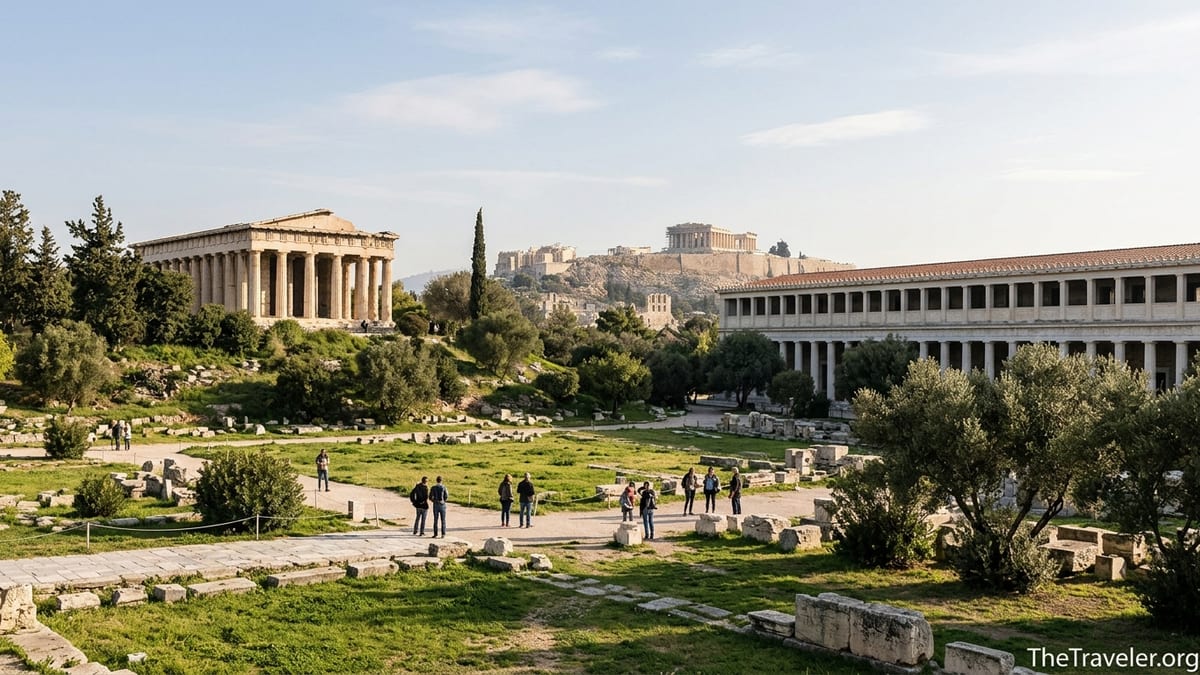
What Exactly Is the Ancient Agora, and How Is It Different from the Acropolis?
The Acropolis is the iconic rocky hill topped by the Parthenon, a ceremonial and religious center that symbolised Athens’ power. The Ancient Agora, by contrast, was the everyday city: a broad, low-lying public space where citizens met to trade, argue cases, vote, and gossip. It lies beneath the northern slope of the Acropolis, between today’s Monastiraki and Thissio districts, and was bounded by hills including the Areopagus and Kolonos Agoraios. In other words, the Acropolis was the sacred skyline; the Agora was where life actually happened.
Walking through the Agora today feels very different from climbing the Acropolis. Instead of crowds funneling up a stone path, you stroll through shaded paths lined with scattered foundations, columns, and wells that once marked stoas, law courts, and council houses. The American School of Classical Studies has excavated much of the area, and modern research highlights the site as “the heart of Athenian democracy,” where institutions evolved over centuries from archaic times through the Roman period. You are not just seeing a single monument but an entire political and social landscape condensed into one walkable park.
Two structures powerfully anchor the scene. On the hill of Kolonos Agoraios rises the Temple of Hephaestus, often described as the best-preserved Doric temple in mainland Greece, its columns and pediments almost intact. On the eastern side stands the long, reconstructed Stoa of Attalos, an ancient colonnaded shopping and meeting arcade rebuilt in the 1950s and now housing the Museum of the Ancient Agora. From many points you also get striking views back up to the Acropolis, so the two sites visually talk to each other even as they tell different stories.
This difference in atmosphere matters when you plan a visit. The Acropolis is intense, iconic, and often crowded; the Agora is more spacious, reflective, and less rushed. If the Acropolis is about that one-world-famous view, the Agora is about context: understanding how Athenians lived beneath the temples they built.
Who Will Get the Most Out of Visiting the Ancient Agora?
The Ancient Agora is especially rewarding for travelers fascinated by history, politics, or everyday life in the ancient world. If you have ever wondered where Socrates argued with his fellow citizens, where juries gathered, or how democracy functioned before representative parliaments, this is your site. Interpretive signs and the museum’s displays of ostraka (potsherds used to vote for exile), official weights and measures, and inscribed decrees give tangible form to concepts that can feel abstract at the Acropolis.
Culture-focused travelers doing more than a quick stopover in Athens generally find the Agora a clear “yes.” If you have two or three full days in the city, it fits naturally alongside the Acropolis and either the Acropolis Museum or the National Archaeological Museum. A typical pattern: morning at the Acropolis, a late-morning or early-afternoon stroll through the Agora, then a museum visit later in the day. Because the Agora is flatter and greener, it also works as a gentle recovery stop after the climb and heat on the rock above.
Photographers and urban explorers also tend to love the site. From the central paths you can capture the Acropolis framed by olive trees and columns, or the Temple of Hephaestus rising above wildflowers in spring. The park-like feel, with birdsong and relatively few tour groups lingering long, makes it a peaceful contrast to the intense bustle of nearby Monastiraki Square. Many visitors who stay in accommodation around Monastiraki or Thissio discover that the Agora becomes their favorite quiet corner of central Athens.
On the other hand, if you prefer highly polished museum experiences or quick hits of spectacle, you may find the Agora less compelling. Much of its meaning lies in low walls and foundations that require imagination, patience and some background reading or a guided tour. For travelers whose main interest is beaches, nightlife, or islands with only one rushed day in Athens, the Agora is often better saved for a future, slower visit.
How Much Time Do You Really Need, and How Does It Fit Into an Athens Itinerary?
Most first-time visitors spend between 1.5 and 3 hours at the Ancient Agora, depending on how deeply they engage. A brisk visit that takes in the main path, the Temple of Hephaestus and a quick walk through the ground floor of the Stoa of Attalos can be done in about 90 minutes. If you like to read signage, linger in the museum, or explore side paths and viewpoints, it is easy to stretch that to 2.5 or 3 hours without feeling rushed.
The site has been operating in 2026 on extended summer hours of roughly 8:00 to 19:30, according to announcements from the Hellenic Heritage authorities. That flexibility makes it easier to plan cool-morning or golden-hour visits, especially in the hot months. Some travelers choose to go straight at opening to enjoy empty paths and soft light, then climb to the Acropolis later in the afternoon when group tours thin out. Others reverse it: Acropolis at 8:00, then a late-morning coffee in Monastiraki followed by the Agora around midday when its trees offer shade.
Accessibility and pacing also matter. While the Temple of Hephaestus sits on a small rise reached by sloping paths, the main central area and the Stoa of Attalos are relatively gentle. The official Athens information notes that the museum inside the Stoa is wheelchair accessible, and there are accessible itineraries that connect the Agora with nearby sites like Kerameikos. Older travelers or anyone sensitive to heat often find the Agora a more comfortable environment than the steep marble ramps of the Acropolis.
If you are on a tight schedule, think in trade-offs. With a single full day, most travelers prioritize the Acropolis and one major museum. The Agora can still fit if you move efficiently: an early Acropolis visit, a simple lunch around Monastiraki, and an afternoon walk through the Agora before dinner in Thissio. With only a half-day in Athens, however, you are unlikely to experience the Agora properly without shortchanging more iconic stops.
Tickets, Costs, and Practical Logistics in 2026
As of mid-2026, Greece no longer offers the older bundled “combined” ticket that once covered the Acropolis, Ancient Agora, Roman Agora, Hadrian’s Library, Kerameikos and several other sites in one pass. Recent visitor reports describe having to buy separate tickets for each site, with cumulative costs easily topping 100 euros per person if you include the Acropolis, multiple agoras, the Temple of Olympian Zeus and the Acropolis Museum. That matters if you are traveling as a family or on a tight budget.
Entry to the Ancient Agora itself is significantly cheaper than the Acropolis, and seasonal discounts apply. The Greek Ministry of Culture typically offers reduced admission from November through March, plus several free entrance days each year, including March 6, April 18, May 18, October 28 and the last weekend of September, along with certain Sundays in winter. If your visit happens to fall on one of those dates, you can walk into the Agora and its museum without paying, which makes it a particularly good value stop near the city center.
In practice, most travelers either buy tickets directly at the site entrance near Thissio or Monastiraki, or via official channels and reputable resellers that package the ticket with an audio tour. Audio tours can add real value at the Agora because so much of its interest is in how spaces were used rather than in towering, intact monuments. One common approach, for example, is to book a self-guided audio tour that covers both the Acropolis and the Agora, which you can do at your own pace over one or two days.
Reaching the site is straightforward. The main entrances sit a short walk from Thissio and Monastiraki metro stations, and many hotels in central Athens lie within a 10 to 15 minute walk. Because you can often see the Temple of Hephaestus and the Stoa of Attalos from the surrounding streets and train lines, some budget-conscious visitors decide to admire the site from outside the fences and put their ticket money toward museums instead. Whether that is a good idea depends largely on your priorities, which we will come to below.
Family Value: Is the Ancient Agora Good With Kids and Teens?
For families, the Ancient Agora can be either a quiet highlight or a forgettable walk among rocks, and the difference lies in how you approach it. Younger children often enjoy the open space, the chance to run along paths, and the sense of being in a “ruined city” under the watchful Acropolis. The Temple of Hephaestus, almost complete with its columned sides and visible friezes, looks recognizably like a temple from storybooks, which helps keep their attention more than broken foundations alone.
Inside the Stoa of Attalos, the Museum of the Ancient Agora offers concrete objects that lend themselves to storytelling with kids: jurors’ ballots, bronze voting tickets, official measures used in the marketplace, and everyday items like toys and tools. Parents can turn these into mini-mysteries: “Can you guess what this was used for?” or “Imagine making a law here and dropping your vote into this jar.” For teens studying world history or civics, seeing the physical remains of early democratic practice can make classroom concepts come alive.
At the same time, there are limitations. Signage is mostly text-heavy and geared toward adults. There are few interactive elements, and in hot weather children may tire quickly without shade breaks and water. Strollers can navigate much of the central area and the museum, but rougher paths and steps limit full access. Most families report that 60 to 90 minutes is the sweet spot before attention flags, especially if the Agora is part of a full sightseeing day that also includes the Acropolis or museums.
If your children are very young, with limited patience for ruins, you may decide that views of the Agora from surrounding streets combined with a visit to the Acropolis Museum offer a better return. The museum’s climate-controlled galleries, glass floors, and cafe with Acropolis views are often easier environments for toddlers and parents alike. Families with older school-age kids or teens, however, usually find the Agora a worthwhile, relatively low-stress outdoor complement to the hilltop experience.
History and Educational Value: When the Ancient Agora Becomes Essential
For travelers deeply interested in history, politics, or philosophy, the Ancient Agora is not just “nice to have”; it is arguably the single most important site in Athens after the Acropolis. This was the space where the institutions of Athenian democracy evolved over centuries, where laws were proposed and debated, and where figures like Pericles and Socrates moved among citizens. Modern interpretations from Greek heritage organizations explicitly frame the site as the clearest reflection of how democracy developed in Athens, more than any single temple or statue.
Many of the most revealing artifacts are indoors in the Stoa of Attalos. Here you see ostraka bearing scratched names of prominent Athenians targeted for ostracism, fragments of public decrees, and things as mundane as official water clocks used to time speeches in the law courts. Taken together, these give a granular sense of how rule of law was administered and how much effort the city invested in fairness and order. For students, academics, or anyone fascinated by governance, the Agora is effectively an open-air textbook.
The broader landscape adds depth. You can stand on the central paths and look up to the Acropolis, imagining citizens glancing toward Athena’s sanctuary while arguing policy in the open air. The Altar of the Twelve Gods once marked the point from which all distances to Athens were measured, underlining the site’s centrality in daily life. Workshops, stoas, and later Roman additions show how the space evolved as Athens changed hands, giving a sense of continuity and adaptation over nearly a millennium.
Because of this density of meaning, many classicists and guides quietly rank the Agora as their favorite site in the city. Travelers who arrive with that mindset, perhaps having read a short history of democracy or watched a documentary, consistently describe the visit as transformative. If understanding the “how” and “why” of ancient Athens matters to you as much as the postcard view, the Agora is very hard to skip.
When Does It Make Sense to Skip the Ancient Agora?
Despite its importance, the Ancient Agora is not a must-do for every visitor. The clearest case for skipping it is when your time in Athens is extremely short. If you only have one afternoon or evening before catching a ferry the next morning, it is reasonable to focus on the Acropolis itself and perhaps a single museum or a walk through Plaka. In such a compressed schedule, the more subtle rewards of the Agora will likely be lost in fatigue and information overload.
Budget can be another factor. With the end of the combined ticket and the need to purchase separate entries, visiting multiple archaeological sites in Athens has become expensive, especially for couples or families. If you are already stretching to cover the Acropolis, its museum, and a major national museum, and you are not particularly passionate about civic history, then admiring the Agora from the perimeter while walking between Monastiraki and Thissio can be a sensible compromise.
It may also be wise to skip or shorten a visit during extreme heat. In recent summers, Greek authorities have occasionally closed exposed sites like the Acropolis in the hottest hours due to heat risk. While the Agora has more shade, it is still largely outdoors, and long walks between ruins can be draining in 40-degree Celsius temperatures. If your travel dates coincide with a heatwave and you are sensitive to heat, an air-conditioned museum may deliver more enjoyment for the same ticket price.
Finally, travelers who are largely indifferent to ancient history and are visiting Athens mainly as a gateway to the islands or for nightlife may not find the Agora compelling. The site rewards curiosity and reflection more than quick photo stops. If that does not match your mood or interests, there is no need to force it simply because guidebooks label it a top sight.
The Takeaway
So, is the Ancient Agora worth visiting? For travelers who care about the story of Athens, the answer is usually yes. It is the place where the abstract idea of “democracy” becomes visible in stones and inscriptions, where you can picture citizens casting votes, merchants haggling, and philosophers questioning received wisdom under the same Attic sky. The surviving Temple of Hephaestus and the reconstructed Stoa of Attalos provide strong visual anchors in a landscape that otherwise asks you to imagine a busy city where ruins now lie quiet.
The site is at its best for those with at least a full day and a half in Athens, an interest in history or politics, and a willingness to walk, read, and think. Families with school-age children, students, and culture-focused travelers will find rich rewards in the museum objects and the open-air setting. Visitors with only a few hours in the city, a tight budget, or little interest in ruins may reasonably decide that views of the Agora from surrounding streets combined with the Acropolis and a major museum give them enough of ancient Athens for now.
Ultimately, the Ancient Agora is less about a single must-photograph monument and more about gaining a three-dimensional sense of how Athenians lived, argued, believed, and governed themselves. If that dimension of travel appeals to you, set aside a couple of hours, bring water and curiosity, and wander the pathways where Western political ideas first took shape. If not, you can always leave it for a future trip when you have more time to let the quieter corners of Athens speak.
FAQ
Q1. Is the Ancient Agora suitable for a short one-day stop in Athens?
If you have a single packed day, it can fit, but you will need to prioritize. Most travelers in that situation focus on the Acropolis and one museum, then add the Agora only if they have extra time and energy.
Q2. Can I see enough of the Ancient Agora from outside without buying a ticket?
You can see the Temple of Hephaestus and the Stoa of Attalos quite clearly from nearby streets and the train line, which gives a good sense of the setting. However, you will miss the museum, the feeling of walking through the central space, and many smaller ruins if you stay outside the fences.
Q3. How does the Ancient Agora compare to the Roman Agora nearby?
The Ancient Agora is larger, greener and more historically significant for democracy and daily life in classical Athens. The smaller Roman Agora, built in the Roman period just to the east, is interesting but more limited, with a compact courtyard and a few standout features rather than a broad civic landscape.
Q4. Is the Ancient Agora accessible for visitors with limited mobility?
The terrain is uneven in places, but the central area and especially the Stoa of Attalos museum are relatively accessible, with documented routes and wheelchair access. Some higher viewpoints and rough paths may still be challenging, so it is wise to plan for a partial visit focused on the flattest sections.
Q5. What is the best time of day to visit the Ancient Agora?
Early morning and late afternoon generally offer the most comfortable temperatures and softer light, especially in summer. Midday can be hot and bright, so if you must visit then, plan for frequent shade breaks and bring water, a hat and sunscreen.
Q6. Do I need a guided tour to appreciate the Ancient Agora?
You do not need a guide, but some form of interpretation helps a lot. A guided tour or a good audio guide will point out where specific public buildings stood and explain how Athenians used them, which is especially useful when many structures survive only as foundations.
Q7. Is the Ancient Agora interesting for children and teenagers?
Yes, particularly for older children and teens who have studied ancient Greece or democracy at school. The open space to explore and the concrete objects in the museum can engage them, though very young children may tire quickly if the visit runs longer than an hour or so.
Q8. How long should I plan to spend at the Ancient Agora?
Most visitors are satisfied with about 1.5 to 2 hours, which allows time to walk the main paths, see the Temple of Hephaestus up close, and visit the museum. Enthusiasts of history and archaeology can easily extend that to 3 hours.
Q9. Is the Ancient Agora a good place for photography?
It is an excellent spot for photos, with views of the Acropolis framed by trees, the well-preserved Temple of Hephaestus, and the long colonnades of the Stoa of Attalos. Early morning and late afternoon provide the best light and fewer crowds in your shots.
Q10. If I have to choose, should I visit the Acropolis Museum or the Ancient Agora?
If you can only pick one, the Acropolis Museum usually offers more comprehensive displays and is particularly strong on sculpture and the Parthenon. The Ancient Agora, however, gives a stronger sense of the city’s civic life on the ground. Many travelers try to do the Acropolis, the Acropolis Museum, and the Agora over two days for the fullest picture.