


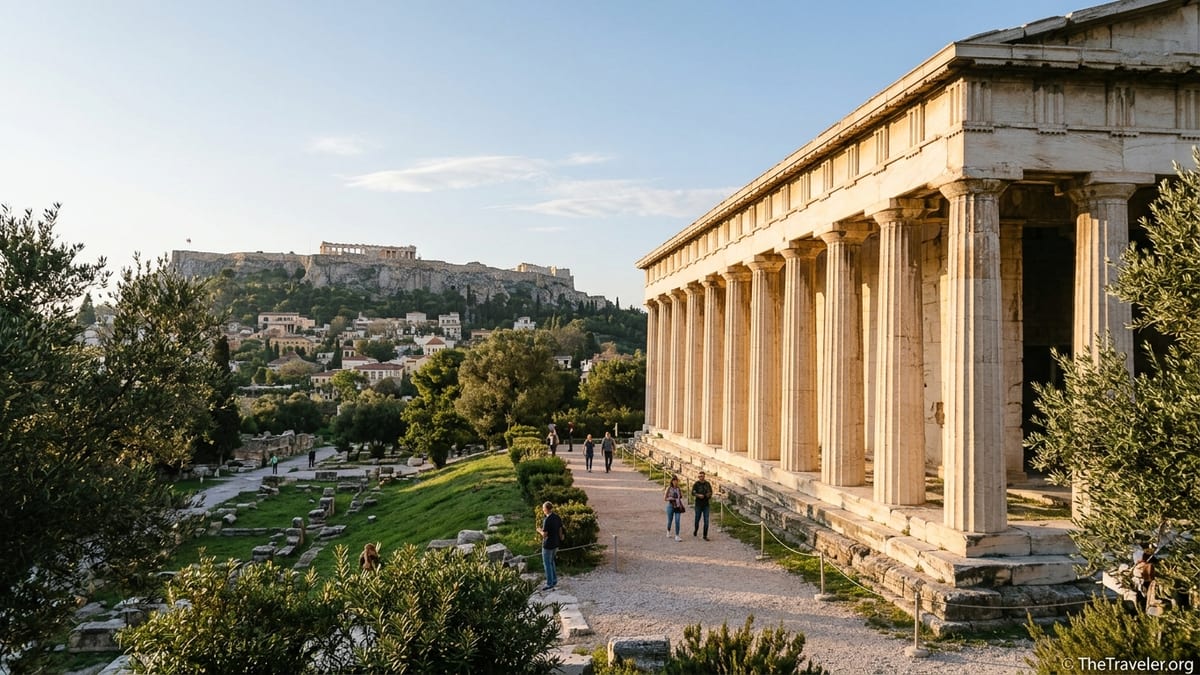
For many travelers, the most moving moment in Athens does not happen at the Parthenon at all. It happens a few hundred meters away, standing in the shade of marble columns at the Temple of Hephaestus in the Ancient Agora. Perfectly proportioned, almost completely intact, and framed by olive trees with the Acropolis rising across the valley, this 5th century BC sanctuary gives an unusually clear sense of what a classical Greek temple really felt like. This is where the abstractions of “ancient Athens” suddenly become real.
Get the latest updates straight to your inbox!
Getting Your Bearings: Where the Temple Sits in the Ancient Agora
The Temple of Hephaestus stands on the low hill of Agoraios Kolonos on the northwest edge of the Ancient Agora of Athens. When you enter the site from the main gate near Adrianou Street in Monastiraki, you first wander through low ruins and shaded paths. The temple is the high point on the western side, visible almost immediately as a nearly complete rectangle of creamy stone rising above the trees.
From the hill, you look down on the open expanse of the Agora, once the bustling civic heart of classical Athens. To your right you can usually spot the long, colonnaded Stoa of Attalos, now housing the site museum. Ahead and to the southeast, the Acropolis rock dominates the skyline, with the Parthenon clearly visible, especially on clear mornings. Many visitors comment that this vantage point helps them mentally map ancient Athens: marketplace below, civic buildings scattered around, religious and political center on the Acropolis beyond.
The surrounding modern neighborhoods are just as practical for today’s traveler. The Thissio and Monastiraki districts, both within a 5 to 10 minute walk of the entrance, are packed with small hotels, short-term rentals, and cafes. It is entirely feasible to walk from a budget guesthouse near Monastiraki Square, buy your combined archaeological site ticket at the Acropolis early in the morning, and then arrive at the Temple of Hephaestus as your second stop before the midday heat builds.
Because the temple is inside the fenced archaeological park, you cannot just walk up to it from the street. You enter the Ancient Agora first, show your ticket, and then follow signposted paths uphill. The gradual climb takes only a few minutes on a well-trodden gravel path, but the elevation change is enough to create those sweeping views that make the site so photogenic.
A Temple That Still Looks Like a Temple
Visitors are often surprised that the Temple of Hephaestus looks, in their words, “like something out of a textbook illustration.” It is a Doric peripteral temple, with a ring of fluted columns around a central inner chamber. Crucially, most of that structure is still standing. The outer colonnade, much of the roofline, the pediments, and even elements of the internal walls survive, so you get an almost three-dimensional sense of the original building, instead of having to imagine it from a few reconstructed columns.
Walk slowly along the south side and you can easily count the 13 columns on the long edge and the 6 on the short facades. Unlike the shattered remains at many sites, these columns still support the entablature and frieze, which means you can trace the lines of the architecture with your eyes, seeing how it all fits together. Travelers who have already visited the Parthenon frequently comment that, although the Parthenon is grander, this temple feels more complete and comprehensible at human scale.
The temple’s remarkable condition is partly due to its later reuse. From roughly the 7th century AD until the 19th century, it served as a Christian church dedicated to Saint George. That continuous occupation meant the building was maintained, its roof kept intact and its walls kept standing while many other pagan structures crumbled. When modern travelers stand beneath the colonnades, they are seeing not just a classical monument but a building that functioned for more than two millennia without ever completely falling into ruin.
You cannot enter the inner cella, but you can walk all around the exterior, often in partial shade, pausing to examine details like triglyphs and metopes, and the weathered steps at the base. Guides leading small groups will sometimes stop on the east side, where the light can be softer in late afternoon, and show old engravings or illustrations comparing the temple in the 18th century with its present state. For independent travelers, basic interpretive panels in English and Greek help decode the main architectural features.
A Walk Through Time: From Bronze God to City Protector
The temple was begun around the mid-5th century BC, traditionally dated to around 449 BC, in the same generation that saw the building of the Parthenon. It was dedicated primarily to Hephaestus, the god of fire and metalworking, and probably also honored Athena in her role as patron of crafts. This made sense in the context of its surroundings. The western side of the Agora was home to metalworkers and potters, and the hill itself was associated with craftsmen, so setting a temple to their patron god on the height above their workshops was both devotional and symbolic.
Inside the cella, ancient writers describe statues of Hephaestus and Athena, likely in bronze. While those cult images are long gone, travelers standing at the east front can picture worshippers processing up from the Agora below, perhaps bringing offerings from the metal shops and foundries that ringed the marketplace. This link between religion and everyday work is one reason many modern visitors, especially those interested in social history, find the site more relatable than the loftier, more overtly political symbolism of the Parthenon.
Over centuries, as Athens shifted from classical city-state to Hellenistic, then Roman, then Byzantine and Ottoman settlement, the building’s role evolved. Its conversion into a Christian church brought new frescoes and altars, traces of which specialists have studied even if most are not visible today to casual visitors. In the 19th century, after Greek independence, it served briefly as a ceremonial site for national events, including a service in honor of King Otto’s arrival in Athens.
For today’s traveler, that long layered history results in an unusual atmosphere. You are standing in one of the very few temples whose roof and inner walls still convey the sense of an enclosed sacred space, yet you are in the middle of a busy modern capital. On a quiet weekday morning, the cooing of doves in the roof beams and the distant sound of the Metro trains from Thissio station can feel like a reminder that this has never been a museum piece alone, but a structure embedded in a living city.
Views, Photos, and the Best Times of Day to Visit
The Temple of Hephaestus offers some of the most rewarding viewpoints in central Athens for visitors with a camera or smartphone. From the eastern end, you can frame the columns in the foreground with the Acropolis rising behind, a classic composition that appears frequently in travel magazines. On slightly hazy summer afternoons the rock takes on a pale beige glow, while the temple’s closer marble shows stronger texture in the raking light.
Photographers looking for softer light often aim for early morning right after opening time, particularly from late March to early June and again from September to October. At these times, the sun is low enough to cast long shadows from the columns along the stylobate, emphasizing depth. Travellers staying in nearby Plaka or Monastiraki can realistically walk to the Agora shortly after it opens and enjoy 20 or 30 minutes with relatively few other people around the temple, a stark contrast to the crowds that build up at the Acropolis by mid-morning.
Casual visitors frequently take advantage of the benches and stone blocks scattered around the hill to pause and soak in the panorama. One popular spot is slightly downslope on the east side, where the temple fills the left of the frame and the Acropolis sits to the right. Couples often ask fellow travelers to snap a photo from here, capturing both monuments in a single image. Even with just a smartphone, it is quite easy to get a wide shot that feels like a postcard.
Sunset can be beautiful but also busier, particularly in high season. The golden light on the marble is stunning, but the Ancient Agora’s closing time usually precedes the actual sunset in summer, so you will experience more of the late-afternoon glow than full dusk. Travelers who want actual sunset shots of the temple itself often switch vantage point and photograph it from outside the Agora, for example from the pedestrian promenade in Thissio, capturing the lit columns from a distance once the site is closed.
Tickets, Practicalities, and How to Explore Comfortably
Because the Temple of Hephaestus sits inside the Ancient Agora archaeological park, you visit it on the same ticket. Many travelers choose the multi-site combined ticket, which costs around thirty euros and typically includes the Acropolis and several other major sites over a five-day period. This option tends to be good value for anyone planning to see more than two or three ancient monuments in Athens, especially if you spread your sightseeing out to avoid heat and fatigue.
Opening hours vary by season, but in the high season months the site usually opens in the early morning and closes late afternoon to early evening. It is wise to check current times shortly before your trip, as hours can shift due to seasonal changes, public holidays, or heatwave precautions. In peak summer, there are occasional midday closures when temperatures rise to unsafe levels, so local hotels and city tourist information desks often advise guests to plan ancient site visits for early or late in the day.
The walk up to the temple from the entrance is short, but the ground is uneven in places, with gravel paths and occasional low steps. Sturdy sandals or trainers are more comfortable than flip-flops, particularly if you have already climbed around the Acropolis earlier in the day. Families with small children commonly bring lightweight strollers for the flatter museum areas, but often end up carrying them up the short incline to the temple hilltop.
Practical services are relatively simple. There are toilets and a small gift shop within the Agora, but no cafe inside the fenced area. Most travelers grab a bottle of water from a kiosk or mini-market in Monastiraki or Thissio before entering. After your visit, it is easy to reward yourself with a cold coffee or light meal at one of the outdoor terraces overlooking the site, where you can often still see the temple peeking above the trees as you eat.
Why So Many Visitors Love This Temple More Than the Parthenon
Ask travelers which ancient site moved them the most in Athens, and a surprising number will mention the Temple of Hephaestus before the more famous monuments. Part of the appeal is scale. Where the Parthenon can feel distant and crowded, especially at peak times, this smaller temple feels approachable and almost intimate. You can stand close to the columns, trace the chisel marks in the stone, and walk a full circuit without feeling rushed along by tour groups.
Another factor is the sense of completeness. Many people arrive in Athens with mental images of “Greek temples” as whole, roofed buildings, only to find that in reality most are fragmentary. At Hephaestus, the proportions still read clearly, the roofline is intact enough to cast solid shadows, and the colonnade forms a continuous ring. For visitors without a background in archaeology, this makes it far easier to connect the sophisticated drawings in guidebooks to what they see in front of them.
The setting also plays a major role. Standing on the hill, you are far enough above the Agora to get sweeping views, yet close enough to pick out details like the line of the Panathenaic Way or the footprint of the Bouleuterion. It is easy to imagine craftsmen, traders, and politicians moving below while ritual activity unfolded in the temple above. This layered, lived-in atmosphere makes the site feel less like a monument on a pedestal and more like part of an actual city.
Finally, the temple rewards repeat visits. Travelers who spend several days in Athens sometimes return to the Ancient Agora simply to sit near its steps again. On a cool winter afternoon, with low sun and only a handful of others around, the place can feel contemplative, almost like a quiet neighborhood church. On a bright spring day alive with school groups and walking tours, the same space feels energetic, echoing the buzz of the ancient marketplace. That capacity to change mood with the seasons and times of day is a big part of why people remember it fondly.
Making the Most of Your Time in and Around the Temple
The Temple of Hephaestus fits naturally into a half-day exploration of the Ancient Agora, but you can also build a broader walking loop around it. One popular route starts with an early Acropolis visit, continues down the slope into the Agora by late morning, and finishes with lunch in Monastiraki or Thissio. For example, a traveler staying near Syntagma Square might take the Metro to Acropoli station at opening time, spend two hours on the rock, then walk down Dionysiou Areopagitou and around to the Ancient Agora entrance. By the time they reach the temple hill, the sun is high but the colonnade still offers pockets of shade.
Inside the Agora, it is worth pairing your temple visit with a stop at the museum in the Stoa of Attalos. The displays there include small finds that help contextualize the life of the marketplace below: pottery, tools, inscriptions, and everyday objects. Many visitors report that seeing a potter’s tool or a bronze fitting in the climate-controlled showcases, then looking up at the temple dedicated to the patron of such crafts, connects the dots in a memorable way.
Guided tours can add depth but are not essential. Numerous local guides and small-group operators offer two- or three-hour walks that focus on the Ancient Agora and the temple, often priced in the range that makes sense for couples or small groups sharing the cost. Solo travelers on a budget often prefer to download a map of the Agora and a short audio guide or podcast episode, then wander at their own pace, stopping to read the discreet signage around the temple.
When you leave the site, you can continue your immersion in the neighborhood’s modern life. The pedestrian paths in Thissio and the flea-market lanes of Monastiraki are filled with street vendors, buskers, and cafes. Many travelers enjoy the contrast: within the fences, the traces of a 2,500-year-old marketplace dominated by a classical temple; outside, the contemporary bazaar of souvenirs, antiques, and coffee bars, with the same temple still visible on its hill above it all.
FAQ
Q1. Where exactly is the Temple of Hephaestus located inside the Ancient Agora?
The temple stands on the low hill of Agoraios Kolonos at the northwest edge of the Ancient Agora, overlooking the main archaeological remains and the Stoa of Attalos.
Q2. Is the Temple of Hephaestus included in the general Agora ticket?
Yes. The temple is inside the fenced Ancient Agora site, so access is included in both the standard Agora ticket and the common multi-site ticket that covers several major monuments.
Q3. Can visitors go inside the Temple of Hephaestus?
No. You cannot enter the inner chamber, but you can walk all the way around the exterior, approach the steps closely, and view the interior through the colonnade.
Q4. How long should I plan for a visit to the Temple of Hephaestus?
Most travelers spend 20 to 40 minutes at the temple itself, often as part of a 1.5 to 2 hour exploration of the wider Ancient Agora.
Q5. What is the best time of day to visit for photos and views?
Early morning and late afternoon usually offer the best light, with softer shadows on the columns and clear views of the Acropolis from the east side of the temple.
Q6. Is the walk up to the temple suitable for children and older travelers?
The walk is short and on a gentle slope, but paths are uneven in places. Most children and older visitors manage it comfortably with sensible footwear and occasional rests.
Q7. Why is the Temple of Hephaestus so well preserved compared to other Greek temples?
Its continuous use, especially its conversion into a Christian church for many centuries, meant that its roof and walls were maintained instead of being quarried away.
Q8. Are guided tours necessary to appreciate the temple?
Guided tours are not required but can add context. Clear signage and basic background reading are enough for many independent travelers to enjoy the site fully.
Q9. Can I see the Temple of Hephaestus without entering the Ancient Agora?
You can see the temple from outside the fences, especially from the pedestrian promenades in Thissio, but close-up access and the hilltop views require an Agora ticket.
Q10. Is the Temple of Hephaestus a good alternative if the Acropolis is very crowded?
It is an excellent complement and, at busy times, often feels calmer and more intimate than the Acropolis, while still delivering impressive classical architecture and views.