


More news on this day
Air travelers across the United States faced a difficult start to the day on May 26 as more than 2,100 delays and over 100 cancellations rippled through major hubs including Atlanta, San Francisco, Los Angeles, Denver, Seattle and Dallas, disrupting schedules for American, United, Endeavor, SkyWest and several other carriers.
Get the latest news straight to your inbox!
Major Hubs Struggle With Congestion and Rolling Ground Restrictions
Publicly available tracking data showed hundreds of delayed departures and arrivals clustering around the country’s busiest hubs, with Hartsfield–Jackson Atlanta International, San Francisco International, Los Angeles International, Denver International, Seattle–Tacoma and the Dallas–Fort Worth area among the hardest hit. Many of the disruptions involved large network carriers such as American Airlines and United Airlines, along with regional partners including Endeavor Air and SkyWest Airlines that operate connecting flights under big-brand banners.
Information on the Federal Aviation Administration’s National Airspace System Status site indicated that ground stops or formal delay programs were possible or in effect at several of these airports during the day, limiting the rate at which flights could arrive and depart. These traffic management initiatives are commonly used when thunderstorms, low clouds or high winds temporarily cut the capacity of busy runways and approach paths, forcing airlines to hold flights on the ground at origin airports and compress departure banks once conditions improve.
Recent coverage of operations at Atlanta’s airport noted that storms over the Memorial Day weekend already triggered ground stops and warned that additional weather-related programs were possible, adding pressure on airlines that rely on the hub to connect passengers across the Southeast and beyond. Similar constraints at Denver and San Francisco, where afternoon storms and coastal marine layers are frequent in late spring, contributed to mounting delays that spread across airline networks by midday.
Data from flight-tracking dashboards suggested that while outright cancellations remained relatively limited compared with peak winter disruption events, the sheer volume of delayed flights created a difficult travel experience. Even modest schedule changes at multiple hubs can combine into missed connections and unplanned overnight stays, particularly for passengers linking regional operations such as Endeavor and SkyWest services with long-haul flights on American and United.
Weather Systems Drive Much of the Disruption
Forecasters tracking conditions over the continental United States on May 26 pointed to lines of thunderstorms, low ceilings and gusty winds in several regions, including the Southeast, the central Rockies and parts of the West Coast. These patterns are typical for the season and often trigger the FAA’s use of traffic flow initiatives such as ground stops, where flights meeting certain criteria are held on the ground, and ground delay programs, which meter departures into constrained airports on a controlled schedule.
FAA guidance documents describe ground stops as a tool to slow or halt inbound traffic in response to sudden capacity drops, including convective storms, rapidly shifting wind patterns or temporary runway closures. Ground delay programs, by contrast, assign controlled departure times to flights headed for a congested airport, smoothing out peaks and valleys in demand as weather systems evolve. Both mechanisms were highlighted as possibilities for Atlanta, Dallas, Denver and San Francisco in the agency’s system status updates for May 26.
In addition to the broad national picture, recent reporting from Denver indicated that high winds had prompted a ground stop at Denver International Airport as recently as May 24, underscoring how quickly local conditions on the High Plains can deteriorate. Coverage of weather impacts at Houston’s George Bush Intercontinental Airport earlier in the weekend showed how severe storms and flood concerns there produced a separate wave of delays for United Airlines and its partners, some of which continued to echo through schedules into Tuesday.
According to aviation safety and air traffic management analyses, convective weather remains one of the primary drivers of delays across the U.S. system in late spring and summer. While airlines and controllers use detailed forecasts and sophisticated planning tools, the exact timing and intensity of thunderstorms can still force last-minute changes, compressing departure windows and leaving aircraft and crews out of position for subsequent flights.
Network Carriers and Regional Partners Feel the Strain
The latest disruption highlighted how major network airlines and their regional affiliates share the burden when weather and traffic initiatives strike multiple hubs at once. Public airline schedule and fleet information shows that SkyWest operates flights under codeshare agreements for several large carriers, including Alaska Airlines, American Airlines, Delta Air Lines and United Airlines, while Endeavor Air is a key regional partner for Delta. As a result, a ground stop or delay program at a single hub can reverberate across branded networks that stretch from large coastal gateways to small community airports.
When severe weather narrowed arrival and departure windows at big hubs on May 26, regional flights were often the first to see preemptive delays or cancellations. Aviation operations research notes that airlines may trim thinner regional routes to preserve limited capacity for long-haul and higher-demand services, a strategy that protects overall network revenue but magnifies the impact on travelers in smaller markets who have fewer alternative options.
For American and United, each of which relies heavily on megahubs like Dallas–Fort Worth, Chicago, Houston and Denver, the combination of storms and air traffic constraints over the Memorial Day travel period created a complex logistical puzzle. Aircraft and crew rotations needed for today’s schedule were still absorbing the knock-on effects of earlier weather events in Houston and Atlanta, contributing to the more than 2,100 delays and just over 100 cancellations logged within, into or out of the United States.
Industry trackers have also pointed to tight staffing in parts of the air traffic control system as a complicating factor. Recent analyses of FAA budget and workforce plans describe a system that has been working to address controller shortages at several high-volume facilities. While there was no immediate indication that staffing alone caused today’s disruptions, limited flexibility can reduce the system’s ability to recover quickly once storms clear and traffic surges back toward normal levels.
Passengers Face Missed Connections and Crowded Terminals
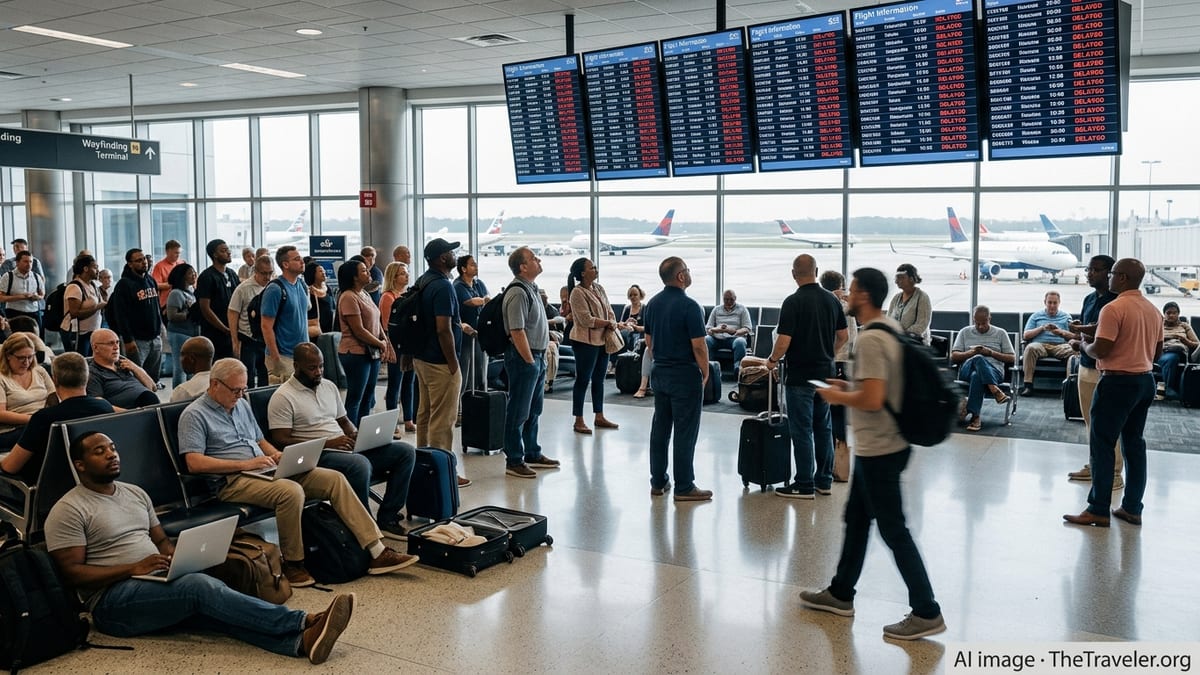
For travelers, the operational nuances translated into long lines at check-in counters and security checkpoints, crowded gate areas and mounting anxiety over missed connections. Airport social media feeds and local broadcast coverage from several of the affected cities on May 26 showed images of busy concourses and departure boards stacked with flights bearing delay notations of 30 minutes or more.
Consumer advocates note that even when cancellations remain relatively modest, high rates of delay can create comparable disruption. A passenger whose flight from a regional airport is pushed back by an hour or more may miss a carefully timed connection at a hub, even if the onward flight departs only slightly behind schedule. With Memorial Day travel volumes elevated, rebooking options into already-full flights can quickly dwindle, increasing the likelihood of overnight stays and extended travel times.
Publicly available airline policies indicate that U.S. carriers often provide meal vouchers, hotel accommodation or rebooking assistance in cases where disruptions are within the airline’s control, such as mechanical issues or crew scheduling. When storms or air traffic control programs are the primary cause, however, assistance can be more limited, leaving passengers to shoulder costs for food and lodging while they wait for the system to recover.
Travel analysts suggest that passengers flying during peak travel weekends build extra buffer time into connections, particularly when routing through weather-prone hubs in late spring and summer. They also advise monitoring airline apps and flight-tracking tools closely on travel day, since early notifications of ground stops or delay programs can provide an opportunity to adjust plans before long queues form at airport service desks.
Outlook for the Remainder of the Holiday Week
Looking ahead to the rest of the Memorial Day week, aviation weather forecasts indicate that unsettled conditions will likely persist across parts of the central United States and Southeast, with additional rounds of thunderstorms possible near several major hubs. FAA planning materials emphasize the continued use of traffic management initiatives such as ground stops and ground delay programs to maintain safety and reduce the risk of airborne holding when storms pop up near busy arrival corridors.
Analysts following airline operations caution that recovery from a heavy delay day can take time, especially when multiple hubs are affected in short succession. Aircraft may end up overnighting at nonstandard locations, and flight crews can time out under duty regulations, forcing carriers to swap equipment and staffing at the last minute. The effect can be particularly pronounced for regional operators like SkyWest and Endeavor, which run dense schedules with smaller aircraft and tighter utilization patterns.
Industry commentary in recent weeks has also focused on broader structural issues in the U.S. air traffic system, including efforts to modernize technology and manage air traffic controller staffing more efficiently. Policy debates in Washington and within the aviation community have raised questions about how the system will cope with growth in demand over the next decade while maintaining resilience during peak travel periods and severe weather events.
For now, travelers planning to fly in the coming days are being encouraged by airlines and airport operators to check flight status early and often, allow additional time at the airport and be prepared for potential schedule changes as the summer travel season gets underway with a turbulent start.