


More news on this day
Air travelers across the United States faced another day of disruption as widespread flight cancellations swept through major hubs including New York, Chicago, Boston, Denver, San Francisco, Miami and Dallas, with more than 2,200 flights disrupted nationwide and dozens scrubbed at individual airports, according to multiple tracking services and published reports.
Get the latest news straight to your inbox!
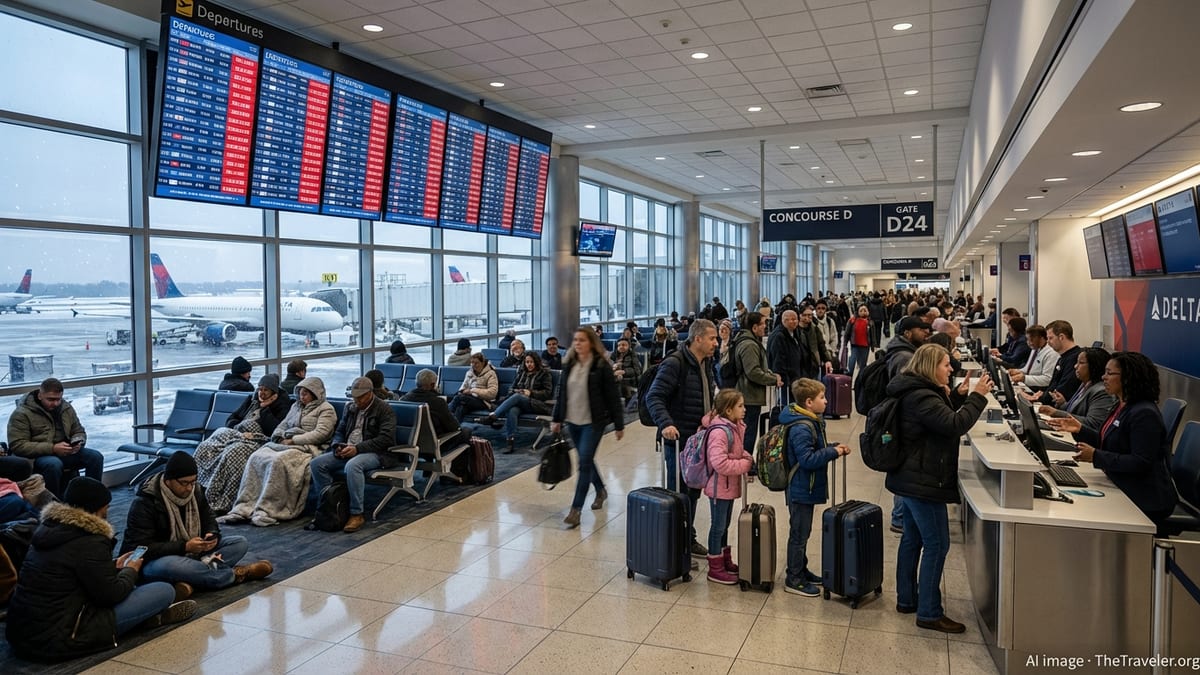
Major Hubs From Coast to Coast Hit by Cancellations
Publicly available tracking data show that the latest wave of cancellations has clustered around some of the country’s busiest airports, amplifying the impact on both domestic and international travelers. Airports serving New York, including John F. Kennedy and LaGuardia, have reported dozens of cancellations as storms and air-traffic constraints strain already tight schedules.
In the Midwest, Chicago’s O’Hare and Midway airports have seen a sharp uptick in disrupted flights, with airlines consolidating departures and arrivals as they work through weather-related backlogs and crew rescheduling challenges. Similar patterns are being reported in Denver, where thunderstorms and earlier operational slowdowns have produced rolling cancellations that continue into subsequent days.
On the coasts, San Francisco and Boston have emerged as notable trouble spots. Low clouds, strong winds and congestion at peak times have led carriers to trim schedules or cancel select services outright. According to airport and airline dashboards, even a relatively small number of cancellations at each of these hubs can translate into significant ripple effects along their extensive route networks.
In the South, Miami and the Dallas area are facing disruptions tied to a mix of convective weather and broader system imbalances. As aircraft and crews fall out of position, carriers are canceling or combining flights to restore order to daily operations, leaving passengers contending with long lines at rebooking counters and limited same-day alternatives.
Southwest, American, United, Delta, Alaska and JetBlue Affected
The disruption is not confined to a single airline. Data from flight-status trackers indicate that Southwest, American, United, Delta, Alaska and JetBlue all appear on the list of carriers with a heightened number of cancellations and delays. The severity varies from airline to airline, depending on route networks, hub locations and how much of each schedule passes through the hardest-hit airports.
Southwest appears particularly exposed at Chicago Midway, Denver and Dallas Love Field, where point-to-point operations depend on aircraft turning quickly between flights. When storms or ground stops slow those turns, cancellations can multiply as aircraft miss subsequent rotations. Passengers on popular leisure routes from these airports have reported abrupt schedule changes and extended waits for rebooking.
American and United, which operate large hub-and-spoke systems, are navigating a different but related challenge. Their hubs in Chicago, Dallas, Miami, Denver, New York and San Francisco are critical connection points, so a decision to cancel one bank of departures can require schedule adjustments across dozens of spokes. Publicly available information shows that both carriers have offered fee-free changes on select routes during peak disruption periods.
Delta, Alaska and JetBlue have also logged cancellations at affected coastal and transcontinental gateways. JetBlue’s strong presence in New York and Boston leaves it especially sensitive to East Coast weather and air-traffic initiatives, while Alaska’s operations at West Coast airports such as San Francisco can be disrupted by low visibility and coastal storm systems. Delta, with a broad national footprint, may experience scattered cancellations wherever local conditions flare.
Weather, Airspace Constraints and Crew Positioning Drive Disruptions
Analysts note that the raw cancellation figures only tell part of the story. The combination of severe or fast-changing weather, airspace flow programs and complex crew-rest regulations can force airlines to trim schedules even when skies appear clear at a passenger’s local airport. Storms over a key hub or along a major corridor can prompt ground delays or reroutes that take hours to unwind.
Recent storms moving across the Midwest and Northeast have repeatedly slowed operations at Chicago, New York and Boston, according to aviation weather advisories. Each round of thunderstorms, low ceilings or gusty crosswinds reduces the number of arrivals and departures that controllers can safely handle, prompting airlines to cut flights preemptively to avoid gridlock on the tarmac.
Once flights are canceled, aircraft and crew positioning rapidly becomes a second-order problem. A plane stranded by weather in Denver may be scheduled to operate several additional segments, and a crew timed out by long delays in Miami cannot simply be reassigned to a late-night departure in Dallas without satisfying duty limits. Publicly available planning documents and industry briefings highlight how these operational constraints can keep cancellation counts elevated even after the worst weather has passed.
Airspace initiatives can also contribute to disruption. When traffic managers slow flows into congested regions or temporarily reduce routes through storm-affected areas, airlines often respond by pruning their schedules further. The end result for travelers is a patchwork of cancellations and delays that may appear arbitrary but are tied to real-time capacity reductions in the national airspace system.
Nationwide Tally Shows More Than 2,000 Flights Affected
Aggregated figures from flight-tracking services and airline operations portals indicate that the current episode of disruption has resulted in more than 2,200 flights canceled across the United States, along with many more delayed. At specific airports, the number of cancellations may appear modest, often fewer than 100 per location, but the system-wide impact is far higher once missed connections and repositioning flights are factored in.
Industry observers point out that even a single day with several hundred cancellations can affect travelers for much longer. Passengers whose flights are scrubbed late in the day may be forced to wait until the following afternoon or later for an open seat, particularly on popular business and leisure routes. Aircraft pulled from service for schedule recovery reduce available capacity in the days that follow, driving up load factors on the remaining flights.
The disruption has been especially acute at major coastal and central hubs. New York, Chicago, Denver, Dallas, Miami, Boston and San Francisco all serve as critical junctions where travelers switch planes and airlines concentrate their most heavily booked routes. When these airports appear repeatedly on cancellation boards, the effect cascades outward to smaller cities that rely on connecting service.
Travel commentary in recent months has underscored that such episodes are becoming more visible to the public as passengers increasingly turn to real-time flight tracking and social media to document their experiences. While cancellations are not new, the combination of fuller planes, limited spare capacity and more frequent severe-weather events has made each disruption harder for the system to absorb.
What Travelers Can Do if Their Flight Is Canceled
Consumer advocates and travel specialists advise that, during periods of widespread disruption, preparation and flexibility are essential. Passengers are encouraged to monitor flight status closely in the 24 hours before departure, using airline apps and airport information screens to watch for schedule changes. Many carriers now allow same-day changes and self-service rebooking through digital channels, which can reduce time spent waiting in line at the airport.
When cancellations do occur, publicly available guidance from transportation regulators states that travelers are typically entitled to a refund if a flight is canceled and the passenger chooses not to travel. Airlines may also offer meal vouchers, hotel accommodations or alternate routing in specific circumstances, although policies can differ markedly between carriers and may depend on whether the disruption is classified as within the airline’s control.
Travel planners often recommend building extra time into itineraries that involve connections through weather-prone hubs, especially during seasons associated with thunderstorms, snow or coastal storms. Early-morning departures are frequently cited as less vulnerable to rolling delays, since aircraft and crews are already in place after overnight stays.
For now, the thousands of passengers whose trips intersect New York, Chicago, Boston, Denver, San Francisco, Miami, Dallas and other affected airports face a travel environment defined by uncertainty. With flight schedules under pressure and storms continuing to churn across key regions, travelers are likely to see additional cancellations and delays as airlines work to realign aircraft, crews and routes in the days ahead.