


More news on this day
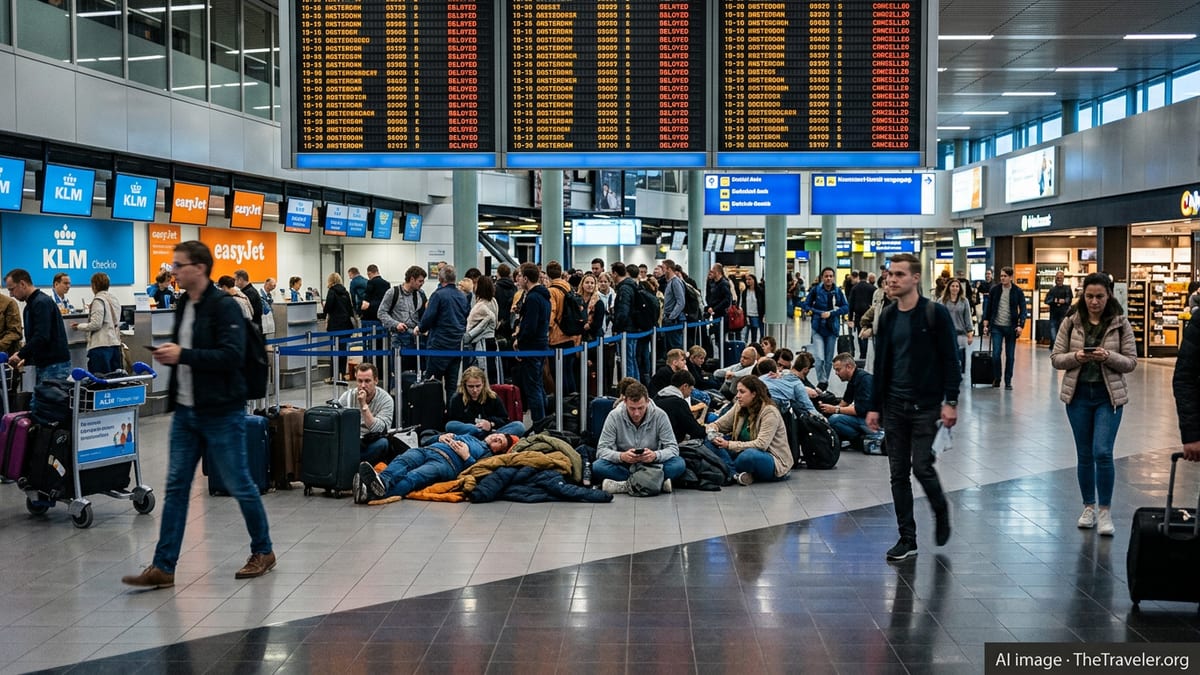
Severe Atlantic weather and knock-on scheduling problems are stranding hundreds of passengers across western Europe, as 49 flight cancellations and more than 500 delays ripple through Portugal, Spain, France and Ireland, disrupting operations at Porto, Madrid, Paris, Dublin and other major hubs.
Get the latest news straight to your inbox!
Western Europe’s Air Corridors Severely Disrupted
Publicly available disruption trackers for Europe show a fresh wave of operational problems building across major airports, with cancellations and delays concentrated in the western fringe of the continent. Data drawn from recent AirHelp disruption summaries and airport punctuality reports indicate that nearly 50 flights have been cancelled and more than 500 delayed in a single day across Portugal, Spain, France and Ireland, with Porto, Madrid, Paris and Dublin among the hardest-hit gateways.
The figures follow a pattern seen repeatedly in recent months, where relatively small numbers of outright cancellations are matched by several hundred late departures and arrivals. Industry monitoring platforms describe days with more than one thousand disrupted flights across Europe, illustrating how weather systems and staffing constraints at a handful of hubs can quickly affect schedules for airlines operating from Scandinavia to the Iberian Peninsula.
For passengers at the affected airports, the statistics translate into missed connections, unexpected overnight stays and long queues at rebooking desks. Travellers connecting between transatlantic services and intra-European routes operated by SAS, Icelandair, easyJet and other carriers are particularly vulnerable when delays compound across multiple sectors in a single itinerary.
Operational data reviewed by TheTraveler.org suggest that the current disruption is less severe than the continent-wide breakdowns recorded earlier in the year, but still significant enough to leave aircraft and crews out of position and to trigger cascade effects at secondary airports beyond the initial weather front.
Porto, Madrid, Paris and Dublin in the Crosshairs
Airport-specific statistics highlight the emerging pressure points. Porto, a growing base for low-cost and leisure airlines, has recorded fluctuating on-time performance in recent punctuality reports, with days of strong reliability punctuated by weather-related slumps that trigger wave after wave of short-haul delays. Arrivals and departures data from the airport show clusters of late flights on routes to Madrid, Paris and key European hubs that feed long-haul networks.
Madrid’s Adolfo Suárez Madrid–Barajas Airport has repeatedly appeared in disruption tallies this year, including previous days when more than a dozen cancellations and dozens of delays were recorded. When outbound services from Madrid depart late, the knock-on effect can ripple across Iberia, Air Europa and partner networks, as well as low-cost rivals and regional carriers sharing the same runway and airspace capacity.
Paris Charles de Gaulle and Orly, France’s primary international gateways, are also regular fixtures in performance analyses when weather systems or congestion affect the north of the continent. Recent winter-weather and storm events have shown how even modest snowfall, high winds or reduced visibility can lead to double-digit cancellations and several hundred delays in and out of Paris alone, straining ground-handling resources and slot allocations.
In Ireland, Dublin Airport has been repeatedly highlighted in recent coverage for experiencing heavy congestion on days of adverse weather, with reports of more than 200 delayed services in a single day earlier this year. Current disruption levels are lower but still material, with today’s delays feeding into evening bank departures to the United Kingdom, Scandinavia and continental Europe.
Airlines Grapple With Cascading Operational Challenges
The airlines most exposed to the latest wave of disruption are those that operate tight turnarounds and multi-leg itineraries across Europe’s congested airspace. AirHelp’s recent overviews of European travel disruption have repeatedly listed easyJet, SAS and Icelandair among carriers forced to reroute or reschedule services when storms, strikes or air-traffic control constraints arise.
For SAS and Icelandair, which both run connecting banks through Nordic hubs to destinations in western Europe, delays at airports such as Dublin, Paris and Madrid can quickly undermine onward schedules. A late arrival from a weather-affected airport often means a missed departure slot for the return leg, which then impacts the next rotation for that aircraft and its crew, amplifying disruption far beyond the original storm zone.
Low-cost carrier easyJet, which operates dense short-haul networks across France, Portugal and Spain, faces a similar challenge. Punctuality data and disruption reports show that when severe weather or airspace constraints hit a single base, the airline must frequently cancel a limited number of flights in order to stabilise the rest of the timetable. The current tally of 49 cancellations appears consistent with this strategy, effectively sacrificing a small portion of the schedule to protect hundreds of other departures from more severe knock-on delays.
Legacy airlines serving Porto, Madrid, Paris and Dublin are not immune. Recent European disruption summaries list traditional flag carriers such as Air France, Iberia, Aer Lingus, British Airways and TAP Air Portugal among those experiencing scattered cancellations and significant delays on days of adverse conditions, particularly where runway capacity or de-icing bottlenecks reduce the number of aircraft movements per hour.
Weather and Structural Strains Behind the Latest Snarl
Recent weeks have underscored how vulnerable European aviation remains to weather extremes. In early April, an Atlantic storm system that battered western and northern Europe generated more than 200 cancellations and almost 1,500 delays in a single day, with Dublin among the most heavily affected hubs and airlines including easyJet, SAS and Icelandair all reporting notable schedule disruption.
Operational analyses suggest that the current problems share some of the same underlying drivers, even if the immediate meteorological trigger is less intense. Strong winds, heavy rain and low cloud layers can all force air-traffic managers to reduce arrival and departure rates at busy airports, while ground-handling crews work more slowly in poor conditions. Once a morning wave of flights is disrupted, the resulting delays can linger throughout the day.
Beyond the weather itself, structural factors in the European aviation system contribute to repeated disruption episodes. Tight aircraft utilisation, ongoing staffing challenges among ground handlers and air-traffic controllers, and congested air corridors over western Europe all reduce the system’s ability to absorb shocks. When one heavily used hub such as Paris or Madrid experiences a capacity squeeze, neighbouring airports including Porto and Dublin often see inbound flights retimed or rerouted, magnifying the number of delayed services.
Regional patterns observed in punctuality reports for February and March 2026 indicate that some hubs are consistently operating close to capacity, with on-time performance metrics sliding when exceptional conditions arise. Analysts argue that without additional resilience measures, passengers should expect further days where a few dozen cancellations and several hundred delays become an unwelcome feature of European travel.
What Today’s Chaos Means for Travellers
For travellers caught in the latest disruption, the immediate challenge is navigating a crowded and often confusing rebooking landscape. Airline mobile apps and airport information screens are now the primary tools for tracking gate changes and updated departure times, and travel advisories repeatedly urge passengers not to proceed to the airport until flight status has been reconfirmed on the day of departure.
Passenger rights within the European Union and associated countries play an important role in shaping how delays and cancellations are handled. Under Regulation EC 261/2004, travellers on eligible flights may be entitled to care, assistance and, in some circumstances, financial compensation when cancellations or long delays occur. Specialist claims platforms emphasise that entitlement depends on factors such as route, operating carrier and the cause of the disruption, with extreme weather generally treated differently from operational or staffing shortcomings.
Travel-management and consumer guides recommend that passengers retain boarding passes, booking confirmations and receipts for meals, accommodation or alternative transport purchased while stranded. These documents can be critical when submitting claims later, whether directly with airlines or through third-party services that assist in recovering compensation.
As Europe heads into the peak summer travel season, analysts warn that similar disruption episodes are likely whenever strong weather systems, strikes or airspace restrictions emerge. For now, the day’s tally of 49 cancellations and 506 delayed services serves as a reminder that even a modest shock can leave hundreds of travellers stranded across Europe’s busiest air corridors.