


The Baltic Sea has two historic heavyweights facing each other across the water: Helsinki’s island fortress of Suomenlinna and Estonia’s medieval jewel, Tallinn Old Town. Both are UNESCO World Heritage sites, both are beloved by locals, and both routinely appear on Northern Europe bucket lists. Yet they deliver very different kinds of historic experiences. If you have limited time in the region, should you wander Tallinn’s cobbled lanes or sail out to the granite bastions of Suomenlinna? This guide compares them side by side so you can decide which one will leave the stronger impression on you.
Get the latest updates straight to your inbox!
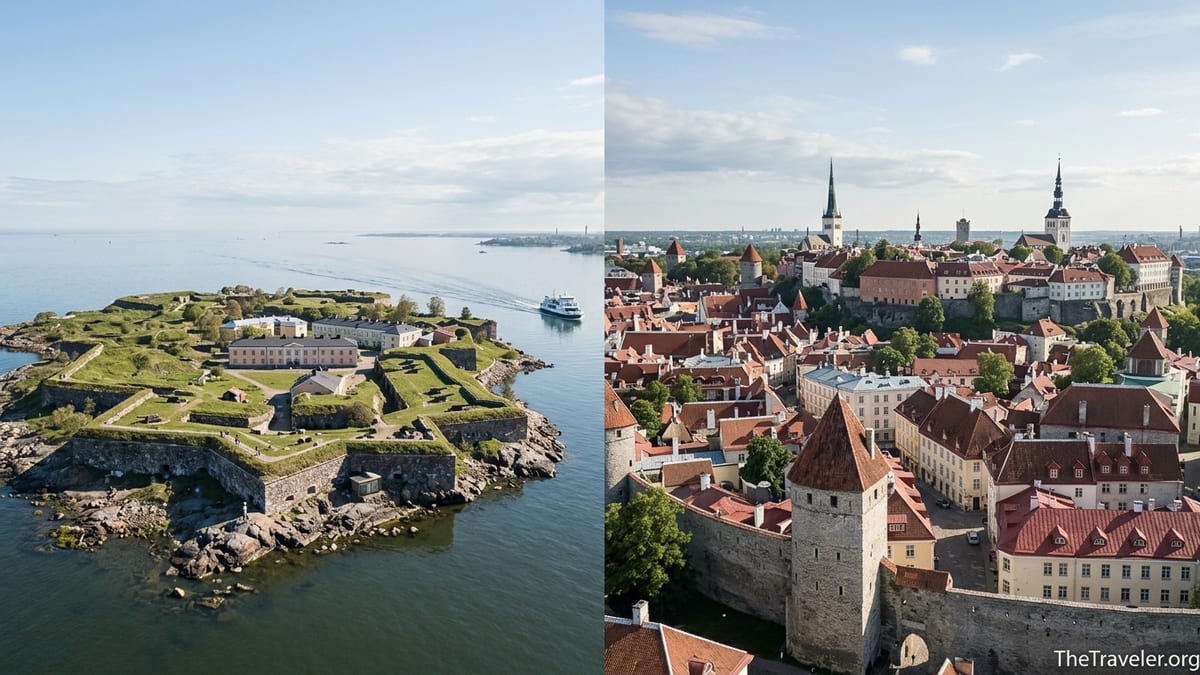
Two UNESCO Icons, Two Very Different Stories
Suomenlinna and Tallinn Old Town share UNESCO World Heritage status, but their histories and atmospheres diverge sharply. Suomenlinna is an 18th century sea fortress built on a cluster of low islands just off Helsinki, intended to guard the Swedish Empire’s eastern flank and later integrated into the Russian and then Finnish defense systems. Today, it is part open-air museum, part living neighborhood with around 800 residents and a distinctly maritime, windswept character.
Tallinn Old Town, by contrast, is one of Europe’s most intact medieval Hanseatic cities, with a 13th century street plan still largely visible in its tangle of alleys, guild houses and Gothic churches. Enclosed by thick limestone walls and studded with towers, it feels like a compact medieval city that simply kept on living into the 21st century, now housing cafes, workshops and apartments in buildings that once belonged to merchants and monastery orders.
On a typical summer day, a visit to Suomenlinna means a 15 to 20 minute public ferry ride from Helsinki’s Market Square, sea spray on the deck, and arrival at a quiet quay framed by low, pastel-colored barracks. A visit to Tallinn Old Town usually begins by passing through one of several medieval gates, such as Viru Gate, and stepping straight into a tightly packed cityscape where red-tiled roofs and spires close in overhead.
In practical terms, Suomenlinna works best as a half-day excursion from Helsinki, often combined with time in the city itself. Tallinn Old Town, on the other hand, easily fills a full day and more, and can anchor a weekend city break. If you are weighing which feels more “memorable,” start by asking whether you are drawn more to fortifications and seascapes or to layered urban history and street life.
Arrival and First Impressions: Island Fortress vs City Within Walls
The journey to each site sets the tone. To reach Suomenlinna, most visitors board the HSL public ferry from Helsinki’s central Market Square. The crossing is short, roughly 15 to 20 minutes, but surprisingly atmospheric. You pass ice-scored rock islets, see Helsinki’s skyline recede, and glide past the fortress ramparts themselves before docking at the main pier. The experience feels like entering history by water, much as soldiers and sailors would have done in previous centuries, and the only “ticket” you need is a regular Helsinki transport ticket, since there is no separate entrance fee to the islands.
Arriving in Tallinn Old Town is the opposite: instead of sea and sky, you are plunged into dense stone and brick. From the ferry port or the modern city, most travelers approach on foot, passing through gates like Viru or the towers near the Fat Margaret cannon tower. Within moments you leave behind glass facades and tram lines and find yourself under high walls, hemmed in by medieval houses, with cobblestones ringing underfoot.
First impressions color many travelers’ memories. Some visitors recall their first sight of Suomenlinna as low, grassy ramparts and rusting cannons against the Baltic, a place that feels both strategic and strangely peaceful. Others remember Tallinn Old Town’s first moments as sensory overload: street musicians playing in Town Hall Square, the smell of roasted almonds from a stall dressed in faux-medieval garb, and the sudden sight of St Olaf’s spire towering above the roofs.
If you travel between Helsinki and Tallinn by commercial ferry, you can experience both in a single trip, but the emotional contrast is striking. One is about leaving the city behind and entering a self-contained maritime world; the other is about stepping through the skin of a modern capital into what feels like an intact medieval city center.
Depth of History: Military Stronghold vs Living Medieval City
Suomenlinna tells a focused story of military architecture and shifting empires. Built in the mid-18th century when Finland was part of Sweden, it later served Russia and finally independent Finland. Walking the main route from the Jetty Barracks to the monumental King’s Gate, you pass dry docks that once serviced an archipelago fleet, earth ramparts designed to withstand naval bombardment, and powder magazines now softened by grass.
Museums on the islands add depth. The Suomenlinna Museum’s permanent exhibition, for example, covers more than 270 years of fortress history across Swedish, Russian and Finnish periods, using models, artifacts and a short film to explain how the fortress operated through wars and peacetime. Scattered around the islands, smaller museums look at topics such as military history and submarine warfare, anchoring what could otherwise feel like a purely scenic walk.
Tallinn Old Town’s history is broader and more urban. The area reflects centuries of trade, religion and daily life in a Hanseatic port city. Its layout clearly preserves the divide between the upper town of Toompea, historically a seat of power, and the lower town, where merchants and guilds conducted business. Surviving sections of the town walls, along with towers such as Kiek in de Kök, speak to a city that had to defend its prosperity from both external enemies and internal fires.
Instead of one overarching narrative of fortification design, Tallinn’s Old Town offers overlapping stories: Lutheran churches adapted from earlier Catholic ones, a town hall pharmacy that has operated for centuries, and courtyards where merchant houses open onto storage spaces that once held salt and grain. Where Suomenlinna lets you inhabit a particular military past, Tallinn invites you to imagine the full fabric of medieval urban society, from ruling elites to artisans and apothecaries.
On-the-Ground Experience: Walking Routes, Crowds and Atmosphere
In Suomenlinna, the main experience is a linear island walk. Official maps suggest a blue-marked route that takes around one to one and a half hours at a gentle pace, starting from the Visitor Centre near the main pier and threading past defensive walls, bastions, a church that doubles as a lighthouse, and the King’s Gate at the far end. Many travelers linger on rocky shorelines for picnic stops, watching ferries and cruise ships glide through the archipelago.
The atmosphere is generally calm, even in high season. There are no cars, just the occasional service vehicle, and the scale is low and human. You might pass school groups on excursions, local residents walking dogs, and small art galleries or cafes set in former military buildings. Even when cruise groups arrive, it is usually easy to step off the main path to quieter corners, such as the back of Susisaari island or lesser-used shoreline trails.
In Tallinn Old Town, the experience is far more urban and vertical. You navigate a network of streets where gradients can be steep, especially when climbing to Toompea Hill. Landmark viewpoints at Kohtuotsa and Patkuli platforms deliver sweeping views over a forest of red-tiled roofs and Gothic church towers, but may involve staircases and cobbled ramps. In peak summer and during events like Tallinn Old Town Days or Christmas market season, narrow streets around Town Hall Square can be densely packed.
The atmosphere shifts block by block. Just a turn or two away from the main squares, side streets around the city wall or near former monasteries can feel as quiet and contemplative as Suomenlinna’s back paths. Yet you are never far from modern cafes, wine bars and design shops occupying the ground floors of centuries-old houses. For many travelers, it is this tension between historical setting and lively everyday use that makes Tallinn memorable.
Must-See Highlights and Real-World Examples
In Suomenlinna, one of the most memorable sights is the Great Courtyard, a broad, grassy square framed by long, low barracks where soldiers once drilled. Today it can feel almost village-like, with kids kicking a football where regiments once assembled. Another strong impression comes from the King’s Gate, a monumental stone portal carved into the rock at the southeastern edge of the fortress. Standing there on a windy afternoon, waves slapping against the quay and ferries passing in the distance, you get a real sense of the fortress as a gate to the city.
Many visitors also single out the submarine on display at the Military Museum and the preserved dry dock, which gives a tangible sense of how ships were built and repaired in the age of sail. Because entry to the islands themselves is free, spending becomes a matter of choices: perhaps a small fee for a museum ticket, coffee in a cafe housed in a 19th century bakery, or a simple supermarket picnic carried from Helsinki.
In Tallinn Old Town, the iconic highlights cluster close together, creating a dense run of experiences. The Town Hall Square, with its pointed-gable merchant houses and Gothic town hall, often forms the visual centerpiece. In winter, this is where a Christmas market sets up, complete with lights, glühwein stalls and a tall tree, turning the whole square into a festive set piece framed by medieval facades.
Climbing a tower of St Olaf’s Church or another high viewpoint delivers a different kind of memory. Looking down over the red roofs, you can trace the old fortifications encircling the city and pick out towers like Fat Margaret and Kiek in de Kök along the line of walls. On the ground, a visit to sections of the city wall open to the public lets you physically walk inside the fortifications, peering through narrow windows that once hosted archers. Paired with a stop in a centuries-old pharmacy or a visit to an underground bastion passage, the day can feel like a layered, immersive dive into everyday medieval life.
Practicalities: Time, Cost and Seasonal Considerations
Suomenlinna is straightforward to weave into a Helsinki itinerary. The public ferry runs year-round from early morning until late at night, with at least several departures per hour in the daytime. You use the same tickets as for trams and buses, so there is no special “tourist premium” for the boat ride itself. Once on the islands, you can explore freely at your own pace without an entry fee, which makes it attractive for budget-conscious travelers. The main constraint is time and weather: in winter, short daylight and wind off the Baltic can make walks bracing and limit how long you want to linger outdoors.
Tallinn Old Town is accessible in all seasons too, but the way you experience it changes more dramatically. In July and August, long evenings, outdoor terraces and numerous events create a busy, lively atmosphere. Winter brings early darkness and icy cobbles, but also cozy cafes and the atmosphere of Christmas markets. Prices inside the Old Town can be higher than in surrounding neighborhoods, especially at restaurants directly on the main squares, so some travelers choose to eat or stay just outside the walls and wander in for sightseeing.
Time-wise, Suomenlinna fits comfortably as a three to five hour excursion, including ferry crossings and some cafe or picnic stops. Tallinn Old Town rewards a full day at minimum, and many visitors choose to stay overnight or longer, using it as a base to explore modern Tallinn districts beyond the walls. If you are taking a day trip by ferry from Helsinki to Tallinn, factoring in crossing times and port procedures, you can still see the core sights, but you may feel rushed compared with the unhurried half-day rhythm of Suomenlinna.
Seasonal limitations affect both experiences. Suomenlinna’s grassy ramparts and seaside rocks are at their best from late spring to early autumn; in slippery winter conditions, some paths can be less pleasant and winds harsh. Tallinn’s steep lanes and viewpoints can also be tricky in ice and snow, though city crews usually keep main routes passable. If your trip falls in shoulder seasons, both destinations can feel pleasantly uncrowded, amplifying their sense of history.
Which Is More Memorable for Different Types of Travelers?
For travelers fascinated by military history, fortification design and seafaring, Suomenlinna often leaves the deeper mark. The very act of reaching it by boat, walking bastions with grass-covered earthworks, and seeing where guns once defended the harbor creates a strong, self-contained narrative. It also appeals to those who enjoy quiet, scenic places: photographers capturing low-angled evening light on stone walls, families with kids scrambling over rocks, or solo travelers looking for a peaceful escape from city streets.
For lovers of medieval urban history, architecture and street culture, Tallinn Old Town tends to win. It offers an almost theatrical backdrop for wandering, where every turn reveals a new mix of gables, towers and tiny courtyards. Travelers interested in religion, guilds or everyday life in historic Europe will find more varied clues here: churches, cloisters, merchant houses, city archives and small museums that together sketch an entire society rather than a single fortress.
If you are traveling with children, the choice can be nuanced. Suomenlinna gives kids space to run, grassy slopes to roll down, cannons to climb on and a clear “fortress” story that is easy to grasp. Tallinn Old Town offers more varied stimulation, from costumed performers at festivals to towers you can climb, but it also involves more walking on hard cobbles and managing crowds. For travelers with reduced mobility, Suomenlinna’s paths include some uneven surfaces but are generally more forgiving than Tallinn’s steep, cobbled streets, though both have accessible routes with some planning.
Ultimately the more memorable experience often aligns with your travel personality. Minimalists who like a single strong theme and natural surroundings lean toward Suomenlinna. Travelers who thrive on sensory richness, cafes, viewpoints and layered histories gravitate toward Tallinn Old Town. If you have several days in the region, combining both gives you a compact masterclass in Baltic history: one day on an 18th century sea fortress, another inside a medieval Hanseatic city.
The Takeaway
Choosing between Suomenlinna and Tallinn Old Town is less about which is objectively “better” and more about what kind of historical atmosphere you want to inhabit. Suomenlinna delivers a maritime, contemplative experience where fortress walls, grass and the open sea dominate, and the story centers on defense, empire and strategic geography. Tallinn Old Town immerses you in a dense urban tapestry where merchants, monks, rulers and modern residents all seem to coexist in narrow lanes and along high walls.
If your schedule only permits one, think about how you want to remember the Baltic: as a windswept archipelago scattered with bastions and cannons, or as a compact city of spires and cobbles glowing under lantern light. Either way, you will be walking through a landscape where the past remains unusually visible. With a bit of planning, you can even let the Baltic ferries carry you between both worlds and decide for yourself which historic experience lingers longest after you return home.
FAQ
Q1. Can I visit both Suomenlinna and Tallinn Old Town in one weekend?
Yes, it is realistic to see both in a weekend if you base yourself in either Helsinki or Tallinn and use the frequent ferries between the two cities, but you will need to prioritize key sights and accept a fairly full schedule.
Q2. Which is better for a short layover in Helsinki, Suomenlinna or a day trip to Tallinn?
For a short layover of less than a full day, Suomenlinna is usually the better choice because the ferry crossing is short, it uses local transport tickets, and you avoid international ferry timings and border formalities required to reach Tallinn.
Q3. Is Tallinn Old Town very crowded in summer?
In July and August, Tallinn Old Town can be busy, especially around Town Hall Square, Viru Gate and the main viewpoints, but quieter side streets and sections of the city wall are often much calmer just a few minutes’ walk away.
Q4. Is there an entrance fee to Suomenlinna?
No, there is no entrance fee to the Suomenlinna islands themselves; you only pay for the ferry and any optional museum tickets, tours, food or drinks you choose to purchase during your visit.
Q5. Which destination offers better views for photography?
Tallinn Old Town offers elevated views from platforms and church towers over red roofs and towers, while Suomenlinna provides low, wide seascapes and fortress walls; the “better” views depend on whether you prefer city panoramas or coastal landscapes.
Q6. How much walking is involved at each site?
Suomenlinna involves a mostly level walk of around one to one and a half hours along marked paths, while Tallinn Old Town requires more varied walking, including cobbled streets, slopes and stairways if you visit hilltop viewpoints and tower interiors.
Q7. Is one destination more child-friendly than the other?
Both can be enjoyed with children, but Suomenlinna is generally more relaxed for families, with open spaces, grass, rocks to explore and fewer cars, while Tallinn offers more urban stimulation but can be tougher for small children on cobbles and in crowds.
Q8. Can I experience local food in both places?
Yes, Suomenlinna has a handful of cafes and restaurants, some in historic buildings, while Tallinn Old Town has a large range of eateries from simple bakeries to atmospheric restaurants serving Estonian and broader Baltic cuisine.
Q9. Which is more budget-friendly overall?
Suomenlinna tends to be more budget-friendly because there is no entrance fee, the ferry uses regular public transport tickets, and you can easily self-cater, whereas Tallinn Old Town, though still reasonable by European capital standards, often encourages more spending on dining and activities.
Q10. If I love medieval history, should I prioritize Tallinn Old Town?
Yes, if your primary interest is medieval urban life, architecture and city walls, Tallinn Old Town is the stronger choice, while Suomenlinna is ideal if you are more drawn to later-period fortresses and maritime military history.