


For many first-time visitors, Helsinki’s maritime story begins and ends with a half-day trip to Suomenlinna. The sea fortress deserves its world heritage status, but the waters and neighborhoods around it hold quieter, more local corners that most travelers never reach. Planning even a day around these lesser-known places can completely change how Suomenlinna – and Helsinki itself – feels.
Get the latest updates straight to your inbox!
Why Look Beyond the Walls of Suomenlinna
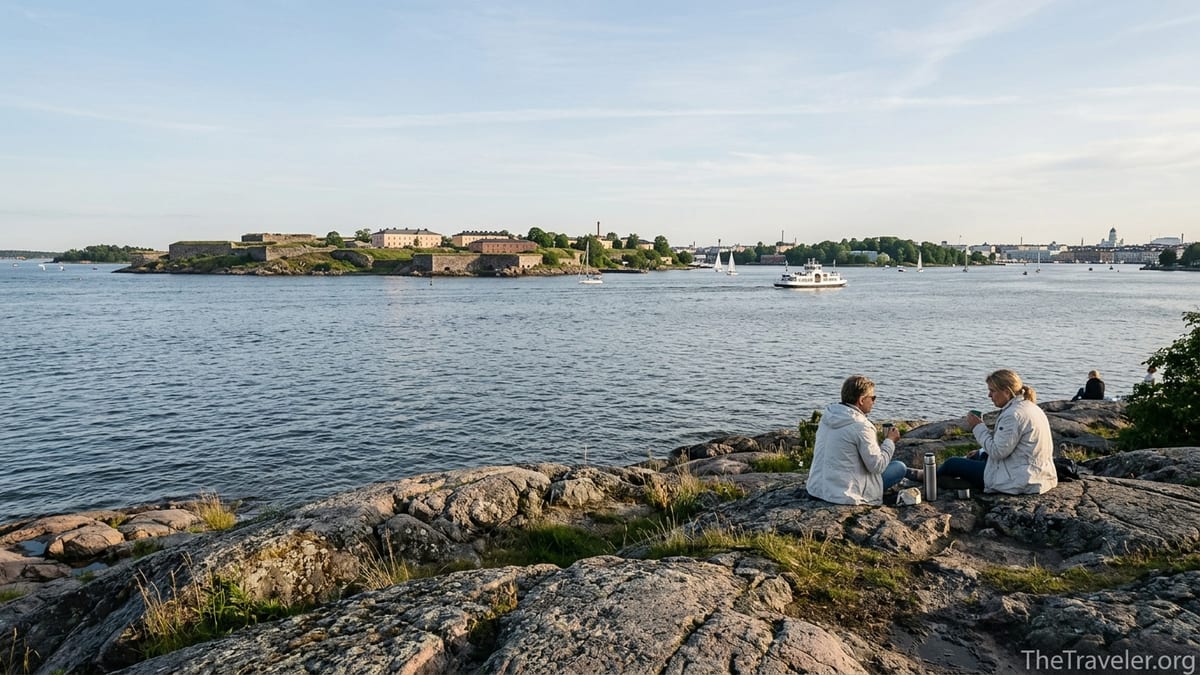
On a summer afternoon, the main route through Suomenlinna can feel almost as busy as Helsinki’s city center. Day-trippers funnel from the ferry pier past the visitor center and cafés toward the King’s Gate, then loop back again. It is a beautiful circuit, but it is only one fragment of a much larger archipelago and shoreline cultural landscape. Within the same waters you can find car-free islands where you might share a rock with a couple of locals and a thermos of coffee, rather than dozens of tour groups.
What many visitors do not realize is how compact this area is. From the Market Square, ferries fan out not only to Suomenlinna but also to small nearby islands such as Vallisaari and Lonna in about 10 to 20 minutes, with a similar boarding process and comparable ticket prices. On land, coastal paths lead from the same downtown waterfront to parks and neighborhoods where Helsinki residents come to walk, swim and watch the fortress islands from a distance. With a little planning, you can see the famous fortress and still spend several hours in places where the city moves at its own pace.
Thinking beyond Suomenlinna is less about skipping a major sight and more about balancing it. If you visit the fortress in the morning, for example, you can spend your afternoon wandering through early 20th century streets in Eira and Ullanlinna, or walking out to Kaivopuisto park to watch ferries slide past Suomenlinna’s profile on the horizon. By connecting these dots, you turn a standard excursion into a full maritime day that feels both iconic and intimate.
Vallisaari: Wild Neighbor to a World Heritage Fortress
Just a short boat ride from the same Market Square that serves Suomenlinna, Vallisaari has quietly emerged as one of Helsinki’s most rewarding day-trip islands. Once closed to civilians and used by the Finnish Defence Forces, the island only opened to visitors in 2016. Today it is known locally for its lush, almost overgrown atmosphere, in contrast to Suomenlinna’s more manicured battlements. Trails here cut between mossy old fortifications, meadow clearings and rocky viewpoints looking straight across to the fortress walls on Suomenlinna.
Vallisaari is structured around two marked routes: Alexander’s Trail, roughly 3 kilometers, and the Kuninkaansaari loop of around 2.5 kilometers that continues via a causeway to the neighboring island. Signage encourages people to stay on path, both for safety and to protect the dense plant life that has flourished in the decades since military use. Benches and lookouts are placed at intervals where the view opens to the open sea, the skyline of central Helsinki or the silhouette of the white cathedral behind the harbor. On a typical summer day you may pass families, birdwatchers and a few photographers, but the island still feels significantly quieter than Suomenlinna’s busiest spots.
Services on Vallisaari remain modest by design. In recent seasons there have been seasonal cafés, a small harbor, dry toilets and a limited number of pre-bookable tent-like tree hammocks for those who want to stay overnight. Sauna lovers can check for public slots at the island’s shore sauna, typically run on a seasonal timetable. Even without booking anything, however, a half-day visit is simple to arrange: waterbuses run between roughly May and September, often priced similarly to other local archipelago routes, and you can comfortably walk the main circuit in two to three hours with stops.
Lonna: Small-Island Slow Life Within Sight of the City
Where Vallisaari feels wild, Lonna is all about small-scale, human-sized simplicity. The tiny island sits almost on the line between the Market Square and Suomenlinna, so close to the city that you can clearly see the domes of Uspenski Cathedral and the cranes of the harbor. Historically used for naval purposes, the island has in recent years been carefully converted into a low-key recreation spot, with a restaurant, a relaxed outdoor terrace, a public sauna and a few event spaces.
Most visitors arrive on a separate waterbus service that runs during the warmer months, often from late spring into early autumn. The crossing takes only about 10 minutes. The absence of cars and the compact size of the island mean that within a few minutes you can walk from the ferry pier to the rocky shoreline, find a flat rock facing the sea and watch ferries slide past toward Suomenlinna. It is an easy add-on for anyone who wants the feel of the archipelago without committing to a long hike or multi-island itinerary.
Lonna is particularly pleasant towards the late afternoon and early evening. Locals book sauna slots in advance, combining a steam with a swim off the ladder into the Baltic and then a drink on the terrace. Seating is informal, and you will see everything from couples in wool sweaters to families with children sharing plates from the restaurant kitchen. Prices on the island are comparable to central Helsinki cafés and bistros, so it is worth budgeting for at least one drink or a simple meal to make the most of the atmosphere.
Kaivopuisto: Classic Seaside Park Life with Fortress Views
South of the Market Square, the coastline bends toward one of Helsinki’s most historic green spaces: Kaivopuisto. Locals know it as Kaivari, a large waterfront park that dates back to the 19th century and now blends lawns, rocky promontories and a band of embassies and villas. On clear days the paths along the water are full of joggers, parents with prams and people carrying supermarket picnic supplies to the nearest smooth rock ledge overlooking the sea. From many of these spots you get a textbook view of Suomenlinna as a low line of fortifications across the water, providing the context that is hard to appreciate when you are on the island itself.
Although Kaivopuisto features in some guidebooks, it rarely feels crowded by international visitors. That is partly because it sits a pleasant walk away from the core tourist circuit. From the Market Square you can stroll along the shore roads, past small marinas and café terraces, and reach the park in 20 to 30 minutes depending on your pace. Tram lines and buses serve the surrounding Ullanlinna district, but many locals prefer to walk, treating the approach as part of the outing. In summer, you might pass outdoor yoga classes, groups grilling at designated spots and clusters of people at the clifftop café terraces that open seasonally.
Kaivopuisto is also one of the best places to feel Helsinki’s “city by the sea” character without leaving the mainland. The park slopes gently from tree-lined lawns down to bare granite where people sit almost at water level. From here you can watch the ferries that connect to Stockholm and Tallinn, smaller waterbuses heading toward Vallisaari, Lonna or Suomenlinna, and even local paddleboarders cutting quietly across the bay. On long summer evenings, when daylight stretches late, it can be worth timing your Suomenlinna visit for earlier in the day and then returning to Kaivopuisto for a slow walk and sunset picnic.
Eira and Ullanlinna: Architectural Calm Behind the Shoreline
Just behind Kaivopuisto, the districts of Eira and Ullanlinna offer a very different kind of Helsinki experience. These early 20th century neighborhoods grew up when Finland was still part of the Russian Empire. Today they are known for their Jugend and Art Nouveau buildings, many of them now home to embassies, design studios and sought-after apartments. While downtown streets closer to the railway station can feel functional and busy, Eira and Ullanlinna are remarkably calm, with small parks, curving streets and façades that reward slow looking.
One way to include these neighborhoods before or after Suomenlinna is to follow a simple loop. From the Market Square, walk uphill toward the historic center, then angle southwest toward Ullanlinna, eventually descending again to the shoreline near Kaivopuisto. Along the way you will pass pastel-colored apartment houses with ornate balconies, narrow side streets where you might glimpse small courtyards, and corner cafés that cater more to locals than tour groups. Prices for coffee and pastries are similar to the rest of the city, but you may find more Finnish being spoken around you than near the harbor.
Eira, slightly further west, has a reputation as one of Helsinki’s most affluent residential pockets. Its streets mix steep hills, small squares and glimpses of the sea at the end of cross streets. It is not a place of big-ticket attractions; rather, the draw lies in feeling the everyday fabric of the city. For visitors who enjoy photography, this is a good area to capture characteristic Helsinki details: granite base courses, carved wooden doors, wrought-iron railings and lamps. If you plan your Suomenlinna visit for the morning ferry and return by early afternoon, you can easily spend the rest of the day wandering Eira and Ullanlinna without ever needing to board another vehicle.
Planning a Day that Combines Suomenlinna with Hidden Corners
Because the ferry to Suomenlinna runs as part of the regular public transport system, it is straightforward to organize a layered day combining the fortress, nearby islands and shoreline neighborhoods. A practical approach is to start early, catching a morning ferry to Suomenlinna before the bulk of day-trippers. Spend two to three hours there following the main route, visiting at least one of the museums that are open in your season, and walking out to the more open rocks near the southern edge where you can watch ships pass. Instead of lingering for lunch, consider bringing a simple picnic bought in the city to give you more time later elsewhere.
By late morning or around midday, continue your day in one of two ways. If the weather is calm and you are keen on islands, return to the Market Square and board a boat to Vallisaari or Lonna. Both crossings take less than half an hour, and you can often buy tickets from a small kiosk at the pier or in advance via local transport apps. On Vallisaari, follow Alexander’s Trail and plan a café stop partway through. On Lonna, you might limit yourself to a lunch and short shoreline stroll before returning. For a more urban feel, skip the second island and instead walk or take a tram south to Kaivopuisto, then slowly make your way along the coast, watching the fortress from different angles.
Whichever combination you choose, one of the rewards of this approach is perspective. Seeing Suomenlinna only from within its bastions can make it difficult to understand why it was built there in the first place. Observing it from Vallisaari’s viewpoints, from the terrace at Lonna or from the rocks in Kaivopuisto lays out the geography in front of you. The narrow channels, the shipping lanes into the modern harbor and the chain of low islands become more obvious. That sense of the bigger picture, combined with quieter, more local corners, is what turns a routine half-day tour into something more like a small maritime journey.
Seasonal Tips and Practical Details
The experience of both Suomenlinna and its lesser-known neighbors changes markedly across the year. In summer, from roughly June to August, all services are in full swing: ferries run frequently, cafés and restaurants keep extended hours, and outdoor terraces on islands like Lonna or in Kaivopuisto’s seafront pavilions are at their liveliest. This is also when the islands are at their greenest, with Vallisaari’s meadows in bloom and the lawns of Kaivopuisto packed on weekends. Prices for food and drink do not spike dramatically with the season, but you can expect slightly longer queues at the most popular spots on fine-weather days.
In spring and autumn, when waterbus schedules are more limited, it becomes even more important to check departure times a day or two in advance. Regular public ferries to Suomenlinna generally operate year-round, even cutting through ice in midwinter, but seasonal boats to islands like Vallisaari and Lonna are tied to navigable waters and demand. Shoulder seasons can be ideal if you are comfortable with cooler temperatures. You may need a windproof jacket, but in return you get quieter paths, easier photo opportunities and, on some days, a sense of having sections of trail almost to yourself.
Winter presents a different set of trade-offs. The fortress is starkly beautiful under snow, and the ferry crossing through ice can be a memorable experience. At the same time, daylight is short, many outdoor cafés are closed, and trails on less visited islands may not be accessible at all. In this period, pairing a shorter Suomenlinna visit with an afternoon exploring Eira, Ullanlinna and the waterfront cafés near Kaivopuisto can be more comfortable than building a multi-island day. Regardless of season, shoes with good grip, layered clothing and a thermos or reusable bottle can make a surprising difference to your comfort, especially if you intend to spend several hours outside.
The Takeaway
For many travelers, Suomenlinna will always be the headline act of a trip to Helsinki. Yet the waters and neighborhoods around the fortress reward curiosity at least as much as the ramparts themselves. Vallisaari’s wild greenery, Lonna’s compact charm, the long lawns of Kaivopuisto and the calm streets of Eira and Ullanlinna all offer different ways to understand how Helsinki has grown around its maritime setting.
By looking beyond the fortress walls, you are not adding obscure detours so much as completing the picture. A morning among bastions and tunnels followed by an afternoon on a quiet shoreline rock, or a slow walk through embassy-lined streets, turns a standard itinerary into a connected, human-scale day. You still take the classic ferry ride, still photograph the cannons and courtyards, but you also carry home memories of watching the same islands from across the water, alongside the people who live with them every day.
FAQ
Q1. Can I visit Vallisaari and Suomenlinna on the same day?
Yes, many visitors combine them. With an early ferry to Suomenlinna and a mid-day boat to Vallisaari, you can comfortably walk both in one long summer day.
Q2. Do I need a separate ticket for Lonna and Suomenlinna?
Usually yes. The public ferry to Suomenlinna is part of the city transport system, while Lonna is served by a separate seasonal waterbus with its own tickets.
Q3. Is Kaivopuisto worth visiting if I am short on time?
If you like seaside walks, Kaivopuisto is an easy and rewarding add-on. From the Market Square you can reach it on foot in under half an hour along scenic shoreline paths.
Q4. Are shops and cafés on the smaller islands open year-round?
No. On Vallisaari and Lonna most services operate only in the warmer months, typically from late spring to early autumn, so always check seasonal opening times.
Q5. Can I swim near Suomenlinna or the other islands?
In summer, locals swim from designated spots on Suomenlinna, Lonna and parts of the Kaivopuisto shoreline. Water is cold by many standards, so enter carefully and follow local signs.
Q6. How much walking should I expect on Vallisaari?
The main marked routes are around 3 kilometers and 2.5 kilometers. With viewpoints and photo stops, most people spend two to three hours walking at an easy pace.
Q7. Are Eira and Ullanlinna suitable for families with children?
Yes. Streets are generally quiet, pavements are good for strollers, and you are close to parks like Kaivopuisto, where children can run, climb rocks and play.
Q8. What should I wear for a multi-stop day around the islands?
Dress in layers, bring a windproof jacket and wear comfortable shoes with good grip. Weather can change quickly, even in summer, especially out on exposed rocks.
Q9. Is it possible to visit these places on a budget?
Yes. Ferries are relatively affordable, and walking in parks and neighborhoods is free. Save money by bringing snacks or a picnic and limiting paid museum visits.
Q10. Do I need to book anything in advance?
For ferries and regular visits, advance booking is rarely essential in summer. However, saunas, special tours and some island restaurants may require or strongly recommend reservations.