


I had seen countless photos of Helsinki’s Temppeliaukio Church, the so called Rock Church, before I finally stepped through its doors. From above, it looked like a low concrete disc dropped into a granite outcrop, interesting but hardly emotional. I assumed it was one of those places that Instagram had made more famous than it deserved to be. It was only after visiting in person, standing beneath the copper dome while a piano rehearsal floated through the air, that I finally understood why this church has become one of Finland’s most talked about buildings.
Get the latest updates straight to your inbox!
Arriving at a Church Hidden in Plain Sight
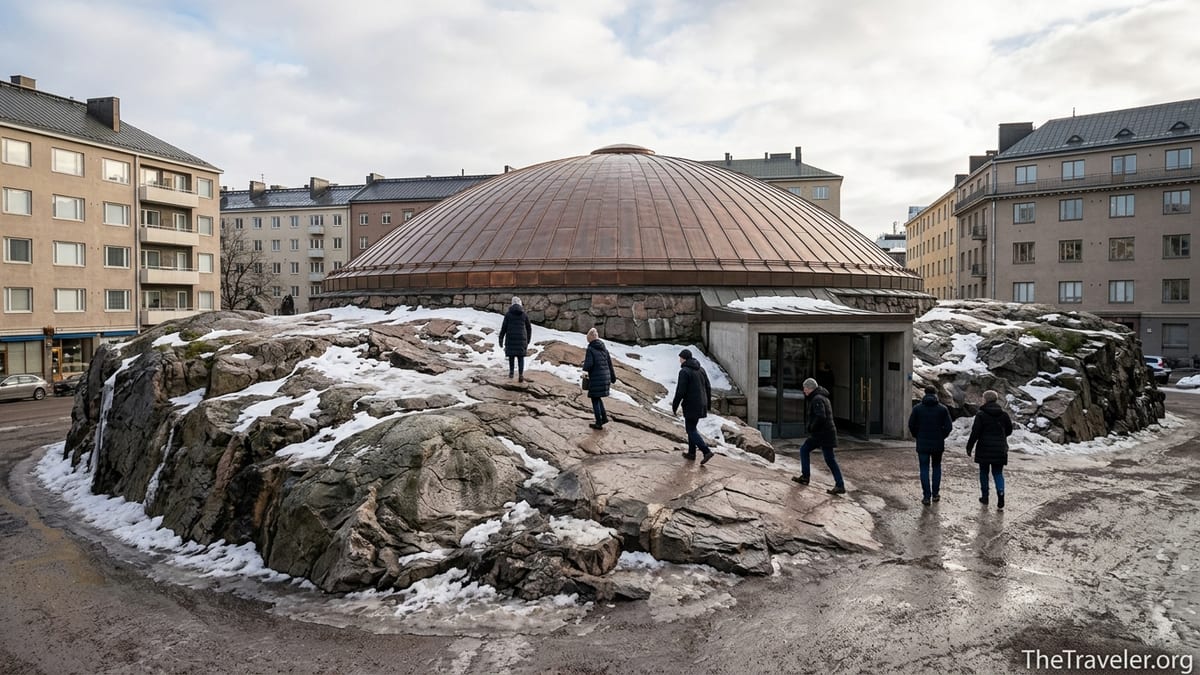
Temppeliaukio Church sits in the Töölö district, a short walk from Kamppi and Helsinki’s compact downtown, yet it manages to feel tucked away. Coming along Fredrikinkatu or from the residential streets around Lutherinkatu, you do not see a soaring spire or ornate facade. Instead, you come upon a rocky hill with a low circular structure cut into the stone and a ring of ribbed copper peeking above street level. On a winter morning, when I arrived, the rock was dusted in snow and local children were using one side of the slope as an improvised slide, barely glancing at the sightseers filtering toward the entrance.
This first impression already hints at why the church is so celebrated. Completed in 1969 by architect brothers Timo and Tuomo Suomalainen, it was carved directly into two billion year old bedrock rather than built on top of it. The rugged granite around the entrance is not decorative landscaping added later; it is the original hillside into which the church has been excavated. From the street, the building reads more like a natural outcrop than a traditional house of worship, and that decision to prioritize landscape over monumentality remains radical even today.
Practical details matter to travelers here too. The church is open most days of the year, typically from around mid morning to late afternoon, but hours shift frequently with services and concerts. On the day I visited in early spring, public visiting ended at 3:30 p.m. for a wedding. Other days it stays open until 5:00 p.m. or later. Entrance is ticketed during visiting hours, and recent prices have been in the range that makes it comparable to visiting a major museum rather than a free neighborhood church. For anyone planning a trip, it is worth checking the same day’s schedule rather than assuming fixed hours.
Despite the controlled entry, stepping down the ramp and through the doors does not feel like joining a theme park queue. Inside, a small foyer with simple wooden ticket counters gives onto the main hall, and it is only when you turn the final corner that the true impact of the space registers.
Inside the Rock: First Impressions of the Sanctuary
The shock of Temppeliaukio’s interior comes from how unapologetically raw it is. The circular sanctuary is encircled by rough rock walls that still bear the drill marks from excavation. Instead of hiding the scars of construction, the architects made them part of the design, letting the natural fractures and ledges guide the shape of the room. The walls rise irregularly around the space, a continuous band of grey and reddish granite that feels closer to a cave than a cathedral.
Above this ring of stone floats the church’s most distinctive feature, a shallow copper dome lined with spiraling bands of metal. In person, the copper reads as a warm, matte gold rather than a bright metallic surface, and it is punctuated by 180 slender glass skylights that create a halo of daylight around the perimeter. On the crisp day I visited, the low Nordic sun poured in from one side, tracing a shifting line of light across the rock and seating. At other times, especially in summer evenings, the light can be soft and diffuse, lending the whole space a gentle glow that visitors consistently mention in recent reviews.
What photographs rarely capture is how quiet the room feels even when it is busy. On my visit, several coach groups arrived within minutes of each other. There were cameras clicking, whispered explanations in English, Japanese, and Spanish, and the occasional shuffle of boots on the stone floor. Yet the rock absorbs much of the ambient noise. There is no harsh echo, no metallic clang. It feels, quite literally, grounded. The altar, framed by a natural rock crevice and a simple cross, seems to grow out of the bedrock. The combination of minimal furnishings, stone, and soft light makes the room feel more like a sheltered clearing in the forest than an urban church.
Standing near the back, I realized how different this is from many other famous European churches. There is no stained glass narrative to decode, no gilded side chapels demanding attention, no historical figures laid out in marble effigy. Instead, the drama comes from the meeting of geology and human engineering. That restraint is part of why architects, designers, and everyday travelers all cite Temppeliaukio as a masterpiece of modern Nordic design.
Hearing the Space: Acoustics That Explain the Hype
If the architecture explains half of Temppeliaukio’s fame, the acoustics explain the rest. The rock walls, left intentionally rough rather than smoothed or covered, diffuse sound in a way that specialists describe as both rich and clear. The copper dome and concrete ribs above act as a gentle reflector, helping project sound evenly throughout the room. This was not accidental. Finnish conductor Paavo Berglund and acoustical experts were consulted during the design, and their requirements directly influenced the decision to leave the rock exposed.
I had read that the church hosts hundreds of concerts in a typical year, ranging from organ recitals and chamber music to choir performances and even occasional folk or contemporary shows. That sounded impressive on paper, but it was only during an unadvertised piano rehearsal, which began while I was walking the perimeter, that the praise fully made sense. A single pianist on the modest stage began to work through a piece by Sibelius. The first notes were soft and unassuming, but they seemed to bloom in the space, hanging in the air without echoing harshly. Even from the far side of the sanctuary, every phrase was distinct.
Travelers who time their visit to coincide with a concert often talk about this same experience. In recent seasons, visiting ensembles and competitions have chosen Temppeliaukio specifically because the venue enhances unamplified instruments. A choir can sing pianissimo and still reach the back rows. A single violin can fill the dome without needing microphones. This makes the church a favorite with musicians, who appreciate not just the spectacle but the practical acoustical qualities.
From a visitor’s point of view, this also changes how you use the space. Instead of rushing in, snapping a few photos, and leaving after five minutes, it is worth sitting for a while simply to listen. Even when there is no scheduled performance, there is often someone practicing or quietly playing the church’s organ or grand piano. On my visit, I found myself staying well beyond the typical thirty minute window, letting the sound and silence alternate. It is the kind of place where you notice small details, like the way a single cough from the gallery emerges clearly and then disappears, or how footsteps on the wooden platform create a soft rhythm that never overwhelms conversation.
Design Details That Reveal Themselves Slowly
The more time you spend inside Temppeliaukio, the more its modest details come into focus. The seating, for instance, consists of simple wooden pews with blue upholstery rather than ornate carved benches. The color, a muted Nordic blue, contrasts with the earthy tones of the rock and copper, echoing the palette you see outside in Helsinki’s harbor and granite shoreline. This quiet color choice is not just aesthetic; it ensures the congregation and visitors remain visually grounded instead of competing with the dramatic architecture.
Along the perimeter, narrow walkways and small staircases lead to slightly elevated viewpoints. From one of these galleries, I could look down on the concentric rings of seating and the central altar, gaining a sense of how the sanctuary nestles perfectly into the circular excavated pit. You can trace the line where bare rock transitions to the band of glass and then to the copper dome. Unlike many historic churches, nothing here feels added as an afterthought; every element relates directly to the original competition idea of a structure growing out of the rock.
Another subtle but important feature is how the church handles natural light in a city known for dramatic seasonal shifts. In the long days of June, when Helsinki barely gets dark, the skylights allow a soft, continuous daylight to bathe the interior. In the depths of December, when the sun sits low and brief, the openings concentrate what light there is into a golden ring. On overcast days, which are frequent along the Baltic, the glass still captures ambient brightness without causing glare. This makes every visit slightly different. Travelers who have been more than once often remark that the church felt like an entirely new space on a winter afternoon compared with a summer morning.
Small human touches keep the building from feeling like a cold design exercise. Near the entrance, a modest shop sells postcards, music recordings from concerts held in the church, and simple souvenirs branded with the building’s distinct copper dome. Staff members, many of them multilingual, field questions about everything from the meaning of the name Temppeliaukio, which refers to the surrounding square, to whether the church can be rented for weddings. It is a working parish church rather than a museum, and if you linger, you may catch glimpses of everyday church life happening around the visitors.
Planning a Visit: What Travelers Actually Experience
Before visiting, I had imagined Temppeliaukio as a quick stop, the kind of attraction where tour buses drop people for ten minutes of photos before moving on. In practice, most independent travelers I spoke with and the crowd I observed stayed between 30 and 60 minutes, sometimes longer if a rehearsal or short recital was underway. The official guidelines describe it as a short visit, but the space invites lingering, especially if you are interested in architecture or music.
Arriving independently on foot or by tram is straightforward. From Helsinki Central Station, it is roughly a 20 minute walk through increasingly residential streets, or a brief tram ride followed by a five to ten minute walk. Buses and guided city tours often include it alongside other landmarks such as the Sibelius Monument and the waterfront market, but coming on your own gives you more flexibility with timing. That can matter, because the church frequently closes for private services, funerals, or special concerts, sometimes with only a few hours of advance notice posted on signs at the door.
Tickets can be purchased on site during opening hours. In recent months, prices listed on local tourism portals and pass programs place Temppeliaukio in the mid range of Helsinki attractions, below a major art museum but above smaller churches which remain free to enter. Children, students, and holders of certain city cards sometimes benefit from reduced entry, and multi-attraction passes occasionally bundle the Rock Church with other sights. For budget conscious travelers, it can help to plan your day so you combine the church with nearby free attractions, such as walks along the seafront or visits to public parks in Töölö.
Once inside, expect a steady but manageable flow of visitors, especially in summer and on cruise ship days. Reviews from 2025 and 2026 consistently mention that mornings and late afternoons outside peak tour hours are calmer. During my visit just after opening time on a weekday, there was a brief rush as two tour groups overlapped, followed by quieter stretches where individuals and small groups could sit undisturbed. Photography is allowed for personal use, but visitors are encouraged to respect services and concerts, when the church asks for silence and sometimes restricts photography altogether.
Why It Lives Up to the Hype
So why did it take actually visiting Temppeliaukio Church for me to understand its fame? In hindsight, it is because the building operates on levels that do not translate well through images or quick descriptions. You can see the copper dome in a photograph, but you cannot feel the way sound moves under it. You can appreciate the raw rock walls in a video, but you cannot sense the quiet, slightly cool air that comes with being surrounded by stone. You can read that the church is popular, but only standing among visitors from around the world and watching them fall silent at the first chord of the organ conveys how deeply the space affects people.
Many iconic churches in Europe are famous for their history or ornamentation. Temppeliaukio is different. Its story is not about kings or relics but about a mid 20th century city deciding to invest in an experimental, nature respecting design. When the project was first proposed, it was controversial that a church would be sunk into a rocky hill rather than crowned with a tower. Decades later, that decision looks prescient. The building feels timeless precisely because it is anchored in something far older than any man made structure: the granite of southern Finland.
For travelers, the experience is also uniquely Finnish. It distills many themes you encounter elsewhere in Helsinki and across the country: a close relationship with nature, a preference for understatement over spectacle, a respect for quiet spaces, and a belief that public buildings should serve multiple roles. Temppeliaukio functions as an active Lutheran parish, a major tourist attraction, and one of the city’s most sought after concert halls. Those roles coexist without the building feeling overused or compromised.
As I stepped back out into the daylight and climbed onto the rock above the dome, children were still playing and locals were cutting across the hill as a simple shortcut home. Looking down at the copper circle embedded in the stone, I realized that the church is experienced from two sides: the public life of the city on top and the inward facing sanctuary below. It is that dual identity, as both landmark and hidden refuge, that ultimately justifies its reputation.
The Takeaway
Temppeliaukio Church is one of those rare attractions that fully earns the attention it receives. What might initially look like a design curiosity tucked into a Helsinki neighborhood reveals itself, in person, as a powerful meeting of architecture, acoustics, and atmosphere. The space works because it is rooted in the natural rock, because it treats light and sound as core building materials, and because it continues to serve locals as a living church and performance venue rather than as a frozen monument.
If you are planning a visit to Helsinki, it is worth doing a small bit of advance planning for Temppeliaukio: check the day’s opening hours, consider timing your visit to overlap with a rehearsal or short concert, and allow more than the bare minimum of fifteen minutes. Sit, listen, and let your eyes adjust to the interplay of stone and copper. The longer you stay, the more you understand why this place is cited in architecture textbooks, loved by musicians, and remembered by travelers long after the rest of their city tour has blurred together.
In a world where so many famous sights can feel overhyped, Temppeliaukio Church stands out as a reminder that genuine innovation and a clear connection to place can create something quietly extraordinary. Its fame is not a product of social media but of the simple fact that, for many who step inside, it delivers an experience that is both unexpected and deeply calming.
FAQ
Q1. Where is Temppeliaukio Church located in Helsinki?
Temppeliaukio Church is in the Töölö district, a short walk northwest of Helsinki Central Station, near the intersection of Lutherinkatu and Fredrikinkatu.
Q2. Do I need a ticket to visit Temppeliaukio Church?
Yes, during regular visiting hours there is an entrance fee for tourists, while worship services are generally free. Tickets are sold at the entrance and via some city passes.
Q3. How much time should I plan for a visit?
Most visitors spend 30 to 60 minutes inside, longer if they catch a rehearsal or concert. It is worth allowing extra time to sit and listen.
Q4. What are the typical opening hours?
The church is usually open daily from late morning to late afternoon, but exact hours vary with services and events, so they change from day to day.
Q5. Are concerts held regularly at the Rock Church?
Yes, Temppeliaukio hosts frequent concerts and recitals, especially classical and choral music, taking advantage of its excellent natural acoustics.
Q6. Can I take photos inside the church?
Photography for personal use is generally allowed during visiting hours, but visitors are asked to be discreet and to respect any restrictions during services or concerts.
Q7. Is the church accessible for visitors with limited mobility?
Access routes include ramps and relatively level pathways, and staff can advise on the most suitable entrances and seating areas for visitors with mobility needs.
Q8. How can I reach Temppeliaukio Church by public transport?
You can walk from Helsinki Central Station in about 20 minutes or take a tram or bus toward Töölö, then walk five to ten minutes from the nearest stop.
Q9. Is Temppeliaukio Church still an active place of worship?
Yes, it is an active Lutheran parish church that holds regular services, weddings, funerals, and special religious events alongside tourist visits and concerts.
Q10. What makes Temppeliaukio Church different from other churches in Helsinki?
It is carved directly into natural bedrock, crowned by a copper dome with skylights, and is renowned for its combination of minimalist design and outstanding acoustics.