


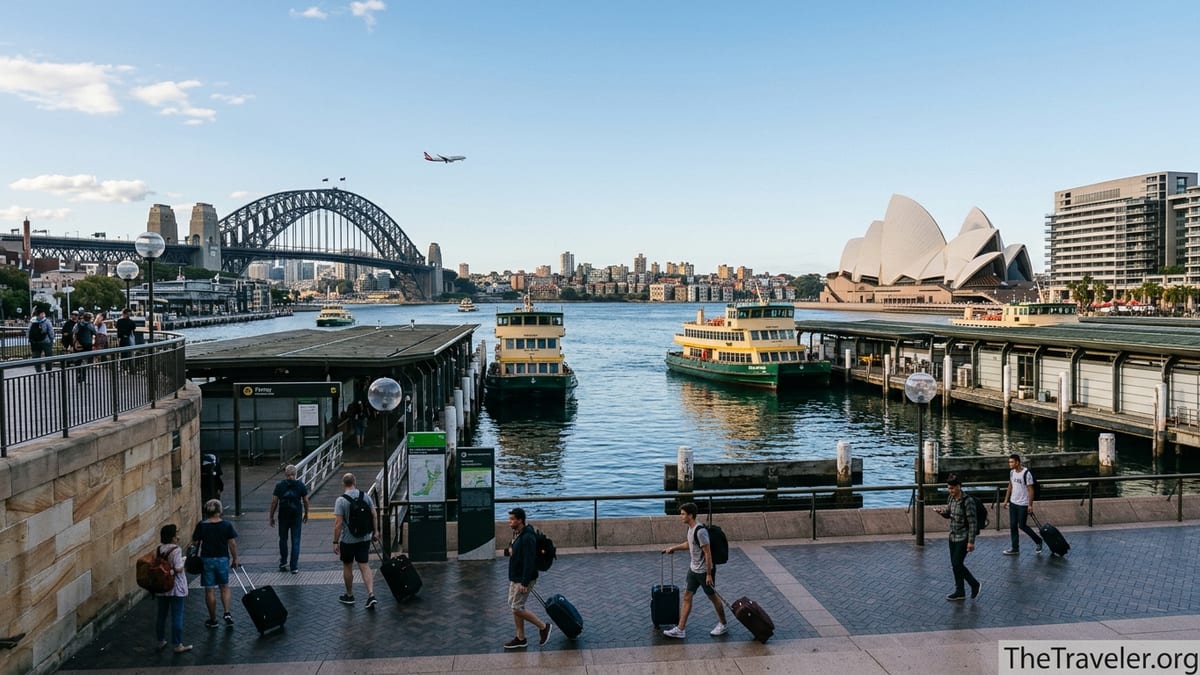
Landing at Sydney Airport and heading straight for Circular Quay is one of the great city arrivals in world travel. Within an hour you can be checking into a hotel with Harbour Bridge views or rolling your suitcase toward a Manly ferry. This guide explains, in practical detail, how to get from the terminals to Circular Quay, which route suits different types of trips, and how to plan a smooth arrival if you are staying near the Opera House or connecting with a cruise.
Get the latest updates straight to your inbox!
Understanding the Sydney Airport to Circular Quay Journey
Sydney Airport sits about 8 to 10 kilometres south of the central city, with both the domestic and international terminals linked to downtown by rail and road. Circular Quay, beside Sydney Cove, is the hub where trains, ferries and light rail all meet, and it is the closest major transport node to the Opera House, The Rocks and many waterfront hotels. In normal conditions you should expect 20 to 35 minutes by taxi or Uber, and around 25 minutes on the Airport Link train once you are on board.
The most important choice on arrival is whether to take the train, a taxi, a rideshare such as Uber, or a pre-booked shuttle. For solo travellers or couples with modest luggage, the Airport Link train combined with a short walk is usually the most efficient and predictable option. For families with multiple suitcases or cruisers dropping bags at the Overseas Passenger Terminal, a taxi or larger Uber can be far easier even if it costs more.
Your decision will also depend on time of day, mobility and budget. In peak weekday traffic, road journeys from the airport to Circular Quay can slow dramatically around the city approaches, while the train runs to a fixed timetable. Late at night, when trains are less frequent, a taxi or rideshare may match or beat the door-to-door time. This guide walks through each option in detail so you can match it to your specific situation rather than guessing at the arrivals hall.
Keep in mind that Sydney’s tap-on smartcard system, Opal, works across train, ferry, bus and light rail. If you plan to use public transport beyond the airport run, setting yourself up with an Opal card or using a contactless credit card from day one can simplify the rest of your stay.
Airport Link Train: Fastest Route to Circular Quay
The Airport Link train, operated as the T8 Airport & South Line, runs directly from both International and Domestic Airport stations to Circular Quay as part of the City Circle. Trains typically stop in the city at Central, Museum and St James before reaching Circular Quay, with total in-train time from the airport to Circular Quay often around 20 minutes. Services usually run every 10 to 15 minutes during the day, with reduced frequency late at night and early morning.
To use the train, follow the “Trains” signs from arrivals to the station located beneath each terminal. You tap on with either an Opal card, a contactless bank card or compatible mobile wallet. Fares include a station access surcharge at the airport stations, so the cost is noticeably higher than a regular suburban trip of similar length. For a concrete example, in mid‑2026 many travellers report paying a total in the mid‑20‑dollar range for a one‑way adult trip from the airport to Circular Quay when the peak surcharge applies, while children and seniors pay less.
Once you arrive at Circular Quay station, you are immediately in the heart of the harbour precinct. Many Opera House–area hotels such as the Pullman Quay Grand, InterContinental Sydney and Four Seasons Sydney are within a 5 to 10 minute walk, mostly on flat or gently sloping pavements. For example, walking from the station to the Opera House forecourt usually takes about 10 minutes at a relaxed pace, hugging the shoreline past the ferry wharves and Customs House.
The main downsides of the Airport Link are the luggage handling and the per‑person cost. The trains are suburban commuter sets rather than airport express stock, so you will be lifting suitcases through ticket gates and onto the train, often at busy times. A solo traveller paying around the mid‑20‑dollar fare can find this excellent value compared with a 60‑dollar taxi, but a family of four may find the combined cost approaches or exceeds a door‑to‑door car. If you have a tight connection to a ferry or dinner reservation, the reliability of the train still makes it compelling.
Taxi and Uber: Door-to-Door Convenience From the Terminals
Taxis and rideshare services such as Uber, Ola and DiDi are widely available at both Sydney Airport terminals and remain the simplest option for most visitors with multiple bags or jet lag. Taxi ranks are clearly signed outside the arrivals halls, and official airport information notes a fixed one‑way taxi fare for trips from the airport to the designated central business district area, which includes Circular Quay. In mid‑2026, the fixed fare trial indicates a typical standard taxi fare of around 60 Australian dollars from Sydney Airport to Circular Quay, with higher set amounts for pre‑booked maxi taxis or groups of five or more.
In real‑world terms, this means that a couple with two large suitcases and carry‑ons can walk straight to the rank, join the queue and expect to pay in the region of 60 dollars for a 20‑ to 30‑minute ride in normal traffic. Payment can usually be made by card, though drivers may add a card surcharge. If you specifically request a larger maxi taxi van at the rank or through an app, expect the fare to be higher, often around 80 dollars on the fixed‑fare scheme for the same journey. This can still be good value if you are a family or small group splitting the cost.
Rideshare pick‑up areas are separate from the taxi ranks and are signed within the airport forecourts. Prices fluctuate with demand, so at quiet times an UberX from the international terminal to a hotel near the Opera House can sometimes undercut the fixed taxi fare slightly, while at peak times or during bad weather surge pricing can push the cost noticeably higher than a standard cab. Many regular visitors check both the Uber app and the taxi rank before committing, choosing whichever looks faster and cheaper on the day.
The biggest advantage of taxi or Uber over the train is not having to wrestle luggage onto platforms or negotiate station escalators. If you are staying at a harbourfront property like the Park Hyatt Sydney in The Rocks, the driver can pull up within a very short walk of the lobby, something that makes a huge difference after a long‑haul flight. For cruise passengers sailing from the Overseas Passenger Terminal at Circular Quay, taxis can deliver you directly to the terminal drop‑off area, avoiding the need to haul bags across busy cobblestone streets.
Choosing the Best Option for Different Types of Travelers
There is no single “best” route from Sydney Airport to Circular Quay; the right choice depends on who you are and what kind of trip you are taking. For solo leisure travellers or couples on city breaks, the Airport Link train is often the sweet spot between speed and cost. For instance, a backpacker arriving mid‑morning with just a carry‑on can typically reach a hostel in The Rocks by taking the T8 train to Circular Quay, then walking up the hill, arriving within about 45 minutes of wheels‑down if immigration is smooth.
Families with young children, strollers and multiple checked bags tend to do better with a taxi or Uber. Picture two parents arriving from North America with three suitcases, a stroller and a toddler, booked into a family room at the Shangri‑La Sydney. The prospect of shepherding bags through the train system and then pushing everything up the steep streets behind Circular Quay is far more stressful than paying around 60 dollars to be dropped at the hotel entrance. For them, door‑to‑door surface transport is worth the premium.
Business travellers on expense accounts, especially those staying at corporate favourites like the InterContinental Sydney, Marriott at Circular Quay or the Four Seasons, may choose based on time of day. In the middle of the day, the train offers predictable timing and avoids city traffic; later in the evening, a taxi or rideshare might save 10 to 15 minutes of waiting time compared with an off‑peak train frequency. Many frequent visitors also take the train into the city and a taxi back to the airport, adjusting to rush‑hour patterns.
Accessibility and mobility are also crucial factors. While airport and city stations have lifts, you may still encounter crowded carriages and gaps between train and platform. Travellers with mobility challenges, heavy sports gear or simply those who dislike stairs may lean strongly toward taxis, rideshares or pre‑booked private transfers. Some local operators run wheelchair‑accessible vehicles from the airport to CBD hotels at fixed rates; these can be particularly helpful for guests staying near the Opera House where footpaths can be uneven.
Connecting to Ferries and Opera House Area Hotels
One of Circular Quay’s great strengths is its role as a transport interchange. From the station, you can walk directly down to the ferry wharves, which serve destinations such as Manly, Taronga Zoo, Watsons Bay and Parramatta, as well as local cross‑harbour routes. Visitors often choose to drop bags at an Opera House–area hotel, then walk back to Wharf 3 or 4 to board a Manly ferry for a first glimpse of the harbour from the water. The short walk from most hotels along Macquarie Street or Circular Quay East to the ferry piers is generally flat and well signed.
For hotels closest to the Opera House itself, such as the Pullman Quay Grand Sydney Harbour on East Circular Quay or the Park Hyatt across at The Rocks side of the cove, the combination of Airport Link train plus a short harbourfront walk works well. For example, after stepping off the T8 at Circular Quay, guests heading to the Pullman typically exit toward the water, turn left along the promenade past the cafes and reach the hotel entrance in under 5 minutes, with minimal road crossings. Those staying at the Park Hyatt can follow the waterfront in the opposite direction, passing the ferry wharves and the Museum of Contemporary Art before curving around to Campbell’s Cove.
If your first priority on arrival is to catch a ferry rather than check in, you can go directly from train or taxi to the wharf. Sailings to Manly in particular are a classic jet‑lag breaker for long‑haul visitors. A practical scenario might be a mid‑afternoon arrival from Asia, a quick Airport Link ride to Circular Quay, a 5‑minute stroll to Wharf 3, then a 30‑minute ferry ride to Manly Beach for an early evening walk and dinner before returning to the city. Since ferry capacity and timetables can vary by season, many travellers check the real‑time screens above the wharves on arrival and build their first afternoon around whatever is departing next.
Light rail and buses also radiate from the Circular Quay area. The L2 Randwick and L3 Kingsford light rail lines run from stops near the ferry wharves into the eastern suburbs, useful if you are staying near Surry Hills or Moore Park but still want the harbour arrival. Several hotel concierges will advise guests to take a taxi from the airport for maximum convenience, then use trains and ferries from Circular Quay for day‑to‑day sightseeing once luggage is safely stored.
Cruise Passengers and the Overseas Passenger Terminal
Many visitors passing through Circular Quay are not staying overnight at all but boarding or leaving a cruise ship at the Overseas Passenger Terminal, located on the western side of Sydney Cove at The Rocks. On turnaround days, the area is especially busy with taxis, luggage trolleys and porters. For passengers embarking at the Overseas Passenger Terminal, taxis and rideshares are usually the most straightforward option, as they can pull directly into the cruise terminal drop‑off zone, allowing you to offload bags close to the check‑in hall.
For disembarking passengers heading to the airport, a mix of train and taxi options works in practice. Some cruise lines and airlines have partnered in recent years to offer seasonal baggage check‑in desks at the terminal, allowing passengers on certain flights to check bags at the wharf and travel to the airport hands‑free. Where available, this can transform the experience: disembark with hand luggage only, stroll the few minutes to Circular Quay station, catch the T8 Airport & South Line to the terminals, and arrive ready to clear security without wrestling suitcases.
Independent cruise passengers often choose to walk from the Overseas Passenger Terminal along the waterfront to Circular Quay station with their luggage, a route that usually takes around 10 minutes at a moderate pace. The path is paved but can be uneven in places. Once at the station, you can buy or top up an Opal card at the ticket machines and board any southbound T8 service to the airport, keeping in mind the separate station access fee at the airport end. If you have a late flight, some travellers instead store their bags at city luggage facilities or with their hotel and spend a few extra hours exploring the Rocks before heading to the airport by train or taxi.
Larger cruise ships that cannot pass under the Sydney Harbour Bridge sometimes berth at White Bay Cruise Terminal, which is further from Circular Quay and not directly served by heavy rail. In that scenario, shuttle buses, taxis and rideshares are the main options to reach either the airport or Circular Quay. Many visitors still make a point of visiting Circular Quay for the Opera House views, even if their ship is at White Bay, by taking a road transfer into the city and then continuing on foot or by ferry.
Luggage, Mobility and Timing Tips for a Smooth Arrival
Luggage handling is where theory often collides with reality. What looks straightforward on a map can feel far more complicated after a 20‑hour flight with two heavy bags. As a rule of thumb, if you cannot comfortably wheel your luggage for 10 to 15 minutes on city pavements, you should budget for a taxi or rideshare at least for the airport–hotel leg. The short walk from Circular Quay station to harbourfront hotels involves some ramps, cobblestones and occasional crowds, especially on weekends when markets operate in nearby The Rocks.
Timing your journey can also ease the start of your stay. Morning peak on weekdays, roughly between 7.30 and 9.30 am, can make both trains and roads busy. The Airport Link remains relatively reliable in peak, but you may need to stand with luggage if seats are scarce. Road traffic into the city can slow significantly approaching the Harbour Bridge and city exits. If you land in this window and have an important meeting or a pre‑booked tour near the Opera House, allowing extra buffer time is wise whether you choose train or car.
If you arrive late at night or very early in the morning, check the Airport Link timetable before relying on the train. Overnight engineering works occasionally affect the T8 line, and in those windows replacement buses or alternative routes may be in place. Taxi and rideshare availability tends to remain reasonable into the late evening, though wait times can stretch when multiple long‑haul flights arrive together. Some travellers arriving after 10 pm choose to pre‑book a private transfer that meets them at arrivals with a name board, trading a slightly higher cost for certainty.
For those with reduced mobility, contacting your hotel in advance can help. Many Opera House–area hotels can arrange accessible transport from the airport or can advise on the flattest walking route from Circular Quay station. For example, guests using wheelchairs at the InterContinental Sydney often follow a relatively level path along Macquarie Street from the station rather than taking the steeper back streets. Lifts and ramps are present at the station but may involve backtracking if you are unfamiliar with the layout, so allowing extra time is sensible.
Planning Your Ideal First Hour in Sydney
Rather than thinking of the airport transfer as a chore, many visitors treat the journey from Sydney Airport to Circular Quay as the opening scene of their trip. With a bit of planning, you can step off the plane, clear immigration and be standing on the Circular Quay promenade gazing at the Opera House within an hour or two. A common “soft landing” strategy for long‑haul arrivals is to check into a nearby hotel, have a quick shower, then stroll around the harbour with a takeaway coffee while your body clock adjusts.
For example, a couple arriving from Europe in the late afternoon might book the Pullman Quay Grand or the Marriott at Circular Quay specifically so they can reach the hotel quickly by train or taxi, drop bags and be back outside to watch the sunset behind the Harbour Bridge. Another popular pattern is to schedule a dinner reservation at one of the waterfront restaurants on Circular Quay East or at Bennelong at the Opera House itself, timing your airport departure so you arrive in the precinct an hour or so before your booking to absorb the atmosphere.
If you have a short stopover and want to maximise time at the harbour, the train is usually the best bet. Consider a scenario where you land at 11 am and have an onward flight at 8 pm. Assuming immigration and baggage take around an hour, you could be on a midday Airport Link service to Circular Quay, enjoy a long lunch and a ferry ride, then return to the airport by train or taxi by late afternoon with ample buffer for security and boarding. This kind of “harbour dash” is common among repeat visitors who already know the layout.
Whatever your arrival plan, keep your first‑day schedule light. Jet lag, seasonal heat and the sensory overload of the harbour precinct can be tiring. Build in time to simply sit on a bench at Circular Quay, watch ferries come and go and decide what you feel capable of doing next. By choosing the airport–city route that best matches your energy and budget, you set the tone for a relaxed and memorable stay.
The Takeaway
Getting from Sydney Airport to Circular Quay is straightforward once you understand your options. The Airport Link train offers a quick, predictable ride directly to the harbour, making it ideal for solo travellers, couples and anyone keen to avoid traffic. Taxis and rideshares provide door‑to‑door convenience that is hard to beat if you have bulky luggage, children in tow or mobility considerations.
For those staying at Opera House–area hotels or joining a cruise at the Overseas Passenger Terminal, choosing the right mode can turn a functional transfer into a highlight. With realistic expectations about cost, timing and luggage handling, you can step into Sydney’s harbour precinct feeling prepared rather than frazzled, ready to enjoy ferries, waterfront walks and one of the world’s most recognisable skylines.
FAQ
Q1. How long does it usually take to travel from Sydney Airport to Circular Quay?
In normal conditions, the Airport Link train takes around 20 minutes of in‑train time, plus walking and waiting, while taxis and Ubers typically take 20 to 35 minutes depending on traffic.
Q2. Is the Airport Link train cheaper than a taxi for two people?
For two adults, total train costs including the airport station access fee often come close to a standard taxi fare, so the train is not always significantly cheaper for pairs compared with a fixed‑fare cab.
Q3. Which option is best if I have two large suitcases and a carry‑on?
With multiple large bags, a taxi or Uber is usually more practical than the train, as you avoid lifting luggage through gates, onto trains and along busy platforms.
Q4. Can I walk from Circular Quay station to the Sydney Opera House with luggage?
Yes, the walk is roughly 10 minutes on mostly flat harbourfront paths, but it can be crowded and slightly uneven in places, so wheeled luggage is preferable to heavy backpacks.
Q5. What is the best way to reach a hotel near the Opera House late at night?
After about 10 pm, trains run less frequently and track work is more common, so a taxi or pre‑booked rideshare from the airport to your hotel is often the most reliable late‑night option.
Q6. How do cruise passengers at the Overseas Passenger Terminal get to the airport?
Most cruise passengers either take a taxi or rideshare directly from the terminal to the airport or walk to Circular Quay station and use the T8 Airport & South Line train, depending on luggage and flight time.
Q7. Are there luggage storage options near Circular Quay if I have hours before my flight?
Yes, several city luggage storage services and some hotels offer bag drops near Circular Quay and The Rocks, allowing you to explore the harbour hands‑free before heading back to the airport.
Q8. Can I use a contactless credit card instead of an Opal card on the Airport Link?
Yes, most visitors can tap on and off with a contactless credit or debit card or compatible phone wallet, which is charged similar fares to an adult Opal card without the need to buy a physical card.
Q9. Is the train from the airport to Circular Quay safe for solo travellers?
The Airport Link is widely used by locals and visitors and is generally considered safe during operating hours, though standard precautions such as keeping valuables close still apply.
Q10. What should I do if there is track work on the Airport Link when I arrive?
If track work affects the T8 line, follow airport signage or staff directions for replacement buses or consider taking a taxi or rideshare directly to Circular Quay or your hotel instead.