


Arriving at Sydney Airport and opening the Uber app should be the easy part of your journey. The challenge is often knowing exactly where to go for pickup, how much it will cost, and whether Uber actually makes more sense than a taxi or train for your particular trip. This guide breaks down Sydney Airport’s Uber and rideshare arrangements at T1 International, T2 Domestic and T3 Domestic, so you can walk off the plane and head straight for the right kerb without second guessing yourself.
Get the latest updates straight to your inbox!
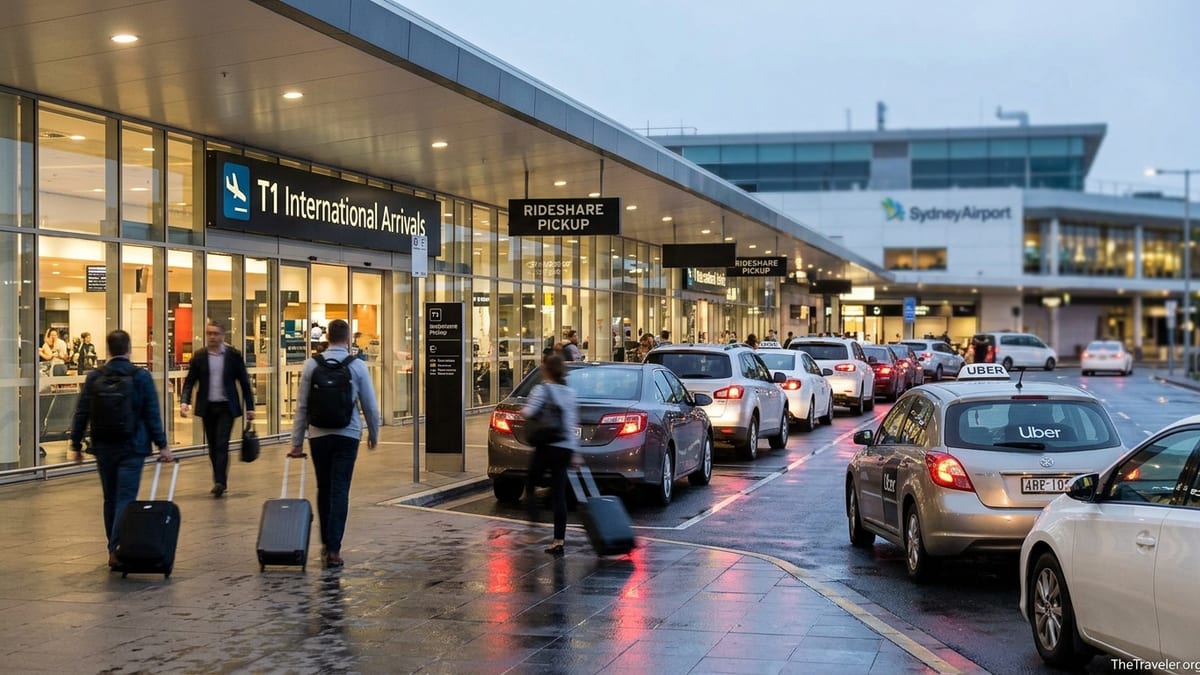
How Uber Works at Sydney Airport Today
Rideshare is now fully embedded in Sydney Airport’s ground transport system. Uber, Ola and DiDi are all allowed to pick up at the airport, but Uber has the most integrated setup, particularly at T1 International where it operates a dedicated kerbside zone using PIN technology. Instead of matching with a specific driver, many T1 passengers now receive a short numeric code in the Uber app and join an Uber queue similar to a taxi rank, handing the code to the next available driver.
At the domestic terminals, Uber pickups are concentrated in the Domestic Priority Pick-up area that serves both T2 and T3. This is a short walk from each terminal and is shared by private cars and rideshare drivers. The airport charges an access fee for vehicles using these zones, which is automatically added to your Uber fare when you get picked up from the airport. That extra cost is one of the key differences between rideshare from the terminal and rideshare from a nearby street or train station.
For travelers, the main decisions are where to walk for pickup, which Uber product to choose and whether the fares you see in the app represent good value compared with a taxi or the T8 Airport & South Line train. On a typical weekday afternoon, a standard UberX from the airport to central Sydney might show a fare in the range of roughly 35 to 55 Australian dollars including tolls and the airport access fee, while a metered taxi for the same trip may land in a broadly similar band depending on traffic and route.
The most important thing to understand is that each terminal at Sydney Airport has its own pattern. T1 now has a much closer kerbside Uber zone than in past years, which is a relief after long walks to remote parking garages. T2 and T3 still funnel most rideshare pickups through the Domestic Priority Pick-up area, which can be busy at peaks but is straightforward if you follow the green signs.
T1 International: Kerbside Uber Zone and PIN System
T1 International is where Sydney Airport has rolled out its most modern Uber experience. The dedicated Uber pickup area sits just a short walk from arrivals, roughly 20 metres from the terminal doors, eliminating the long treks that used to frustrate jet-lagged passengers. After you clear immigration and customs, you exit into the public arrivals hall, follow signs for "Uber" or "Rideshare" and walk out toward the kerbside pickup bays rather than the traditional taxi rank.
When Uber’s PIN system is active, the flow is slightly different from what many travelers are used to. Instead of waiting for the app to assign you to a specific driver and car, you request an UberX to Sydney Airport, confirm your terminal and get a short PIN code displayed in the app. You then walk to the marked Uber pickup zone, join the queue of riders, and when you reach the front you give the PIN to the next driver in line. The driver enters your code, the trip links in both apps and you depart. This reduces the chaos of trying to locate the one Toyota Camry that matches your plate number in a sea of similar cars.
In practice, many long-haul passengers find this system faster, especially in busy evening waves when multiple flights from Asia, the Middle East and North America land within an hour. For example, arriving on an evening flight from Singapore, you might have 20 or 30 people ahead of you in the Uber line but see a continuous stream of cars pulling in. Instead of watching your originally assigned driver circle the terminal or cancel, you simply board the next car available once you reach the front of the queue.
Costs from T1 into the city vary with time of day, traffic and demand. A mid-morning UberX to a hotel near Town Hall might display around 40 to 60 Australian dollars when including the airport access fee and any tolls, while an Uber Comfort could be somewhat higher. If you are traveling as a family of four with luggage, that can be competitive when compared with the combined cost of four individual train fares plus the station access surcharge at International Airport station. For solo travelers, especially at off-peak hours when trains run frequently, the train may still be cheaper and, in some cases, faster during peak traffic.
T2 Domestic: Priority Pick-up for Jetstar, Virgin and Others
Terminal 2 is Sydney’s main domestic hub for airlines such as Virgin Australia, Jetstar and several regional carriers. Uber pickups here do not happen at the front kerb of the terminal. Instead, they are directed to the Domestic Priority Pick-up zone, which is also where many private cars wait for arriving friends and family. From baggage claim, you follow signs marked "Priority Pick-up" or "Rideshare" that lead you across a short stretch of roadways and into a clearly signed parking and pickup area.
The Domestic Priority Pick-up is designed for short stays. Vehicles usually pass through a boom gate and the airport charges a time-based fee. The first segment of time is relatively low cost but the fee can ramp up if your driver or your party lingers. That fee is passed on through the Uber fare, which is why the same trip to central Sydney can be a few dollars more expensive when starting at the airport compared with being picked up from a residential street in Mascot or a nearby shopping center.
On a typical weekday early evening, you might see an UberX from T2 to Surry Hills quoted somewhere around the mid-30s to mid-40s in Australian dollars in normal conditions, depending on traffic and tolls. If rain or a major event pushes demand higher, surge pricing can easily push that into the 50s or more, at which point a metered taxi from the rank near arrivals could be similar or occasionally cheaper. Many locals check both the taxi queue length and the Uber estimate before committing.
One practical tip at T2 is to avoid calling your Uber until you are actually walking toward the Priority Pick-up zone. Domestic traffic around the ramps and roundabouts can be heavy during peak evening banks, and some drivers wait in informal holding spots nearby until a rider is on the way. If you order too early and then get stuck waiting for luggage or a delayed jet bridge, your driver may incur higher parking charges and be more likely to cancel. A good rhythm is to collect bags, walk outside, follow the green Priority Pick-up signage and then request the ride as you approach the pick-up area.
T3 Domestic: Qantas Pickups and the Newer Uber Zone
Terminal 3 is used by Qantas and QantasLink for domestic flights. For several years, Qantas passengers arriving at T3 had to walk to the shared Priority Pick-up area tucked between T2 and T3 for both Uber and taxis. More recently, Sydney Airport and Uber have worked to bring pickup points closer to the T3 terminal, easing that walk for passengers with heavy luggage or late-night arrivals.
In practice, the experience today is similar in feel to T2. You still need to leave the immediate arrivals forecourt and follow signs toward the designated pickup area for rideshare. The airport’s goal has been to reduce congestion on the main departures and arrivals roads, so do not expect an UberX to pull up directly at the same kerb used by Qantas taxis and shuttle buses. When in doubt, focus on the official "Rideshare" or "Uber" signage rather than just relying on the estimated pickup pin in the app, which can sometimes lag behind small changes in traffic flows.
Evening and late-night arrivals into T3 can be a mixed experience for Uber. On quiet nights, you might receive a match in under a minute and be picked up within five minutes of requesting. On busier nights when multiple Qantas flights land close together, some travelers report longer waits or drivers circling the airport road system. If you are landing from Perth or Darwin around midnight with two large checked bags and a carry-on, it is often worth checking how long the taxi queue is versus the number of nearby Uber vehicles showing in the app before deciding.
Fare-wise, Uber from T3 is similar to T2 because both terminals share the same domestic road network and airport access fee structure. A mid-morning UberX from T3 to North Sydney might show a ballpark fare in the 45 to 65 Australian dollar range depending on traffic across the Harbour Bridge and any toll roads taken. For business travelers on expense accounts, the app’s digital receipts can be a major advantage over paper taxi dockets, especially when claiming tolls and airport fees back from employers.
Using the Uber App: Step-by-Step Directions and Common Pitfalls
The basics of requesting Uber at Sydney Airport are the same as anywhere else, but a few local quirks are worth knowing. When you open the app on arrival, it should automatically detect that you are at Sydney Airport and prompt you to confirm your terminal. At T1 International, you may see specific instructions and a note about the Uber PIN system. At T2 and T3, the app will generally direct you to the Domestic Priority Pick-up area or a terminal-specific rideshare bay.
Once you enter your destination, the app shows available products such as UberX, Uber Comfort, UberXL and occasionally premium options. The fare estimate you see usually includes the airport access fee and any known road tolls on the suggested route, although final pricing can change slightly based on actual time and distance. For example, if there is heavy congestion on the M1 or Eastern Distributor, your driver may take an alternate route through local streets, which can shift the final fare up or down within a modest range.
One frequent pitfall is requesting the Uber while you are still inside the terminal dealing with immigration, baggage or duty free shopping. The app may show a very short estimated pickup time, but if your driver reaches the boom gate at the Priority Pick-up zone before you do, they will begin incurring parking fees and may cancel if they cannot see you approaching. To avoid this, wait until you are ready to walk out or are already following signs toward the rideshare zone before tapping "Confirm pickup." This is especially important in the evening domestic peak when traffic jams around the Priority Pick-up entry ramp can push actual arrival times beyond the initial estimate.
Another common issue involves miscommunication about the exact pickup bay. At both T1 and the domestic terminals, the pickup zones are often divided into numbered or lettered sections. Your Uber app will usually include an instruction like "Meet driver at Bay B3" or similar. Pay close attention to these details and double check the bay markings on the kerb. If you are unsure, send your driver a short in-app message with a clear landmark, such as "Standing near the Priority Pick-up pay station" or "Next to sign marked Bay A." Clear communication can prevent your driver from circling past you without spotting you in the crowd.
Surge Pricing, Fees and When a Taxi Might Be Easier
Like most major airports, Sydney experiences sharp peaks in rideshare demand during early morning departures, late evening international arrivals and rainy days when public transport is less appealing. At these times, Uber may apply surge pricing, which multiplies the normal fare estimate. For example, an ordinary 40 dollar trip to Darling Harbour could suddenly display as 70 or more when a storm hits just as several wide-body flights land. The extra cost includes not only higher per-kilometre and per-minute rates but also the fixed airport access fee in the background.
In those moments, it is worth comparing options. If the taxi rank outside your terminal is short and moving quickly, a metered cab can be a simpler, sometimes cheaper door-to-door option. Taxis in Sydney pay their own airport access fees and tolls, but regulations limit how these are passed on to passengers, and some government reviews have emphasised consistency in how airport charges appear on taxi receipts. For a solo traveler heading to a hotel near Central Station, the T8 train line can also be a strong alternative, with a fixed journey time into the city even when the roads are gridlocked.
There are also times when a taxi is simply easier because of logistics. If you are juggling a surfboard bag, two checked suitcases and a stroller, wrestling all of that into an UberX in the Priority Pick-up zone can be stressful, especially if your driver arrives in a small hatchback. A taxi rank attendant can sometimes help match you with a station wagon or maxi taxi more suited to bulky luggage. Similarly, if you are not comfortable using a smartphone app or do not have mobile data after a long international flight, heading straight to the taxi rank or arranging a pre-booked shuttle inside the terminal can be the least stressful choice.
On the other hand, when surge pricing is low and cars are plentiful, Uber’s transparency can be attractive. You see an estimated fare before committing, can track your car on the map and do not need to handle cash. For business trips, the ability to select Uber Comfort for a slightly roomier vehicle and quieter ride, or UberXL for a small group with multiple suitcases, can make the extra few dollars worthwhile. The key is to remain flexible: check the Uber estimate, glance at the taxi queue, and keep the train in mind if you are headed to a central location near Town Hall, Wynyard or Central.
Luggage, Groups and Accessibility Considerations
How much luggage you are carrying should heavily influence whether you use Uber and which product you choose. A solo traveler arriving with a cabin bag and a small backpack will usually fit comfortably into a standard UberX sedan. But a family of four arriving from Los Angeles with four large checked suitcases, two cabin bags and perhaps a stroller will likely need an UberXL or two separate standard cars. At busy times such as school holidays, there can be a wait for larger vehicles, so check the estimated arrival time for UberXL in the app before you finish loading your bags onto a trolley.
The pickup zones at T1, T2 and T3 are all accessible by lift or ramp, but they can be crowded and noisy. If you are traveling with someone who uses a wheelchair or has limited mobility, it may be worth considering a taxi or pre-booked wheelchair-accessible vehicle. While Uber does operate accessible options in some Australian cities, coverage and wait times at the airport can be inconsistent. In contrast, Sydney’s taxi fleet includes a number of wheelchair-accessible vehicles that can be requested through traditional booking services as well as some dedicated disability transport providers.
Groups also need to think about the practicalities of finding each other. It can be tempting for one member of a group to rush ahead, order the Uber and then instruct everyone else to "meet me at the car." At Sydney Airport’s busy pickup zones, this often ends badly, with half the party still navigating customs or the escalators while the driver is already at the boom gate. A smoother approach is to regroup just outside customs or baggage claim, walk together to the signed rideshare area, and only then order the vehicle. This way, if a driver arrives earlier than expected or there is confusion about the bay number, everyone is in the same spot.
Finally, consider how you will handle trolleys. Airport luggage trolleys are not usually allowed beyond certain points in the pickup areas, and some drivers will ask you to unload luggage at the kerb and leave the trolley in a designated bay. Build a few extra minutes into your timing to unload and return the trolley so that you are not rushing while your driver waits at the kerb with the hazard lights on and the airport’s clock ticking on parking charges.
Real-World Examples: City, Suburbs and Beyond
To understand how Uber from Sydney Airport plays out in practice, it helps to look at a few typical trips. Consider a midweek afternoon arrival into T1 International for a couple heading to a hotel in Circular Quay with two medium suitcases. They decide to use the Uber PIN system, walk to the kerbside Uber zone and request an UberX once they are almost there. The app shows an estimated fare in the range of roughly 45 to 65 Australian dollars including tolls and the airport fee. They board the next available car in the Uber line, arrive in the city in around 25 to 35 minutes depending on traffic, and charge the trip to a shared credit card stored in the app.
On another day, a group of three friends lands at T2 Domestic after a budget flight from Melbourne, each with a backpack and one small rolling suitcase. Their destination is a shared apartment in Newtown, only a short distance beyond the airport precinct. They walk together to the Domestic Priority Pick-up zone and request an UberX. The app suggests a fare somewhere around the 25 to 40 Australian dollar range in normal traffic. Because they are splitting the cost three ways, this can end up cheaper per person than the train, especially once the station access fee is factored in. In this scenario, Uber feels convenient and good value.
By contrast, a solo business traveler arriving late in the evening to T3 and staying at a hotel directly above Wynyard Station might face a different calculation. If surge pricing is active due to a thunderstorm, the UberX estimate could climb into the 70s or even higher, while the taxi queue outside could be modest. At the same time, trains on the T8 line still run into the city, and the total tap-on fare plus station fee, although not cheap, may be significantly lower than a surged Uber. In this case, the traveler might choose the train for price and predictability, or grab a taxi for simplicity if carrying only a small bag.
Longer trips change the equation again. A family heading straight from T1 to a holiday rental in the Blue Mountains with several suitcases might find that an UberXL quote looks high but still undercuts the cost of a private shuttle for four people. On the other hand, someone heading to a nearby suburb like Mascot or Alexandria could save money by taking the train one stop and ordering Uber from a local street, avoiding the airport access fee altogether, though this adds an extra step and may not be worth it if you have heavy luggage or are unfamiliar with the area.
The Takeaway
Uber has become one of the most popular ways to leave Sydney Airport, but it is not automatically the best choice for every traveler or every situation. T1 International now offers a much improved kerbside Uber zone with PIN technology that can speed up pickups in busy periods, while T2 and T3 channel most rideshare traffic through the Domestic Priority Pick-up area. Understanding those layouts, and waiting to request your car until you are actually walking toward the pickup zone, will go a long way toward making your experience smoother.
Surge pricing, airport access fees and luggage all matter. For couples or small groups with manageable baggage, an UberX or UberXL from the airport to central Sydney can be cost effective and comfortable, particularly when trains are crowded or infrequent. For solo travelers, late-night arrivals, mobility needs or very heavy luggage, taxis, trains or pre-booked transfers may be easier, even if the headline fare is similar. The smartest approach is to stay flexible: compare the live Uber estimate with the taxi queue in front of you and keep the train in mind.
Whichever option you choose, plan a little ahead. Make sure your phone has data or a local SIM if you intend to use Uber, follow the airport’s rideshare signs carefully, and factor in a few extra minutes to navigate lifts, ramps and luggage trolleys. With these details sorted, your journey from Sydney’s terminals into the city, suburbs or beyond can be a straightforward final step in your trip rather than an unwelcome stress point.
FAQ
Q1. Where exactly do I meet my Uber at Sydney Airport’s T1 International terminal?
At T1 you follow the signs for Rideshare or Uber from the arrivals hall to a dedicated kerbside Uber pickup zone a short walk from the terminal doors, then request or confirm your Uber in the app and wait at the marked bays.
Q2. How does the Uber PIN system work at T1 International?
When the PIN system is active, you request an UberX to T1, receive a short numeric code in the app, walk to the Uber pickup line and give that code to the next driver in the queue, who enters it to link the trip.
Q3. Where is the Uber pickup area for T2 Domestic flights?
For T2, pickups are directed to the Domestic Priority Pick-up zone, reached by following signs from baggage claim toward the green Priority Pick-up area shared with private cars and other rideshare services.
Q4. Do Qantas passengers at T3 use the same Uber pickup as T2?
Qantas and QantasLink passengers arriving at T3 are directed to a designated rideshare pickup area near the terminal, which is closely linked to the Domestic Priority Pick-up arrangements that also serve T2.
Q5. Is there an extra fee for taking Uber from Sydney Airport?
Yes, Sydney Airport charges a ground transport access fee for rideshare pickups, and this is automatically included in your Uber fare when you depart from the airport terminals.
Q6. How bad can surge pricing get at Sydney Airport?
Surge pricing fluctuates, but during storms, peak holiday periods or late-night arrival banks, estimates can rise significantly compared with normal times, sometimes adding tens of dollars to a typical city-bound trip.
Q7. When is a taxi easier than an Uber at Sydney Airport?
A taxi can be easier if the Uber app shows long wait times or high surge pricing, if the taxi rank is moving quickly, or if you have very bulky luggage or accessibility needs better handled by a taxi or maxi cab.
Q8. Can I avoid the airport fee by getting an Uber from a nearby suburb instead?
Some travelers take the train or a local bus to nearby suburbs like Mascot or the city and then request an Uber from the street to avoid airport access fees, though this adds complexity and is less practical with heavy luggage.
Q9. Which Uber option should I choose if I have a lot of luggage?
If you have more than one large suitcase per person or bulky items like surfboards or strollers, choosing UberXL or considering two standard cars is usually safer than relying on a small sedan turning up for an UberX request.
Q10. Is public transport a realistic alternative to Uber from Sydney Airport?
Yes, the T8 Airport & South Line serves both the International and Domestic stations; while there is a station access surcharge, trains can be faster and cheaper than Uber or taxis for solo travelers heading to central Sydney.