


Landing at Sydney Kingsford Smith Airport and wondering how to get into the city center without overpaying or wrestling your luggage across town? In 2026, travellers can choose from several well developed options: the Airport Link train, taxis, rideshares such as Uber, shared shuttles and private transfers. Each suits a different budget, group size and hotel location, and recent changes like a fixed taxi fare to the CBD and updated airport train fees have shifted the value equation. This guide walks through the main choices with real-world examples so you can step off the plane and head toward your Sydney hotel with confidence.
Get the latest updates straight to your inbox!
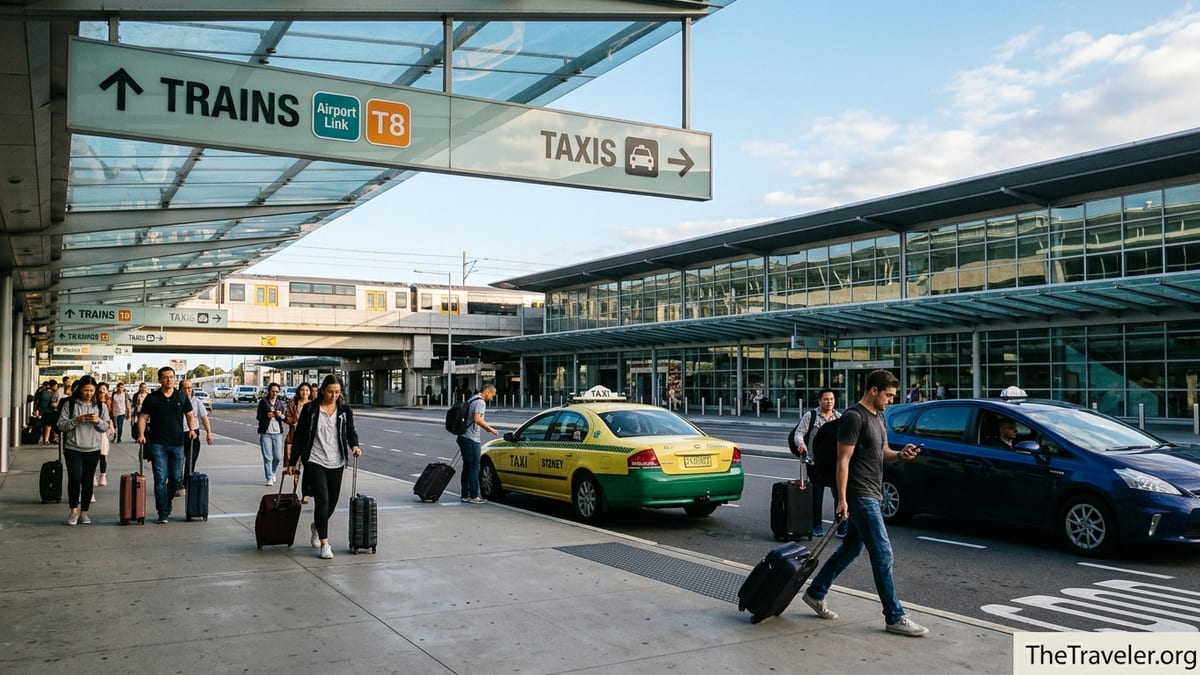
Key Things To Know Before You Leave the Terminal
Sydney Airport (SYD) sits about 8 kilometers south of the Central Business District, so journeys into the city are relatively short in distance but can vary a lot in time and cost depending on traffic and the option you choose. There are three passenger terminals: T1 for international flights, and T2 and T3 for domestic. The airport is directly connected to the suburban rail network via the Airport Link line, and most road transfers follow similar corridors toward Central Station and the CBD hotel zones around Darling Harbour, Town Hall, Wynyard and Circular Quay.
Two policy changes are particularly important for 2026 arrivals. First, the New South Wales government is trialling a fixed taxi fare for non-booked rides from Sydney Airport taxi ranks into a defined CBD area, currently set at about 60 Australian dollars for a standard cab and 80 dollars for a maxi taxi carrying five or more passengers. This means visitors heading to popular areas like Town Hall or Circular Quay know the total fare up front, including airport and road charges, though card surcharges can still apply. Second, the station access fee charged on top of regular rail fares at the airport stations has been updated in June 2026, keeping airport train trips noticeably more expensive than normal Sydney train journeys but often still competitive with taxis for solo travellers.
Because the airport is close to the city, small differences in party size or luggage can flip the best-value choice. A solo business traveller with a cabin bag heading to a George Street hotel at 8:30 on a Monday morning will usually be better off on the Airport Link train, while a family of four with two large suitcases and a stroller arriving at 9 pm on a Sunday might pay roughly the same for a taxi to their Darling Harbour apartment as they would for train tickets, and avoid changing at Central Station.
Before you pick an option, it helps to know where exactly your hotel sits. Many first-time visitors say they are “staying in the CBD,” but a high-rise at Wynyard, a serviced apartment behind Central Station and a boutique hotel in The Rocks all involve different walking distances and transfer times from each mode. Check your confirmation email for the street address and look it up on a map relative to Central Station, Town Hall, Wynyard, Circular Quay and Museum stations; that will guide which transfer styles make the most sense.
Airport Link Train: Fastest Into the CBD for Solo Travellers
The Airport Link train is usually the fastest way into central Sydney during weekday daylight hours, especially in peak traffic. Trains from the International (T1) and Domestic (T2/T3) airport stations run roughly every 10 minutes in daytime and connect directly to Central, Museum, St James, Circular Quay, Wynyard and Town Hall stations. The journey from the international terminal to Central typically takes about 12 minutes, and to Town Hall or Wynyard around 20 to 25 minutes.
Fares are paid using an Opal card or contactless bank card, and consist of a standard Sydney train fare plus the special airport station access fee. In late 2025 and 2026, a peak adult trip of up to 10 kilometers that includes the airport station fee works out to a little over 22 dollars one way from the city to the airport; the inbound fare from the airport to the city is in a similar range. The bulk of that is the access fee, which is applied at both International and Domestic Airport stations and goes largely to the state government. While exact amounts change slightly with indexation, the key takeaway is that the airport train costs several times more than a normal Sydney metro fare but can still be cheaper than a taxi if you are traveling on your own.
To see how this compares in practice, consider a solo traveller landing at 8 am on a Tuesday, staying near Town Hall Station. With hand luggage only, they can walk from arrivals to the station in about 5 minutes, tap on, and be at Town Hall roughly 25 minutes after wheels-down if immigration is smooth. The total cost will be in the low twenties in Australian dollars, and there is no risk of being stuck in weekday traffic through Surry Hills or around George Street. In contrast, even if a taxi were faster outside of the heaviest peak, the fixed fare from the airport taxi rank into the CBD would be about 60 dollars, nearly three times the cost.
The equation changes for couples and small groups. Two adults paying around 22 dollars each are already close to a rideshare or taxi fare in light traffic, and a family of four paying close to 90 dollars in total usually finds door-to-door road options better value. You should also factor in the last leg from the station to your hotel. Rolling a single suitcase from Wynyard Station to a George Street hotel is manageable, but dragging multiple roller bags and a stroller up the hill from Circular Quay to The Rocks after a 24-hour flight from Europe can be genuinely tiring. In those cases, even if the train looks reasonable on paper, a taxi, Uber or pre-booked transfer may be more practical.
Taxis: New Fixed Fare for the CBD and When Cabs Make Sense
Taxis remain a straightforward option at both the international and domestic terminals, with clearly signed ranks just outside arrivals. In November 2025, New South Wales introduced a 12-month trial of fixed fares for non-booked taxis from Sydney Airport taxi ranks directly to a mapped CBD area, designed partly to tackle reports of tourists being overcharged. Under this trial, which continues into 2026, standard taxis pay a flat fare of 60 dollars and maxi taxis 80 dollars when carrying five or more passengers or when specifically requested as larger vehicles. These amounts include relevant tolls, the airport access fee and the basic journey, though credit card surcharges and any cleaning fee are additional.
For a couple heading from the international terminal to a hotel near Hyde Park, that 60 dollar fixed fare can be quite appealing. The ride normally takes around 20 to 30 minutes depending on traffic, and you get dropped at the door. Compare that with paying over 40 dollars for two Airport Link tickets, then navigating stairs or lifts at Museum or Town Hall stations and walking a few blocks with luggage. For many visitors coming off long-haul flights, the extra 15 to 20 dollars for a taxi feels worth it for comfort and simplicity.
The fixed fare only applies if you join the rank at the airport and travel directly to the designated CBD area defined in government maps. If you ask the driver to stop at a supermarket in Surry Hills on the way, or if your accommodation is in suburbs such as Newtown, Bondi or North Sydney, the meter-based maximum fare rules apply instead. Under typical conditions, an airport taxi to central Sydney outside the fixed-fare zone falls in the 45 to 65 dollar range for a standard cab, depending on traffic and route, though prices for journeys to the eastern beaches or inner west can be higher once distance and any tolls are added.
There are still occasional reports of visitors paying more than expected, particularly for trips to suburbs outside the CBD trial map. To protect yourself, confirm with the driver at the rank that your hotel is within the fixed-fare CBD area and state clearly that you want the fixed 60 dollar fare if you are eligible. For destinations outside the zone, ask for an approximate metered estimate before departing. If something seems off at the end of the journey, keep your receipt. New South Wales maintains a taxi fare hotline where passengers can report suspected overcharging, and fines have been issued to drivers found breaching fare rules. Most rides, however, are problem-free and offer a comfortable door-to-door trip.
Uber and Rideshare: Flexible Door-to-Door, With Price Fluctuations
Rideshare services like Uber, DiDi and Ola are deeply embedded in Sydney’s transport mix and extremely popular for airport transfers. Sydney Airport has dedicated rideshare pickup areas at both the international and domestic terminals, and Uber in particular has worked with the airport to bring pickup zones closer to the terminal doors. Each rideshare provider adds an airport access fee to trips originating from the airport, usually a small amount automatically included in the app fare.
Under normal conditions, a standard rideshare such as UberX from Sydney Airport to a typical CBD hotel around Town Hall or Wynyard falls roughly in the 35 to 55 dollar range. Journeys very late at night, very early in the morning or during busy Friday and Saturday evening peaks can be more expensive because of dynamic pricing. For example, a couple arriving at 10:30 pm on a quiet weekday evening might see an in-app quote of around 40 dollars to a Pitt Street hotel, including the airport fee. The same ride at 6 pm on a Friday, when heavy traffic and events in the city increase demand, could push toward or even above 60 dollars.
The appeal of rideshare lies in the combination of app-based certainty and flexibility. You see an approximate fare before you confirm, track your driver’s approach and have your drop-off location set exactly to your hotel entrance. For travellers heading to inner suburbs such as Surry Hills, Newtown or Paddington, rideshare can also be more convenient than the train, which might require changing at Central and then either another train, a light rail connection or a bus. A young couple staying in an Airbnb near Crown Street in Surry Hills, for example, can step out of the terminal and be at their door in roughly 20 minutes by Uber in light traffic, without handling luggage through crowded station concourses.
The main downsides are price variability and occasional pickup delays. Drivers sometimes wait for fares to surge before accepting, particularly at peak times, which can leave passengers watching the app while the estimate climbs. There have also been scattered complaints about certain routes being taken that avoid toll roads, stretching ride time while leaving toll surcharges still listed in the fare if not carefully checked. A practical strategy is to open the app after you collect your bags, compare the rideshare price with the fixed 60 dollar taxi fare into the CBD, and make a decision on the spot. If the rideshare quote is significantly lower and your destination is outside the official CBD fixed fare zone, Uber or DiDi often wins. If surge pricing pushes the app quote close to or above taxi levels, joining the taxi rank or riding the train could be better value.
Shuttles and Private Transfers: Best for Groups and Heavy Luggage
Shared shuttle services and private transfers fill a specific niche between public transport and ad-hoc taxis or rideshares, especially for larger groups, cruise passengers or travellers with mobility needs. Several operators offer advance-booked shuttles that run from the airport to major CBD hotels, Circular Quay cruise terminals and popular suburbs. These can be minivans collecting multiple parties or larger coaches that group arrivals from several flights.
In 2026, door-to-door shared shuttles from Sydney Airport into the CBD typically price per person, often somewhere in the range of 25 to 35 dollars per adult for city hotels and slightly more for the eastern beaches. A couple might therefore pay a similar amount to the Airport Link train, but with the benefit of a direct drop-off at their hotel. The trade-off is time. Because shuttles circulate between several terminals and then make multiple stops through the city, a ride from the international terminal to a Darling Harbour hotel that would take 25 minutes by taxi might stretch to 45 minutes or more if your stop is last on the route.
Private transfers sit at the premium end of the scale. For a fixed price quoted at the time of booking, you can secure a sedan, SUV or minivan and often meet-and-greet service in the arrivals hall. A typical private sedan transfer into the CBD might cost in the 90 to 140 dollar range depending on vehicle class, with larger people-movers for six to eight passengers priced higher. For groups, this can work out well: four friends on a multi-stop trip from the airport to two CBD apartments, splitting a 140 dollar private van, each end up paying not much more than they would for train tickets, while enjoying guaranteed space for luggage and a direct ride.
Shuttles and private transfers are particularly practical for travellers with heavy or bulky luggage. Cruise passengers with large suitcases boarding at the Overseas Passenger Terminal in Circular Quay often opt for pre-booked transfers so they do not need to roll bags across cobblestone streets. Families with young children who need guaranteed child seats also favor private transfers where they can request appropriate restraints ahead of time. The key is to book with a reputable operator, check pickup instructions carefully, and allow extra time if your service is shared rather than private.
Comparing Cost, Time and Luggage Handling by Traveller Type
To decide what works best for you, it helps to look at typical traveller profiles. For solo business travellers staying in the CBD core near Wynyard, Town Hall or Martin Place, the Airport Link train is usually the fastest and cheapest combination. A one-way fare in the low twenties delivers you into the heart of the city in under 25 minutes most of the day, and you only need to manage one small suitcase. Many business hotels are within a short, flat walk from these stations, such as properties along George Street, Kent Street or near Darling Harbour.
For couples on holiday, the calculus becomes more nuanced. Two Airport Link tickets can total close to 45 dollars, similar to a rideshare on a quiet evening or only modestly cheaper than the 60 dollar fixed taxi fare into the CBD. If your hotel entrance is not directly across from a station, such as a boutique property in The Rocks or an apartment hotel deep in Darling Harbour, the appeal of paying a bit extra for a door-to-door car ride grows. On the other hand, if you are staying near Central Station or directly above Town Hall, and you enjoy walking, the train can still make sense. Many couples adopt a hybrid strategy: they take a taxi or rideshare from the airport on arrival when they are most tired, then use the train on their way back to the airport at the end of the trip.
Families and groups of friends often benefit most from taxis, rideshares or private vans. Consider a family of four staying in a serviced apartment near Darling Harbour with two large suitcases, two carry-ons and a stroller. Four Airport Link tickets could approach 90 dollars, and the family would still need to navigate up and down escalators and walk 10 to 15 minutes from Town Hall Station to their accommodation. By contrast, an 80 dollar maxi-taxi under the fixed fare to the CBD or a pre-booked van in a similar price range will pick them up at the kerb and drop them directly outside their building, saving energy and stress. Likewise, a group of six friends heading to a shared apartment in Surry Hills might find that splitting a private minivan transfer costs little more per person than the train, with far greater convenience.
Luggage is a major factor that travellers underestimate. Sydney’s CBD is walkable but hilly in places, with some older stations like Museum and St James involving stairways and narrow exits. If you are backpacking with one soft bag, the Airport Link is easy. If you are carrying hard-shell suitcases and shopping bags after a long-haul flight, even a short transfer across town can feel complicated. Road options remove almost all lifting except into and out of the vehicle. For older travellers or anyone with mobility challenges, that alone can justify the higher cost of a taxi or private transfer.
Choosing by CBD Hotel Zone: Central, Town Hall, Wynyard and Circular Quay
Where you are staying in the CBD strongly influences the smartest transfer choice. If your accommodation is right around Central Station, Surry Hills or Haymarket, the Airport Link is particularly compelling. You can step off the train, exit toward Chalmers Street or Elizabeth Street, and be at many hotels within a 5 to 10 minute walk. Popular properties and hostels around Railway Square, such as those on Pitt Street and Wentworth Avenue, fall into this category. Even with a wheeled suitcase, the walk is manageable and mostly flat.
For hotels near Town Hall and Darling Harbour, the picture is more mixed. The train stops at Town Hall directly underneath the busy retail area around George and Pitt Streets, with underground exits leading toward the QVB and the western edge of the CBD. A traveller staying at a hotel on Sussex Street or near the Darling Harbour promenades can walk from Town Hall in about 10 to 15 minutes, but will likely need to navigate crowds and a few inclines. If you are light on luggage and arriving in the middle of the day, the train plus walk is reasonable. If you arrive late at night, in heavy rain or with children, a taxi or rideshare to your hotel’s driveway is often more comfortable and not dramatically more expensive for two or more people.
Wynyard and Circular Quay serve the northern CBD, The Rocks and access to ferries. The Airport Link lines that run through Central, Museum and St James also continue to Wynyard and Circular Quay, so you can stay on the train all the way to these stations without changing. This is excellent for travellers staying in high-rise business hotels along George Street, Kent Street or in the financial district around Wynyard. For The Rocks and the waterfront near Circular Quay, however, the terrain slopes upward and includes some cobblestones. Rolling a suitcase from Circular Quay Station to a boutique hotel tucked into a heritage lane can be charming but strenuous after a long flight. A taxi or rideshare that drops you at the front door may be worth the extra cost, particularly for older travellers or anyone with mobility concerns.
For stays outside the traditional CBD, such as Bondi, Coogee, Newtown or the inner west, the train becomes less efficient. You might ride to Central and then transfer to a bus or another train line, or take Airport Link to Green Square and change to a bus. In these cases, it is often worth pricing a rideshare directly from the airport. For example, a couple heading to a Bondi guesthouse might pay around 50 to 70 dollars in an UberX depending on time of day, compared with airport train fares plus bus tickets and a transfer with luggage. The more complex the public transport connection, the more attractive a single seamless road journey becomes.
The Takeaway
In 2026, getting from Sydney Airport to the city center is straightforward, but the “best” option depends on your priorities and circumstances. The Airport Link train is generally fastest and best value for solo travellers or light-packers heading to hotels near Central, Museum, Town Hall or Wynyard. The station access fee keeps fares high by rail standards, but still competitive against taxis for one person, and you are insulated from road congestion.
The introduction of a fixed 60 dollar taxi fare for eligible trips from the airport ranks into the CBD reshapes the choice for couples and small groups staying in city hotels. For two or more adults with luggage, paying a little extra above train prices for a door-to-door taxi, especially after a long-haul flight, is often justifiable. Rideshares like Uber sit in the middle, offering flexible door-to-door service with transparent app pricing but subject to surge pricing at busy times. Shared shuttles and private transfers fill the gaps for larger groups, cruise passengers and those with heavy bags or mobility needs, trading either time (for shared vans) or money (for private cars) for extra comfort and simplicity.
Before you land, check exactly where your hotel is relative to major CBD stations and think honestly about how you want to handle your luggage. Then, once you have your bags in hand, quickly compare the Airport Link fare, the fixed taxi price into the CBD and the live rideshare quote for your destination. With a sense of current fees and a realistic view of travel times, you can pick the option that fits your trip instead of choosing by guesswork at the arrivals kerb.
FAQ
Q1. How long does it take to get from Sydney Airport to the CBD?
The actual travel time is usually 15 to 30 minutes by taxi, rideshare or private transfer in normal traffic and about 12 minutes from the airport to Central Station on the Airport Link train. You should allow extra time for baggage claim, walking to your chosen transport and potential peak-hour congestion if you land around the morning or evening commuter rush.
Q2. Is the Sydney Airport train worth the extra station access fee?
For solo travellers or anyone who values speed and predictability, the Airport Link is often worth it. Even though the station access fee pushes the total fare above 20 dollars one way, you get a fast, frequent service that is independent of road traffic and delivers you directly to major CBD stations. For couples and families, the combined ticket cost can approach or exceed a taxi or rideshare, so it is less compelling unless your hotel is very close to a station and you are light on luggage.
Q3. How much should I expect to pay for a taxi from Sydney Airport to the city?
For eligible non-booked trips from the airport taxi ranks directly into the designated CBD area, there is a fixed fare of about 60 dollars for a standard taxi and 80 dollars for a maxi taxi carrying five or more passengers. These fixed fares include usual airport charges and tolls but not card surcharges. For destinations outside the CBD trial area, metered fares from the airport to inner-city suburbs commonly fall somewhere between 45 and 70 dollars depending on distance and traffic.
Q4. Are Ubers cheaper than taxis from Sydney Airport?
In many cases, yes, but it depends on demand at the moment you arrive and where you are going. A standard rideshare to a CBD hotel often costs between 35 and 55 dollars in normal conditions, which can be lower than the 60 dollar fixed taxi fare. During busy times or major events, surge pricing can push rideshare costs close to or even above taxi levels. The best approach is to open your preferred app after collecting luggage, check the live fare estimate and compare it with the known fixed taxi price for CBD trips.
Q5. What is the best option if I have a lot of luggage or a stroller?
If you are carrying multiple large suitcases, sports gear, musical instruments or a stroller, a taxi, rideshare or private transfer is usually more comfortable than the train. These options reduce the need to lift bags on and off trains or navigate stairs and escalators in busy stations. Families with young children often prefer a maxi taxi or private van where there is more space and, in the case of private transfers, the option to pre-book child seats.
Q6. Which transfer option is best for early-morning or late-night arrivals?
All main modes operate when flights arrive, but practical availability varies. The Airport Link runs from early morning until late night, though overnight services are limited. Taxis are present at ranks around the clock, and rideshare coverage is generally good in the early morning and late evening, though wait times can be longer. For very late or very early flights, many travellers like the certainty of a pre-booked private transfer or minicab, especially if they are heading to suburbs outside the CBD.
Q7. How do I get from Sydney Airport to Circular Quay or The Rocks?
You can take the Airport Link train directly from the airport to Circular Quay Station without changing lines, which is convenient if you have light luggage and your hotel or cruise ship terminal is nearby. Travel time from the international terminal to Circular Quay is around 20 to 25 minutes once on board. Alternatively, taxis and rideshares offer door-to-door service to hotels in The Rocks or along the waterfront and are often a better choice if you have heavy bags, mobility concerns or are travelling with several people.
Q8. Are there shuttle buses from Sydney Airport to CBD hotels?
Yes, several companies operate shared shuttle buses that run from the airport to popular CBD, Darling Harbour and Circular Quay hotels. These services are usually pre-booked, price per person and can be cost-effective for solo travellers and couples, though they typically take longer than taxis or trains because of multiple hotel stops. Private shuttle or minivan transfers can also be booked for families and small groups who prefer exclusive use of the vehicle.
Q9. Can I use a contactless credit card instead of an Opal card on the Airport Link?
Yes, you can tap on and off at Sydney train station gates, including the airport stations, using a contactless Visa, Mastercard, American Express card or compatible device such as a phone or smartwatch. The system charges you a comparable fare to an adult Opal card, including the airport station access fee. This is useful for visitors who do not want to buy and load a separate transport card, though you should try to use the same card or device for all taps to avoid being charged multiple incomplete journeys.
Q10. What is the best transfer option for a group of five or more people?
For larger groups, a maxi taxi, rideshare SUV, private van or pre-booked shuttle is usually more economical and convenient than individual train tickets. A group of five or six staying in a CBD hotel might find that an 80 dollar fixed-fare maxi taxi or a competitively priced minivan transfer splits down to a reasonable per-person cost, with the bonus of travelling together and having plenty of room for luggage. For groups heading to suburbs or the beaches, a private transfer tailored to your destination often provides the most efficient door-to-door solution.