


With limited time in Athens, many travelers find themselves asking a very specific question: if I can only give my full attention to one major ancient site, should it be the Acropolis or the Temple of Olympian Zeus? Both are iconic, both appear on city passes and tour itineraries, and both tell different chapters of Athens’ story. Yet they offer very different on-the-ground experiences in terms of crowds, views, historical impact, and value for money. This guide compares them side by side so you can prioritize with confidence.
Get the latest updates straight to your inbox!
Understanding the Two Sites: What You Actually See
The Acropolis is the rocky hill crowned by the Parthenon that dominates central Athens. When visitors say they are “going to the Acropolis,” they usually mean the entire archaeological complex on the summit: the Parthenon, Erechtheion, Temple of Athena Nike, Propylaea gateway, and sweeping city views in every direction. It is the single most visited ancient site in Greece and the symbol that appears on everything from tourism posters to euro coins.
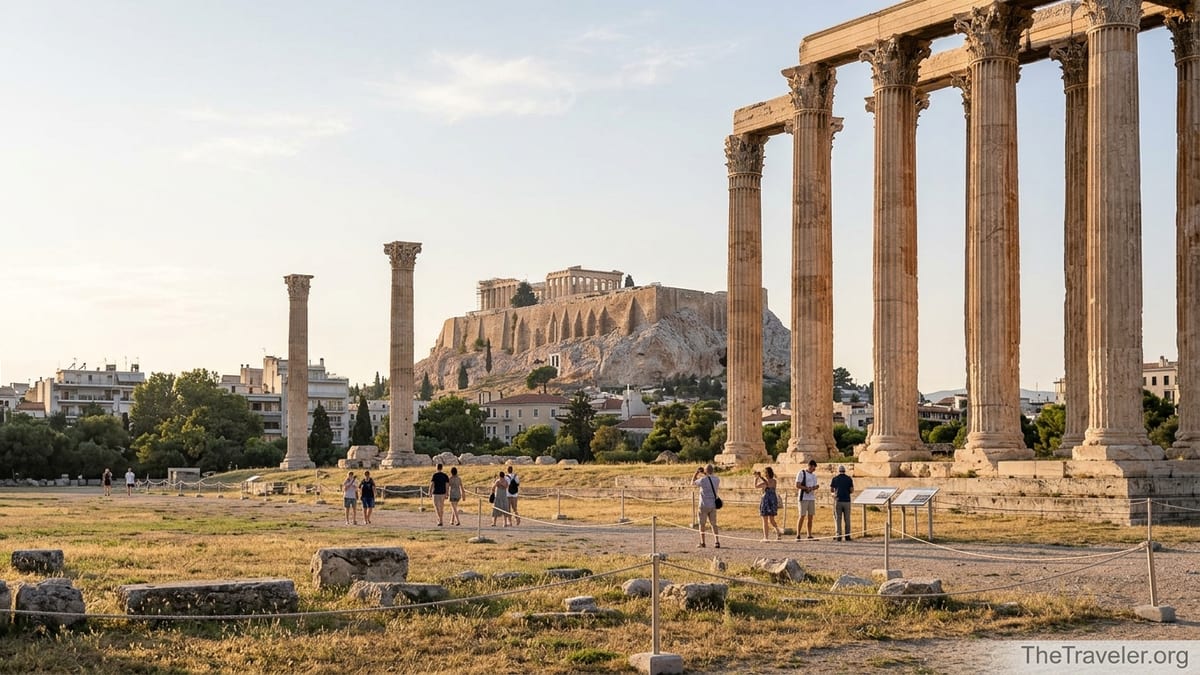
The Temple of Olympian Zeus, often called the Olympieion, is located on flat ground a short walk southeast of the Acropolis. What you see today is a fenced archaeological park focused on the remains of what was once the largest temple in ancient Greece, dedicated to Zeus. Only a handful of the original more than one hundred colossal columns still stand, with a famous fallen column lying like a stone domino on the grass. The scale is impressive, but the site feels more open and fragmentary.
In practical terms, the Acropolis is a dense cluster of monuments on a compact hilltop, where you move along a defined path up marble slopes and through tight bottlenecks. By contrast, the Olympieion is mostly open space. You can walk around the surviving columns, look back to the Acropolis rising behind Hadrian’s Arch, and often find yourself sharing the grounds with only a few dozen other visitors, especially outside peak midday hours.
For a first-time traveler, the distinction matters. The Acropolis is about immersion in a complete sacred rock, still ringed by structures and walls. The Temple of Olympian Zeus is about scale and perspective, seeing just how huge one sanctuary could be and how it sits in the broader Athens landscape.
Tickets, Costs, and Combination Options
As of mid 2026, a standard Acropolis ticket in high season is around 30 euros for general admission, with reduced prices for eligible visitors. That ticket covers the hilltop site itself but not the Acropolis Museum, which has its own separate fee. There is also a multi-site combination ticket, typically around 30 to 35 euros, that includes the Acropolis plus several other ancient sites such as the Ancient Agora, Roman Agora, Hadrian’s Library, and the Temple of Olympian Zeus, valid over multiple days. Policies and prices can shift, so it is best to confirm shortly before you travel, but this gives you a realistic range for budgeting.
The Temple of Olympian Zeus on its own has a lower individual ticket price, usually less than the Acropolis basic ticket. However, many visitors do not buy it separately. Instead, they enter the Olympieion using the multi-site ticket they purchased primarily for the Acropolis. For example, a traveler spending two days in Athens might buy the combined pass, use it for an early morning Acropolis visit on day one, then stroll through the Temple of Olympian Zeus later that afternoon without feeling pressure to “get their money’s worth” from a single site entry.
Free admission days can also affect your choice. Greek archaeological sites periodically offer free entry on certain dates, particularly in the low season and on specific cultural days. These free days apply to both the Acropolis and the Olympieion. If your stay coincides with one, it may tilt your schedule: you could time your Acropolis visit for a free Sunday and instead pay a small standalone fee to wander a quieter Olympieion on another day.
In short, if you are on a strict budget and visiting at least a few archaeological sites, the multi-site combination ticket can make prioritizing easier. You effectively pay for the Acropolis and treat the Temple of Olympian Zeus as a high-value bonus stop rather than an either-or decision.
Historical Weight: Icon vs Colossus
Historically, the Acropolis is the undisputed heavyweight. These structures are tied directly to the golden age of Athens in the fifth century BCE, when the city was at the height of its political and cultural power. The Parthenon and its neighbors are associated with Pericles, the birth of democracy, and masterpieces of classical architecture and sculpture. If you have ever seen photographs of the Parthenon marbles, or studied Greek art in school, standing on the Acropolis connects you to that specific world.
The Temple of Olympian Zeus tells a different, more drawn-out story. The sanctuary around it was one of the oldest in Athens, but construction of the colossal temple itself took centuries and several regimes to complete, with major phases under Hellenistic rulers and eventual finishing touches under the Roman emperor Hadrian in the second century CE. At its height, it was among the largest temples in the Greek world, famous in antiquity for its forest of gigantic columns and an enormous cult statue of Zeus.
For history-minded travelers, this difference is important. On the Acropolis, you are looking at the heart of classical Athens and the same skyline that Athenians saw when drama, philosophy, and democracy were reshaping the Mediterranean. At the Olympieion, you are seeing how power and religion evolved in a city that outlived its classical heyday, became part of broader empires, and still commissioned grand projects long after its political peak.
If your primary interest is classical Athens and the story of democracy, the Acropolis should be your clear priority. If you are equally curious about Roman Athens and long-term continuity, visiting both sites gives you a fuller narrative: the Acropolis as the city’s crown and the Olympieion as a testament to centuries of ambition and devotion.
Views, Atmosphere, and Photography
When travelers talk about unforgettable views in Athens, they almost always mean the panorama from the Acropolis. From the summit you can look out over the entire basin: the modern city spreading to the sea, Mount Lycabettus rising to the northeast, and other landmarks like the Ancient Agora and Pnyx laid out below. Early in the morning, the marble glows softly; later in the day the light turns harsh, but the sense of scale remains striking.
The Temple of Olympian Zeus offers a more horizontal, contemplative experience. Standing beside one of its towering columns, you feel how small a human is next to that much stone, yet you remain at street level with trees, grass, and nearby traffic humming beyond the fence. Many photographers love the classic angle that frames the temple columns with the Acropolis rising behind them. From just outside the site, near Hadrian’s Arch, you can capture that double-layer shot without even entering, but walking inside gives you more freedom to play with composition and foreground.
In terms of atmosphere, the Acropolis can swing from almost meditative at opening time to crowded and noisy by late morning. On a July day shortly after 10:00, it is common to see large cruise-ship groups lining the steps at the Propylaea and guides raising flags above clusters of visitors. At 8:15 on the same morning, you might share a quiet corner near the Erechtheion with just a handful of photographers and early risers.
The Olympieion often feels like a calm pocket inside a busy city. Even in high season, you may find stretches where you can sit on a low wall, look up at the columns, hear cicadas in the nearby trees, and forget that one of Europe’s busiest tourist sites lies ten minutes’ walk away. For someone who loves ruins but dislikes crowds, that atmosphere can be just as valuable as any postcard view.
Crowds, Comfort, and Time on Site
Crowd patterns between the two sites are not remotely comparable. The Acropolis attracts the vast majority of organized tours in Athens, including cruise excursions that converge between about 10:00 and early afternoon. Guides, hotels, and official advice all recommend aiming for the first entry slots of the day or the final 60 to 90 minutes before closing. In peak summer, travelers report that by 10:00 lines at the main gate can stretch far down the hill, and shaded waiting space is limited.
On the ground, that means the Acropolis experience can vary dramatically depending on timing. If you enter at 8:00, you can often walk straight in, climb at your own pace, take unobstructed photos of the Parthenon, and be heading back down by the time large tour groups arrive. If you arrive around 11:30 on a hot July or August day, you are more likely to shuffle through narrow points, queue for photos, and search for slivers of shade along the marble paths.
By contrast, the Temple of Olympian Zeus is rarely packed. Even in midsummer, visitors often report being able to buy a ticket on the spot and walk in with no line. Inside, the open grass and wide paths spread people out. You might encounter one or two small tours, but there is none of the bottleneck effect you get on the Acropolis steps or at the Parthenon viewpoints. For many travelers, the Olympieion functions as a welcome breather in an otherwise intense sightseeing schedule.
In terms of time, most first-time visitors spend around 1.5 to 2 hours on the Acropolis, including the walk up, photo stops, and a slow loop of the summit. Those deeply interested in archaeology or photography sometimes stay longer, especially if combining the site with the slopes and nearby viewpoints. The Olympieion usually takes 30 to 45 minutes, even if you pause for photos from multiple angles and read the information boards. That difference alone can shape your priorities if your Athens visit is limited to one or two days.
Accessibility and Practicalities: Getting In and Moving Around
Both sites are centrally located and easy to reach on foot from many Athens neighborhoods. From Syntagma Square, it is about a 15-minute walk up to the Acropolis entrance via the pedestrianized Dionysiou Areopagitou street, and roughly 10 minutes downhill to the Temple of Olympian Zeus and Hadrian’s Arch. Many visitors naturally link the two on a single sightseeing loop, perhaps visiting the Acropolis in the morning and strolling to the Olympieion in the afternoon.
The Acropolis itself involves a sustained uphill walk with sections of smooth, sometimes slippery marble and uneven stone steps. There is an elevator for visitors with mobility issues, but it requires separate coordination and can sometimes be affected by weather or maintenance. Footwear matters here in a way it does not at the Olympieion. In practical terms, lightweight trainers or walking shoes with decent grip are far safer than flat leather sandals or flip-flops, especially if there has been rain or if dust and fine gravel have polished the surfaces.
The Temple of Olympian Zeus is on level ground and generally easier to navigate, with a mix of compacted earth and gravel paths. It is still an archaeological site, so there are irregular surfaces and the usual restrictions on climbing, but many visitors with moderate mobility challenges find it significantly less intimidating than the Acropolis slopes. If you are traveling with a grandparent or someone recovering from a knee injury, you might choose to let the more mobile members of the group tackle the Acropolis while everyone reunites later at the Olympieion or in nearby Plaka.
Facilities are also more limited on the hilltop. The Acropolis has basic services such as security, some shaded rest spots, and water fountains at or near the entrance, but you should not expect cafes or extensive shelter from sun and wind. The Olympieion is simpler still: a quiet fenced site with ticket booth, occasional shade from trees, and basic amenities nearby on surrounding streets. In hot months, carrying water and a hat is essential at both.
Which Should You Prioritize in Different Itineraries?
If you have only one full day in Athens and want a single flagship ancient experience, the Acropolis should be your clear priority. Rising early, prebooking a timed-entry ticket for the first slot, and pairing the hilltop visit with the Acropolis Museum gives you a coherent story of classical Athens in a single day. In this scenario, you can treat the Temple of Olympian Zeus as an optional add-on if time and energy allow, especially if you hold a multi-site ticket.
For travelers with two or three days in the city, a balanced plan might look like this: early-morning Acropolis on day one, followed by the museum in the heat of the afternoon; then on day two, a gentler circuit through the Ancient Agora and the Olympieion, with cafe stops in between. This pacing allows you to experience both the intense, must-see summit and the quieter, more reflective atmosphere among Zeus’s columns without rushing.
If you are revisiting Athens or have already climbed the Acropolis on a previous trip, you might reasonably decide to prioritize the Temple of Olympian Zeus instead. In that case, you could spend a morning exploring the Olympieion at leisure, continue on foot through the National Garden and Panathenaic Stadium, and focus the rest of your stay on neighborhoods, food, and contemporary culture rather than repeating the classic hilltop circuit.
For those very sensitive to crowds, or traveling at the peak of summer when heat and congestion are at their worst, it can sometimes make sense to downplay the Acropolis or time it very aggressively. For example, a traveler with limited heat tolerance might plan an 8:00 Acropolis visit strictly capped at 90 minutes, then retreat to air-conditioned spaces and later linger at the Olympieion in the softer light of late afternoon when the open space and lower visitor numbers make the experience more manageable.
The Takeaway
The Acropolis and the Temple of Olympian Zeus are not rivals so much as complements. The Acropolis is the non-negotiable highlight for most first-time visitors, the place where you stand among world-famous temples and look out over the city that shaped so much of Western culture. It is crowded, it is labor-intensive to visit, and it commands the highest ticket price, but it delivers an experience that very few travelers regret.
The Temple of Olympian Zeus, by contrast, is a spacious, calmer site that offers a powerful sense of scale, beautiful photo angles toward the Acropolis, and a chance to reflect on Athens’ long history from archaic times through Roman rule. It rarely justifies being your only ancient stop in the city, but as part of a multi-site ticket or a slower second-day itinerary, it becomes one of the most rewarding and surprisingly peaceful places to stand among ruins in central Athens.
If time or budget forces you to choose just one, prioritize the Acropolis. Plan ahead, go early or late in the day, wear good shoes, and consider pairing your visit with the Acropolis Museum for full context. If you have the flexibility for both, treat the Olympieion as a welcome counterpoint: a place where colossal columns rise from the grass and the Acropolis crowns the skyline beyond, reminding you that in Athens, history is never just one monument on a hill.
FAQ
Q1. If I only have half a day in Athens, should I choose the Acropolis or the Temple of Olympian Zeus?
If you must choose one, go with the Acropolis. It offers the most complete and iconic experience, with multiple major monuments and sweeping city views in a compact but dramatic setting.
Q2. How much time should I budget for each site?
Most visitors spend about 1.5 to 2 hours on the Acropolis, including the climb and photo stops. The Temple of Olympian Zeus usually takes 30 to 45 minutes, even at a relaxed pace.
Q3. Are the tickets for the Acropolis and the Temple of Olympian Zeus the same?
No. The Acropolis has its own ticket, while the Olympieion has a cheaper individual ticket. However, many travelers use a multi-site combination ticket that includes both, which can offer better value if you plan to see several ancient sites.
Q4. Which site is better for avoiding crowds?
The Temple of Olympian Zeus is usually far less crowded. The Acropolis can be very busy, especially from late morning to early afternoon in peak season, so early or late entry times are strongly recommended.
Q5. Is either site suitable for travelers with limited mobility?
The Acropolis involves uphill walking on uneven and sometimes slippery stone surfaces. The Temple of Olympian Zeus is on flat ground and generally easier to navigate, making it a better option for those with moderate mobility challenges.
Q6. Can I see both the Acropolis and the Temple of Olympian Zeus on the same day?
Yes. Many visitors climb the Acropolis first thing in the morning, then visit the Temple of Olympian Zeus later the same day, especially if they are using a multi-site ticket that covers both sites over several days.
Q7. Which site offers better photo opportunities?
The Acropolis offers spectacular panoramic views and close-up shots of the Parthenon and other temples. The Temple of Olympian Zeus is excellent for dramatic shots of giant columns and for framing the Acropolis on the hill behind, particularly from inside the site and near Hadrian’s Arch.
Q8. Do I need to book tickets in advance?
For the Acropolis in high season, advance booking for a timed entry slot is highly advisable to avoid long lines and sold-out time windows. For the Temple of Olympian Zeus, same-day purchase at the gate is usually sufficient, though policies can change, so checking shortly before travel is wise.
Q9. Is there shade at these sites, especially in summer?
Shade on the Acropolis is limited and the marble reflects heat, so a hat, sunscreen, and water are essential. The Temple of Olympian Zeus has more open grassy space with some trees, but it is still mostly exposed, so you should prepare for sun at both sites.
Q10. If I have already visited the Acropolis on a previous trip, is the Temple of Olympian Zeus still worth it?
Yes. The Olympieion offers a different perspective on Athens, with its colossal scale, quieter atmosphere, and strong visual connection back to the Acropolis. It is especially worthwhile if you enjoy ruins, photography, or exploring the city at a more relaxed pace.