


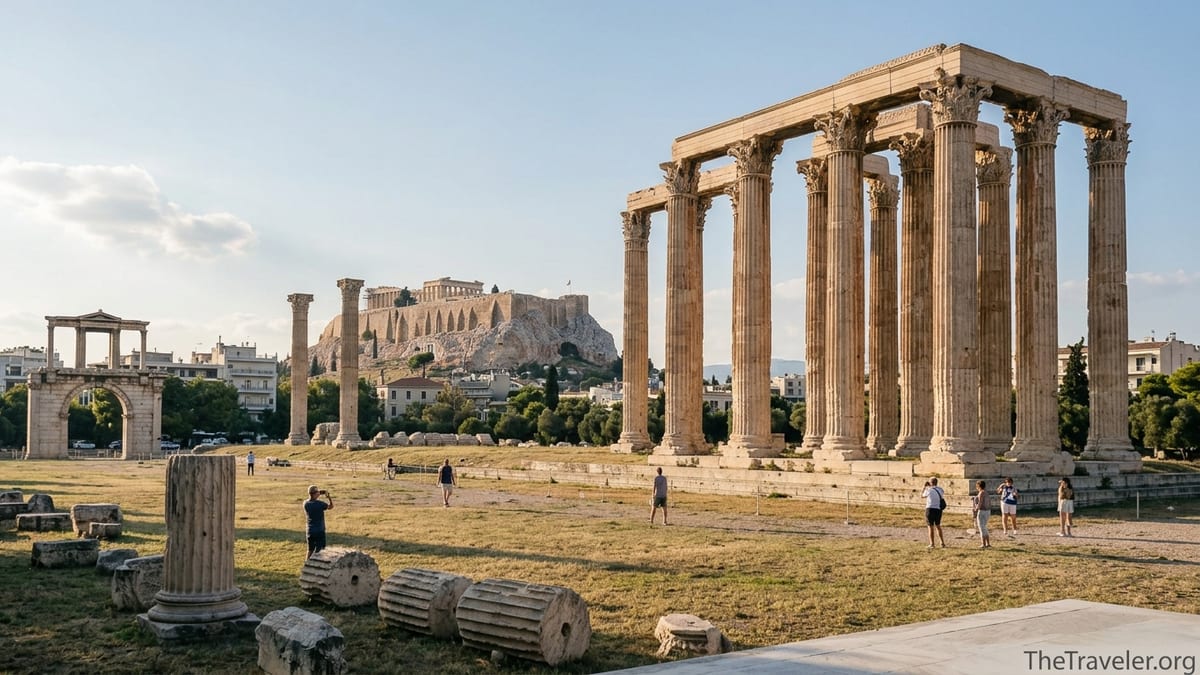
The Temple of Olympian Zeus, or Olympieion, sits in a broad open field in the heart of Athens, framed by Hadrian’s Arch and a skyline view of the Acropolis. It is one of the easiest ancient sites to reach on foot or by metro, and a natural stop to link Syntagma Square, the Acropolis and the Panathenaic Stadium into one compact walking route. This guide explains exactly where the temple is, how to get there from the main visitor neighborhoods, and how to combine it with nearby landmarks in a single, efficient itinerary.
Get the latest updates straight to your inbox!
Where Exactly Is the Temple of Olympian Zeus in Athens
The Temple of Olympian Zeus stands in the archaeological complex known as the Olympieion, on Vasilissis Olgas Avenue at the eastern edge of central Athens. The site is just beside Hadrian’s Arch and roughly midway between the foot of the Acropolis hill and the Panathenaic Stadium. In distance terms, it is about 500 meters southeast of the Acropolis hill and around 700 meters south of Syntagma Square, which means it comfortably falls within a ten to fifteen minute walk for most visitors.
What makes the location so practical is the ring of key neighborhoods around it. To the north you have Syntagma, with its metro hub and airport express bus stop. To the west lies Plaka, the historic old quarter that wraps around the northern and eastern slopes of the Acropolis. To the southwest, the Acropolis Museum and Acropolis Metro station sit just across the pedestrianized Dionysiou Areopagitou street, only a few minutes away on foot. To the east, the National Garden, Zappeion Megaron and the Panathenaic Stadium form a green corridor that leads almost directly to the temple’s entrance.
For planning purposes, imagine the Olympieion as a flat, open rectangle of ruins bordered by Vasilissis Olgas Avenue to the north and the tree-filled National Garden and Ardittos Hill to the east and south. The main visitor gate is on the north side of the site near Hadrian’s Arch. Almost every route you take, whether from Syntagma, Plaka or the Acropolis, will bring you to this gate after a straightforward street-level walk.
The area around the temple is busy with traffic during rush hours, but sightlines remain wide open. Even if you choose not to enter, you can glimpse the surviving Corinthian columns from the sidewalk or from passing city buses and hop-on hop-off coaches that loop along Vasilissis Olgas Avenue.
Reaching the Olympieion from Syntagma Square
Syntagma Square is the most common starting point for first-time visitors, thanks to its metro interchange and direct airport bus line. From here, the Temple of Olympian Zeus is easily reached on foot, and walking is usually faster and more pleasant than trying to ride one stop on public transport. Expect roughly ten minutes at a relaxed pace, slightly longer if you stop to photograph the Parliament building or the National Garden on the way.
To walk from Syntagma, start at the front of the Parliament building, facing the square. With the Parliament at your back, cross the square heading diagonally to the right, toward Amalias Avenue, the main avenue that runs past the National Garden. Once on Amalias, turn right and walk south. You will have the National Garden’s iron fence and trees on your left and a line of hotels, offices and cafes on your right. After about 600 meters, the avenue curves slightly and ahead of you, on the left side of the road, you will see the marble bulk of Hadrian’s Arch and the fenced-off field of the Olympieion beyond it.
The entrance to the Temple of Olympian Zeus is not directly under the arch but a short distance further along Vasilissis Olgas Avenue, which branches off Amalias at this point. Follow the sidewalk as it bends left and look for the ticket booth and gate on your right, a minute or two past the arch. This is the same entrance used by tour groups and independent visitors alike, so you will usually notice a small cluster of people and signs indicating tickets and opening hours.
If you are arriving at Syntagma by metro and feel tired or are visiting at midday in high summer, taxis are plentiful around the square. A short ride from Syntagma to the Olympieion typically takes less than five minutes in light traffic, and the cost is modest because the distance is so short. Ask the driver to drop you at “Naos tou Olympiou Dios” or “Hadrian’s Arch” and you will be delivered almost directly to the gate without needing additional directions.
From Plaka and Acropolis Metro to the Temple
Many visitors stay in or near Plaka, the atmospheric district of narrow streets and neoclassical houses that stretches beneath the Acropolis. From most Plaka hotels, the Temple of Olympian Zeus is less than a fifteen minute walk, and from the lower eastern side of Plaka it can be under ten. The most intuitive route is to head downhill toward the busy thoroughfares of Amalias Avenue or the intersection near Hadrian’s Arch, using the view of the Acropolis and the open space of the Olympieion as rough visual guides.
If you are starting from Acropolis Metro station, which sits on Line 2 of the Athens Metro network, the route is even simpler. Exit the station following the signs for the Acropolis Museum. Once outside, you stand on Makrigianni Street near the pedestrian Dionysiou Areopagitou promenade. Turn left so that the Acropolis Museum is behind you. Within a few minutes you will reach a large intersection at the end of the promenade, where you meet Leoforos Amalias and Vasilissis Olgas Avenue near Hadrian’s Arch.
As you approach this intersection, the temple’s columns appear to your left in the open field across Vasilissis Olgas Avenue. Cross at the traffic lights and follow the sidewalk along the avenue, keeping the columns on your left and the flow of cars on your right. The ticket entrance lies ahead, set back slightly from the road. In total, the walk from the Acropolis Metro station to the Olympieion entrance usually takes around five to seven minutes, making it one of the shortest transitions between two major sites in central Athens.
Acropolis Metro is also a useful station for those staying further south along Line 2, such as in the Koukaki area. You can ride the metro to Acropolis, visit the Acropolis Museum first, then walk to the temple and onward to Syntagma or the Panathenaic Stadium in a single, logical loop without having to re-enter the metro system.
Connecting the Temple with the Acropolis
The Temple of Olympian Zeus and the Acropolis are natural partners in any Athens itinerary. The temple sits directly below the southeastern flank of the Acropolis hill, and walking between them is not only efficient but also rich in views and context. Many travelers choose to visit the Acropolis in the early morning to avoid crowds and heat, then descend toward the Olympieion around late morning or early afternoon.
From the main Acropolis exit on the southeastern side near the Theater of Dionysus, follow the path downhill to rejoin the pedestrian Dionysiou Areopagitou street. Turn left and walk east, with the Acropolis rising above on your left and a line of cafes and souvenir shops on your right. After a short stretch, you will reach the Acropolis Museum and the stairs down to Acropolis Metro station. Continue past the station area, staying on the same side of the road, until you reach the end of the pedestrian zone where it joins the major avenue at Hadrian’s Arch.
At this junction, the transition to the Temple of Olympian Zeus is simply a question of crossing the road. The arch stands as a photogenic frame with the Acropolis visible through it from many angles, so it is worth pausing here. Once you have taken your photos, follow Vasilissis Olgas Avenue along the fence of the archaeological site. The ticket office appears shortly afterward on your right-hand side. Door to gate, the walk from the Acropolis exit to the Olympieion entrance rarely takes more than fifteen to twenty minutes, even at a leisurely pace with photo stops.
Because the two sites are so close, some travelers prefer to admire the temple only from the outside if time is tight, using the view from the road or from the Acropolis slopes. However, entering the Olympieion offers a very different atmosphere from the often crowded Acropolis. The scale of the remaining Corinthian columns is better appreciated up close, and the open field gives you more space to sit, rest and contemplate the skyline views without the same level of congestion that the Acropolis typically experiences in peak season.
Walking from the Temple to the Panathenaic Stadium
Another classic connection is between the Temple of Olympian Zeus and the Panathenaic Stadium, the marble arena that hosted the first modern Olympic Games in 1896. The two sites are close enough to be combined in less than an hour of gentle walking and visiting, which makes them ideal companions either before or after a stop at the Acropolis.
From the temple’s entrance on Vasilissis Olgas Avenue, turn left and walk east along the avenue with the archaeological site behind you. Almost immediately you are walking beside the National Garden and then the landscaped grounds around Zappeion Megaron, a grand neoclassical building used for exhibitions and events. You can either remain on the sidewalk along the busy main road or detour slightly into the garden paths to enjoy more shade and greenery. Both options will bring you to the intersection near the Panathenaic Stadium.
After roughly ten minutes on foot, you will see the curve of the stadium’s white marble stands rising on your right as you follow the continuation of Vasilissis Olgas, which becomes Vasileos Konstantinou Avenue. The main entrance is clearly signed, and tour buses frequently stop nearby. From the temple gate to the stadium entrance, most visitors cover the distance in ten to fifteen minutes. The route is almost entirely flat and suitable for most fitness levels, although there are road crossings where you should use marked pedestrian lights.
Many organized city tours, such as half-day Athens sightseeing excursions, also link the Temple of Olympian Zeus and the Panathenaic Stadium by coach, often with short photo stops at each. Even if you are not on a tour, you can use their pattern as a model: late morning at the Acropolis, midday at the temple, a shaded stroll through the National Garden and Zappeion, and then an afternoon visit to the stadium before looping back toward Syntagma or your hotel in Plaka.
Using the Athens Metro and Other Transport Options
Although walking remains the most satisfying way to connect the Temple of Olympian Zeus with nearby sights, the Athens Metro provides a reliable backbone for getting close to the area from further afield. Two metro stations are especially relevant: Syntagma and Acropolis. Both lie on Line 2, with Syntagma also serving Line 3, which is the line most visitors use when coming directly from the airport.
If you are arriving from the airport by metro, the most straightforward option is to stay on Line 3 until Syntagma and then change to Line 2 if needed, or simply exit and walk to the temple as described earlier. Travelers staying in neighborhoods along Line 2, such as Omonia or Neos Kosmos, can ride directly to Acropolis station and use the short five to seven minute walk to the Olympieion entrance. For those who prefer not to walk in the heat, short taxi hops from either Syntagma or Acropolis station are easy to arrange outside station exits.
Trams and buses also serve the area around the Olympieion. The Athens tram system has a stop at Zappeio, in front of the Zappeion complex near the National Garden. From there, the walk to the temple is about five minutes, mostly along Vasilissis Olgas Avenue. Several city bus lines and hop-on hop-off sightseeing buses stop near Hadrian’s Arch, which is effectively the public transport landmark for the temple. When in doubt, ask drivers for “Arch of Hadrian” or “Temple of Zeus” and they will usually indicate the correct stop as routes are well established for tourists.
For visitors with mobility considerations, the combination of metro to Acropolis or Syntagma and a short taxi ride can minimize walking distances. Pavements are generally smooth along the main avenues, though curb cuts and crossing timings can vary. If you rely on a wheelchair or have limited mobility, it is worth planning your route around the most level segments, such as the flat stretch between Syntagma and Hadrian’s Arch and the short corridor between the temple and the Panathenaic Stadium along Vasilissis Olgas and Vasileos Konstantinou.
Planning Your Visit: Tickets, Hours and Practical Tips
The Temple of Olympian Zeus is managed as an archaeological site, so it follows the general patterns of opening hours used by the Greek Ministry of Culture. In high season, typically from April through October, the site usually opens in the morning and closes in the early evening, while in the winter months hours may be shorter, often closing by mid-afternoon. Exact times can change from year to year, so it is wise to check the current schedule shortly before your trip or verify at another major site in Athens on arrival.
Ticket prices have evolved in recent years, and the combined ticket that once covered multiple archaeological sites in Athens has been phased out in favor of individual tickets and separate passes. As a result, the Temple of Olympian Zeus now has its own admission fee, which is generally lower than that for the Acropolis but still significant enough that budget-conscious travelers may weigh whether to enter or simply view the columns from outside the fence. There are also free admission days several times a year, often including selected national holidays, cultural heritage days and certain Sundays in the low season.
When deciding how much time to allocate, most independent travelers find that thirty to forty-five minutes is enough for a relaxed visit inside the Olympieion. The site is open and fairly compact, with a central cluster of towering Corinthian columns, scattered column drums and foundations, and interpretive panels providing historical context in Greek and English. There are relatively few shaded spots, so visiting in early morning or late afternoon can be more comfortable during the summer heat, especially if you plan to combine the visit with the Acropolis and the Panathenaic Stadium on the same day.
Nearby amenities are limited within the site itself, but just outside the fence along Vasilissis Olgas and Amalias Avenue you will find small kiosks selling bottled water and snacks, along with cafes and restaurants closer to Syntagma and Plaka. Public toilets are available at the site entrance during opening hours. Many visitors choose to bring a reusable water bottle and refill it at fountains encountered elsewhere in the city, then top up at kiosks near the temple when needed.
Building an Easy Half-Day Route Around the Olympieion
Thanks to its central position, the Temple of Olympian Zeus fits seamlessly into a compact half-day or full-day walking route that links several of Athens’ headline sights. A common pattern for first timers is to start at Syntagma in the morning, walk down Amalias Avenue to the temple, continue to the Panathenaic Stadium, and then loop back through the National Garden toward Plaka and the Acropolis. This route keeps distances manageable while providing a varied mix of archaeological ruins, modern urban views and shaded green spaces.
One practical example is to begin at Syntagma around 9:00, watch the changing of the guard if timings align, then stroll down Amalias to reach the Olympieion entrance by about 9:30. After a forty minute visit inside the temple grounds, you could walk east along Vasilissis Olgas, pass Zappeion and reach the Panathenaic Stadium by around 10:30. An hour there, including climbing some of the marble tiers for a view, leaves you time to stroll back through the National Garden toward Syntagma or exit near the lower end of the garden to approach Plaka and the Acropolis area around lunchtime.
Alternatively, if you prefer to prioritize the Acropolis at the coolest and quietest time of day, you might enter the Acropolis site as soon as it opens, spend two to three hours exploring the hill and its monuments, then descend to Dionysiou Areopagitou and walk toward Hadrian’s Arch and the Temple of Olympian Zeus late in the morning. From there, continue to the stadium or return toward Plaka for a meal. The crucial point is that the Olympieion works best as a connective piece between these larger draws, rather than as a stand-alone detour on the edge of town.
Independent travelers often track their route with mapping apps to keep an eye on distances, but central Athens is compact enough that you can simply follow the major landmarks. If you can see the Acropolis hill, Syntagma’s Parliament building and the open expanse of the stadium and temple fields, you are unlikely to stray far off course. For those nervous about navigation, many self-guided walking itineraries published by local tourism bodies and city blogs outline almost this same loop, using the Temple of Olympian Zeus as a pivot point.
FAQ
Q1. How far is the Temple of Olympian Zeus from Syntagma Square on foot?
The distance is roughly 700 meters, which most visitors cover in about ten minutes at a normal walking pace along Amalias Avenue.
Q2. Which metro station is best for visiting the Temple of Olympian Zeus?
Acropolis Metro station on Line 2 is the closest, about a five to seven minute walk away, while Syntagma station is also convenient and about ten minutes on foot from the temple.
Q3. Can I easily combine the Temple of Olympian Zeus with an Acropolis visit in one day?
Yes. The temple sits directly below the Acropolis hill, and walking between the main Acropolis exit and the Olympieion entrance typically takes fifteen to twenty minutes.
Q4. How do I walk from the temple to the Panathenaic Stadium?
From the temple gate, follow Vasilissis Olgas Avenue east toward the National Garden and Zappeion, then continue along Vasileos Konstantinou Avenue. The stadium entrance appears on your right after about ten to fifteen minutes.
Q5. Is it worth paying to enter the Temple of Olympian Zeus or is the outside view enough?
Many travelers enjoy the outside view, but going inside allows you to stand at the base of the towering Corinthian columns and experience the open, less crowded atmosphere of the archaeological field.
Q6. Are there shaded areas near the Temple of Olympian Zeus?
Inside the site itself shade is limited, but the nearby National Garden and the paths around Zappeion offer plenty of trees and benches for a cooler break between visits.
Q7. What is the best time of day to visit the temple?
Early morning or late afternoon is usually most comfortable, especially in summer, as midday sun can be intense and there is little shade within the site.
Q8. Can I see the temple if I have limited mobility?
The columns are clearly visible from the sidewalks along Vasilissis Olgas and Amalias Avenue, and short taxi rides from Acropolis or Syntagma stations can minimize walking for those who need it.
Q9. Are there cafes or restaurants near the Temple of Olympian Zeus?
While there are no cafes inside the site, you will find kiosks, casual eateries and sit-down restaurants along Amalias Avenue and in the nearby streets of Plaka and around Syntagma.
Q10. How much time should I plan for a visit to the Temple of Olympian Zeus?
Most independent visitors spend about thirty to forty-five minutes inside the site, not including the time needed to walk there from Syntagma, Acropolis or the Panathenaic Stadium.