


The Temple of Olympian Zeus sits in the middle of modern Athens, a huge ring of marble columns framed by Lycabettus Hill and the Acropolis. It is visually dramatic, yet many travelers are unsure how much time to budget: Is this a 20-minute photo stop or a place to linger? The answer depends on your pace, the weather, and how you are fitting it into a wider Athens itinerary. This guide breaks the visit into realistic time blocks, from quick in-and-out stops to relaxed strolls that include Hadrian’s Arch and nearby green spaces, with concrete examples to help you plan your day.
Get the latest updates straight to your inbox!
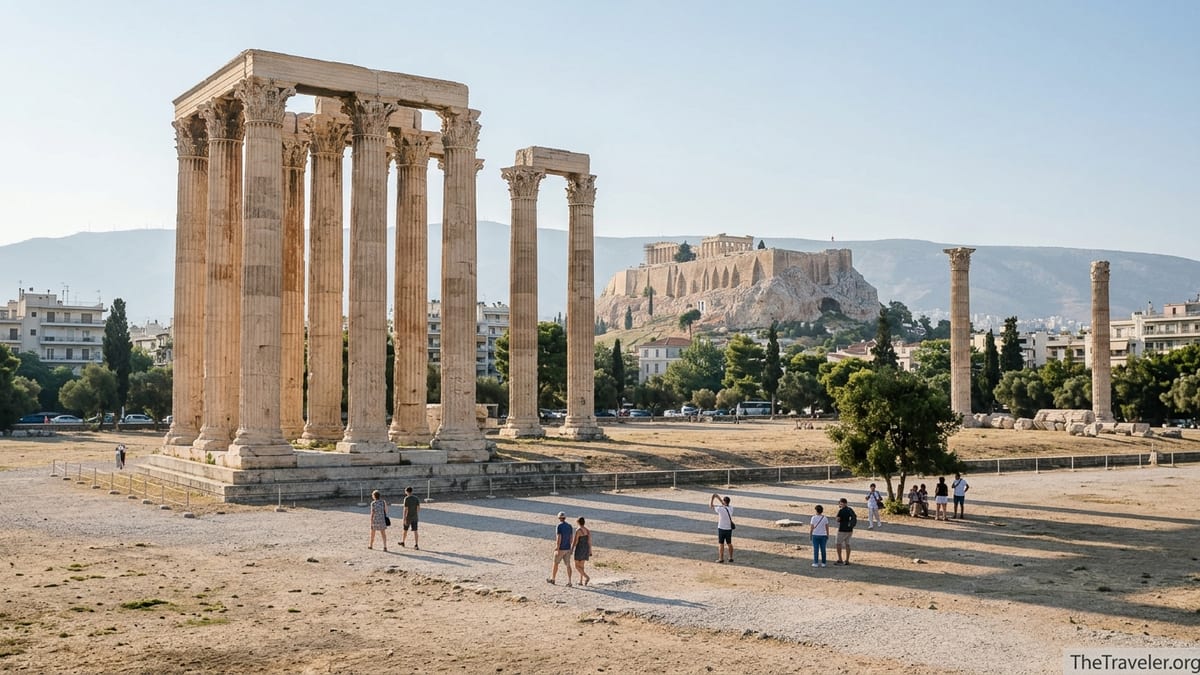
What to Expect at the Temple of Olympian Zeus
The Temple of Olympian Zeus, or Olympieion, was once the largest temple in Greece, with 104 towering Corinthian columns. Today 15 columns still stand and one lies dramatically toppled, giving a clear sense of the scale without needing much imagination. The archaeological zone is compact and mostly open ground, so visitors are not moving through long museum galleries but around a single central monument with a few smaller remains scattered around the field.
From most viewpoints inside the fenced site you can see the Acropolis rising behind the columns, which makes it a favorite spot for photographers. The ground is uneven in places but generally easy to walk, more like a flat gravel field than a hillside. There are basic information panels in English and Greek, but not an extensive exhibition. For many travelers this immediately sets expectations: the value is mostly in the views and the atmosphere, not in a deep interpretive display.
The site lies just off Leoforos Vasilissis Amalias, the main avenue that runs between Syntagma Square and the Acropolis area. It is next to the National Garden and just across the avenue from the Zappeion and Panathenaic Stadium area. In practice, that means the Temple of Olympian Zeus rarely requires a special trip on its own. Most visitors build it into a walking route between central Syntagma, Plaka, and the Acropolis neighborhood.
Tickets are sold at a small booth at the entrance and the temple operates under the same seasonal hours as other state-run archaeological sites in Athens, generally opening around 8 am and closing in the early evening, with shorter hours in winter. During the main tourism season, locals often suggest aiming for early morning or late afternoon to avoid the most intense heat and crowds.
Time Needed: Quick 20-Minute Stops vs One-Hour Wanders
For travelers on a tight schedule, a focused visit can be as short as 20 minutes from gate to gate if you already have a ticket or the line is minimal. This is enough time to walk straight down the main path, circle once around the columns, take several photos with the Acropolis in the background, and have a quick look at the fallen column segment that shows how the drums were stacked. Many cruise passengers on half-day coach tours experience the site at about this pace.
A more relaxed but still efficient visit takes about 40 to 60 minutes. This pace gives you time to read each of the main information boards, find a few less obvious angles for photographs, and simply sit on a low stone or bench and look at how the temple aligns with the modern city beyond the fence. A common pattern is to arrive from the Acropolis or Plaka, spend just under an hour here, then walk through the nearby National Garden toward Syntagma for a late-morning coffee.
If you are genuinely interested in ancient architecture or want to practice photography, you could spend up to 90 minutes on site without feeling rushed. That might include waiting for changing light as clouds move, framing long shots with Lycabettus Hill or the Acropolis, and sketching or journaling. Independent travelers who visit in the shoulder seasons often report that in quieter moments there is a surprisingly peaceful atmosphere given how close you are to central Athens traffic.
Families with young children typically find that 30 to 45 minutes is a natural limit before attention drifts, especially in summer heat. A realistic strategy is to promise a break in the shaded National Garden or an ice cream stop on the pedestrianized Dionysiou Areopagitou area after you finish your loop around the temple, which helps keep everyone moving without lingering too long in the sun.
Designing a Quick 20-Minute Visit
If you only have 20 minutes to spare, decide in advance that this is primarily a visual stop. On arrival, purchase your ticket, step through the gate, and walk directly down the central path toward the standing columns. Most visitors naturally gravitate to the right-hand side where the Acropolis appears behind the colonnade. This is where you can get the classic shot of the temple with the Parthenon in the distance.
Allow roughly 5 minutes to get your photos from two or three angles. Move to the far side of the columns so that Athens City and the modern buildings form a backdrop behind the marble drums. Then walk across to the area where the fallen column segments lie, which offers one of the most interesting details: you can clearly see the column drums and the metal connectors that once held them together. Even in a short visit, many travelers find this view more instructive than looking up at the intact columns.
On the way back toward the exit, pause briefly at an information panel to ground what you are seeing in time. You might read that construction started in the 6th century BC and the temple was only finished centuries later under the Roman emperor Hadrian. For a quick visit, focus on one or two facts rather than trying to memorize full timelines. This helps the site feel meaningful without slowing you down.
Because your time is tight, avoid side paths and do not worry about covering every corner of the field. The primary value of a short stop is the sense of scale when you stand near the surviving columns and the panoramic view across the site. If you feel drawn to stay longer, that is a good sign you should budget a longer visit on a future trip.
Planning a Relaxed Visit With Heat Breaks
In summer, midday temperatures in Athens often climb above 32 degrees Celsius, and the Temple of Olympian Zeus has limited shade inside the archaeological zone. A relaxed visit in these conditions generally works best early in the morning, around opening time, or later in the afternoon after about 5 pm. Tour groups tend to cluster in the late morning, so if you value quiet, consider arriving closer to 8 am or after 6 pm when the light is warmer and softer for photography.
For a comfortable one-hour visit, come prepared with water, a hat, and sunscreen. There are small kiosks and minimarkets along Amalias Avenue and side streets where you can buy a 500 ml bottle of water for around 0.50 to 1 euro before entering. Inside the site there are typically no vendors, so you will rely on what you bring. Some visitors carry a compact folding umbrella to create their own patch of shade when standing and reading signs.
A practical heat strategy is to alternate between sun and shade in your planning. For example, you might spend about 40 minutes inside the temple grounds, then exit and walk 3 to 5 minutes into the National Garden, where tall trees create much cooler air. Many travelers sit on a bench there for 15 to 20 minutes, scrolling through their temple photos or checking the route to their next stop. Others cross over to a nearby café around the Zappeion or on the edges of Plaka for a cold coffee, such as a freddo espresso, which is a local staple.
If you are visiting Athens with older relatives or anyone sensitive to heat, consider splitting the temple into two shorter visual experiences instead of one long stay. One option is to admire the columns from the sidewalk outside early in the day, then purchase tickets and enter later in the afternoon when you can move more slowly. Because you can clearly see much of the site from the street, it is easy to make a last-minute decision about whether the sun and crowd levels feel manageable.
Including Hadrian’s Arch and Photo Stops
Hadrian’s Arch stands just outside the fenced area of the Temple of Olympian Zeus, at the northeast corner of the site. It is an 18-metre high marble gateway that once marked the symbolic boundary between old Athens and the Roman expansion. The arch is free to see from the sidewalk and requires no ticket, so many visitors combine the two without even realizing they are technically separate monuments.
A realistic plan for photo-focused travelers is to spend 20 to 30 minutes at the arch and the exterior viewpoint of the temple, then decide whether to go inside. For example, you might start on the side of the arch facing the Acropolis Road, framing photos where the Parthenon aligns beneath the archway. Then cross the avenue at the pedestrian crossing, walk along the outside fence of the temple, and choose two or three vantage points that include both the columns and the hills behind.
If you choose to enter the temple grounds after your exterior photo session, allow another 30 to 45 minutes to move slowly between viewpoints without rushing. Some photographers like to bring a small travel tripod and come at golden hour, around an hour before sunset, when the marble glows softly and the city behind fades slightly into haze. Keep in mind that tripods can be restricted or controlled at some Greek archaeological sites, so a compact, non-obtrusive setup is less likely to attract attention.
Travelers often find that the best storytelling sequence in their photo set starts wide and ends close. You could begin with a wide shot that shows Hadrian’s Arch, the traffic of modern Athens, and the temple in the distance, then move to mid-range frames of the columns and finally close-ups of weathered carvings and marble textures. Even without advanced equipment, a modern phone camera can capture these details effectively if you take a moment to tap for focus and adjust exposure.
Tickets, Opening Hours, and Budget Planning
The Temple of Olympian Zeus is a state-run archaeological site, so ticket prices, opening hours, and free-entry days follow national policy. In recent years, the individual ticket price has increased, and the once-popular Acropolis combination ticket that included multiple sites has been discontinued. As a result, most visitors now buy a single ticket for the temple or see it from the outside and prioritize paid entry for larger sites such as the Acropolis and Ancient Agora.
As of the most recent seasons, adult tickets for the Temple of Olympian Zeus are typically in the range of a few euros in winter and higher in summer, with reduced tickets available for certain categories such as non-EU youths or seniors, and free entry for many EU residents under 25 with valid ID. Because pricing has changed more than once in recent years, it is worth checking current details shortly before your trip on official Greek cultural heritage channels or at your accommodation’s front desk.
The temple usually opens around 8 am and closes in the early evening, with shorter hours in the off season. There are also several days each year when entrance to state-run sites in Greece is free, including some national holidays and selected Sundays in winter. If your Athens stay coincides with one of these dates, you may be able to visit the Temple of Olympian Zeus, the Acropolis, and other major monuments without ticket costs, though crowds are typically heavier.
Independent travelers sometimes choose to join a guided walking tour that includes exterior views of the temple and Hadrian’s Arch without entering, then return later on their own if they wish to go inside. This can be cost-effective if you are prioritizing your budget for the Acropolis Museum or other attractions that require separate tickets, while still ensuring you hear a coherent story about the Olympieion as part of Athens’ historical landscape.
Fitting the Temple into a One or Two Day Athens Itinerary
On a one-day Athens itinerary built around the Acropolis, the Temple of Olympian Zeus usually fits best either immediately before or after your time on the rock. For instance, you might book an 8:30 am timed entry for the Acropolis, spend two hours exploring, then descend toward the Acropolis Museum for a short visit or a coffee. From there you can walk 10 to 15 minutes along pedestrianized streets toward the temple, arriving in the late morning. A 40-minute visit at that point can be followed by a shaded walk through the National Garden and a late lunch in the Syntagma or Kolonaki area.
If you prefer to avoid the midday sun entirely, you could reverse the order. Spend the morning at indoor or shaded attractions such as the Acropolis Museum or the National Archaeological Museum, relax during early afternoon, then head to the Temple of Olympian Zeus around 5 or 6 pm. From there, stroll to Hadrian’s Arch, continue into Plaka for dinner at a taverna on a side street, and finish the evening with a wander through the illuminated streets beneath the Acropolis.
Travelers staying two or three days in Athens often distribute the major sites across several half-days. One realistic pattern is to dedicate a morning to the Acropolis and its museum, a separate morning or afternoon to the Ancient Agora and Roman Agora, and to slot the Temple of Olympian Zeus into a flexible gap on your map. Because entry rarely requires substantial queuing outside peak times, you can adjust on the fly. For example, if you find yourself early for a changing-of-the-guard ceremony at Syntagma, you can walk 10 minutes down Amalias Avenue, spend half an hour at the temple, then return in time.
For visitors connecting through Athens on a short stopover, the temple can also serve as a manageable first taste of the city’s classical heritage. If you arrive in the afternoon, check into your hotel near Syntagma or the Acropolis area, then walk down to the temple for a 30-minute stroll as the light softens. This gives you a sense of scale and context before tackling the more crowded Acropolis the following morning.
The Takeaway
Most travelers find that 30 to 60 minutes inside the Temple of Olympian Zeus is enough to appreciate its size, enjoy the views, and take thoughtful photographs. A truly rushed visit can be done in about 20 minutes, especially if you focus on a single circuit and a few key perspectives, while history enthusiasts may happily linger up to 90 minutes with a camera or notebook.
Because the site is compact, largely unshaded, and close to other major landmarks such as Hadrian’s Arch and the National Garden, it lends itself well to flexible planning. Think of it as a visually impressive stop that complements the Acropolis and Ancient Agora rather than competing with them. Whether you add it as a quick detour on the walk between Syntagma and Plaka or build a late-afternoon golden-hour visit around your photo plans, a bit of realistic timing and heat awareness will help you enjoy the Olympieion without feeling rushed or overwhelmed.
FAQ
Q1. How long do most visitors actually spend at the Temple of Olympian Zeus?
Most independent travelers spend about 30 to 45 minutes on site, which is enough time for a slow circuit, photos, and a quick look at the information panels.
Q2. Is a 20-minute visit really worth it?
Yes, if you mainly want the visual impact. In 20 minutes you can walk to the columns, see the fallen segment up close, take photos with the Acropolis in the background, and still keep your schedule tight.
Q3. Should I go inside the site or just view it from the street?
From the street you get an excellent sense of the temple’s scale, and many budget travelers are satisfied with that. Going inside lets you stand closer to the columns, see details of the stonework and fallen drums, and enjoy clearer photo angles without the fence.
Q4. When is the best time of day to visit to avoid heat and crowds?
Early morning around opening time or late afternoon a couple of hours before closing are usually the most comfortable, especially between June and September. Midday can be very hot, and there is little shade inside the site.
Q5. Can I combine a visit with Hadrian’s Arch on the same ticket?
Yes. Hadrian’s Arch stands just outside the temple grounds and is freely visible from the sidewalk, so you do not need a separate ticket. Most visitors walk from the arch to the temple gate in just a minute or two.
Q6. How does the temple fit into a one-day Athens sightseeing plan?
On a busy one-day itinerary, people often visit the Acropolis in the morning, then walk down to the Temple of Olympian Zeus for a 30 to 40 minute stop, followed by a shaded stroll through the National Garden back toward Syntagma or Plaka.
Q7. Is it suitable for travelers with limited mobility?
The site is mostly flat, with gravel and hard-packed earth paths. Some areas can be uneven, but many visitors with limited mobility manage a partial circuit and still enjoy the main views. It is wise to wear supportive shoes and move slowly, especially in heat.
Q8. Are there facilities like toilets or cafés inside the site?
Facilities are basic. There may be restrooms near the entrance, but there are no cafés or shops inside the archaeological zone itself. For drinks or snacks, use the kiosks and cafés on nearby streets before or after your visit.
Q9. Is the Temple of Olympian Zeus a good photo location if I am already visiting the Acropolis?
Yes. From the temple you can frame striking shots of the columns with the Acropolis and Lycabettus Hill behind, creating a different perspective from what you see on the rock itself. Many photographers consider it one of the best vantage points in Athens.
Q10. What should I bring with me for a comfortable visit?
Bring water, a hat, sunscreen, and comfortable shoes, especially in warmer months. A small camera or smartphone is enough for excellent photos, and a light scarf or shawl can help if you want extra sun protection while reading signs or waiting for the right light.