


France’s TER trains are the quiet workhorses of the national rail network, carrying commuters, students and travelers across regions from Brittany’s wild coast to the peaks of the Alps. If you are planning to move beyond the classic Paris–Lyon–Nice high speed routes and really explore the country, understanding how TER services work will save you money, time and frustration. This guide walks you through TER routes, ticket types, typical prices and essential travel tips, using real examples from across France so you can board your next regional train with confidence.
Get the latest updates straight to your inbox!
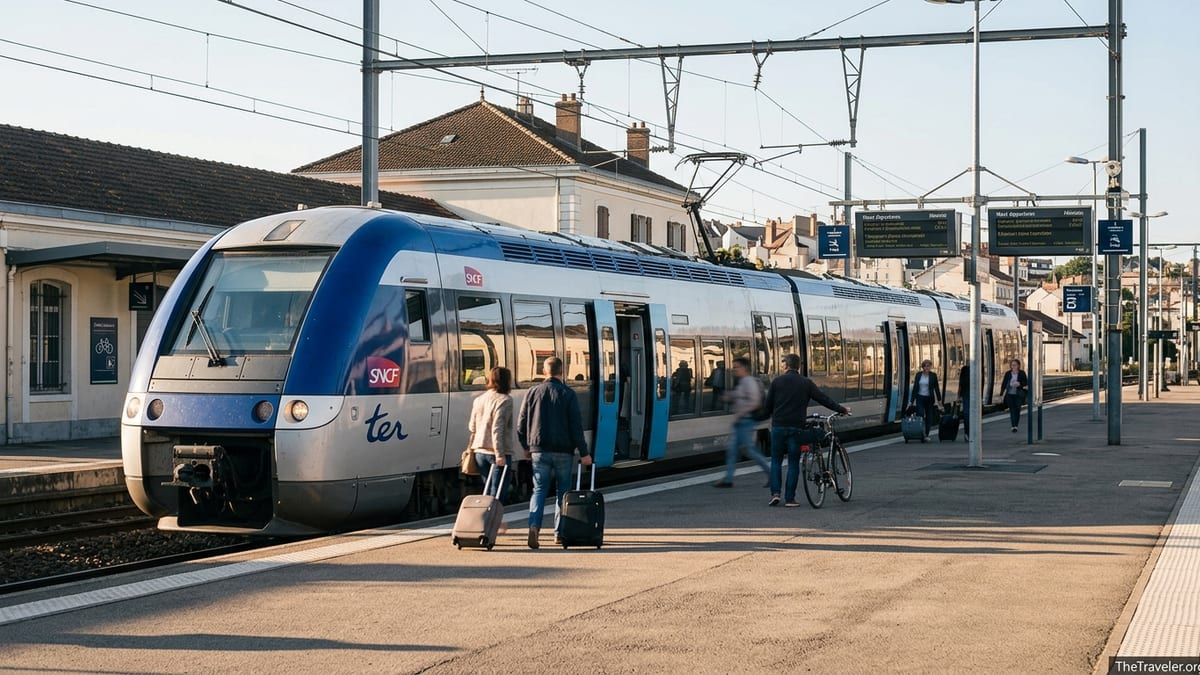
What TER Trains Are and When They Make Sense
TER stands for Transport Express Régional, the brand for regional trains operated by SNCF on behalf of France’s regional councils. In practice, TER services form a dense mesh of lines linking small towns, medium cities and larger hubs. A single journey might be as short as a 15 minute hop from a village to the nearest city, or a three hour cross country ride following river valleys and coastlines. Unlike high speed TGV trains, TER services focus on short and medium distances with frequent stops, moderate speeds and relatively simple pricing.
For travelers, TER trains make the most sense whenever you are moving within a single region or between neighboring regions at modest distances. A visitor staying in Marseille might use TER trains branded as ZOU to explore coastal towns such as Cassis, Bandol or Toulon. Someone based in Bordeaux could rely on TER Nouvelle Aquitaine services to visit Saint Emilion, Arcachon or the Dordogne. In Brittany, TER BreizhGo trains connect Rennes with Saint Malo, Quimper and the Pink Granite Coast. These examples show the real strength of TER: cheap, frequent, no nonsense mobility that lets you treat rail like a local.
TER is also a strong alternative to the car for daily commuters, students and seasonal workers. According to SNCF and regional mobility plans, more than a thousand stations are now served by TER lines, creating an almost suburban like rail offer far beyond major metros. If you expect to travel several days in one region, or commute between two cities such as Lille and Arras or Lyon and Saint Étienne, a TER pass or regional discount card will usually beat the cost and hassle of driving, parking and fuel.
Compared with long distance trains, TER usually offers lower base prices and simpler conditions. There is no seat reservation on most routes, tickets are often valid for an entire day, and penalties for changing plans are minimal or non existent on many regional tariffs. That flexibility is particularly valuable for travelers who want to linger in a village market or wait out a rainstorm rather than racing to a fixed departure time.
Key TER Routes Travelers Actually Use
While TER networks cover every region of mainland France, certain routes are especially popular with international visitors and long stay travelers. On the Mediterranean coast, TER Provence Alpes Côte d’Azur services, marketed jointly under the ZOU brand, run dense local trains between Marseille, Aix en Provence, Toulon, Cannes, Antibes and Nice. For example, a typical TER journey from Nice Ville to Cannes takes about 30 to 35 minutes, with trains running roughly every 30 minutes in the daytime and base fares often in the range of 6 to 10 euros depending on the latest regional tariff and sales channel.
Further west, in Occitanie, liO TER trains link Toulouse with Albi, Carcassonne and the Pyrenees foothills. One well used tourist corridor runs Toulouse–Carcassonne–Narbonne–Perpignan, serving the Canal du Midi, Cathar castles and Mediterranean beaches. Occitanie also promotes an "Occitanie Rail Tour" concept, encouraging visitors to string together rail segments to explore from the Cévennes mountains to the Camargue marshes using day passes valid on regional liO trains and some associated buses. In practice, you might ride a morning train from Montpellier to Nîmes for Roman sites, continue on to Arles in Provence, then finish the day on a later TER to Avignon, all under a single regional pass.
On the Atlantic side, TER Nouvelle Aquitaine services are particularly useful around Bordeaux. Short hops like Bordeaux Saint Jean to Saint Emilion, Libourne, Arcachon or Pauillac allow easy access to vineyards and the Atlantic coast. A typical off peak TER ride from Bordeaux to Saint Emilion is around 35 minutes, with a one way base fare often in the 10 to 15 euro bracket in recent regional fare tables, while Bordeaux to Arcachon takes about 50 minutes with comparable pricing. These journeys are popular enough that some departures feel like commuter trains in the morning and tourist shuttles in the afternoon.
In the north, TER Hauts de France trains connect Lille with Arras, Amiens, Dunkirk and many smaller towns. A rider commuting from Lille Flandres to Arras will usually find multiple departures each hour during peak times, and open data from the region shows a structured fare grid by origin destination pair, with shorter hops under ten euros and longer stretches proportionally higher. A similar pattern holds in other regions such as Grand Est, Bourgogne Franche Comté and Centre Val de Loire, where TER links medium cities like Reims, Dijon or Tours with their surrounding countryside and neighboring regions.
Understanding Tickets, Fares and Validity
Unlike TGV tickets, which are tied to specific trains and often come with complex fare conditions, TER tickets are designed for simplicity and flexibility. In most regions, a standard TER ticket is valid for travel on the chosen route during a specific day, with no compulsory seat reservation. The official SNCF traveler conditions explain that a TER ticket purchased for a date is generally valid on all TER trains on that route for that calendar day, though some regions may impose peak time restrictions on certain promotional fares or passes.
Pricing is set by each regional council, which means that a 50 kilometer trip in Brittany may not cost the same as a 50 kilometer trip in Provence. Nevertheless, patterns emerge. A short city to suburb hop, such as Rennes to Vitré in Brittany or Lyon Part Dieu to Villefranche sur Saône in Auvergne Rhône Alpes, often costs in the high single digits for a regular adult ticket. A medium distance leg of 80 to 120 kilometers might land in the 15 to 25 euro bracket, as seen on many Bordeaux area journeys in Nouvelle Aquitaine or Lille based trips in Hauts de France. Longer cross regional routes can be higher, but are still usually cheaper than TGV options over similar distances.
Where TER becomes truly budget friendly is with regional reduction cards and passes. For instance, in Occitanie the LibertiO card offers percentage reductions, often between 30 and 50 percent, on most liO TER journeys for holders who pay an annual fee. In Provence Alpes Côte d’Azur, the Carte ZOU family of products provides discounts for young people, students and frequent travelers, with some study passes priced at around 90 euros per year for large reductions on daily commutes. In Brittany, BreizhGo tourist passes can include unlimited regional train and some bus travel over 2 or 7 days, targeted at holidaymakers hopping between coastal resorts. These products change periodically, so it is wise to check the official regional TER pages or SNCF Connect app for current names, eligibility and exact prices just before you travel.
Observant travelers should also note the difference between full fare, regional promotional fares and national discount schemes. A walk up ticket at a station vending machine generally sells at the regional "normal" tariff. Buying through SNCF Connect or a regional app may offer the same price or occasionally slight online only reductions or limited time promotions, particularly outside peak commuter hours. Holders of national SNCF discount cards, such as those geared to youth, seniors or frequent travelers on long distance trains, may see additional reductions on TER segments when those segments are included in longer, through journeys that combine TGV and TER on a single booking.
How and Where to Buy TER Tickets
In most of France, buying a TER ticket is straightforward and can be done through three main channels: digital, station based and onboard. Digital purchases through the SNCF Connect app or website now account for a growing share of TER ticket sales. From abroad, many travelers set up an SNCF Connect account before arriving, allowing them to search regional routes, compare TGV and TER options on the same screen, and buy e tickets that live in the app or as PDFs. When you book a simple TER ride, such as Montpellier to Sète or Nice to Antibes, your ticket usually appears as a barcode or QR code that conductors scan on board.
At stations, ticket vending machines marked with the SNCF or regional TER branding accept major bank cards and often cash. In smaller stations, these machines may be the only sales point. They typically allow you to select a destination, travel date, passenger type and any applicable discount card. Many machines present routes region by region, so in Occitanie the interface highlights liO TER lines, while in Provence Alpes Côte d’Azur you will see ZOU products. Staffed ticket counters still exist in busier stations such as Toulouse Matabiau, Rennes or Bordeaux Saint Jean, and they are useful if you need advice on combining TER with TGV, redeeming a regional pass or clarifying the validity of a discount card.
On some lines and at very small rural stops without ticket machines, it may be possible to buy tickets directly from the conductor, although this is less common than in the past. In those cases, conductors usually sell at the standard fare and may apply a small supplement if they believe you could reasonably have bought a ticket before boarding. To avoid misunderstandings or fines, it is always safer to have a valid ticket or pass in hand before you step onto the train. If a machine or app is out of order, take a quick photo or screenshot as evidence and look for staff on the platform or the first car.
One useful feature for complex trips is the "Billet direct" concept, where a single purchase combines multiple train segments into an end to end journey. This is particularly relevant if you are, for example, traveling from a small Occitanie town to Paris with a TER leg followed by a TGV connection. Buying both as one through ticket from the same sales channel increases your protection if delays occur, because the entire itinerary is treated as a single contract with minimum connection times built in.
Onboard Experience, Comfort and Accessibility
Boarding a TER train is generally relaxed and informal compared with large TGV departures. There is rarely any gate control at the platform entrance. In most cases you simply walk to the correct platform, confirm the destination and intermediate stops on the departure board, and step aboard. Newer TER rolling stock includes double deck Regio 2N trains in regions such as Provence Alpes Côte d’Azur, Occitanie and others, as well as modern single level units with wide doors and low floors for easier boarding. Older trains still circulate on some rural lines, but regional councils have been gradually renewing fleets to improve comfort and accessibility.
Inside, expect 2nd class open saloon seating in a 2+2 layout, with modestly padded seats, overhead luggage racks and sometimes luggage spaces near doors. Many TER trains now offer power outlets at seats, though not always on every unit or every seat pair, and Wi Fi is less consistently available than on TGVs. Air conditioning is standard on recent stock but can vary on older units, which matters in hot regions like Provence or Occitanie in summer. Toilets are usually located in at least one car per trainset, and family or bike spaces are marked with clear pictograms. Because there are no reservations, you can move freely between cars to find a quieter section, a table seat or more space for luggage.
Accessibility varies by station and line. Large hubs such as Lyon Part Dieu, Lille Flandres or Toulouse Matabiau offer elevators or ramps to each platform, tactile paving and staffed assistance points. Many medium stations now have raised platforms to provide level or near level boarding with newer TER trains. However, at rural halts you may still encounter low platforms with a step up into the train and no staff on site. Travelers with reduced mobility can request assistance in advance through SNCF’s dedicated service, specifying TER journeys just as they would TGV. It is advisable to request help at least 48 hours before travel when possible.
During the journey, conductors perform routine ticket checks, often shortly after departure or between major stations. They are usually approachable sources of local information: if you are unsure whether to change at Narbonne or Perpignan for a small coastal branch line, or if you want to confirm the best stop for a specific village, asking the conductor before the train gets busy is a wise move. Announcements may be made in French only on smaller lines, but on popular tourist corridors heading to the Riviera or the Alps, you will sometimes hear key information repeated in English during summer.
Money Saving Strategies and Regional Pass Examples
Because each region sets its own tariffs, the best way to save on TER travel depends heavily on where and how often you ride. Still, three broad strategies hold across France: use regional reduction cards, look for unlimited day or week passes and combine TER segments smartly with long distance tickets. A good concrete example comes from Occitanie, where the Occitanie Rail Tour pass allows unlimited travel on liO TER trains and some partner buses from a starting price advertised around 10 euros per day for multi day options. A traveler spending five days exploring Toulouse, Carcassonne, Perpignan and the Pyrenees could buy such a pass and ride multiple segments per day without worrying about individual fares.
On the Mediterranean coast, the ZOU range in Provence Alpes Côte d’Azur offers several passes tailored to intensive use. Students and apprentices can access ZOU study passes with annual prices quoted around 90 euros in recent documents, effectively slashing monthly commuting costs between university towns and hometowns. For visitors, shorter term ZOU passes periodically appear that bundle train, tram and bus access along the Riviera for 3, 7 or 14 days, allowing unlimited hop on hop off travel between Marseille, Toulon and Nice for a fixed price. While the exact offers change seasonally, the general principle is that if you will ride TER daily for sightseeing, a regional pass will quickly pay for itself.
In Brittany, the BreizhGo pass family illustrates another approach. Regional authorities have promoted 2 and 7 day passes combining train and coach lines, particularly attractive along the Quimper–Concarneau–Brest axis and coastal routes near Saint Malo. A couple vacationing in Brittany might buy a 7 day pass, base themselves in Rennes, and use TER plus buses to visit Dinan, Saint Malo, Vannes and Quiberon without renting a car. In the north of France, Hauts de France offers products that discount regular commuting between cities like Lille, Arras and Amiens, as well as youth products giving generous reductions on off peak travel to the coast at Calais or Boulogne.
National discount cards can stack with some of these regional products in specific conditions, especially when TER segments are attached to TGV journeys. For example, a traveler with a national youth discount card traveling from a small town in Occitanie to Paris might pay a reduced fare for both the TER and TGV legs when booked together. However, rules about cumulative discounts are complex and change over time. When in doubt, test combinations in SNCF Connect: create an itinerary including both segments and compare the total price with separate bookings and with the cost of any regional day pass you might buy instead.
Essential Practical Tips for Riding TER Like a Local
Good preparation makes TER travel feel smooth and intuitive. Before you head to the station, check your route in a journey planner such as SNCF Connect or a regional TER site. Pay attention to the symbols that flag replacement buses or disruptions. If engineering works are scheduled, a train listed as TER may in fact be a coach marked "car TER" on your ticket and station screens. In those cases, boarding usually takes place in front of the station or at a dedicated bus bay, and travel times can be longer than the usual rail timetable.
On the day of travel, plan to arrive at the station 10 to 15 minutes before departure, especially in unfamiliar stations where you may need time to find the right platform. Most TER tickets bought online or at modern vending machines no longer require physical validation in the old punch machines, but if you see yellow composting machines on the platform and your ticket is printed on traditional card stock without a date or barcode, it is safer to validate it before boarding. Failure to do so can, in some regions, lead to a fine even if you have paid for the ticket itself.
Once on board, spread out sensibly. Keep bags off empty seats during busy periods and place larger luggage in the open spaces near doors or at coach ends rather than blocking aisles. On lines heavily used by cyclists, such as those serving the Loire à Vélo cycling route between Tours and Orléans, bike spaces can fill quickly. If you are traveling with a bicycle in summer, consider off peak trains in mid morning or mid afternoon, and be prepared to wait for the next departure if spaces are already taken. Some regions require free or low cost bike reservations on specific peak season services, so checking local rules a few days ahead can prevent surprises.
Finally, keep an eye on connection margins if your TER links up with a long distance train or flight. A 10 minute same platform change between two TER services at a small station is usually safe; conductors can often hold a connection slightly if many passengers need to change. However, when connecting to a TGV at a major hub, building in at least 30 minutes, and preferably more during busy holiday weekends, is prudent. TER delays of 5 to 15 minutes are not rare, especially on routes with dense commuter traffic or when sharing tracks with freight. Treat TER as reliable but not precision timed in the way of airport shuttles, and plan buffers accordingly.
FAQ
Q1. Do I need seat reservations on TER trains in France
In almost all cases you do not need or receive a seat reservation on TER trains. You simply board with a valid ticket or pass and choose any free seat in the correct class. Only very exceptional regional services tied to events or special operations may use reservations, and these are clearly labeled when booking.
Q2. How much does a typical TER journey cost
Prices vary by region and distance, but as a rough guide short trips between nearby towns often cost under 10 euros, while medium journeys of around 80 to 120 kilometers might fall between about 15 and 25 euros at standard adult fares. Regional passes and discount cards can reduce these amounts significantly for frequent travelers or eligible groups such as students and youths.
Q3. Are TER tickets flexible if my plans change during the day
Standard TER tickets are generally flexible on the chosen travel day, meaning you can take any TER on the route printed on your ticket for that date, subject to regional conditions. If you decide to linger for lunch or take an earlier train, you normally do not need to exchange the ticket as long as you remain within that calendar day and route.
Q4. Can I use TER trains to get from the airport into city centers
On some routes, yes. For example, regional trains serve stations near major airports like Lyon Saint Exupéry or Nice, but in several cities the primary airport link is a tram, metro or dedicated express service. It is worth checking whether the airport has its own branded train service or whether the nearest TER accessible station requires a short tram or bus ride from the terminal.
Q5. How do I know if my TER will be replaced by a bus
Timetable apps and station departure boards mark replacement buses with labels such as "car TER" or a bus pictogram. If you see this next to your train number, expect a coach instead of a train and follow signs or announcements at the station to the correct boarding point, which is usually outside the main entrance or at a dedicated bus bay.
Q6. Are TER trains suitable for traveling with children
Yes, TER trains are widely used by families and are generally child friendly. You will often find space for strollers near doors, and toilets on board many trains. Some regions offer reduced fares or free travel for younger children within certain age brackets, so checking local rules before buying tickets can produce useful savings for family trips.
Q7. Can I bring a bicycle on TER trains
Many TER trains accept bicycles, often free of charge, in designated bike spaces marked with pictograms near doors. However, capacity is limited, and on busy summer routes popular with cyclists you may find all spaces taken. In that case, staff can ask you to wait for a later train. Some regions impose bike reservations or seasonal rules on specific lines, so it is sensible to check the regional TER site or app before travel.
Q8. What happens if my TER is late and I miss a connection
If you bought a through ticket that combines TER with another train, the entire itinerary is treated as one contract, and SNCF staff will normally rebook you on the next available service in case of a missed connection. If you purchased separate tickets, assistance becomes more discretionary, so building generous connection times between independently booked TER and TGV segments is recommended.
Q9. Are TER trains safe to use late at night
Safety levels on TER trains are broadly comparable to other public transport in France. Late evening services often have fewer passengers, so common sense precautions apply: keep valuables out of sight, stay in well lit cars, and if in doubt sit near other travelers or close to the conductor’s usual position. Regional authorities and SNCF run regular security patrols, especially on busy commuter and urban fringe lines.
Q10. Do TER trains run on public holidays and Sundays
Yes, but with reduced frequency. On Sundays and public holidays many lines operate fewer trains, particularly early in the morning and late at night, and some purely commuter oriented services do not run at all. Always consult the specific date in an official timetable or journey planner rather than assuming weekday patterns will apply.