


More news on this day
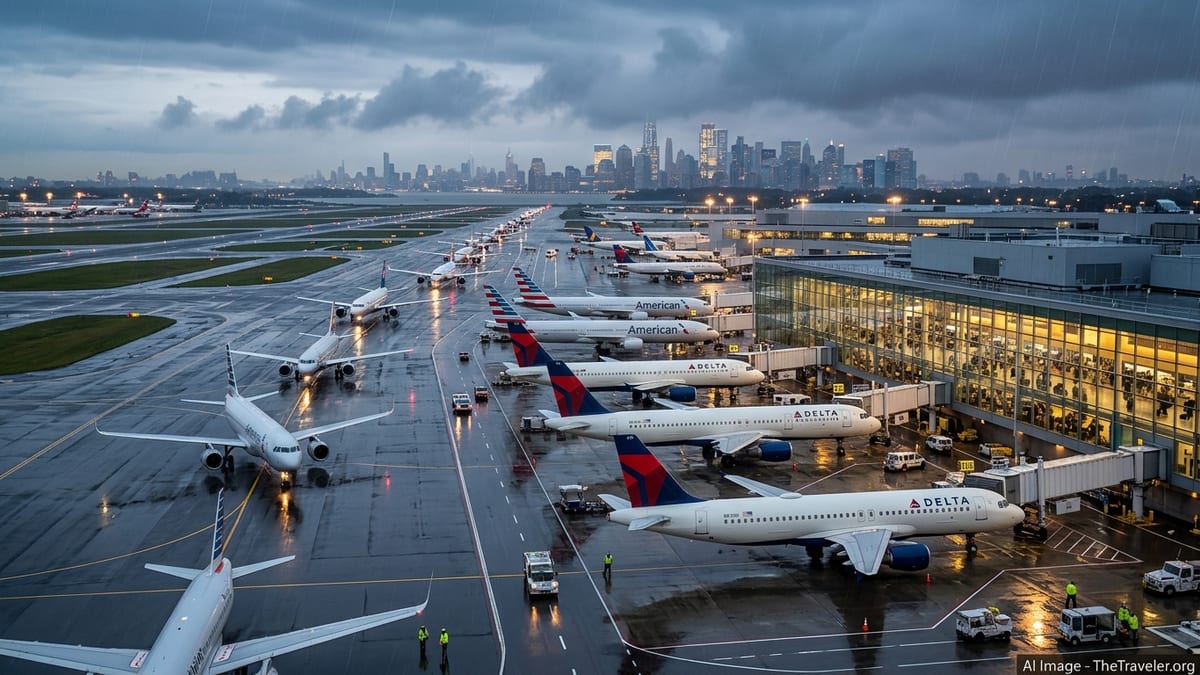
Storms impacting both U.S. coasts on Thanksgiving Day 2026 are contributing to scattered flight delays and cancellations at major airports, as nearly 6 million people are expected to travel by air during one of the busiest holiday periods of the year.
Get the latest news straight to your inbox!
Holiday air travel volumes remain near record highs
The current wave of delays is unfolding during what AAA describes as a near-record Thanksgiving travel period. In a national forecast issued on November 16, 2026, the organization projected that 81.5 million people in the United States would travel at least 50 miles from home between Tuesday, November 24, and Monday, November 30. That figure is slightly below the 81.6 million estimated for the 2025 Thanksgiving period, ending a three-year run of new highs but still keeping overall travel at an elevated level.
Within that total, AAA expects 5.96 million travelers to fly domestically over the seven-day period. The forecast calls for a marginal 0.2 percent decline in air passengers compared with 2025, but airlines and airports are still handling volumes that are close to recent records. Separate projections from airlines for the broader late November travel window indicate that carriers anticipated tens of thousands of flights and several million passengers across the second half of the month.
Because the AAA figures are forecasts rather than final counts, they provide context rather than a definitive tally. Nevertheless, they illustrate why even localized weather problems or individual airport incidents can ripple quickly through the system over Thanksgiving week, especially when combined with tight schedules and high aircraft utilization by airlines.
Storms and incidents disrupt operations at key hubs
The weather backdrop for Thanksgiving 2026 involves active storm systems on both coasts. Guidance from the National Oceanic and Atmospheric Administration on November 24 highlighted a developing autumn storm likely to bring rain, some embedded thunderstorms and gusty winds to parts of the lower Mississippi Valley and Southeast on the key pre-holiday travel days. Additional coastal storms were forecast to affect sections of the East Coast and West Coast around the holiday itself, with heavy rain, coastal flooding, strong onshore winds and areas of mountain snow.
These storms are now materializing into specific impacts. In the East, conditions were severe enough in New York City for organizers of the Macy’s Thanksgiving Day Parade to take the unprecedented step of postponing the 100th edition of the event from Thursday, November 26, to Saturday. City agencies cited strong winds and poor weather conditions in their planning, and regional emergency management bulletins have warned of hazardous travel at various times due to high winds, heavy rain and tidal flooding in coastal areas.
Farther south, operations at Miami International Airport were constrained on the evening of Wednesday, November 25, after a FedEx aircraft overran a runway. Local officials reported that all but one runway were temporarily closed in the hours following the incident, just as pre-Thanksgiving traffic peaked. By early Thursday, the Federal Aviation Administration was reporting multi-hour delays in parts of the system, and it will take time for schedules to fully absorb the knock-on effects of that episode in addition to weather-related constraints.
West Coast airports experience scattered Thanksgiving delays
On the West Coast, coastal storms and a series of high-tide and heavy-surf events have created challenging operating conditions near several major airports. Forecasts for California and the Pacific Northwest in the days leading into Thanksgiving called for periods of heavy rain, strong winds along the coast, rough seas and mountain snow in higher elevations. These conditions can slow arrivals and departures when they intersect with peak travel windows.
Real-time data from flight-tracking services on Thanksgiving morning indicated that large coastal airports including Los Angeles International, San Francisco International and Seattle-Tacoma International were experiencing a mix of delayed and on-time operations. At times during the morning hours, Los Angeles showed several dozen delayed flights and isolated cancellations, while San Francisco and Seattle recorded smaller clusters of delays. These figures are snapshots and fluctuate through the day as airlines adjust schedules, crews and routings to evolving conditions.
At the same time, anecdotal reports from travelers suggest that experiences vary widely by departure time and terminal. Some early-morning passengers at San Francisco described relatively smooth security lines and boarding, while other travelers at Los Angeles and regional California airports reported heavier crowds and longer waits, particularly on the evening of Wednesday, November 25. The variation reflects not only the weather but also individual airline schedules, staffing levels and the time of day.
Nationwide impact: delays more common than cancellations so far
Nationally, delay statistics compiled by flight-tracking platforms and news organizations show that, so far, Thanksgiving week 2026 has produced more delays than outright cancellations. On Wednesday, November 25, one widely cited dataset recorded several thousand delayed flights in the United States and dozens of cancellations, a volume consistent with a busy holiday period affected by regional storms rather than a single, system-wide disruption.
By Thursday morning, the pattern appeared to be similar: scattered ground delay programs and flow controls at affected airports, but most of the U.S. network operating, albeit with slower turnarounds and longer taxi times at times. Weather-related air traffic control initiatives, such as miles-in-trail restrictions and required spacing between arrivals in poor visibility or high winds, remain among the primary drivers of delays. These measures are intended to preserve safety while keeping at least some traffic moving through congested airspace.
The relatively modest number of cancellations compared with delays is important for travelers. While late departures and arrivals can disrupt connections and ground transport plans, they are often recoverable within the same day, especially when airlines are able to substitute aircraft or reassign crews. Cancellations, by contrast, typically require complete rebooking and may strand passengers overnight when flights are already operating near full capacity. At this stage in the holiday period, available data suggests that most disruptions have taken the form of delays rather than large-scale scrubbing of flights.
What Thanksgiving travelers should check and expect next
For those flying later on Thanksgiving Day or over the weekend, the main variables will be how long the current coastal storms persist and whether additional weather systems evolve along busy corridors. Forecast products from federal and private meteorological agencies still show unsettled conditions along portions of both coasts through at least Friday, November 27, with some improvement expected in parts of the interior. However, even as weather improves, aircraft and crew positioning imbalances can continue to generate delays as airlines work to return equipment to scheduled rotations.
Travelers with upcoming flights are likely to see a dynamic operational picture. Airport-by-airport delay maps on flight-tracking platforms update throughout the day and can show where arrival or departure programs are in effect. Airline mobile apps and booking systems typically post the most up-to-date information on specific flights, including gate changes, revised departure times and options for self-service rebooking when significant disruptions occur. Some carriers also issue travel waivers that allow changes without standard penalties when particular routes or regions face forecast weather problems; passengers should verify directly with their airline whether any such policies apply to their itinerary.
Given the high passenger volumes forecast through Monday, November 30, travelers may want to allow additional time at the airport even if their particular route is not yet affected by delays. That can help account for longer security queues, crowded parking facilities and shuttle buses, and potential lines at check-in desks. Those connecting through weather-affected hubs might also consider monitoring earlier and later flight options on the same day, in case conditions worsen and rebooking becomes necessary. As the holiday weekend progresses, the balance of disruptions may shift from outbound Thanksgiving journeys to return travel on Sunday and Monday, so staying informed about both weather and airport status remains essential.