


More news on this day
A nationwide Delta Air Lines technology outage on November 22, 2026, triggered more than 2,000 flight delays just as Americans began their Thanksgiving trips, briefly overwhelming operations at Atlanta and other major hubs and pushing searches related to “Delta flight delays” to the top of U.S. Google Trends.
Get the latest news straight to your inbox!
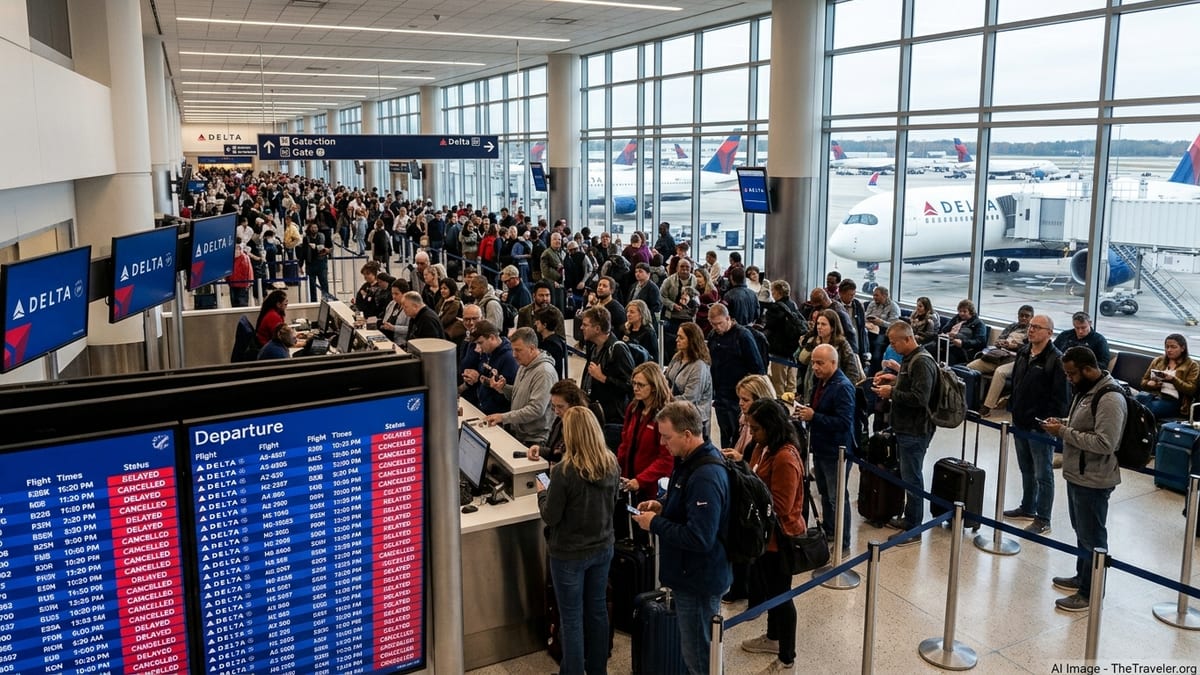
How a single system failure rippled through Delta’s network
Delta’s disruption on Sunday 22 November began with a malfunction in an automated system used to calculate aircraft weight and balance before departure, according to statements from the airline and reports from U.S. aviation regulators. The issue affected pre-departure procedures for departing flights and led to a temporary ground delay program focused on Hartsfield-Jackson Atlanta International Airport, Delta’s largest hub, while operations teams worked to restore normal processes.
Public flight-tracking data show how quickly the outage translated into operational disruption. FlightAware figures cited by several outlets indicate Delta recorded about 2,200 delayed flights on November 22, representing roughly two thirds of its scheduled services that day. Separate tallies from broadcast and online reports put cancellations in the low hundreds, meaning that while most flights eventually operated, many passengers faced prolonged waits at departure airports and missed connections at hubs across the network.
The airline has said the outage first hit core automation for weight and balance calculations and also affected baggage handling processes at some locations. Airports reporting significant Delta delays included Atlanta, Minneapolis–St. Paul, New York LaGuardia, Newark, Washington National, Boston, Miami and others, with passengers sharing images and accounts of crowded departure halls and long customer service queues. Although the Federal Aviation Administration stressed that its own systems were not the cause, the agency did issue a targeted ground delay program for Delta flights into and out of Atlanta in order to meter traffic while the carrier worked through its backlog.
Search data shows “Delta delays” dominating pre-Thanksgiving interest
While airline outages are not uncommon in the peak holiday season, the timing and scale of Delta’s problem meant it quickly became one of the most visible travel stories ahead of Thanksgiving. Google Trends data for the United States show that queries related to Delta’s troubles surged on November 22 and 23, coinciding with the worst of the disruption and the first major outbound wave of holiday air travel.
According to a breakdown of U.S. trending searches, the phrase “Delta Airlines flight delays” reached the platform’s highest interest score on November 22, indicating relative search volume at or near the maximum Google records for that topic in the chosen period. Closely related queries including “Delta outage,” “Delta ground stop,” “Delta Air Lines Atlanta ground delay,” “Delta delays today” and “Delta flights” also recorded sharp spikes in the same 24-hour window. These terms collectively pushed Delta to the forefront of aviation-related searches, ahead of general Thanksgiving travel queries and well above interest in other individual carriers over that short period.
Google Trends data are normalized rather than providing absolute numbers, but third-party tallies based on the trending lists indicate that the main Delta-related query group generated more than 100,000 searches in the United States on November 22 alone. That figure does not represent all searches about Delta’s operations, but it underlines the extent to which one carrier’s technical problem shaped the broader online conversation about holiday flying. By November 24 search interest in those exact terms had moderated, but it remained elevated compared with typical baseline levels for Delta outside major incidents.
Context: a busy Thanksgiving travel season already under weather and tech strain
The outage unfolded against a backdrop of intense Thanksgiving demand and a series of other operational stresses across the U.S. aviation system. Forecasts from national travel organizations ahead of the holiday projected tens of millions of Americans traveling at least 50 miles from home, with around five million expected to take domestic flights over the core holiday window. Separate analyses based on Transportation Security Administration checkpoint counts suggested that the Sunday and Monday before Thanksgiving would be among the busiest air travel days of 2026.
In the week leading up to November 22, the system had already been tested by a nationwide air traffic control outage and by a separate technology failure at another major U.S. carrier, United Airlines, which led to delays for its departing flights. At the same time, weather services warned of heavy rain, high winds and localized flooding on parts of the East and West Coasts, and subsequent reporting has confirmed that poor weather did generate additional delays and cancellations at several large airports as the week progressed. Although these events were operationally distinct from Delta’s own technology issues, together they contributed to a perception among travelers that the 2026 Thanksgiving period could be unusually fragile.
Historical data from the U.S. Department of Transportation help explain why disruptions around this time draw so much attention. Air Travel Consumer Reports released in recent months show that Delta typically operates with on-time performance around or above 80 percent of scheduled domestic flights, with roughly 5 to 6 percent of its operations delayed for reasons categorized as within the carrier’s control and similar proportions affected by broader system or weather factors. Those figures, drawn from months earlier in 2026, underline that a single day with more than 60 percent of flights delayed represented a significant deviation from the airline’s usual performance profile.
How Delta, regulators and passengers responded
Delta has said that it restored its weight-and-balance automation later on November 22 and that by that evening operations were improving, although delays continued at a reduced level into the late hours of Sunday and into Monday. The carrier issued public apologies and stated that employees were prioritizing completion of the day’s schedule and assisting disrupted customers. According to the airline and contemporary news coverage, Delta offered hotel rooms and meal assistance to affected travelers where required and allowed some itinerary changes under its existing flexibility and travel waiver policies.
The Federal Aviation Administration confirmed on its official channels that the Sunday disruption was not linked to any failure in FAA air traffic control systems, differentiating it from earlier nationwide issues in November. Instead, the agency framed its role as managing traffic flows around Delta’s main hub to reduce congestion while the airline cleared its queues. Once Delta’s internal systems were restored and aircraft began moving through Atlanta and other nodes more normally, the FAA lifted its Delta-specific ground delay measures and reported that national traffic flows were stabilizing.
Passenger responses varied depending on where travelers were in the system when the outage occurred. Those already in the air typically arrived close to their scheduled times, though onward connections were sometimes affected by the knock-on impacts of delayed inbound aircraft. Customers departing from major Delta bases, particularly Atlanta, faced the longest waits and most complex rebookings, with some staying overnight near airports when same-day alternatives could not be arranged. Discussions on social media and traveler forums highlighted difficulties reaching call centers during peak periods on Sunday afternoon and evening, as well as mixed experiences with rebooking through airline apps versus in-person desks.
What it means for travelers through the rest of Thanksgiving week
By Thanksgiving Day itself, flight tracking and airport status boards indicated that Delta’s operations had largely returned to their typical patterns, with the proportion of delayed flights closer to historic seasonal averages. There were still localized disruptions at specific airports tied to weather and unrelated incidents, such as a runway overrun involving a cargo aircraft in Miami that led to temporary airfield closures and knock-on delays across multiple carriers. However, there has been no indication from Delta or regulators that the November 22 outage was continuing to affect the carrier’s systems several days later.
For travelers yet to fly over the remainder of the holiday window, the main implications lie in how quickly conditions can change when demand is high. Historical Thanksgiving data show that the Sunday after the holiday consistently records the heaviest congestion and highest share of late arrivals in U.S. domestic aviation, with a much quieter pattern on Thanksgiving Day itself. This means the bulk of passengers returning home after the long weekend may still face crowded airports and sensitive schedules, even if Delta’s specific technology issue has been resolved.
Those with upcoming Delta flights are being advised by airports, consumer groups and the airline itself to take familiar precautions rather than any special steps prompted by the outage. These typically include checking flight status frequently through official airline channels, enabling notifications in carrier apps, allowing extra time at large hubs, and monitoring weather forecasts along planned routes. Since travel waivers and fee-free change policies can vary by route and date and may be tied to specific events such as the earlier air traffic control outage or localized storms, passengers who are considering voluntary changes are being urged to review the current conditions attached to their tickets and any active advisories on the airline’s website before altering plans.
Regulators and industry analysts are likely to examine Delta’s November 22 disruption alongside other technology failures seen this year to assess whether additional resilience measures or reporting rules are required. For now, though, the episode stands primarily as a reminder of how a failure in a single automated system at one major carrier can briefly dominate both airport departure boards and U.S. search trends at one of the busiest times of the travel calendar.