


More news on this day
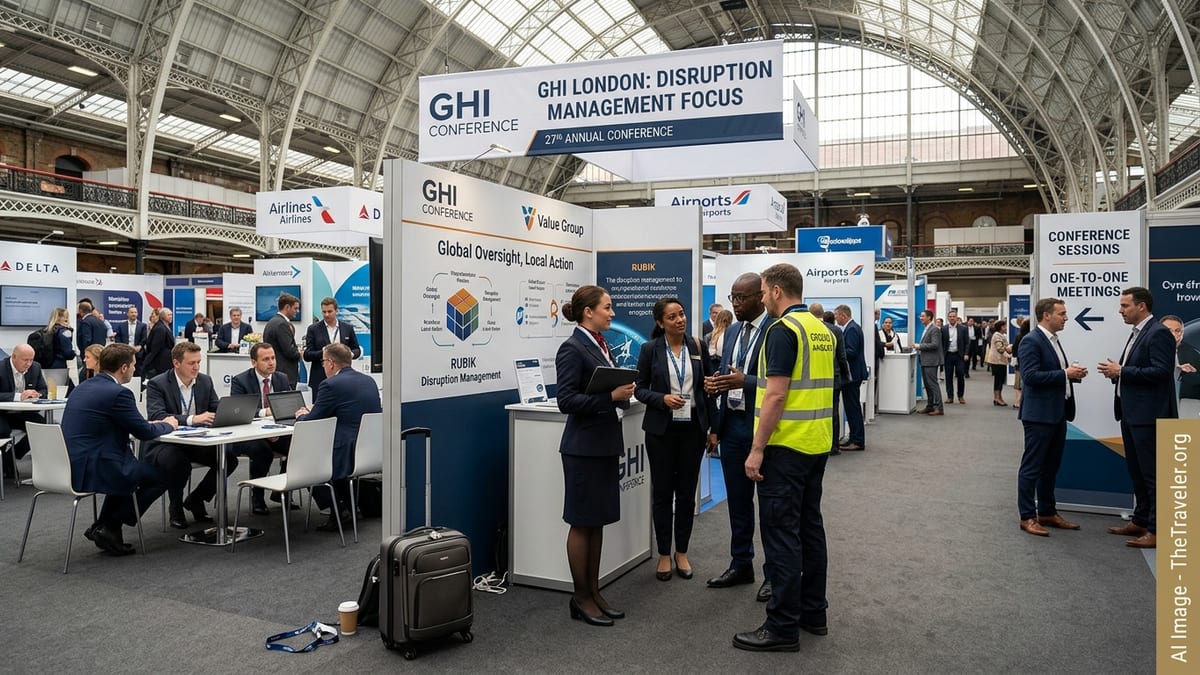
Italy-based disruption-care specialist Value Group plans to use the 27th Annual Ground Handling International (GHI) Conference at Olympia London from 1 to 3 December 2026 to demonstrate upgraded versions of its RUBIK irregular-operations platform alongside a broadened hotel and transport partner network, as new global ground-handling safety provisions take effect and industry leaders meet to discuss how passengers are supported when flights are severely disrupted.
Get the latest news straight to your inbox!
Flagship London conference coincides with new global safety rules
The 27th Annual GHI Conference is confirmed to run at Olympia London from 1 to 3 December 2026, with event listings from the venue and organiser describing it as the group’s flagship global forum for the ground-handling sector. The three-day meeting is scheduled to combine conference sessions, an exhibition and pre-arranged one-to-one meetings between airlines, handlers, airports and technology suppliers.
Recent promotional material for the event points to an expected attendance of around 1,000 to 1,100 stakeholders, including more than 115 airline carriers, about 120 ground-handling companies and upwards of 90 exhibiting GSE and IT suppliers if participation follows the pattern of the 2025 edition. These numbers are presented as indicative rather than final but give a sense of the scale at which new tools such as disruption-care platforms will be discussed.
The London conference takes place just days after new ground-handling provisions in ICAO Annex 14, Volume I, become applicable on 26 November 2026. The amended text introduces a dedicated section on ground handling that requires states to assess regularly the impact of ground-handling activities on aviation safety and recommends defining criteria for safety oversight as part of national safety programmes. Additional proposals affecting Annexes 6, 9 and 14 and the Procedures for Air Navigation Services for aerodromes have an applicability date in November 2028, signalling a multi-year process of regulatory change that conference debates are expected to address.
Agenda previews released by GHI and partner organisations highlight themes such as evolving ground-handling regulation, human performance and safety on the ramp, decarbonisation of ground-support equipment and the digitalisation of airport operations. A keynote developed with the Aviation Services Association (ASA World), which has entered a long-term partnership with GHI, is expected to examine the emerging regulatory era for ground handling, while other sessions will consider regional rules in Europe and practical responses from service providers. For technology companies, the timing links product capabilities not only to customer service but also to documentation, oversight and compliance with new safety expectations.
RUBIK positioned as rules-driven link between airlines, rights and local capacity
Within this context, Value Group plans to highlight how its RUBIK platform is used to manage disruption care when flights are heavily delayed, cancelled or diverted. Company material describes Value Group as an Italy-headquartered specialist in irregular-operations services, combining a 24-hour operations control centre with software and a contracted network of hotels and surface-transport providers. RUBIK is presented as the layer that connects airline policies and passenger entitlements with local accommodation and transport capacity at airports where disruption occurs.
At the heart of the system is a configurable rules engine that translates each airline customer’s disruption-care policy, together with applicable passenger-rights regulations and local consumer law, into structured workflows. On routes where frameworks such as EU Regulation 261/2004 and the United Kingdom’s post-Brexit rules apply, carriers must provide care in defined circumstances, and Value Group states that airlines using RUBIK encode their own thresholds and standards within the platform.
Using those rules, RUBIK can determine whether passengers or crew affected by a particular disruption qualify for assistance such as hotel rooms, meals or local transport. The platform is designed to limit variations between airports by providing a single reference for entitlement decisions, helping airlines apply legal duties and any additional internal commitments consistently, particularly during large-scale events that strain local resources.
RUBIK is also promoted as a tool for crew-care management, drawing on many of the same hotels and transport providers but following contractual rest requirements and duty-time limitations instead of passenger-rights statutes. In this configuration, the platform’s booking and allocation functions are tuned to crew hotel contracts, minimum rest times and airline safety standards, with the goal of shortening the interval between an operational decision, such as a diversion or rotation change, and confirmed accommodation and transfers for affected crews.
Multiple deployment models and a wider supplier network
Ahead of the London conference, Value Group has been outlining several deployment models designed to suit airlines with different IT capabilities and station profiles. At major hubs and heavily served airports, RUBIK can be integrated with airline reservation and operational-control systems via application programming interfaces so that it receives structured disruption messages once a delay or cancellation crosses thresholds set by the carrier.
In this more integrated model, once an event qualifies for care according to the airline’s rules, RUBIK can ingest passenger lists, perform automated entitlement checks and trigger outbound communications. Passengers may receive SMS or email notifications containing personalised links to secure pages where their specific entitlements are explained and a list of pre-approved hotel and, where relevant, local-transport options is displayed. Filters are configured to reflect nightly price caps, preferred hotel chains, distance from the airport, room occupancy policies and any differentiated criteria the airline applies for particular cabins, frequent-flyer tiers or markets.
For outstations or routes where deep IT integration is not yet available, Value Group promotes a lighter configuration that relies on QR codes and browser-based flows instead of direct connectivity to airline back-end systems. In this set-up, airline or ground-handling staff generate incident-specific QR codes or short web links that can be displayed at boarding gates, check-in areas and information desks when irregular operations occur. Passengers are asked to confirm their disrupted flight details and identity before accessing a tailored list of hotel and transport offers that match the airline’s parameters.
Agent-facing dashboards are intended to support travellers who cannot or prefer not to use self-service tools, including those requiring special assistance, families with young children and passengers without suitable devices. Value Group indicates that demonstrations in London will show how stations can begin with a QR-led configuration and later migrate towards deeper system integration, with more automated entitlement checks, messaging and reporting as internal IT projects progress.
The company also plans to showcase the scale and geographic spread of its supplier base. While detailed lists of contracted hotels and transport providers are not publicly available, recent presentations emphasise that Value Group has expanded its network ahead of the 2026–27 winter season. This depth of supply is presented as critical for securing sufficient local capacity during multi-flight disruptions, although the extent of coverage will vary by airport and depends on each airline’s commercial arrangements.
24/7 control centre and oversight in a tightening regulatory landscape
Beyond the software itself, Value Group places considerable emphasis on its 24/7 Operations Control Center, which monitors airline schedules, weather forecasts, airspace restrictions and airport-capacity notices to identify locations where disruption risk is building. Where agreements exist with airlines, the centre can issue early alerts to local station teams and, within defined limits, inform hotel and transport partners that capacity may be needed, allowing some preparation before queues form at desks.
When irregular operations are underway, the control centre functions as an escalation and support resource for airport staff and handlers using RUBIK. According to company explanations, central staff can help interpret how specific cases fit within an airline’s encoded rules, confirm the status of hotel allocations and evaluate possible exceptions for vulnerable or stranded passengers. Final decision-making remains with each airline or its contracted handler, but the central oversight is intended to promote consistency in applying policies across multiple airports during complex events such as regional storms or widespread air-traffic control issues.
The timing of Value Group’s presence in London aligns with the introduction of new oversight expectations for ground handling. Under the amended ICAO Annex 14, states must now assess the impact of ground-handling operations on aviation safety and are encouraged to establish safety-oversight criteria for this part of the system. ICAO’s guidance material and subsequent proposals related to Annexes 6 and 9 and PANS-Aerodromes, applicable from November 2028, indicate that regulators will continue refining how ground-handling performance and risk management are supervised over the coming years.
Regional developments add another layer to this picture. The European Commission and the European Union Aviation Safety Agency have been working on an EU-level framework for ground-handling providers, while the UK Civil Aviation Authority is examining how to reflect international changes and domestic priorities in its own regulations following the country’s exit from the EU. Within this evolving environment, disruption-care platforms are being discussed not only as tools for managing passenger flows but also as potential aids in documenting decisions, supporting post-event analysis and supplying structured data for safety and compliance reporting.
Operational questions for handlers, airlines and passengers
For ground-handling companies that manage irregular operations on behalf of multiple airlines at the same airport, the multi-airline configuration of systems such as RUBIK is likely to be a practical focus in London. Questions include how clearly the platform separates each airline’s rules, how logins and permissions are structured for staff serving several carriers and what training is required in a workforce characterised by frequent turnover and varying levels of digital familiarity.
The answers may influence whether handlers deploy a single disruption-care tool across their customer base or restrict it to particular contracts. Some may opt to start with airlines whose IT systems and commercial agreements lend themselves most easily to integration, then consider broader rollouts once workflows have been tested during real-world disruption events.
Another area of interest concerns the practical impact of self-service tools on queues and waiting times at airport service points. Airlines and handlers that have begun using QR-led flows and direct hotel-booking links generally continue to operate staffed counters as well, reflecting caution about assuming rapid behavioural change among passengers who may be stressed, unfamiliar with digital processes or travelling without personal devices. Observations from winter 2026–27 deployments, including any new rollouts associated with the GHI conference, are expected to shape how widely self-service options are extended and which customer segments they target.
For passengers, the presence of disruption-care providers among exhibitors at the 27th Annual GHI Conference is one sign that airlines and handlers are dedicating structured attention to how care is organised when flights go significantly off schedule. Adoption of platforms such as RUBIK remains a commercial and operational decision for each airline, influenced by IT integration capacity, data-protection assessments, the structure of hotel and transport contracts and budget priorities. Some carriers may choose to deploy these tools initially at primary hubs or on selected networks, while others may prioritise crew-layover and operational resilience before extending self-service options to a wider passenger base.
Where an airline has implemented an integrated disruption-care system by late 2026 or during 2027, travellers on affected itineraries may increasingly receive targeted notifications with secure links to hotel and, in some cases, local-transport arrangements when their flights are severely disrupted. At other stations, passengers are more likely to encounter QR codes or short web addresses at gates, check-in areas or information points, with airport staff available to support those who cannot or prefer not to complete the process on their own devices. In all cases, the underlying rights to meals, accommodation and rerouting continue to be set by applicable passenger-rights regulations, local law and each airline’s conditions of carriage rather than by the specific technology used to communicate offers.
What travellers should verify ahead of the 2026–27 winter season
With ICAO’s ground-handling provisions in Annex 14 taking effect on 26 November 2026 and the GHI conference following immediately afterward, discussions at Olympia are expected to influence how disruption-care tools are refined and used over the next several seasons rather than triggering immediate, uniform changes worldwide. For now, travellers planning journeys in late 2026 and 2027 who want to understand what might happen if their flights are disrupted should turn first to their airline’s own information.
Airlines typically publish disruption and compensation policies, including references to regional passenger-rights frameworks, on their websites. Reviewing those sections in advance, and checking that contact details such as phone numbers and email addresses are up to date in booking profiles, increases the likelihood that any notifications from airlines or their service providers will reach passengers quickly if irregular operations occur. Where carriers have introduced tools like RUBIK, they may also describe how self-service hotel selection or care vouchers are delivered during disruption.
Passengers flying to, from or within regions with detailed passenger-rights regimes, including the European Union and the United Kingdom, may find it useful to familiarise themselves with those rules before travel, so that they can distinguish between minimum legal entitlements and any additional assistance offered on a discretionary basis. That distinction is important when interpreting offers presented through digital platforms, which are built to reflect each airline’s combination of regulatory obligations and commercial choices.
Over the coming months, airlines, ground handlers, regulators and technology suppliers are likely to use the London conference as an opportunity to test ideas, compare experiences from early deployments and assess how disruption-care platforms can support both passenger service and emerging oversight requirements. Any resulting changes in how hotel offers, transport options and other elements of care are communicated are expected to appear gradually, airline by airline and station by station, as new tools are embedded into day-to-day operations ahead of future winter seasons.