


More news on this day
A FedEx Express cargo jet overran a runway while landing at Miami International Airport on the evening of November 25, 2026, forcing the closure of most of the airport’s runways and prompting a Federal Aviation Administration ground stop that has disrupted passenger and cargo flights across South Florida at the start of the Thanksgiving holiday rush.
Get the latest news straight to your inbox!
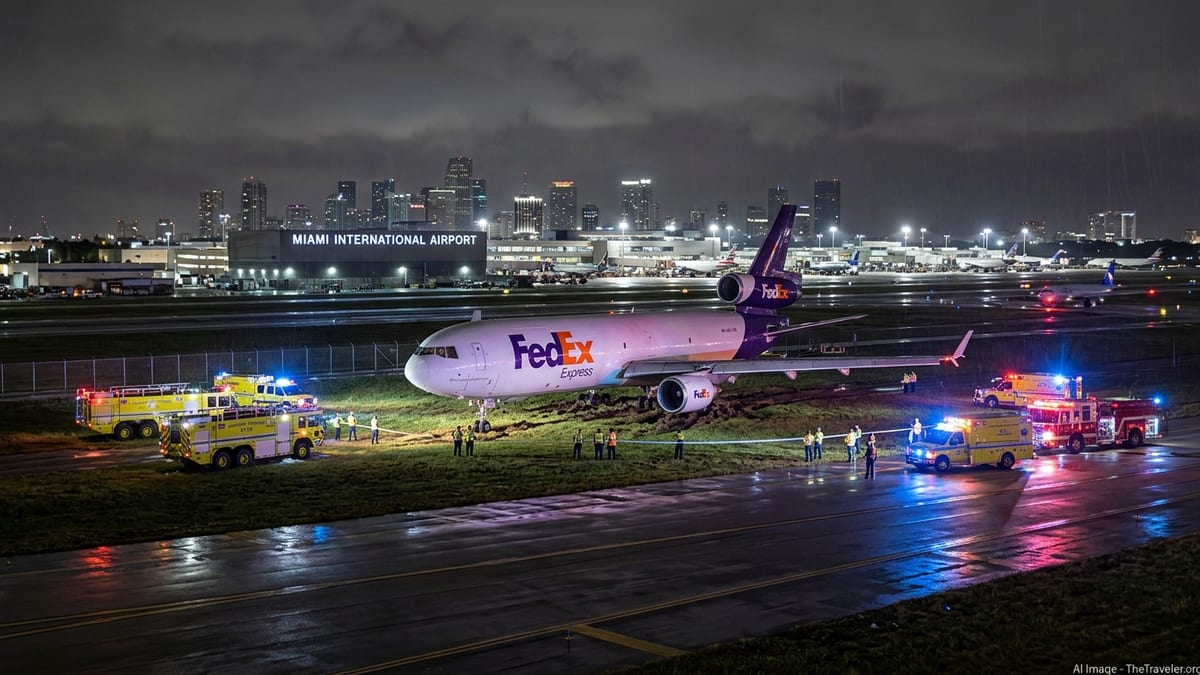
What happened to the FedEx flight at Miami International
According to the Federal Aviation Administration and local officials, a FedEx Express McDonnell Douglas MD-11 freighter arriving from Memphis overran Runway 26R at Miami International Airport at approximately 8:40 p.m. local time on Wednesday, November 25, 2026. The aircraft left the paved surface and came to a stop in a grassy area within the airport perimeter, near the far end of the runway. Early statements from Miami-Dade authorities and FedEx indicate that there were no injuries to the pilots or ground personnel and no post-incident fire, although the aircraft sustained visible damage and will remain in place while investigators document the scene.
Airport officials said the crew had landed toward the west on Runway 26R during a period of deteriorating weather, with rain and thunderstorms moving through the Miami area. Images and video from the scene show emergency vehicles surrounding the purple-and-orange FedEx jet with its nose near the perimeter fencing and its main landing gear embedded in soft ground. While the exact sequence of events has not yet been formally detailed by investigators, both the FAA and the National Transportation Safety Board have classified the occurrence as a runway excursion on landing rather than a crash, emphasizing that the aircraft remained largely intact and on airport property.
FedEx confirmed that the aircraft was operating a scheduled cargo service from Memphis to Miami and said it is cooperating fully with authorities. As of the morning of Thursday, November 26, the company had not released additional operational details, such as the number of crew on board or the extent of the damage, pending the initial investigative work. The airline’s cargo operations at Miami were being adjusted while the disabled aircraft remained on site and while the airport operated with reduced runway capacity.
Runway closures, FAA ground stop and knock-on delays
The disabled FedEx jet came to rest near the end of Runway 26R, one of the primary landing runways at Miami International. Airport management responded by closing that runway and, according to multiple official and airport statements, initially shutting three of the airport’s four runways to protect emergency crews and facilitate the investigation. For a period on Wednesday night, only one runway remained available for arrivals and departures, dramatically reducing the airport’s ability to handle traffic at what is normally one of the busiest travel periods of the year.
Shortly after the incident, the FAA issued a ground stop for flights destined for Miami International, temporarily suspending takeoffs from other airports bound for MIA while the situation was assessed and emergency teams secured the aircraft. The ground stop was later lifted as at least one additional runway reopened, but residual delays continued into Thursday as airlines worked through a backlog of flights and as crews navigated the operational challenges of running a major hub with at least one runway unavailable. Flight-tracking data and airline advisory channels on the morning of November 26 showed a mix of delayed arrivals, departure holds and some diversions to other South Florida airports.
Miami International, which normally operates four runways in various configurations depending on winds and traffic flows, relies heavily on parallel east-west runways for peak bank operations. With Runway 26R out of service and adjacent taxiways partly restricted around the disabled freighter, controllers were required to space aircraft further apart and route arrivals and departures less efficiently. This reduction in arrival and departure rates is the principal reason travelers experienced cascading delays into Thanksgiving Day, even though the immediate safety risk had been contained the previous evening.
Impact on Thanksgiving travelers across South Florida
The incident occurred on the eve of Thanksgiving, a period when U.S. airports are under heavy strain from elevated passenger volumes. Miami International is one of the country’s busiest international gateways and a major connecting hub for flights across Latin America and the Caribbean, and disruptions there quickly affected connecting itineraries, regional links and domestic services. Passengers reported late-night diversions and extended gate holds on Wednesday, along with early-morning delays on Thursday as the airport resumed operations with constrained capacity.
While no major U.S. carrier reported a complete operational shutdown at Miami, airlines warned customers of potential delays and urged them to monitor their flight status closely. Some carriers proactively offered rebooking options or travel waivers for customers flying through Miami on November 25 and 26, reflecting the risk of missed connections and extended wait times even after the FAA ground stop formally ended. Travellers headed to or from nearby airports in Fort Lauderdale or West Palm Beach were generally less affected, although the knock-on effects of delayed aircraft repositioning and shared airspace management meant that some South Florida services outside Miami also experienced longer-than-normal flight times or holding patterns.
For local passengers originating or ending their trips in Miami, the immediate experience was mainly one of schedule disruption rather than safety concerns. Terminals remained open, security checkpoints continued to process travelers, and public transport links to the airport operated normally. However, with fewer active runways and periods of arrival and departure imbalances, some flights waited longer on taxiways, and baggage delivery for certain late-night arrivals was slower while ramp crews worked around the closed runway sector and the presence of emergency vehicles.
Context: a second cargo runway excursion at Miami in three months
The FedEx MD-11 runway overrun is the second serious cargo runway excursion at Miami International in less than three months. On September 6, 2026, a Boeing 767-300 freighter operating for Amazon Air overran Runway 30 during landing and left airport property, striking vehicles on a nearby road and resulting in five fatalities on the ground. That earlier accident prompted an intensive investigation by the NTSB and renewed scrutiny of approach and landing procedures, runway conditions and safety areas at Miami, particularly for heavy freighter operations.
In its investigative updates on the September incident, the NTSB highlighted data from cockpit voice and flight data recorders while stressing that its findings remained preliminary and subject to change. Local authorities have since been working with federal agencies and airport engineers to assess runway safety areas, overrun protections and emergency response coordination at the airport. The fact that a second widebody freighter has now overrun a runway at the same airport, albeit with a very different outcome and no reported injuries, is likely to intensify that focus, although investigators have not yet suggested any common causal factors between the two events.
At this stage, neither the FAA nor the NTSB has provided a public assessment of the contributing factors in the FedEx incident. Weather at the time was reported to include rain and thunderstorms in the area, but officials have not drawn any conclusions about how those conditions may have interacted with aircraft performance, braking action or crew decision-making. Aviation authorities typically caution that early assumptions about cause are speculative until data from recorders, maintenance logs, crew interviews and runway inspections can be thoroughly analyzed.
What investigators and travelers can expect next
By early November 26, emergency and airport crews in Miami had stabilized the FedEx aircraft on the grassy overrun area and established secure access for investigators. The NTSB has opened a formal investigation into the runway excursion and is expected to send a team to the site, as is standard for serious aviation incidents involving large transport-category aircraft in the United States. Investigators will document the aircraft’s final position, examine landing gear and braking systems, analyze runway surface conditions and friction reports, and review air traffic control recordings to reconstruct the approach and landing.
Once on scene work is complete, the aircraft will need to be carefully removed from the overrun area, which may require specialized lifting equipment and temporary closures of nearby taxiways or portions of additional runways. That recovery process can take many hours or even days for a widebody freighter, depending on the extent of structural damage and the condition of the surrounding ground. Until then, Miami International is likely to continue operating with at least one runway closed, and schedules may be adjusted as airlines accommodate the reduced capacity.
For travelers, the most practical step in the coming days is to treat flights to and from Miami as subject to change and to verify status frequently through airline apps or airport information channels, particularly for tight connections. Passengers holding bookings that involve connections through Miami during the Thanksgiving period may wish to allow extra connection time or consider rebooking if their airline offers flexible options. While there is no indication that the incident poses an ongoing safety risk for flights, the operational constraints created by a disabled widebody on the airfield, combined with seasonal weather and holiday traffic, mean that irregular operations at Miami could persist until the aircraft is removed and all runways are fully reopened.