


Most visitors arrive in New York with a mental map that runs from Times Square to Central Park and down to the World Trade Center. It is a spectacular corridor, but it is only a sliver of a city that now attracts close to 65 million visitors a year and spreads across five boroughs, dozens of islands, and hundreds of distinct neighborhoods. For travelers willing to go beyond the usual checklist, New York suddenly becomes larger, quieter, cheaper, and surprisingly easier to enjoy.
Get the latest updates straight to your inbox!
The Tiny Tourist Bubble in a Vast City
Walk along the High Line on a busy Saturday and it can feel as if every tourist in New York has shown up at once. Studies in recent years suggest that the majority of visitors to the elevated park are from out of town, and it shows in the crowds clustering near Hudson Yards and Chelsea Market. A similar scene plays out in Times Square, at the southern edge of Central Park, and around Rockefeller Center. These hotspots dominate Instagram feeds and hotel brochures, but they occupy only a small fraction of Manhattan, let alone New York City as a whole.
Citywide, tourism has nearly returned to record levels last seen before 2020, with local reports indicating that visitor spending has already surpassed earlier peaks. Yet most of that energy is still funneled through the same familiar zones: Midtown and Lower Manhattan, plus a handful of now-classic Brooklyn postcards like the Brooklyn Bridge walk and the DUMBO waterfront. Travelers on a three- or four-day stay might ride the subway daily and still never see a residential street in Queens or the Bronx, or a stretch of shoreline on Staten Island.
The disconnect is practical as much as psychological. Package tours, first-time trip planning guides, and even many hotel concierges still default to a narrow list of attractions. A family staying near Bryant Park may be told that the “musts” are the Statue of Liberty, a Broadway show, the Empire State Building, and a quick hop to the Brooklyn Bridge. Those are worthwhile, but they leave almost no time for discovering where most New Yorkers actually live, eat, and relax.
Thinking of New York as a small set of marquee attractions has consequences for the trip experience. Prices are higher in that bubble, lines are longer, and food quality can be inconsistent. By expanding your mental map to include the outer boroughs, waterfronts, parks, and local commercial streets, you often gain better value, a calmer atmosphere, and a more accurate sense of the city’s everyday life.
Rethinking the Map: From Five Boroughs to Dozens of Micro-Cities
The simplest way to unlock a bigger New York is to stop thinking of it as one city and start thinking of it as a loose constellation of “micro-cities.” Each borough holds several. In Queens alone, the neighborhoods around Jackson Heights, Flushing, and Astoria function almost like separate urban centers, with their own skylines, restaurant scenes, and shopping strips. A traveler who spends an afternoon moving between them will cover more cultural ground than by walking the length of Fifth Avenue.
Consider the experience of a visitor who bases themselves in Long Island City rather than Midtown. Hotel rates here are often lower, especially on weekends, yet the neighborhood sits one or two subway stops from Grand Central and Times Square. Within a ten-minute walk you have the East River waterfront parks with skyline views, MoMA PS1’s contemporary art galleries, and a growing cluster of bars and cafes along Vernon Boulevard. It feels like its own small downtown that just happens to sit across from Manhattan’s towers.
Brooklyn presents a similar story beyond DUMBO and Williamsburg. Neighborhoods like Fort Greene, with its tree-lined brownstone blocks and the cultural hub of Brooklyn Academy of Music, can easily anchor an entire day. Walk south and you hit Prospect Heights and Crown Heights, each with their own busy restaurant rows and Caribbean bakeries. Continue far enough and you eventually reach Prospect Park and the Brooklyn Museum, which together provide a full counterbalance to the Central Park and Metropolitan Museum circuit.
Even within Manhattan, thinking in micro-cities changes how the island feels. Harlem to the north, the Lower East Side and Chinatown downtown, and quieter pockets like the East Village or the Upper West Side each have distinct rhythms, food, and architecture. A visitor who spends time in three or four of these zones, rather than circling the same Midtown blocks, will come away with a much richer impression of New York without adding any extra days to their itinerary.
Waterfronts, Ferries, and the Other New York Harbor
Another way most visitors underestimate New York is by overlooking its waterfront. The famous harbor glimpsed from the Staten Island Ferry or a Statue of Liberty cruise is just a fraction of a vast shoreline that wraps around all five boroughs. In recent years, the city has steadily expanded its public ferry network, making it easier and relatively affordable to move between neighborhoods by water, often for a fare similar to a subway ride.
For travelers, this opens up itineraries that would have been awkward or expensive a decade ago. You can now pair a morning at the beach in the Rockaways with an evening cocktail in Lower Manhattan by riding an NYC Ferry route that runs along the length of the harbor, passing under bridges and past industrial waterfronts. In summer, seasonal routes connect Governors Island, Brooklyn Bridge Park, and various East River piers, letting you treat the harbor like an aquatic version of the subway and turning the transit itself into a sightseeing experience.
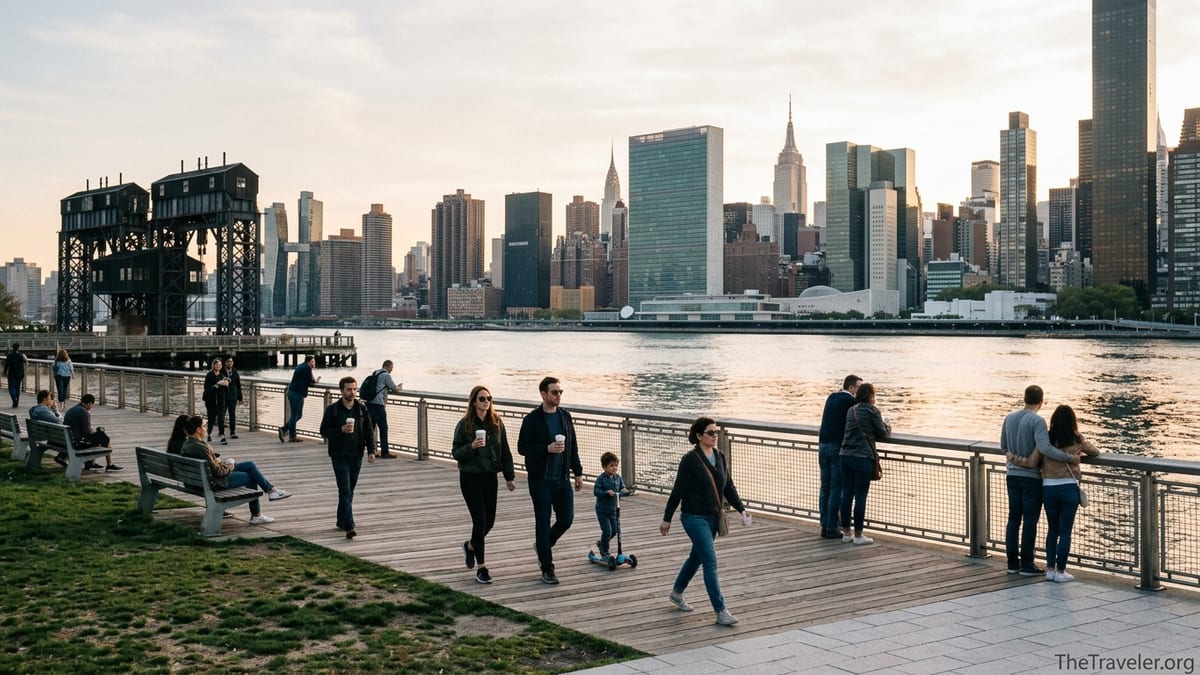
Some of the best skyline views in the city now come from waterfront parks that were once working piers. Brooklyn Bridge Park stretches along the East River with lawns, playgrounds, and sports courts framed by lower Manhattan’s towers, while Domino Park in Williamsburg repurposes an old sugar refinery site into a promenade dotted with industrial relics. Across the river in Queens, Gantry Plaza State Park and Hunters Point South Park face the United Nations and Midtown’s skyscrapers. These places rarely appear on first-timer itineraries, yet they are where you will find locals jogging after work, families picnicking at sunset, and photographers setting up tripods for blue hour shots.
Even Staten Island, which many visitors see only from the deck of the free ferry before turning around, is slowly staking a claim on the travel map. The revamped terminal area at St. George includes a waterfront esplanade and access to residential streets climbing the hill behind the harbor. Farther afield, massive projects like Freshkills Park are transforming former industrial and landfill sites into one of the largest green spaces in the city, a reminder that New York’s future is unfolding far beyond its most famous skyline.
Neighborhoods Where New York Really Eats
Ask New Yorkers where they go for a special dinner and you will get very different answers than you would from a typical visitor guide. Instead of Times Square chain restaurants or celebrity-chef flagships, many residents think in terms of subway stops: the stretch of Roosevelt Avenue under the elevated tracks in Jackson Heights, the Korean restaurants that cluster around Flushing’s Main Street, the Dominican and Mexican spots along Broadway in Washington Heights, or the West African cafes in the Bronx’s Grand Concourse area.
Take Jackson Heights as a concrete example. Within a few blocks of the 74th Street transit hub, you can move from Colombian bakeries selling almojábanas and pandebonos to Tibetan momo shops tucked into small second-floor food courts, then on to South Asian sweet shops and chaat counters. Prices are often far below what you would pay in central Manhattan. A filling plate of Nepali thali or a generous serving of Mexican tacos might cost roughly what you would pay for a single cocktail near Times Square, and you will likely be surrounded by neighborhood regulars rather than tour groups.
Queens’s Flushing neighborhood tells a similar story on a different scale. Descend the stairs into the basement food courts off Main Street and you enter a dense world of Sichuan noodles, Shanghainese soup dumplings, Taiwanese milk tea stands, and bakeries selling pork floss buns. Many stalls accept only cards or mobile payments now, and menus may be posted primarily in Chinese, but staff are used to visitors and happy to guide newcomers. A traveler who allows an entire afternoon here can combine a self-guided food crawl with a stroll in nearby Flushing Meadows Corona Park, where the 1964 World’s Fair structures still loom over soccer games and weekend festivals.
Brooklyn has its own constellation of food neighborhoods that tend to remain under the radar for short-term visitors. In Sunset Park, entire blocks of Eighth Avenue are lined with Chinese groceries, dim sum halls, and bakeries, while a short walk downhill leads to Fifth Avenue’s Mexican and Central American taquerias and bakeries. East of Prospect Park, neighborhoods like Flatbush and Little Caribbean showcase everything from Trinidadian doubles to Jamaican patties and Haitian joumou soup. These are the streets where New York’s culinary reputation is renewed daily, far from the prix-fixe tasting menus of Midtown.
Parks, Green Space, and the Wild Edges of the City
For many visitors, “New York park” is synonymous with Central Park. It remains an essential stop, but it is only one piece of an increasingly ambitious network of green spaces. Some of the most striking parks now lie in the outer boroughs, far from the usual walking tours, and they change how the city feels underfoot.
In the Bronx, Pelham Bay Park sprawls along the Long Island Sound and is larger than Central Park several times over. It includes wooded trails, a historic mansion, and Orchard Beach, a man-made crescent of sand that fills with families on hot summer weekends. Farther west, Van Cortlandt Park offers hiking trails that connect with longer regional routes and a golf course reachable by subway, a rarity in a major global city. These destinations require a little planning, but they offer the experience of leaving the dense grid behind without ever leaving New York’s boundaries.
Staten Island’s Freshkills Park, gradually opening in phases after decades as the city’s main landfill, is another example of how New York is reinventing itself at its edges. Today, guided tours and special events allow visitors to see rolling hills, wetlands, and bird habitats where garbage once towered. When fully developed, Freshkills is projected to become one of the largest parks in the city, nearly three times the size of Central Park, a clear sign that New York’s future green lungs lie outside Manhattan.
Closer to the tourist core, smaller but carefully designed spaces like Little Island in the Hudson River and the continuous riverside paths on both sides of Manhattan have added new ways to experience the waterfront on foot or by bike. Pairing a morning bike ride along the Hudson River Greenway with an afternoon ferry to Red Hook or Governors Island can make a day in New York feel more like an urban coastal getaway than a purely museum-and-theater itinerary.
Practical Ways to Escape the Tourist Track
Seeing the larger New York does not require a complete rewrite of your trip. It often comes down to reallocating a single day, or even an afternoon, away from the standard loop. One realistic strategy is to anchor your stay with a few classic sights, then designate one day as “outer borough day,” with a clear but flexible target such as Queens food, Brooklyn waterfronts, or the Bronx and Harlem.
For example, on a four-night trip, you might spend your first full day in Midtown and around Central Park, your second in Lower Manhattan and Brooklyn Bridge Park, and your third exploring Queens. On that Queens day, start late morning in Long Island City’s waterfront parks, then ride the subway or a bus to Jackson Heights for a multi-stop lunch. Continue onward to Flushing for evening snacks before heading back to your hotel. The total transportation cost remains modest, but the range of neighborhoods and cuisines you encounter will radically expand your sense of the city.
Planning tools have also caught up with this broader view of New York. The city’s official tourism agency increasingly highlights borough-specific itineraries, and neighborhood business alliances in places like Astoria, Fort Greene, and the Bronx’s Arthur Avenue maintain updated event calendars and maps. Locally focused food and culture tours, many run by long-term residents, now operate in areas that once saw few visitors, giving first-timers a structured way to feel comfortable exploring farther afield.
Safety, which understandably influences many travelers’ decisions about where to wander, is best assessed at a granular level rather than by borough-wide reputation. Conditions can vary block by block, but the vast majority of residential neighborhoods that locals recommend for dining and strolling are accustomed to visitors and feel busy well into the evening. The same common-sense habits you would use in any big city apply: stay aware of your surroundings, avoid empty parks late at night, and follow local guidance about which transportation routes are most convenient after dark.
Rethinking Where You Stay and How You Move
The choice of where you sleep each night heavily shapes your mental picture of New York. Staying in Midtown can be convenient if you plan to see multiple Broadway shows, but it also keeps you in the densest concentration of visitor-facing businesses. Shifting your base to neighborhoods like the Lower East Side, Brooklyn’s Downtown or Williamsburg, or Queens’s Long Island City can lower nightly costs and naturally draw you into different daily routines.
In recent years, new hotels have opened in all these areas, often repurposing industrial buildings or modern residential towers. A traveler staying in Downtown Brooklyn, for instance, can have breakfast in a local cafe, walk ten minutes to the Brooklyn Heights Promenade for harbor views, ride the subway one stop into Manhattan for museum visits, then return in the evening for dinner on Atlantic Avenue or in nearby Cobble Hill. The city becomes a set of overlapping villages instead of a daily commute in and out of Midtown.
Transportation habits matter just as much. Many visitors default to taxis and rideshare services, especially when they are unfamiliar with the subway. While car services can be useful late at night or when carrying luggage, relying on them exclusively keeps you tied to the same high-traffic zones. Learning a few key subway lines and integrating ferries and buses where they make sense allows you to think of the entire city as accessible. It also brings you into contact with the daily rhythms of commuters and students, a reminder that New York is more home than spectacle.
Even small adjustments in perspective can have outsized effects. Choosing to visit a well-known sight by a less typical route, such as reaching the Brooklyn Bridge from the Brooklyn side after lunch in a residential neighborhood rather than marching there from City Hall with the crowds, alters how the place feels. Over several days, a string of such choices accumulates into a trip that feels grounded in the lived city rather than in a theme-park version of it.
The Takeaway
New York’s global image is built on a narrow strip of real estate, yet the city that residents inhabit every day sprawls across rivers, islands, and neighborhoods that rarely make it into first-time itineraries. As visitor numbers climb back toward record highs, the gap between what most tourists see and what the city actually is has never been more obvious. The good news is that closing that gap does not require special access or insider connections. It simply requires a willingness to redraw your personal map.
By treating New York as a collection of micro-cities, embracing its ferries and waterfronts, seeking out everyday food streets instead of only marquee restaurants, and choosing a hotel that sits inside a real neighborhood rather than only above a transit hub, you quickly discover how much bigger the city really is. The payoff is not only fewer lines and better value, but also a more honest, memorable understanding of a place you may have thought you already knew. In a city that prides itself on constant reinvention, the most rewarding trips are the ones that allow New York to surprise you.
FAQ
Q1. Is it safe to explore New York’s outer boroughs as a visitor?
Most residential neighborhoods that locals recommend for dining, parks, and waterfronts see steady foot traffic and are used to visitors. As in any large city, use common-sense precautions, stay aware of your surroundings, and check recent local advice for specific areas you plan to visit.
Q2. How many days should I plan if I want to see more than just Manhattan?
With three full days you can sample one outer borough, but four to five days gives you time for at least two boroughs beyond Manhattan, such as a dedicated day in Brooklyn and a half or full day in Queens or the Bronx.
Q3. Are hotels outside Midtown really cheaper?
Prices fluctuate, but many travelers find better value in areas like Long Island City, Downtown Brooklyn, or the Lower East Side. Nightly rates there can often be noticeably lower than comparable properties near Times Square, especially outside peak holidays and major events.
Q4. Do I need to rent a car to visit places like Queens or the Bronx?
No. The subway, city buses, and ferries reach most neighborhoods that visitors are likely to explore. A contactless payment card or transit pass will usually cover your needs, and using public transport often saves time compared with sitting in traffic.
Q5. What is a good first outer-borough neighborhood for food lovers?
Jackson Heights in Queens is an excellent starting point thanks to its concentration of Latin American, South Asian, and Himalayan restaurants within walking distance of a major subway hub. Flushing, Astoria, and parts of Brooklyn such as Sunset Park are also strong options.
Q6. Can I still see the main Manhattan sights if I stay in Brooklyn or Queens?
Yes. Neighborhoods like Long Island City and Downtown Brooklyn are one or two subway stops from central Manhattan. Many visitors base themselves there and commute into Midtown or Lower Manhattan in less than 20 minutes for museums, shows, and landmark visits.
Q7. Are the city ferries useful for tourists, or just a novelty?
They are both scenic and practical. Ferries along the East River and to destinations like the Rockaways or Governors Island can replace longer subway or bus journeys, while also providing skyline views and easy access to waterfront parks on both sides of the harbor.
Q8. How can I avoid the worst crowds at famous attractions?
Visit major sights early in the morning or later in the evening, buy timed-entry tickets where available, and consider approaching them from less common directions. For example, start a Brooklyn Bridge walk on the Brooklyn side, or visit the High Line from its quieter northern or southern ends.
Q9. Are there kid-friendly activities outside the usual Manhattan museums?
Yes. Options include the New York Hall of Science and Queens Zoo in Flushing Meadows Corona Park, the Bronx Zoo, Brooklyn Bridge Park’s playgrounds and carousels, and family-oriented events on Governors Island in warmer months.
Q10. How can I quickly get a feel for a “real” New York neighborhood?
Pick a commercial street that locals rely on, such as a stretch of Broadway in Astoria or Fifth Avenue in Sunset Park, and spend a few hours there. Visit a cafe, a grocery store, and a park or playground, then ride the subway or ferry back. This simple routine offers a grounded glimpse of daily life beyond the tourist bubble.