


Perched on the green slopes of Montjuïc, the Fundació Joan Miró is one of Barcelona’s most rewarding museums, but many visitors leave wishing they had planned the visit differently. From ticket choices and crowd patterns to surprising outdoor spaces and often-missed artworks, a bit of insider knowledge can turn a rushed museum stop into one of the most memorable experiences of your trip.
Get the latest updates straight to your inbox!
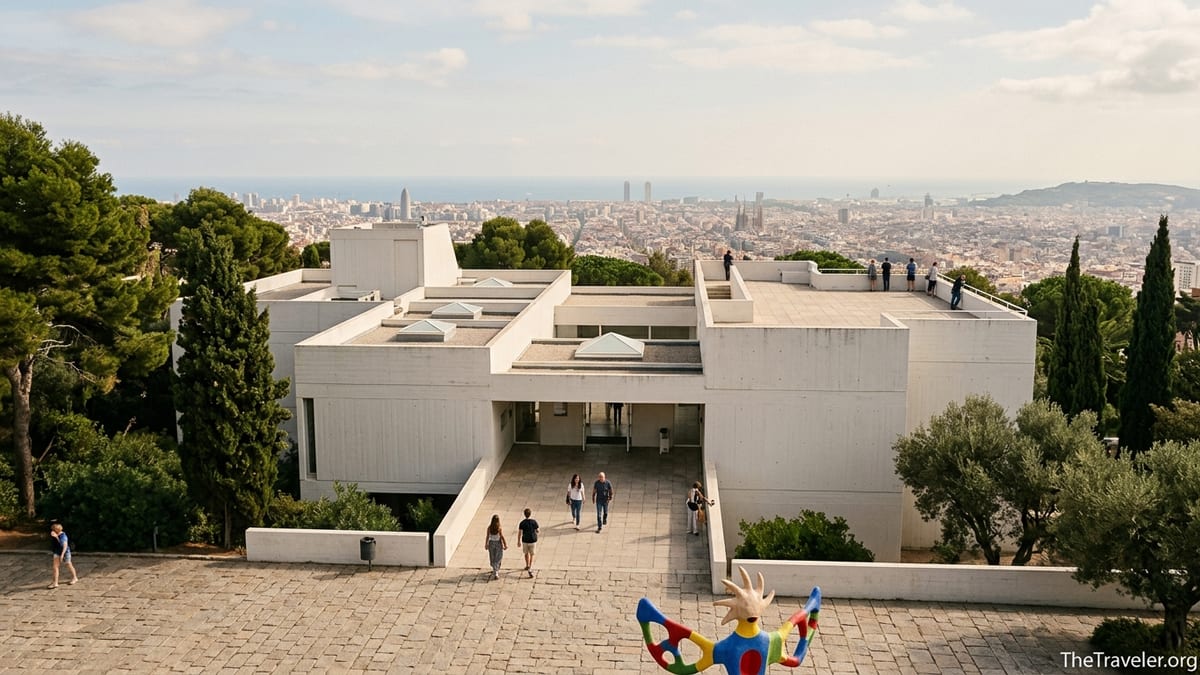
Getting There Is Not as Straightforward as It Looks
On a map, the Fundació Joan Miró sits temptingly close to central Barcelona, but the hill of Montjuïc makes the approach less obvious than most first-time visitors expect. Many assume they can rely on the Montjuïc Funicular straight from Paral·lel metro station, only to find that services can be suspended for weeks at a time for maintenance, as has happened in early 2026. When that occurs, transport authorities usually replace the funicular with shuttle buses, but these can add waiting time and confusion to your schedule. It is worth checking current service notices on arrival in Barcelona and giving yourself a time buffer if you are heading to a timed entry slot.
A more predictable option for many visitors is to combine the metro with a short uphill walk. From Plaça d’Espanya you can ride local buses that climb into Montjuïc park, then walk the last 5 to 10 minutes through gardens to the museum’s white modernist building. Another common strategy is to start higher up at Montjuïc Castle or the cable car and then walk downhill toward the museum, which avoids some of the steepest climbs. Either way, sturdy shoes and a bottle of water are more useful here than at flatter city-center museums.
Taxi and ride-hail services are readily available and can be a smart choice if you are traveling with luggage, young children, or anyone with limited mobility. Drivers are used to dropping passengers at the museum and will usually stop right by the entrance courtyard. In practice, many travelers end up taking a taxi there in the mid-morning heat and then strolling slowly back down through the park afterward, turning the visit into a relaxed half-day on Montjuïc instead of a quick in-and-out stop.
However you arrive, build in just a little extra time. The museum is not tucked into a dense city block like the Picasso Museum in El Born; it is part of a larger landscape of gardens, viewpoints, and cultural venues on Montjuïc. Those extra minutes not only prevent you from rushing through security, but also give you time to adjust to the quieter atmosphere before you step into Miró’s world.
Tickets, Passes, and How to Avoid the Worst Lines
Many visitors wish they had understood the ticket options before showing up at the door. The Fundació Joan Miró sells standard tickets that cover both the permanent collection and current temporary exhibitions, with reduced prices for students, young adults, and seniors. Families often find that child tickets are more affordable than at some other major Barcelona sites, which can make this a good value cultural stop compared with, for example, a family visit to Casa Batlló.
One of the most common regrets is not using a museum pass when planning a broader art-focused itinerary. The Articket Barcelona pass, for example, includes the Fundació Joan Miró alongside heavyweights such as the Picasso Museum, MNAC, MACBA, CCCB, and the Fundació Antoni Tàpies, for a single fixed price that is typically comparable to visiting three or four of these museums individually. Articket holders use a dedicated priority line at each museum, which can shave off significant waiting time during busy weekends and holidays, particularly at the Picasso Museum and MNAC where lines often spill out the door.
Even if you are only purchasing a standalone ticket, spending a few minutes on timing can dramatically change your experience. Late morning, between about 11:00 and 13:00, sees a spike in both tour groups and independent visitors, especially in peak months and when cruise ships are in port. Travelers who arrive right at opening time on weekdays, or in the last two hours before closing, tend to encounter fewer crowds and a quieter atmosphere in the galleries. If you are mixing the museum with a cable car ride or visit to Montjuïc Castle, prioritize the museum early and leave the outdoor viewpoints for later, when the light is softer and crowds thin out.
For many, the last surprise at the ticket desk is the amount of time they actually need inside. An hour can be enough for a brisk highlights visit, but visitors who enjoy reading wall texts, pausing in the gardens, or exploring temporary exhibitions often wish they had allowed two to three hours. When planning your day, avoid booking tightly timed lunch reservations or another strict appointment right after your visit. Giving yourself a flexible window means you can slow down when a particular painting or terrace view captures your attention instead of watching the clock.
The Building and Layout: More Than Just a Series of Rooms
Most visitors arrive focused on Miró’s paintings and forget that the museum building itself is one of Barcelona’s most interesting pieces of modern architecture. Designed by Joan Miró’s friend, the architect Josep Lluís Sert, it is a white, low-slung complex of interlocking terraces, skylights, and courtyards that feels very different from the dense stone palaces of the Gothic Quarter. Inside, natural light filters from above, bouncing off white walls and pale floors in a way that can completely change from morning to afternoon. Walking through the museum becomes a sequence of light-filled “chapters” rather than a continuous corridor.
First-time visitors are sometimes taken aback by the layout, which loops around patios and up and down short staircases. It is easy to miss side rooms if you rush. For example, the gallery that houses the massive “Tapestry of the Fundació,” one of Miró’s large textile works created specifically for the museum, sits in a space that can be overlooked by those who simply follow the largest crowd. Similarly, some of the most atmospheric drawings and early works hide in more intimate rooms that are off the main circulation route.
The key to enjoying the building is to let yourself wander a little. After entering, look at the map briefly, then allow your eye to follow the daylight: many visitors report that some of their favorite discoveries happen when they drift toward a bright corner or open doorway instead of treating the visit like a checklist. It also helps to understand that the building was conceived as a dialogue between inside and outside. At several points, glass walls frame the greenery of Montjuïc, and terraces invite you to step out for a moment, reset, and then return to the art with fresh focus.
If you are visiting with someone who tires easily or uses a stroller or wheelchair, the seemingly gentle ramps and subtle level changes can add up. Fortunately, the museum has elevators and accessible routes, but it is wise to ask staff at the entrance desk for the latest accessibility map rather than assuming that the route you see others taking is the easiest one. Planning a slightly slower circulation from the start can keep the experience pleasant for everyone in your group.
Understanding Miró: Why the “Childlike” Art Is Anything but Simple
Many visitors step into the first gallery of bold colors and simplified forms and quietly wonder whether they are missing something. Miró’s work can appear almost childlike at a glance, especially if your mental image of Catalan art is dominated by the intricate curves and stained glass of Gaudí’s architecture. Without context, it is easy to move quickly from painting to painting, shrugging at the floating dots, lines, and stars, and leave feeling underwhelmed.
One of the most common post-visit comments is “I wish I had read a bit about Miró beforehand.” Even 10 minutes of background can deepen your experience. Miró was a Catalan artist born in Barcelona whose career spanned much of the 20th century, and he had close connections to Surrealism, Catalan identity, and political upheavals in Spain. Many recurring motifs in his work, such as constellations, women, birds, and ladders, are not random decorations but parts of a personal visual language that he developed over decades. For example, the ladder often suggests escape or a link between earth and sky, something that resonates differently when you see it repeated across paintings, drawings, and sculptures.
Inside the museum, look for introductory panels at the beginning of each section. These short texts explain the phase of Miró’s career you are entering, from early realistic landscapes to the increasingly abstract and playful works of his later years. Many visitors find it helpful to choose just a handful of works to focus on deeply rather than trying to take in hundreds at the same pace. You might, for instance, spend several minutes with a single large canvas, reading its date, title, and materials, then step back to notice how it relates to neighboring pieces from the same period.
Audio guides and digital resources can also help, particularly if you tend to feel lost in modern art museums. The Fundació Joan Miró participates in the Bloomberg Connects app, a free digital guide platform that offers audio tracks and contextual information for many works. Visitors who arrive with the app already downloaded often report that they understand the progression of the collection more clearly and that Miró’s visual language starts to feel intuitive rather than opaque by the time they reach the final rooms.
Do Not Miss the Terraces, Gardens, and City Views
One of the biggest surprises for new visitors is how much of the experience takes place outdoors. The museum sits within Montjuïc park and incorporates terraces, patios, and gardens that blur the line between gallery and landscape. Those who hurry through the interior and exit without exploring outside often realize later that they missed some of the most memorable parts of the visit, including key sculptures and striking panoramic views of Barcelona.
As you move through the upper level of the museum, watch for doors leading to rooftop terraces. Here, Miró’s sculptures stand against open sky, their saturated colors and irregular shapes playing off the white geometry of the building and the muted blues and grays of the city below. On clear days, you can see the grid of the Eixample, the hill of Tibidabo, and the Mediterranean in the distance. Visitors who plan ahead sometimes time their visit so that they reach the terraces in the late afternoon, when the low sun adds warm tones and long shadows to the scene.
Recent improvements have opened more of the surrounding landscape to the public, including areas that act as quiet gardens where you can pause between galleries. These outdoor rooms are especially welcome if you are traveling with children or in a group with mixed levels of interest in art. Someone who needs a break from the galleries can step outside, sit on a bench among pines and cypresses, and still feel connected to the museum environment while others explore inside.
Because the terraces are exposed, it is worth considering the weather. On hot summer days, a hat and sunscreen make the rooftop much more pleasant, while in winter or on windy days, a light jacket can be essential. Many visitors recall their time on the terraces as the moment when Miró’s colors and forms clicked for them, as if the sculptures and views together translated his themes of sky, earth, and cosmos into a single lived experience.
Temporary Exhibitions and a Collection That Keeps Changing
Many travelers assume that the Fundació Joan Miró shows a fixed set of works and that a single visit will give them the full picture. In reality, the museum has been actively rethinking and reordering its collection, especially around its 50th anniversary. Recent curatorial projects have organized Miró’s works thematically, for example around materials and the idea of the circle, instead of following a strict chronological route. This means that even visitors returning after a few years can encounter familiar works in new contexts that highlight different aspects of the artist’s practice.
In addition to the core collection, the museum hosts temporary exhibitions that explore specific periods of Miró’s career, his collaborations, or dialogues with other contemporary artists. These shows can significantly change the balance of what you see in a given season. On some visits, you might find an emphasis on his late, more gestural paintings; on others, the focus may shift toward sculpture, works on paper, or experimental materials. Checking the current exhibition program shortly before your trip can guide how much time you allocate and whether you wish to arrange a guided visit.
These changing displays also affect crowd patterns. A high-profile temporary exhibition can attract additional visitors, particularly locals and repeat museum-goers, which may make certain parts of the building busier than usual. At the same time, it can create unexpected pockets of calm in less publicized rooms, where you can stand almost alone before an early landscape or a delicate drawing. If you find one area too crowded, it is often worth circling back later; the museum’s loops make it easy to re-enter a room from another direction when the flow of people has shifted.
From a practical standpoint, temporary exhibitions sometimes bring additional explanatory materials, short films, or interactive elements that appeal to visitors who are less familiar with Miró. Families in particular often appreciate sections where children can engage with shapes, colors, and textures more playfully, turning potential boredom into curiosity. Asking at the information desk which spaces are best suited to younger visitors can help you plan a route that keeps everyone engaged.
Services, Facilities, and How to Pace Your Visit
Many regrets voiced by past visitors are surprisingly basic: not knowing that there was a café, not planning around the cloakroom, or underestimating how tiring even a beautiful museum can be. The Fundació Joan Miró offers the typical services you would expect in a major European museum, including restrooms, a small bookshop, and a café. However, these spaces are not simply add-ons; they are thoughtfully integrated into the building, often with views back toward the park or city, and can serve as welcome pauses in your visit.
The café, for example, is popular for a light lunch or coffee break. Prices are higher than in neighborhood bars down the hill, but roughly in line with other museum cafés in Barcelona. Many visitors choose to arrive mid-morning, explore a substantial portion of the collection, and then recharge over a sandwich, salad, or coffee before continuing. This can be especially helpful if you are also planning to walk up to Montjuïc Castle or over to another cultural site like CaixaForum afterward.
The bookshop is a highlight for art lovers. Beyond standard postcards and magnets, it stocks a good range of catalogues, monographs on Miró, and books on modern art and Catalan culture. Travelers who regret not buying gifts or reading material at other stops often find this a convenient place to pick up something more substantial, such as a compact bilingual catalogue or a high-quality print that can be easily packed in a suitcase.
As for pacing, it helps to think in segments rather than trying to cover everything in one continuous pass. You might, for instance, start with the early works and mid-career paintings, then take a short break on a terrace. Next, explore the large textiles and sculptures, followed by a pause in the café or garden. Finally, return for the later, more experimental works. This approach mirrors the building’s own rhythm of indoor and outdoor spaces and leaves you less exhausted than a straight march through every room without stopping.
The Takeaway
What most visitors wish they had known before arriving at the Fundació Joan Miró can be summed up in three ideas: plan your logistics, respect the building, and give Miró time. Understanding that Montjuïc requires a bit of extra travel planning prevents last-minute stress at the funicular or bus stop. Choosing tickets and passes with your wider itinerary in mind can save both money and time in lines, freeing you to focus on the art rather than the clock.
Inside, remembering that the museum is as much an architectural and landscape experience as a set of galleries encourages you to explore terraces, patios, and gardens, not just the central rooms. When you approach Miró’s seemingly simple forms with even a little context and curiosity, they reward you with layers of meaning that connect back to the sky over Montjuïc, the sea beyond, and the complex history of Barcelona itself.
Allow at least a couple of unhurried hours, download or pick up a guide if you like extra structure, and do not be afraid to slow down with just a few works that speak to you. For many travelers, that combination of thoughtful planning and open-ended wandering turns the Fundació Joan Miró from “just another museum stop” into one of the most personal and memorable encounters with art on their trip.
FAQ
Q1. How much time should I plan for a visit to the Fundació Joan Miró?
Most visitors are happiest when they allow between two and three hours. That gives enough time for the permanent collection, a temporary exhibition, and a pause on the terraces or in the café without feeling rushed.
Q2. Is the Fundació Joan Miró included in any Barcelona museum passes?
Yes, the Fundació Joan Miró is part of the Articket Barcelona pass, which also covers several major museums such as the Picasso Museum, MNAC, MACBA, CCCB, and the Fundació Antoni Tàpies, often with priority entry.
Q3. What is the best time of day to visit to avoid crowds?
Weekday mornings right at opening time and the final two hours before closing are usually quieter. Late morning and weekend afternoons tend to be busier, especially in high season and on days with many cruise passengers in the city.
Q4. How do I get to the museum by public transport?
You can take the metro to Paral·lel and normally connect with the Montjuïc Funicular, or ride buses from Plaça d’Espanya up into Montjuïc park, followed by a short walk. Because service on the funicular can sometimes be suspended, it is wise to confirm the current situation once you arrive in Barcelona.
Q5. Is the museum suitable for children and families?
Yes. The bold colors and playful forms often appeal to children, and the terraces and gardens provide space to move around. Families typically appreciate planning short breaks outside or in the café and focusing on a selection of works rather than trying to see everything in detail.
Q6. Are there good views of Barcelona from the Fundació Joan Miró?
Yes. Rooftop terraces and outdoor areas offer excellent views over the city, including the Eixample grid, Tibidabo hill, and, on clear days, the Mediterranean. Many visitors cite these viewpoints as a highlight of their visit.
Q7. Do I need to book tickets in advance?
Advance booking is not always mandatory but is strongly recommended during weekends, holidays, and the busiest travel months. It helps you secure your preferred time slot and reduces the risk of queuing for walk-up tickets when the museum is already busy.
Q8. Is the Fundació Joan Miró accessible for visitors with reduced mobility?
The museum provides elevators and adapted routes, and staff can advise on the most convenient way to move between levels. Because the building includes ramps, stairs, and terraces, it is helpful to request an accessibility map or guidance at the entrance.
Q9. Is photography allowed inside the museum?
Photography for personal use is often permitted in many areas, but restrictions may apply in specific rooms or temporary exhibitions, and flash is usually prohibited. Check the current rules posted at the entrance or ask staff before taking pictures.
Q10. Can I combine a visit to the Fundació Joan Miró with other sights on Montjuïc?
Yes. Many visitors pair the museum with Montjuïc Castle, the cable car, or nearby cultural centers such as CaixaForum. Planning a half or full day on Montjuïc allows you to explore art, gardens, and viewpoints at a comfortable pace.