


I considered myself a seasoned traveler when I flew out of Barcelona El Prat Airport. I knew the usual rules: arrive early, print the boarding pass, keep liquids small and laptops handy. Yet one rookie mistake at this sprawling Catalan hub almost cost me my flight and turned a relaxed Mediterranean departure into a sweaty sprint. The good news is that my error is incredibly easy to avoid if you know where Barcelona’s bottlenecks and hidden time traps really are.
Get the latest updates straight to your inbox!
How One Wrong Assumption Nearly Cost Me My Flight
My mistake started long before I saw a single departure board. I treated Barcelona El Prat like a compact European airport where two hours before departure is plenty for a non long-haul flight. I left my apartment in Eixample with what I thought was a generous 2 hours and 20 minutes to spare before a mid-morning departure to London. On paper that sounded reasonable, especially on a weekday outside peak summer.
The first red flag came on the Aerobus ride from Plaça de Catalunya. The journey itself is efficient, around 30 minutes to Terminal 1 or 2 depending on the line, but traffic near Gran Via slowed us to a crawl. A single construction bottleneck ate up 15 extra minutes. By the time I rolled my suitcase into T1, my cushion had shrunk to just over 90 minutes. It still felt comfortable, because I made the classic assumption that security would flow the way it usually does in mid-sized European airports.
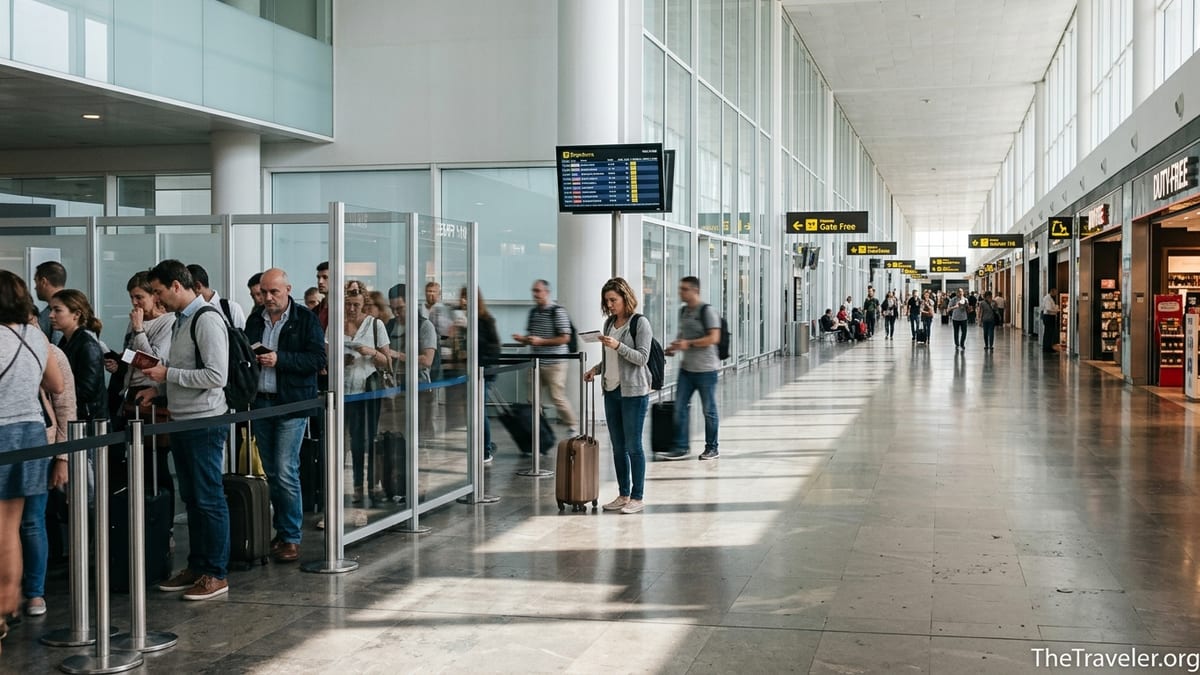
Then I turned the corner into the security area and saw the queue. It was a solid, snaking mass of passengers stretching far beyond the formal zigzag barriers. Airport data suggests typical security waits at Barcelona range from around 15 to 30 minutes, but can spike toward an hour at busy times, especially in Terminal 1. Reality that morning looked closer to the upper end. My quiet coffee and duty-free browse vanished in an instant. I started calculating: long security, possible extra passport check for my non Schengen flight, and a lengthy walk to the gate. My margin had evaporated.
That was the rookie mistake in a nutshell. I had treated Barcelona El Prat as if terminal size, walking distances, and non Schengen controls were an afterthought. I trusted generic “two hours is enough” wisdom without matching it to this specific airport’s layout and patterns. The near miss that followed taught me exactly how Barcelona can punish that sort of complacency, and what you should do differently.
The Real Culprit: Underestimating Security and Passport Control
Security at Barcelona El Prat is where many otherwise confident travelers get caught out. On calmer days you might breeze through in under 20 minutes. At other times, especially between roughly 6:00 to 9:00 in the morning and late afternoon into early evening, waits can balloon. Recent queue tracking assessments put typical waits somewhere between about 15 and 50 minutes depending on terminal, time of day and season. For a non Schengen departure this is only the first hurdle, because passport control often adds a second queue after security.
In my case, I joined a single massive security line serving multiple boarding time windows. Ahead of me were family groups bound for Amsterdam, business travelers for Frankfurt, and holidaymakers with beach bags clearly heading for the islands. Every few minutes a flustered passenger would squeeze past, apologizing as they rushed to the front after hearing their name on the loudspeaker. The line inched forward, but I could feel the clock drilling into my back. By the time I reached the trays, nearly 40 minutes had passed.
Then came passport control. Because I was flying to the United Kingdom, I had to clear exit checks out of the Schengen area. The non Schengen gates in T1 are typically in the D and E zones, past a separate passport line. That queue was shorter than security but moved more slowly, as officers manually inspected passports and asked routine questions about stay duration and onward connections. It added another 15 minutes to my journey. Suddenly I had less than 30 minutes until boarding and still had to walk to a far off gate.
This double queuing system is where many visitors trip up. They see the official advice of arriving two to three hours before an international flight and assume that applies uniformly. In practice, a traveler flying from Barcelona to a Schengen destination such as Paris or Rome might clear security and stroll to nearby gates in an easy 25 to 30 minutes on a normal day. A passenger heading to New York or Toronto can face long security, then passport control, then a substantial hike to a remote gate. Planning for the shorter scenario when you are in the longer one is exactly the kind of rookie error that nearly caught me out.
Barcelona’s Terminal Layout: Bigger and Slower Than It Looks
The other piece I misjudged was sheer scale. Barcelona El Prat is Spain’s second busiest airport and feels more like a self contained shopping mall than a simple terminal. There are two main terminals, T1 and T2. Terminal 1 handles the bulk of full service carriers and many long haul flights. Terminal 2 is split into T2A, T2B and T2C and is older, smaller, and hosts a mix of low cost airlines and regional operations. A free shuttle bus links T1 and T2, but it adds extra uncertainty if you discover too late that your flight departs from the other building.
Within T1 itself, walking distances are not trivial. Local guidance notes that it can easily take 15 to 20 minutes to walk from the central security area out to some D or E gates used for non Schengen flights. The design draws you past long corridors of glass and duty free retail, which looks pleasant but conceals how far you are actually traveling. On my departure, my London flight boarded from a gate almost at the far end of the non Schengen pier. I power walked past endless clothing stores and jamón displays while watching the “Boarding” indicator change from “Final call” to a list of names.
To imagine it in concrete terms, think of arriving at security at 8:30 for a 10:00 long haul departure from T1. You might spend 35 minutes in the security queue and another 15 minutes in passport control. That gets you out into the concourse at around 9:20. If boarding opens around 9:15, you are already cutting it extremely fine. Add a 15 minute walk to the gate and you have almost no buffer for a bathroom stop, a water purchase, or a quick snack. If a gate change pushes you from a shorter C gate to a farther E gate, even that last margin disappears.
The layout can also catch people transferring between terminals. For example, a traveler connecting from a low cost carrier arriving into T2B to a long haul flight departing from T1 might assume a quick walk. In reality, they have to follow signs to the inter terminal shuttle, wait for the bus, ride across the airfield and then repeat check in, security and passport control procedures. With tight connections and a busy day, this can be the difference between an onward flight caught and a ticket lost.
Transportation Timing: Why “Leaving the City” Is Only Half the Story
The rookie mistake did not begin at the airport doors. It began the moment I treated the journey as “30 minutes to the airport” and mentally wrote off everything else. Barcelona’s city center sits around 12 kilometers from El Prat, and multiple transport options share roughly similar travel times on paper yet behave very differently in real life.
The Aerobus, the dedicated airport express service, runs 24 hours a day between Plaça de Catalunya and both terminals, with daytime frequencies of around every 5 to 10 minutes. A single ticket currently costs in the region of 7 euros, with the ride taking about 30 to 35 minutes under normal conditions. But that timing assumes uncomplicated traffic. During morning rush hour on Gran Via or around Plaça d’Espanya, buses can easily take an extra 10 to 15 minutes. That is exactly what happened to me. A delay that felt small in the city translated into a serious problem once it compounded with queues at the terminal.
The metro, via line L9 Sud, is often more predictable because it travels underground from key interchange stations like Zona Universitària. The ride from downtown can take 35 to 45 minutes including changes, and there is a small airport supplement built into the ticket price. Local trains also run from Sants station to Terminal 2, taking about 20 to 25 minutes. A taxi typically runs 25 to 35 minutes from central neighborhoods, with a fixed minimum fare from the airport that usually brings the total into the 30 to 35 euro range depending on traffic and time of day.
Where many visitors trip up is treating those door to terminal times as the only variable that matters. In practice, you should mentally add an extra 30 minutes on top of whatever estimate a navigation app suggests. That buffer covers everything from a delayed metro, to a busy Aerobus stop, to queueing for a taxi after a cruise ship docks. On a Saturday afternoon in July when ships unload thousands of passengers at once, the line for airport taxis at Plaça de Catalunya can snake down the block. What looks like a 30 minute drive can quietly become an hour of waiting and 30 minutes of travel.
My personal mistake was trusting that a mid week morning was immune to those fluctuations. The reality is that early business departures, late finishing conferences, and modest road works anywhere along the route can all conspire against you. The only reliable way to offset them is to treat your “time to airport” as a two stage process: city to terminal, then terminal to gate, each with its own buffer.
Small Choices That Buy You Big Time
What finally saved my flight that day was a combination of luck and one small decision I made almost without thinking: I had checked in online the night before and was traveling with only cabin baggage. That meant I could walk straight past the check in desks to security without queueing again to drop bags. Had I been juggling a large suitcase and waiting behind a long check in line, missing my flight would have been almost guaranteed.
Barcelona El Prat offers a few other options that can quietly transform your experience. One is the paid Fast Track security lane, available in both terminals and often priced in the region of 7 to 10 US dollars or a similar amount in euros when bought through certain airlines or directly at the airport. On a day when general security waits creep toward 45 minutes, Fast Track can bring that down to closer to 10 or 15 minutes. For a family traveling in peak August or anyone with a tight connection, that modest fee can deliver enormous peace of mind.
Another helpful choice is simply to move quickly once you have cleared checks. Barcelona’s T1 concourse resembles a high end shopping arcade, with tapas bars, fashion brands and electronics stores positioned to tempt you into lingering. It is easy to think you are just “two minutes from the gate” and lose 15 minutes over a coffee at an attractive cafe near the central square. The smarter move is to walk directly to your gate first, confirm the actual distance, and then decide whether you have time to return to the central area or use facilities closer to your boarding point.
Food planning is also worth a thought. Prices for simple meals inside the airport are what you would expect from a major European hub: sandwiches in the 6 to 8 euro range, coffee around 3 euros, and sit down tapas or burgers easily climbing higher. If you are watching your budget or traveling with a group, eating something light in the city and using the airport only for a quick snack or bottle of water can reduce both stress and spending. It also means you are not standing in a long queue at a crowded restaurant while your gate quietly switches from “Go to gate” to “Final call.”
What I Would Do Differently Next Time
Walking onto my flight out of breath that day, I mentally rewrote my entire pre departure strategy for Barcelona. The first change I would make, and the one I recommend most strongly, is to treat three hours before departure as a baseline for any non Schengen flight from El Prat, particularly from Terminal 1. That means standing inside your terminal three hours before scheduled takeoff time, not leaving your hotel or apartment three hours before.
For Schengen flights to destinations within most of continental Europe, arriving 2 to 2.5 hours before departure may still be adequate outside peak periods, especially if you have checked in online and only carry hand luggage. But even then, I would add extra time in July and August, on Sunday evenings when weekenders return home, and on Mondays when business travel spikes. If you are catching an early morning flight, build in the potential for slower first metro connections or reduced night bus frequencies.
The second change would be to plan transport with more redundancy. Rather than automatically choosing the Aerobus because it feels straightforward, I would check current traffic conditions, consider the metro for predictable timing, or pre book a taxi if traveling with family or heavy luggage. In a city where rideshare apps like Uber, Cabify and Free Now operate alongside official taxis, comparing prices and estimated arrival times before you leave the hotel lobby is one of the simplest ways to avoid a last minute scramble.
The third change is psychological. Instead of assuming everything will go smoothly, I now try to imagine the worst reasonable scenario: a 45 minute security wait, a 20 minute passport queue, a 20 minute walk to the gate, and a last minute gate change to a farther pier. If I can fit all of that inside my pre boarding window with some time to spare, I feel genuinely relaxed. If I cannot, I adjust my departure from the city. It is a mindset shift from optimistic to cautiously realistic that can make the difference between jogging toward a closing door and boarding with a coffee in hand.
The Takeaway
The rookie mistake I made at Barcelona El Prat Airport was not dramatic. I did not show up without a passport or misread my departure date. I simply underestimated how long it can take to move from the city to the terminal, through security, past passport control and out to a distant gate in a busy, expanding hub. It was a small error in judgment that nearly had large consequences.
If you remember only one thing before your own departure from Barcelona, make it this: treat El Prat as a major international airport whose size and procedures deserve the same respect as London Heathrow or Paris Charles de Gaulle. Give yourself at least three hours at the terminal for non Schengen flights, use online check in whenever possible, consider Fast Track security on busy days, and never assume the walk to your gate will be short. Check the actual gate number, follow the signs and keep moving until you are in the boarding area.
Do that, and Barcelona El Prat becomes just another well organized step on your journey out of Catalonia instead of the final stressful memory. You can enjoy that last cortado at a cafe overlooking the tarmac, watch the mountains beyond the runways fade behind departing aircraft, and know that the one rookie mistake that nearly caught me will not catch you.
FAQ
Q1. How early should I arrive at Barcelona El Prat for a non Schengen flight?
For flights to non Schengen destinations like the United Kingdom, United States or Canada, plan to be inside your terminal at least three hours before departure. This gives you enough time for check in if needed, security, passport control and a potentially long walk to remote gates.
Q2. Is two hours enough for a Schengen flight from Barcelona?
For Schengen flights within most of continental Europe, two hours can be enough in quieter periods, especially with online check in and hand luggage only. In peak summer, on Sunday evenings or Monday mornings, aim for 2.5 hours to protect against longer queues.
Q3. How long does security usually take at Barcelona El Prat?
On a typical day security can take around 15 to 30 minutes, but at busy times or in high season it can stretch towards 45 minutes or more. Non Schengen departures may also face an additional passport control queue after security.
Q4. Is Fast Track security worth paying for at Barcelona Airport?
Fast Track lanes are usually priced in the range of a modest single digit euro amount per person and can significantly cut waiting times during peak hours. If you are traveling in summer, have a tight schedule or simply value a calmer experience, the cost is often worthwhile.
Q5. What is the best way to get from Barcelona city center to the airport?
There is no single best option for everyone. The Aerobus offers a straightforward 24 hour service from Plaça de Catalunya, the metro line L9 Sud is predictable and avoids road traffic, trains from Sants connect to Terminal 2, and taxis or rideshares provide door to door convenience at a higher price. Consider your luggage, group size, time of day and budget.
Q6. How long does the Aerobus take and how much does it cost?
The Aerobus journey from Plaça de Catalunya to the airport normally takes about 30 to 35 minutes, longer if traffic is heavy around Gran Via or Plaça d’Espanya. A single adult ticket typically costs a bit over 7 euros, with slightly lower prices for return tickets.
Q7. How much walking should I expect inside Terminal 1?
Inside Terminal 1, walking from the central security area to distant non Schengen gates in the D or E zones can take 15 to 20 minutes at a normal pace. If your gate changes to one even further along the pier, be prepared to walk a little more, so comfortable shoes and a small daypack help.
Q8. What if I arrive at the wrong terminal for my flight?
A free shuttle bus connects Terminal 1 and Terminal 2, but the transfer can add 20 to 30 minutes once you factor in waiting for the bus, the ride and walking to the right check in zone. Always double check your terminal on the booking confirmation and boarding pass to avoid this last minute stress.
Q9. Are there good food options after security, or should I eat in the city?
Both terminals have a wide choice of cafes, fast food and sit down restaurants after security, with prices at typical major airport levels. Eating something light in the city and using the airport for snacks or drinks can save money and reduce time pressure at busy venues near the gates.
Q10. What is the single easiest mistake to avoid at Barcelona El Prat?
The biggest trap is underestimating how long it takes to go from city to gate. Give yourself more time than you think you need, especially for non Schengen flights, and move straight toward your gate after security and passport control before you relax or shop.