


If you have ever scrolled through Athens photos and wondered why the “Theatre of Dionysus” sometimes looks brand new and other times like a low, ruined bowl of stone, you are not alone. The Greek capital has not one but two major ancient theatres clinging to the southern slope of the Acropolis, and visitors (and even some guidebooks) routinely confuse them. This guide explains exactly which is which, how to recognize them in real life and in photos, and what each one offers to modern travellers.
Get the latest updates straight to your inbox!
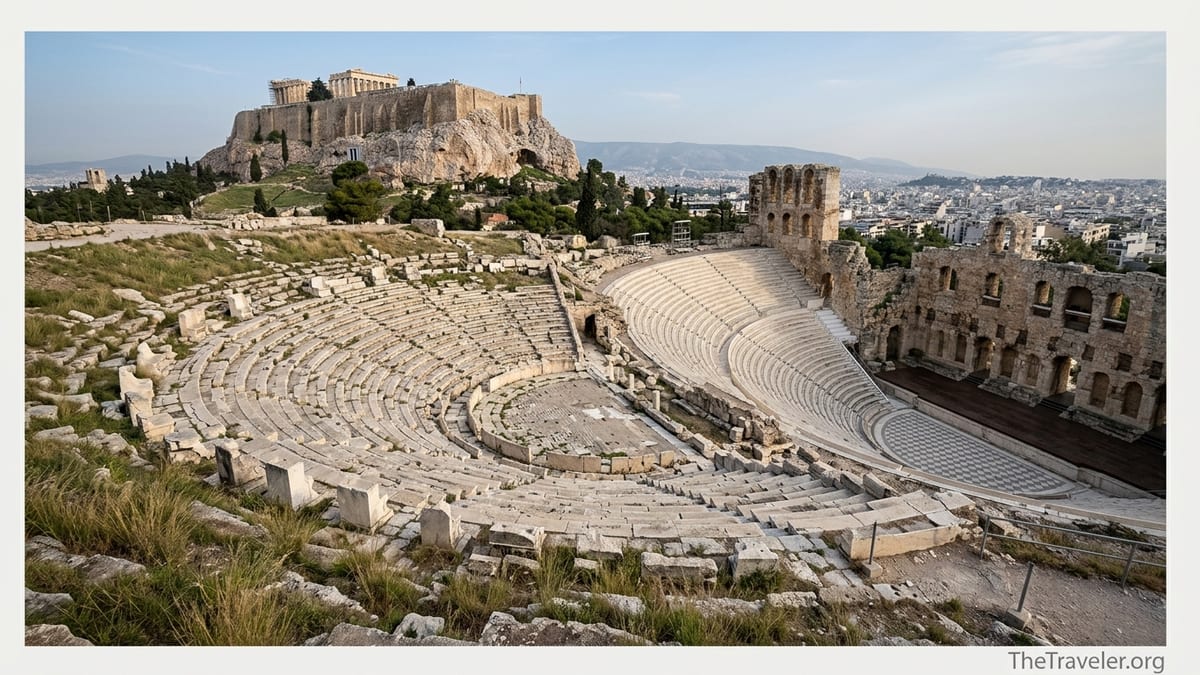
Meet the Two Theatres Under the Acropolis
Both the Theatre of Dionysus and the Odeon of Herodes Atticus sit on the southern flank of the Acropolis hill, just a few hundred meters apart, and both are semi‑circular stone theatres cut into the rock. That physical similarity is the root of the confusion. In practice, though, they are different in age, condition, and function. One is a mostly ruined but hugely important Classical Greek theatre, the other a Roman‑era concert hall that has been heavily restored and is still used for performances.
The Theatre of Dionysus is the older of the two. Built in stages from the 6th to the 4th century BC, it is widely considered the birthplace of Greek drama and once held perhaps 15,000 to 17,000 spectators in its full stone form. Today it appears as a broad, low fan of worn limestone benches, with only the lower tiers clearly preserved and fragments of carved marble seats of honor in the front row.
The Odeon of Herodes Atticus dates from around AD 161, when the wealthy Roman benefactor Herodes Atticus built it in memory of his wife Regilla. Much smaller, with a capacity of around 5,000, it looks dramatically different to modern eyes because its cavea and orchestra were rebuilt in gleaming Pentelic marble in the 1950s. When you see photographs of a steep white theatre with an imposing multi‑story stone wall behind the stage and views over modern Athens, you are looking at the Odeon, not the Theatre of Dionysus.
For a visitor on the ground, the simplest rule of thumb is this: the “new‑looking” theatre with intact marble seating and back wall is the Odeon of Herodes Atticus; the lower, more eroded, open ruin without a tall stage building is the Theatre of Dionysus.
Location on the Hill: How to Find Each One
Both monuments cling to the Acropolis’ south slope, but you encounter them at different points of a standard visit. With a regular Acropolis and slopes ticket you enter from the main southeastern gate on Dionysiou Areopagitou Street. Almost immediately after the security check and ticket validation, the first large theatre you see downhill to your left is the Theatre of Dionysus, spread broadly across the slope.
From here, an easy path continues uphill along the same side of the rock. After roughly five to ten minutes of gentle climbing, you reach a fenced viewpoint from which you can look down into the Odeon of Herodes Atticus. The Odeon hugs the southwestern corner of the hill and is slightly higher relative to the modern pedestrian avenue; many visitors first glimpse it from above while walking around the Acropolis plateau, its semicircle framing the city below.
This geography matters for planning. The Theatre of Dionysus sits inside the general Acropolis & South Slope archaeological zone, normally included in the standard Acropolis combination ticket. In contrast, the Odeon of Herodes Atticus is a functioning performance venue. During the day you generally view it from above behind railings rather than freely wander its seats, and entry to sit inside is usually limited to ticket holders for specific concerts, especially during the Athens Epidaurus Festival between roughly June and September.
In practical terms, if you are visiting on a typical summer morning with an Acropolis ticket, you will be able to stroll among the stones of the Theatre of Dionysus, but you will likely only gaze down into the Odeon from viewpoints unless you have separate evening performance tickets.
What Each Theatre Looks Like: Visual Clues and Photo Examples
Because the two structures so often appear mislabeled online, it helps to anchor them in your mind with some visual rules. The Theatre of Dionysus is wide and relatively shallow. Its remaining stone rows do not climb very high up the hill, and there is no towering stage wall at the back. Instead, you see fragments of the orchestra (the circular performance space), a low retaining wall, and scattered carved marble thrones in the front row, some inscribed with the names of priests and dignitaries.
Many travellers describe it as a “ruin” rather than a theatre, because large portions of the seating bowl were lost over the centuries and only the lower cavea survives clearly. Photos from ground level tend to show broken steps, weathered limestone, and grass growing between the stones. If you have seen a picture where you could imagine ancient Athenians in plain stone benches open fully to the sky, with the Acropolis rock looming behind, that is likely the Theatre of Dionysus.
The Odeon of Herodes Atticus has a very different feel. The seating is steep and uniform, made of smooth, pale marble that looks 20th‑century in its neatness. Behind the stage stands a high, arched backdrop of masonry with niches and windows: the remnants of the original three‑story Roman scaenae frons. From the side and above, many photos capture the curve of pristine seats, the dark wooden stage, and then the sprawl of modern Athens in the distance.
When travellers share a sunset shot of a nearly intact amphitheatre, often with concert lighting rigs on stage and the Parthenon just out of frame above, they are almost always looking at the Odeon. If a social media post is tagged “Theatre of Dionysus” but shows flawless white tiers and a back wall, you can safely assume it is a mislabeled photo of the Odeon of Herodes Atticus.
Different Histories, Different Stories
The Theatre of Dionysus grew organically with the rise of Athenian drama. A simple wooden arrangement existed by the 6th century BC as part of the sanctuary of Dionysus Eleuthereus, where festivals to the god of wine and theatre were held. Over time, Athenians replaced the wooden seating with stone, expanded the cavea up the hillside, and refined the stage buildings. By the 4th century BC, when statesman Lycurgus oversaw major works, the theatre approached its full stone form, facing the city with rows of seats rising nearly to the base of the Acropolis rock.
This is where the plays of Aeschylus, Sophocles, Euripides, and Aristophanes were first performed for the City Dionysia festival. Crowds of thousands watched tragedies such as Sophocles’ “Oedipus Rex” and comedies lampooning politicians and philosophers. Standing in the surviving lower rows today, many visitors comment that it feels easier to imagine the civic and religious atmosphere here than in the more polished Odeon.
The Odeon of Herodes Atticus belongs to a different era. Built more than five centuries later under Roman rule, it was conceived as an odeon, a covered venue designed primarily for music and speech rather than large‑scale drama. Originally it had a cedar‑wood roof and richly decorated interior, and ancient writers praised it as one of the finest buildings of its type. It hosted concerts, philosophical lectures, and public events for elite Athenian society.
In late antiquity the roof burned and the building fell gradually into ruin, but its basic form remained legible. In the mid‑20th century, Greek authorities restored the seating and orchestra in marble so that the odeon could function again as a performance space. Since the 1950s it has hosted everyone from Maria Callas and the Bolshoi Ballet to contemporary musicians, making it a rare ancient monument that doubles as a living cultural venue.
Visiting Today: Access, Tickets, and What to Expect
Most travellers encounter the Theatre of Dionysus as part of a daytime Acropolis visit. With the standard Acropolis & South Slope ticket, you can walk down into the theatre area, sit cautiously on the lower stone benches where permitted, and examine the marble prohedria seats at the front. Information panels explain the evolution of the sanctuary and highlight where the altar to Dionysus once stood in the orchestra.
Because the site is largely unshaded, it can be very hot in high season. Many visitors prefer to include it early in the morning, before tackling the climb up to the Parthenon. From some angles, you can photograph both the theatre below and the Acropolis walls above, making it clear how closely drama and religion were intertwined in ancient Athens.
By contrast, daytime access to the Odeon of Herodes Atticus is usually limited to viewpoints along the Acropolis path and the pedestrian street below. You peer down into the theatre from above or look in through gates from Dionysiou Areopagitou. This is still rewarding: you get sweeping views of the cavea, the stone backdrop, and the city beyond. However, if you want the full experience of sitting in the marble seats and watching a live performance, you will need to book performance tickets, typically many weeks in advance for major summer events.
A typical pattern for culture‑minded travellers is to tour the Acropolis and Theatre of Dionysus in the cool of the morning, retreat for a long lunch and rest, then return in the evening dressed slightly smarter for a concert at the Odeon. Many locals treat performances there as one of the highlights of the Athens summer, and travellers often remark that hearing a symphony or opera in a 2,000‑year‑old theatre under the night sky is a trip memory that rivals seeing the Parthenon itself.
Why Visitors Mix Them Up So Often
The confusion between the two theatres is not only a matter of names. Online, countless social posts label a glowing evening shot of the Odeon of Herodes Atticus as the “Theatre of Dionysus,” simply because users search for “Acropolis theatre” and pick the first historical name they recognize. Threads on travel forums are full of corrections from locals clarifying that the theatre with modern concerts and floodlights is the Roman odeon, while the birthplace of tragedy is the more eroded structure closer to the main gate.
On the ground, the problem is amplified by the layout of visits. Many people hurry past the lower Theatre of Dionysus on their way up to the Parthenon, glance at the ruins without fully absorbing their shape, and then later, from the summit, look down at the striking, intact marble bowl of the Odeon. When they recall “the theatre below the Acropolis” afterward, the crisp, restored image of the Odeon sticks more clearly in memory than the weathered stones of the older theatre, so names get swapped in retellings.
Language also plays a role. The Greek term “odeon” is less familiar to many English‑speaking visitors than “theatre,” so people default to calling both structures “the theatre,” assuming any ancient venue with seats and a stage fits that label. Without realizing it, they flatten two distinct types of building, and two different time periods, into one generic idea of “the Greek theatre beneath the Acropolis.”
Understanding these patterns in advance can help you slow down and appreciate each site on its own terms. When you plan your route, deliberately schedule a few extra minutes to linger at the Theatre of Dionysus before climbing higher. Later, when you reach the viewpoints above the Odeon, you will immediately recognize that you are looking at a different structure with a different life story.
Which One Should You Prioritize?
For most travellers, the Theatre of Dionysus is the more important site in terms of historical significance. If you care about Ancient Greece, this is the place where drama as we know it was born. Even in ruin, it offers a powerful sense of continuity: you stand in the same slope where Athenians once listened to the first performances of the tragedies and comedies that still shape world literature.
That said, the Odeon of Herodes Atticus tends to deliver the more immediately impressive visuals, especially at golden hour. Its restored marble, high stage wall, and sweeping view over Athens make it a natural favorite for photography. For travellers who may not have a strong background in classical history but enjoy atmospheric venues, an evening performance here can be the emotional high point of a trip.
If your time is very limited, you do not need to choose one over the other entirely. A standard Acropolis visit will take you past both, at least from a distance. The real decision is whether to invest extra time exploring the Theatre of Dionysus more closely or to secure tickets for a concert at the Odeon. As a rule of thumb, history enthusiasts, teachers, and students may want to linger at the Theatre of Dionysus, while music lovers and romantically inclined travellers may choose to devote budget and planning energy to a night at the Odeon.
Many visitors, of course, do both: morning among the stones where Sophocles was staged for the first time, and evening under the stars listening to a modern orchestra. Experiencing the quiet archaeological site and the living theatre in one day underscores how Athens’ ancient venues continue to shape its cultural life.
The Takeaway
Sorting out the two theatres beneath the Acropolis is less about memorizing dates than about learning a few clear distinctions. The Theatre of Dionysus, older and more ruined, is the broad Greek theatre closest to the main Acropolis gate and the birthplace of drama. The Odeon of Herodes Atticus, later and Roman, is the steep marble concert hall with a tall stone backdrop and sweeping city views, best appreciated during an evening performance.
When you understand which is which, your photographs make more sense, your memories feel sharper, and your appreciation of Athens deepens. Instead of “the theatre under the Acropolis,” you will recall two specific places: the sanctuary where Athenians once honored Dionysus with new plays, and the odeon where modern audiences still gather to hear music beneath the same rock. Together, they tell a story of cultural continuity that stretches from Classical Athens to the present day.
FAQ
Q1. Which theatre under the Acropolis is the Theatre of Dionysus?
The Theatre of Dionysus is the broader, more ruined Greek theatre closest to the southeastern Acropolis entrance, without a high stage wall and with weathered stone benches.
Q2. Which theatre is the Odeon of Herodes Atticus?
The Odeon of Herodes Atticus is the steep, restored Roman theatre with smooth marble seating and a tall stone backdrop, overlooking modern Athens from the southwest slope.
Q3. Can I visit both theatres with a standard Acropolis ticket?
You can enter and walk around the Theatre of Dionysus with the Acropolis & South Slope ticket, but the Odeon of Herodes Atticus is usually seen from viewpoints unless you have separate performance tickets.
Q4. Why do so many photos mislabel the two theatres?
Many people search generically for “Acropolis theatre,” recognize the famous name “Theatre of Dionysus,” and then attach it to striking photos of the better preserved Odeon of Herodes Atticus.
Q5. Which theatre is older?
The Theatre of Dionysus is older, with origins in the 6th century BC and major stone phases in the 5th and 4th centuries BC, while the Odeon of Herodes Atticus was built in the 2nd century AD.
Q6. Where were the plays of Sophocles and Euripides first performed?
Classical tragedies and comedies by playwrights such as Aeschylus, Sophocles, Euripides, and Aristophanes premiered at the Theatre of Dionysus during religious festivals for Dionysus.
Q7. Can I attend a concert at the Odeon of Herodes Atticus?
Yes, during the summer Athens Epidaurus Festival and other events, the Odeon hosts evening performances. Tickets should be bought in advance and are separate from Acropolis admission.
Q8. Which theatre offers better photo opportunities?
For dramatic city views and a sense of an intact ancient venue, the Odeon of Herodes Atticus usually photographs better. For historical atmosphere and context, the Theatre of Dionysus is more meaningful.
Q9. Is there any shade at the Theatre of Dionysus?
The Theatre of Dionysus is mostly exposed, with limited shade. In summer it is best visited early in the morning or later in the afternoon when the sun is less intense.
Q10. If I only have one hour around the Acropolis, which theatre should I prioritize?
If history is your main interest, prioritize walking through the Theatre of Dionysus. If you are more drawn to impressive views, focus on the viewpoints above the Odeon of Herodes Atticus.