


More news on this day
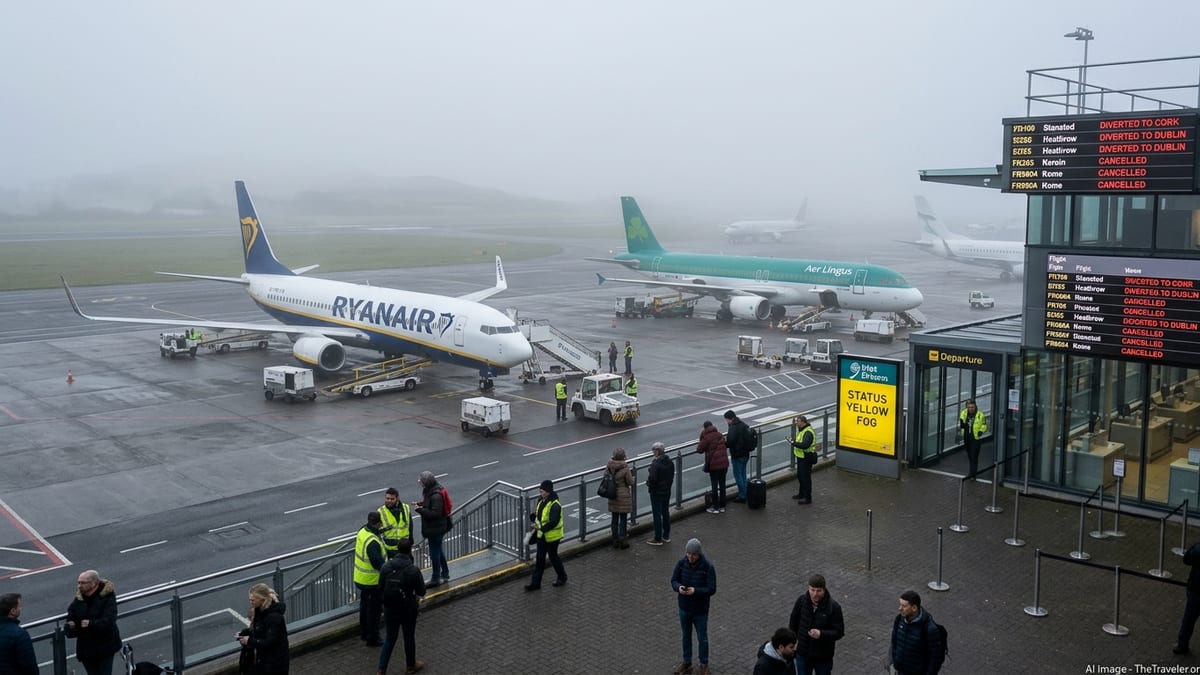
Dense fog around Shannon Airport in County Clare on 25 November 2026 forced several Ryanair and Aer Lingus flights to divert to Cork and Dublin, disrupting key links to London, Rome and the Canary Islands and leaving some passengers facing cancellations and rebookings.
Get the latest news straight to your inbox!
What happened at Shannon on 25 November
According to local reports, low visibility at Shannon Airport persisted for much of the afternoon and evening on Wednesday 25 November 2026, reducing the airport’s ability to receive arriving traffic and prompting a sequence of diversions to other Irish airports. Thick fog was reported across parts of County Clare throughout the day, matching the conditions described by airlines and operational data services for Shannon at the time.
The first confirmed diversion involved Ryanair service FR109 from London Stansted, which had been scheduled to arrive at Shannon in the early afternoon. Tracking data and contemporary coverage indicate that the aircraft did not conduct an approach into Shannon and instead routed directly to Cork Airport, where it landed without incident. The flight is a regular Ryanair link between Stansted and Shannon and normally provides a key connection between the London region and Ireland’s west.
Later in the day, Ryanair’s FR9804 from Rome Ciampino, also bound for Shannon, diverted to Dublin rather than continuing to the west coast. Local reporting notes that this diversion occurred shortly after the aircraft crossed the Irish coastline over Wexford, suggesting that by that stage conditions at Shannon had not improved sufficiently to allow a safe landing within the operator’s minima. The corresponding outbound service from Shannon back to Rome, FR9805, was cancelled and listed as such on Shannon Airport’s live departures page, with passengers instructed to contact their airline for rebooking options.
Further diversions to Cork and impact on London and Canary Islands services
As fog persisted into the late afternoon, two additional Ryanair arrivals from Spain’s Canary Islands were unable to land at Shannon. Flight FR5030 from Lanzarote and FR1348 from Fuerteventura, both scheduled as winter-sun routes into the west of Ireland, diverted to Cork. Operational listings for Cork confirm that the airport regularly handles Ryanair services from both islands, making it a practical diversion point for these flights when Shannon is affected by poor weather.
Aer Lingus operations between London Heathrow and Shannon were also disrupted. Local coverage states that flights EI385 and EI387 from Heathrow to Shannon diverted to Cork because of the poor visibility at Shannon. As a direct consequence, the matching outbound sectors from Shannon back to Heathrow, EI386 and EI388, were cancelled. Heathrow is Shannon’s busiest single route by frequency, and these Aer Lingus services are an important part of the airline’s wider long-haul and European connection network, so the loss of two round-trips in one evening had a disproportionate impact on passengers with onward itineraries.
Data from route and airport profiles underline why Cork and Dublin were chosen as diversion points. Shannon and Cork are approximately 95 kilometres apart by road, and Cork handles a similar mix of short- and medium-haul European flights, including many Ryanair and Aer Lingus services. Dublin, as Ireland’s main hub, is commonly used for diversions of flights approaching from continental Europe, such as those arriving from Rome. The combination meant that aircraft could land at well-equipped airports within relatively short flying times while crews and airlines arranged onward transport or rebooking for affected customers.
Weather conditions and operational constraints
The episode coincided with a period of dense fog reported across parts of Munster and the mid-west, including County Clare, on 25 November. Met Éireann had issued a Status Yellow fog warning covering the region in late November, advising that poor visibility was likely in places, particularly overnight and during the early part of the day. While individual flight decisions rest with pilots and airlines operating under aviation regulations, such warnings provide important context for the operational picture at airports like Shannon.
Airports and airlines work within defined visibility minima, which differ depending on factors such as runway equipment, aircraft type, crew training and the category of instrument landing system in use. When horizontal or vertical visibility drops below those limits, arriving aircraft may be unable to complete an instrument approach or landing, even if the airport itself technically remains open. In those cases, diversion to an alternate airport identified in the flight plan is the standard response, particularly when forecasts suggest that conditions at the destination are unlikely to improve quickly.
Publicly available flight data for Shannon during November 2026 show that diversions are relatively infrequent in normal conditions, but that fog, strong winds or other adverse weather can cause clusters of diversions on specific days. Over the 30-day period around the incident, only a small proportion of flights into or out of Shannon were recorded as having diverted, underlining that the disruptions on 25 November were closely tied to the particular weather pattern that day rather than reflecting a wider long-term issue at the airport.
How passengers were affected and options for rebooking
The diversions and cancellations affected several categories of traveller. Passengers booked to fly directly to Shannon found themselves arriving into Cork or Dublin instead, while those scheduled to depart Shannon on the cancelled return services, particularly Aer Lingus flights EI386 and EI388 to London Heathrow and Ryanair FR9805 to Rome, needed new arrangements. In such situations, airlines typically offer rebooking on the next available flight on their own network, rerouting via another airport where possible, or in some cases refunds, in line with their conditions of carriage and relevant air passenger rights regulations.
For travellers ending their journey in the Shannon region, the most immediate practical issue was surface transport from the diversion airports. Cork Airport lies to the south of Shannon and Limerick, and passengers diverted there commonly complete their journeys by coach, pre-arranged buses provided by the airline, rail links via Cork city, or taxis and hire cars, depending on what the airline has arranged and the passenger’s own preferences. Dublin is farther from Shannon by road, and passengers who arrived there from Rome may have chosen to continue by domestic flights, intercity coach services or rail connections to Limerick or Ennis, depending on availability and the timing of their onward plans.
Some Aer Lingus customers heading to or from London Heathrow may also have been connecting with long-haul services. With both EI385 and EI387 diverting and their corresponding outbound legs cancelled, those travellers would have needed to be rebooked, either via later Heathrow services where seats were available or by rerouting through Dublin or other hubs in the Aer Lingus and partner airline networks. Such rebooking can take time to arrange, particularly when multiple flights are disrupted in a short window, so passengers affected on 25 November were advised in local coverage to stay in direct contact with their airline for up-to-date information.
What travellers should check after the fog disruption
By 26 November, Shannon Airport’s live departure and arrival boards were showing a normal pattern of operations, with scheduled services to London Heathrow, Rome, Lanzarote, Fuerteventura and other key destinations operating as timetabled or with only routine minor delays. This indicates that the fog-related disruption was limited to a relatively short period on 25 November, rather than evolving into a prolonged closure or multi-day interruption to traffic through Shannon.
Even so, the episode underlines the importance for travellers of monitoring flight status closely in periods of unsettled weather, especially during Ireland’s late autumn and winter when fog, strong winds and heavy rain are more prevalent. Aviation authorities and weather agencies consistently advise passengers to check the latest information with their airline before setting out for the airport when severe or disruptive weather is forecast, since airline websites and apps are usually updated faster than third-party flight trackers or static timetables.
Passengers with upcoming bookings to or from Shannon, Cork or Dublin should therefore confirm their flight status on the day of travel, pay attention to any SMS or email alerts issued by their airline, and allow additional time for their journey to the airport if poor visibility or other adverse weather is expected. Those connecting through Heathrow or other hubs on itineraries involving Shannon may wish to build in longer connection times during the winter season to reduce the risk of missed onward flights in the event of further short-notice disruptions caused by weather conditions beyond the airlines’ control.