


More news on this day
A FedEx Express cargo aircraft overran a runway at Miami International Airport on the night of Wednesday, November 25, 2026, forcing a temporary closure of all but one runway at one of the United States’ busiest holiday hubs but resulting in no reported injuries, according to airport officials and local authorities.
Get the latest news straight to your inbox!
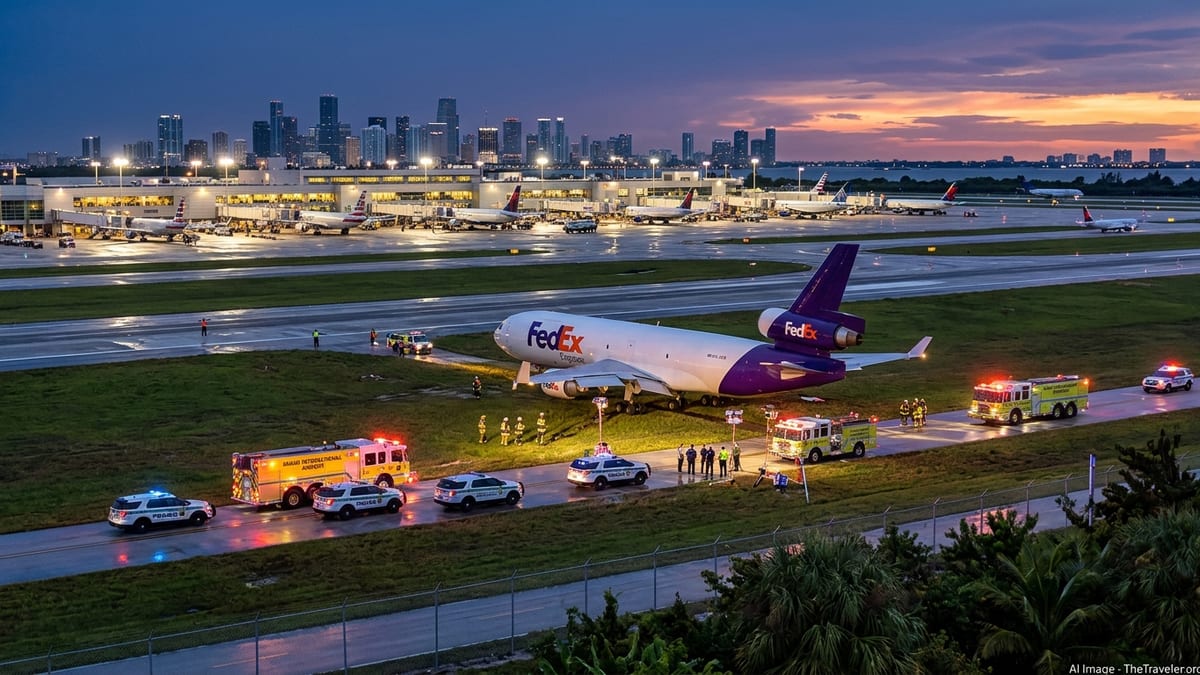
What happened during the FedEx runway excursion at MIA
According to Miami International Airport and local law enforcement, the incident occurred at around 8:40 p.m. Eastern time on November 25, when a FedEx cargo aircraft landing on Runway 26R failed to stop within the paved runway length and came to rest beyond the runway end. Initial photos and video from the scene show the aircraft largely intact, with its nose and main landing gear off the paved surface near the airport perimeter area. Authorities described the event as a runway excursion rather than a crash, and there were no reports of fire.
Local outlets reported that the aircraft involved was a McDonnell Douglas MD‑11 freighter operating a FedEx Express flight from Memphis to Miami. Airport officials said there were no injuries among the small number of crew members on board, and Miami‑Dade Fire Rescue confirmed that no hospital transports were required. Early statements from the airport and county officials did not indicate any damage to buildings or vehicles outside the airfield perimeter, in contrast to a separate fatal cargo overrun at Miami earlier this year.
The precise sequence of events on final approach and landing has not yet been formally detailed by investigators. Radar playback viewed by aviation tracking communities indicated that the aircraft touched down relatively far along the runway, but data from flight recorders and official performance analysis will be needed to establish exactly how the landing unfolded and why the crew were unable to stop on the prepared surface.
Operational impact on one of the busiest holiday travel days
The incident occurred on the eve of the U.S. Thanksgiving holiday, traditionally one of the busiest travel periods of the year for Miami International Airport and for the national airspace system. Airport and Federal Aviation Administration officials said that, with an aircraft disabled off the end of Runway 26R, all but one runway at Miami were temporarily taken out of service while emergency responders secured the scene and assessed the condition of the aircraft and surrounding area. The FAA issued a ground stop for flights bound for Miami for a period on Wednesday evening, meaning some departing flights elsewhere in the country were held on the ground before being allowed to take off for MIA.
Passenger flights already en route to Miami continued to land using the remaining available runway, and operations gradually resumed as airfield capacity constraints were managed. However, the reduction in runway availability, combined with existing weather‑related delays in South Florida, contributed to a buildup of delays for both arrivals and departures. Some flights diverted temporarily to nearby airports such as Fort Lauderdale while crews and dispatchers reassessed conditions at Miami.
The timing of the event, coinciding with heavy Thanksgiving travel, meant that even a short‑lived ground stop had outsized effects for some travelers, with knock‑on delays reported into late evening. For cargo operators, including FedEx, the disruption intersected with a peak shipping window leading into the holiday weekend. At the time of writing, Miami International Airport had not released a detailed breakdown of the number of delayed or diverted flights linked specifically to the FedEx excursion, but officials indicated that normal runway operations were being restored in stages as the aircraft and any debris could be cleared.
Weather, aircraft type and what is currently known about causes
The FedEx runway excursion occurred during a period of unsettled weather over South Florida. Local meteorological reports and coverage from Miami news outlets described passing rain and thunderstorms in the area on Wednesday evening, with wet runway conditions and gusty winds reported around the time of the incident. It is not yet known to what extent, if any, weather contributed to the overrun. Investigators will assess runway friction measurements, braking reports from other aircraft, and data from the plane’s recorders before reaching any conclusions.
The aircraft involved was reported to be an MD‑11F, a three‑engine widebody freighter type that remains in dedicated cargo service after having been retired from most passenger fleets. While the MD‑11 has a long safety record, its landing characteristics and higher landing speeds compared with some twin‑engine widebodies have been scrutinized in previous cargo accidents. Regulators previously grounded other MD‑11 freighters operated in the United States for inspections following a fatal UPS crash in 2025, and that grounding was subsequently lifted after mandated corrective actions. In the Miami incident, the aircraft appeared structurally intact in early images, and there were no immediate indications of an in‑flight structural failure similar to that earlier crash, but only a full investigation can determine whether any mechanical issues played a role.
At this early stage, authorities have not publicly assigned a cause or contributing factors, and no official preliminary report has yet been released. The National Transportation Safety Board typically deploys a team to serious runway excursions involving large transport‑category aircraft, as it did after a separate cargo overrun at Miami in September, and then issues a preliminary summary within several weeks. That initial report is expected to document factual information such as weather, crew details, aircraft configuration, landing data and runway conditions, without yet providing a full analysis or probable cause.
Context: a second major cargo runway overrun at Miami in 2026
The FedEx incident comes less than three months after an Amazon‑operated cargo jet overran a different runway at Miami International Airport on September 6, 2026, fatally striking vehicles outside the airport perimeter and killing multiple people on the ground. In that earlier case, 21 Air Flight 7598, a Boeing 767 freighter flying for Amazon, rolled beyond the end of Runway 30 and impacted a roadway and parking area, leading to a significant on‑scene response and a full safety investigation by the National Transportation Safety Board. That accident drew national attention to runway safety practices at one of the country’s major cargo gateways.
Miami International Airport is both a large passenger hub and one of the leading cargo airports in the United States, with a high volume of overnight shipments, e‑commerce flights and Latin America freight connections. The combination of intense cargo activity, frequent summertime thunderstorms and complex airfield geometry means that runway operations are closely watched by regulators and industry. In response to the September 6 overrun, the NTSB has already opened a detailed investigation, and in a recent update it highlighted issues such as aircraft stopping performance on wet runways, runway safety areas and the interaction between pilot decision‑making and real‑time weather information at Miami.
While it is too early to link the FedEx MD‑11 excursion on November 25 to any particular factor or to the earlier 21 Air accident, the fact that Miami has now seen two serious cargo overruns in a single year is likely to intensify scrutiny of landing practices and runway safety margins at the airport. Any longer‑term implications for runway use policies, declared distances, approach minima or braking‑action reporting at Miami will depend on the findings of the separate NTSB investigations and any safety recommendations they eventually produce.
What travelers and shippers should know in the coming days
For passengers traveling through Miami International Airport over the Thanksgiving weekend, the immediate impact of the FedEx incident is expected to be short‑term schedule disruption rather than long‑term closures. Once the disabled aircraft is removed and the runway surface inspected for damage, the affected runway can be returned to service if no repairs are needed. Until then, travelers may continue to experience residual delays as airlines work through aircraft and crew rotations that were affected by Wednesday night’s ground stop and temporary reduction in runway capacity.
Passengers with flights into or out of Miami over the next 24 to 48 hours are advised to monitor their airline’s app or customer alerts closely, as departure and arrival times may shift while operations normalize. Some carriers may continue to reroute a small number of flights through nearby airports such as Fort Lauderdale or Palm Beach if congestion persists. For those making tight connections, particularly on international itineraries, leaving extra time at the airport and confirming gate assignments shortly before travel can help mitigate the risk of missed onward flights.
For freight customers and shippers, FedEx and other cargo operators will be assessing the impact of the incident on their Miami schedules, especially for overnight and time‑definite shipments moving through the region. FedEx has not yet released a detailed public statement on how many consignments were aboard the MD‑11 involved in the excursion or how cargo will be recovered and forwarded, but in similar past events operators have typically prioritized re‑routing affected shipments through alternate hubs and using spare aircraft when possible. Businesses relying on just‑in‑time deliveries into South Florida in the days immediately after the incident may wish to track individual consignments and consider contingency plans while the carrier’s cargo handling teams adjust their operations.