


More news on this day
American Airlines’ two largest unions are intensifying criticism of the carrier’s leadership after November’s nationwide Federal Aviation Administration ground stop triggered days of cancellations and delays, arguing the airline’s recovery problems exposed planning, staffing and technology weaknesses that hit crews and passengers harder than at rival carriers.
Get the latest news straight to your inbox!
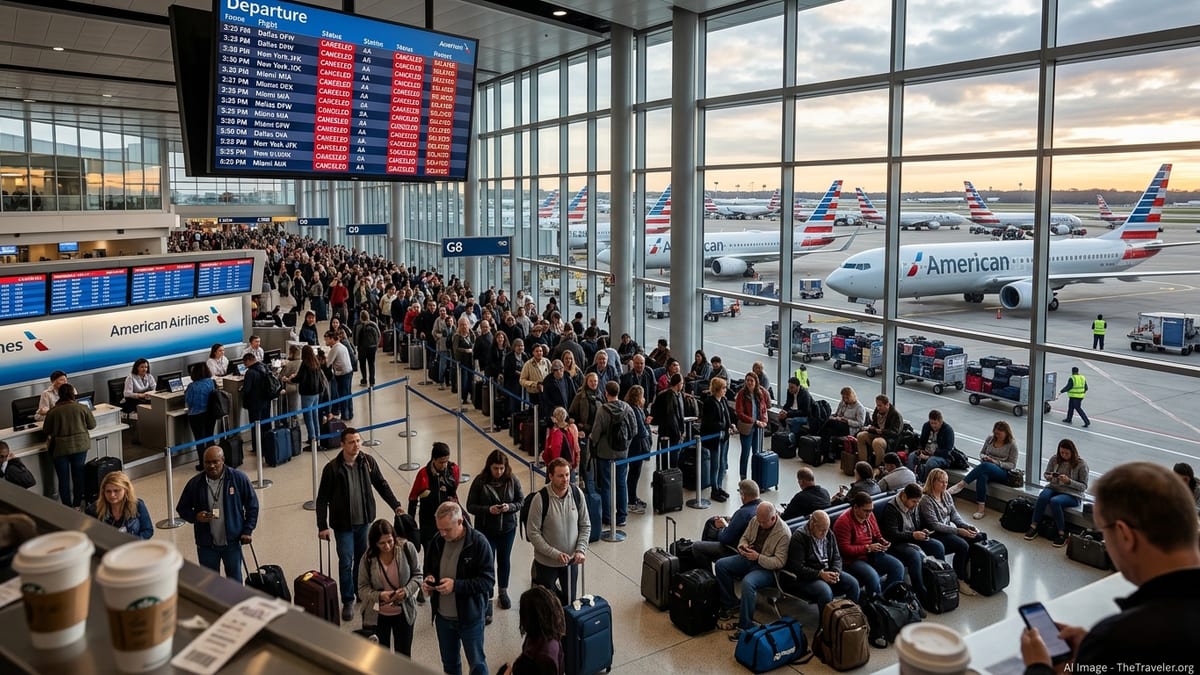
FAA ground stop leaves U.S. aviation system scrambling
The crisis began on Friday, November 13, 2026, when the FAA ordered a nationwide ground stop in response to a telecommunications failure affecting communications and radar systems across multiple air traffic control centers. The halt, which lasted roughly four hours and 45 minutes, temporarily paused most departures across the United States during a busy pre‑holiday travel period while the agency worked to stabilize its systems and verify that it was safe to resume flights.
Federal officials later said more than 12,000 flights were canceled that Friday, including over 9,000 flights operated by major U.S. carriers. Even after the nationwide ground stop was lifted, airlines faced rolling disruptions as aircraft and crews were left out of position, gates backed up and passengers needed to be reaccommodated. The Department of Transportation and FAA have both described the event as the most extensive ground stop since a system failure in January 2023, prompting congressional scrutiny of ongoing air traffic modernization and backup protections.
Public statements by the FAA and the U.S. Department of Transportation emphasize that the decision to halt departures nationwide was made "out of an abundance of caution" once it became clear the communications problems were not confined to a single facility. An FAA question‑and‑answer update published on November 15 confirmed that the agency is working with its telecommunications contractors to determine the exact technical root cause and to recommend changes intended to prevent a similar nationwide outage.
American’s operation struggles to recover through the weekend
Like other major airlines, American Airlines was forced to suspend departures during the ground stop and then restart operations with aircraft and flight crews scattered across the network. In an update to customers posted on November 13, the airline said it was focused on operating as many flights as possible that evening while preparing for recovery in the following days. American acknowledged that the disruption would affect flights across its hubs and advised customers to monitor its app and website for rebooking options.
Operational data published by the airline and subsequent updates over the weekend show that American continued to experience elevated cancellations and delays into Saturday, November 14, and Sunday, November 15, before targeting what it described as a “largely normal schedule” on Monday, November 16. While detailed carrier‑by‑carrier cancellation percentages for each day vary by data source and time of reporting, the federal Air Travel Consumer Report confirms that the ground stop and its aftermath significantly worsened on‑time performance metrics across the system for mid‑November, with American among the most affected large U.S. airlines.
The extended recovery period matters for travelers because each canceled or heavily delayed flight can cascade into multiple subsequent schedule disruptions. When aircraft end up overnight in the wrong city or crews reach maximum duty limits before reaching their scheduled destination, it can take days to realign the operation with the published timetable. American’s size, hub‑and‑spoke structure and tight scheduling meant that bottlenecks at major hubs translated into missed connections and long rebooking lines for many passengers through the weekend.
Union leaders highlight crew impact and renew criticism of management
American’s labor unions have seized on the November ground stop as evidence, in their view, that the company has underinvested in irregular‑operations planning and front‑line support. The Association of Professional Flight Attendants, which represents cabin crew at American, issued multiple communications to members on November 13 and November 18 laying out problems reported during and after the ground stop. These included crew members unable to reach company contacts for reassignment guidance, difficulties securing contractually required hotel rooms, and confusion over pay protections when flights were canceled or significantly delayed.
In its November 18 update, APFA said it was formally reviewing alleged contract violations tied to the incident, particularly around lodging, scheduling and duty limitations, and pressing the airline to resolve any pay discrepancies. The union framed the ground stop as part of a wider pattern in which large‑scale disruptions, whether caused by weather, technology or air traffic issues, expose what it considers to be gaps in the airline’s contingency plans. APFA has previously criticized American’s leadership for focusing on premium cabins, lounges and shareholder returns while, in its view, not doing enough to strengthen the systems and staffing that support crews during irregular operations.
The Allied Pilots Association, which represents American’s pilots, has also raised concerns about the airline’s resilience to major disruptions, although detailed post‑ground‑stop communications are more limited in public view. Both unions have, in earlier statements this year, questioned senior management’s approach to operations and labor relations, with APFA’s board previously taking the unusual step of issuing a vote of no confidence in American Airlines Group CEO Robert Isom. Union leaders argue that the November disruption reinforces their call for leadership changes or, at minimum, a substantial shift in priorities toward operational reliability and crew support.
Leadership transition and questions over American’s operational strategy
The renewed union pressure is unfolding as American prepares for a change at the top of its operations organization. In a Form 8‑K filing with the U.S. Securities and Exchange Commission on November 20, 2026, American Airlines Group disclosed that Chief Operating Officer David Seymour will retire at the end of the year. Seymour has served in senior operational roles through the airline’s merger integration, multiple industry shocks and recent labor agreement implementations, and the company credited him as a “steady, trusted and deeply committed leader” in its public announcement.
American has said that a successor will assume responsibility for leading airport, flight and inflight operations, operations planning and analytics, product management, and the integrated operations center that coordinates the airline’s daily schedule. The timing of Seymour’s departure, disclosed just days after the nationwide ground stop, has added urgency to union demands for a new operational strategy. While the retirement was framed by the company as the next step in solidifying its leadership team, labor groups are urging the board to treat the transition as an opportunity to overhaul systems and procedures for handling large‑scale disruptions.
For travelers, the leadership change is significant because the COO’s organization sets many of the policies that dictate how quickly an airline can recover from events outside its direct control. Decisions about spare aircraft and crews, investments in crew‑tracking and hotel‑booking technology, staffing levels at call centers and airport help desks, and protocols for proactively canceling or consolidating flights all fall under the operations umbrella. How American’s next operations chief balances cost control with resilience will help determine whether future nationwide or regional disruptions produce similar levels of cascading cancellations.
Implications for travelers and what to watch next
While the November 13 ground stop originated with a federal systems failure, the disparity in how quickly airlines recovered has practical consequences for travelers choosing between carriers, routes and connection points. Early data from flight‑tracking firms and federal reports indicate that some airlines were able to restore close to normal schedules more quickly than others over the weekend. From a traveler’s perspective, what matters is less the initial cause than how effectively an airline communicates, reaccommodates and protects customers when things go wrong.
Following the ground stop, the U.S. Department of Transportation reiterated that passengers are entitled to a refund when an airline cancels a flight and the traveler chooses not to be rebooked. American’s customer‑facing updates encouraged affected passengers to use self‑service tools in the app and on the website where possible, but APFA’s reports underscore that, for crews and many customers, long hold times and limited staffing at irregular‑operations desks remained a challenge. Travelers with near‑term bookings on American and other major carriers are being advised by consumer groups and airports to allow extra time, keep contact details updated in airline profiles, and monitor flight status frequently during the ongoing investigation period.
In Washington, lawmakers on key transportation committees have requested detailed briefings from the FAA and telecommunications providers on the outage’s causes and safeguards against recurrence. Any new regulatory requirements that emerge from these reviews are likely to focus on redundancy, cyber and physical security, and clearer communication protocols when nationwide ground stops are implemented. For airlines, however, the more immediate pressure is coming from within. As American’s unions push for operational reforms and the company prepares for a new operations chief in early 2027, travelers will be watching whether upcoming policy and technology changes translate into a more resilient experience during the next major disruption, regardless of its source.