


More news on this day
Delta Air Lines says it has restored the automated system used to calculate aircraft weight and balance after a technical outage on November 22 caused an FAA ground stop into Atlanta and widespread delays across the United States at the start of the busy Thanksgiving travel period.
Get the latest news straight to your inbox!
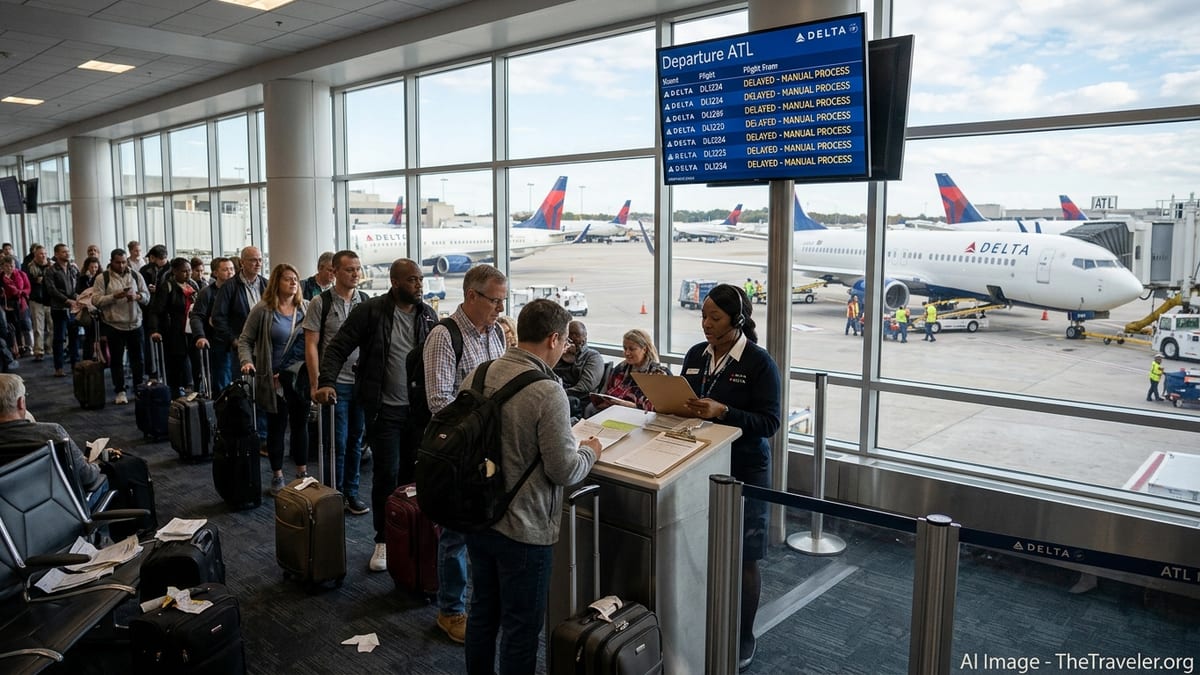
How the outage unfolded at Delta’s Atlanta hub
The disruption began on the morning of Sunday, November 22, when Delta reported problems with the automated system that calculates weight and balance for departing flights. The system is used to determine how passengers, baggage, cargo and fuel are distributed on each aircraft, and its output forms part of the required paperwork before a flight can depart. According to statements from the airline, the issue affected flights across its network but had the most visible impact at its largest hub, Hartsfield-Jackson Atlanta International Airport.
At Delta’s request, the Federal Aviation Administration initially issued a ground stop for some Delta-operated flights bound for Atlanta while the carrier worked to diagnose the technical fault. That order meant affected flights were held at their origin airports rather than allowed to depart for Atlanta. Within roughly an hour, the FAA converted the ground stop into a ground delay program, allowing flights to depart in a controlled, metered flow with typical departure holds of around 45 to 60 minutes for services headed to Atlanta.
Because departing flights from Atlanta were leaving later than scheduled while crews completed manual calculations, arriving aircraft had fewer gates available. That gate congestion at Hartsfield-Jackson, one of the world’s busiest hubs, created additional knock-on delays as aircraft waited on taxiways for parking positions to open. Delta said that by later in the day the outage was resolved and automation restored, but operational data show that the carrier continued to work through residual delays into the evening.
Scale of delays and where passengers were affected
The outage came at the start of the peak Thanksgiving travel period and hit an airline that routinely operates thousands of daily departures. Delta and its Delta Connection partners had roughly 5,000 flights scheduled globally on November 22. Flight-tracking data collated by multiple outlets indicate that on that day more than 2,000 Delta flights were delayed, representing roughly half or more of the carrier’s schedule, with a smaller number of cancellations, as the airline sought to keep as many flights operating as possible.
Atlanta bore the brunt of the disruption because of both the FAA restrictions and the airport’s role as Delta’s primary hub. By early evening on Sunday, FlightAware data showed that nearly 1,250 flights in and out of Hartsfield-Jackson across all airlines were delayed, underscoring how congestion at a major hub ripples beyond a single carrier. Travelers reported waits on board aircraft and in terminals not only in Atlanta but at airports around the country, including New York LaGuardia, Newark, Washington Reagan National, Washington Dulles, Boston, Baltimore, Miami, Minneapolis, Nashville, San Antonio and Birmingham, as aircraft and crews fell out of position.
The impact was not limited to Delta’s mainline jets. Regional flights operated under the Delta Connection banner, which rely heavily on tight turnarounds and connections at Atlanta and other hubs, also experienced delays. In several cases, passengers reported being boarded and then held at the gate for extended periods while crews awaited finalized weight-and-balance figures cleared by dispatch. While weather and unrelated air traffic control programs in the Northeast also contributed to delays that day, Delta has said that around 70 percent of its schedule disruptions on November 22 were directly tied to the automation issue.
What went wrong with weight-and-balance automation
Delta has not provided a detailed technical explanation of the failure, but has confirmed that the problem was confined to the system that automates weight and balance calculations for departing aircraft. Airlines rely on such tools to bring together passenger counts, checked baggage, cargo loads, fuel quantities and seating distribution and to ensure that each aircraft remains within safe weight limits and center-of-gravity ranges specified by the manufacturer and regulators.
When the automated system is unavailable, airlines can revert to manual or semi-manual methods of calculating these figures, using standardized weight tables and performance charts. This approach is slower because it requires additional cross-checks between flight crews, dispatchers and ground staff. On Sunday, Delta said it implemented these manual workarounds to keep flights moving while technicians worked to restore the automated tool, emphasizing that at no point were safety standards reduced.
Regulatory guidance from the FAA stresses that adherence to weight and balance limits is critical to flight safety. Exceeding structural weight limits or operating with a center of gravity outside approved ranges can alter how an aircraft handles on takeoff and landing, and in severe cases could compromise structural integrity. For travelers, that context helps explain why flights facing weight-and-balance system outages cannot simply depart on time without the necessary calculations, even if weather appears fine and the aircraft is at the gate on schedule.
Connection to earlier nationwide disruptions and ongoing recovery
The Delta outage followed a sequence of other recent technology problems affecting U.S. aviation infrastructure in November. On November 13, a router issue in a federal system triggered the largest nationwide ground stop in roughly a quarter-century, temporarily halting departures around the country and affecting tens of thousands of flights over several days. Later that same week, a separate outage at United Airlines disrupted its own operations and led to hundreds of delays and cancellations before systems were restored.
These events have drawn renewed attention to the dependence of both airlines and air traffic control on complex IT systems, as well as to the challenges of maintaining and upgrading those systems while handling near-record passenger volumes. Travel demand around Thanksgiving 2026 is forecast by federal agencies to approach or surpass pre-pandemic levels, meaning that even relatively short-lived outages can have significant knock-on effects as airlines attempt to reposition aircraft and crews and absorb displaced passengers into already crowded schedules.
For Delta, the most acute operational impacts from the November 22 outage were concentrated on Sunday itself and the morning of Monday, November 23, as the airline worked through residual delays and a smaller number of additional cancellations. By Monday afternoon, operations at Atlanta and across the network were broadly stabilizing, according to airport and airline statements, although some passengers continued to report individual flights experiencing manual processing of weight-and-balance data. That lag is not unusual after a system outage, as airlines reconcile data and work through a backlog of rebooked customers and displaced aircraft.
What affected travelers can expect and how to prepare
Delta has said customers whose flights were canceled as a result of the automation issue can request a refund if they choose not to travel. For travelers who still needed to reach their destination, the airline has been rebooking on the next available itineraries, including via alternative hubs when possible. In cases where passengers were stranded overnight away from home because of cancellations or missed connections linked to the outage, Delta has been providing hotel accommodation and meal vouchers, subject to availability and the specifics of each itinerary.
As of November 26, the automated weight-and-balance system is reported to be functioning normally, and Delta’s network is operating close to its planned schedule, although weather and routine congestion continue to affect some flights. Travelers flying over the remainder of the Thanksgiving period should continue to monitor their flight status closely, using both airline apps and airport departure boards, because any additional weather or traffic constraints could compound residual tightness in the system following this month’s series of disruptions.
Passengers with upcoming trips on Delta or through Atlanta may wish to allow extra time for connections, especially at peak hours, and to build flexibility into ground transport plans at their destination. Because the recent outage affected flights across the network, some aircraft and crews may still be slightly out of their usual positions, increasing the risk of knock-on delays if new problems occur. Before heading to the airport, travelers should check for any updated travel waivers, schedule changes or rebooking options offered by the airline and consider adjusting plans if their itinerary involves tight connections through busy hubs.