


More news on this day
A new Federal Aviation Administration runway safety directive that tightens how air traffic controllers use “line up and wait” departures took effect nationwide just days before the 2026 Thanksgiving holiday period, raising concern that already busy airports could see slightly longer taxi and takeoff queues even as federal officials insist the change is designed to improve safety without significantly disrupting schedules.
Get the latest news straight to your inbox!
What the new FAA rule actually changes on the runway
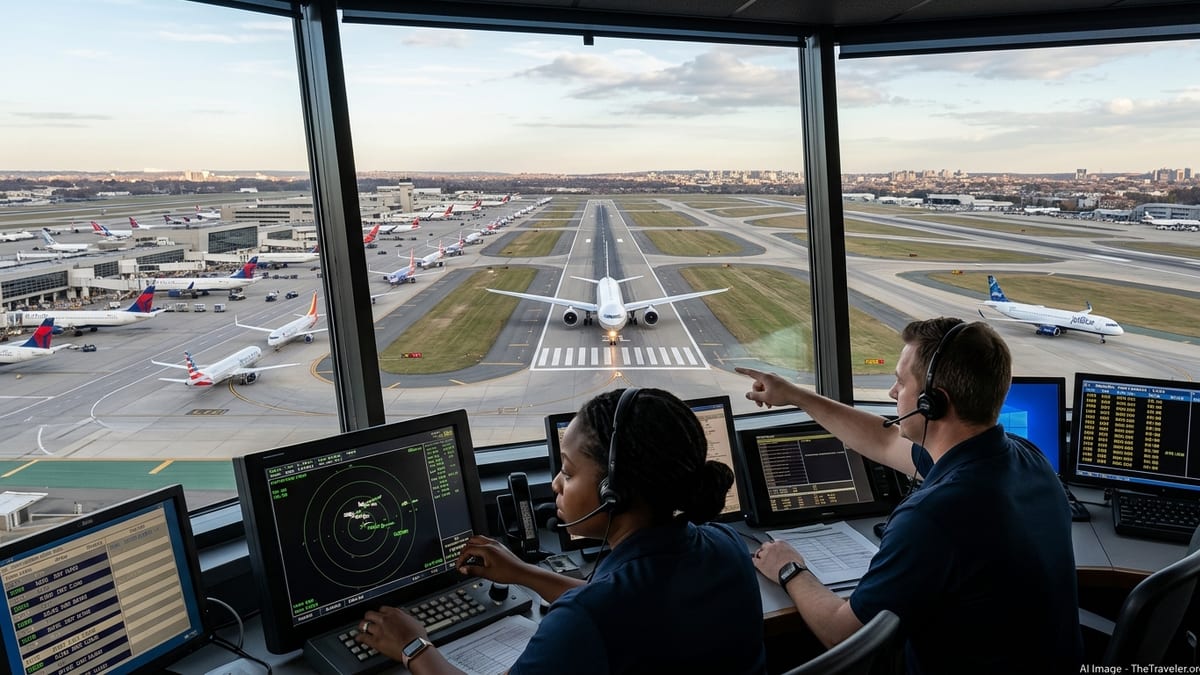
The current discussion centers on a change in how U.S. air traffic controllers may use a common departure instruction known as “line up and wait,” or LUAW. Under LUAW, a controller can clear an aircraft to enter a runway and hold in takeoff position while another aircraft is still landing or departing, with the expectation that a takeoff clearance will follow shortly. The new policy, which took effect nationwide in the days leading up to Thanksgiving 2026, tightens those conditions. At many towered airports, controllers now face stricter limits on how many aircraft they may line up, how early they can issue LUAW, and in what runway configurations the procedure is allowed.
Publicly available FAA controller guidance already framed LUAW as a carefully managed tool to keep runway operations efficient while maintaining separation between aircraft. The updated directive further emphasizes a conservative use of the procedure, particularly at complex airports with intersecting or closely spaced runways. While the exact language is issued through internal orders and facility-level briefings rather than consumer-facing documents, aviation trade reporting and specialist travel outlets describe a clear direction: LUAW is to be used less aggressively when there is any risk that arriving and departing traffic could conflict.
In practice, this means that at some busy airports controllers who previously might have lined up multiple departures on a runway while an aircraft was on short final may now defer LUAW until after the arrival has fully cleared or until traffic patterns are simpler. The new rule also ties LUAW more closely to real-time staffing and supervisory oversight, requiring that controllers have adequate support and surface monitoring tools before using the technique at high volumes. The net effect, particularly in peak banks of departures, is that some takeoffs will sequence slightly later than they would have under the more permissive guidance that was in place earlier in 2026.
Why the rule is arriving in the middle of the holiday rush
The timing is striking. The change took effect only days before the core Thanksgiving travel window from 23 November to 1 December 2026, a period during which the FAA projects roughly 417,000-plus flights in U.S. airspace, the highest Thanksgiving traffic level in about 16 years according to figures shared with national media. That means the new runway procedures are being tested immediately in one of the most demanding weeks on the aviation calendar, when even minor operational changes can ripple through already tight schedules.
The FAA has framed the LUAW revision as part of a broader runway safety effort that predates this holiday season. Throughout 2023 and 2024, the agency and the National Transportation Safety Board highlighted several serious runway incursions and close calls at major airports, prompting reviews of surface operations, controller training and technology such as surface detection radar and alerting systems. The LUAW changes fit within that continuum, prioritizing clearer separation between landing and departing aircraft and giving supervisors a more direct role in overseeing how aggressively the procedure is used during busy periods.
Federal officials have been careful to stress that the holiday timing is tied to the broader safety program’s implementation schedule rather than Thanksgiving specifically. In comments to national outlets this week, an FAA spokesperson said the measures were not expected to significantly affect overall airport capacity. However, the agency has also acknowledged that any tightening of runway rules inherently trades a small amount of peak-efficiency potential for a higher safety margin. Industry analysts note that Thanksgiving is essentially the first major holiday stress test for the updated LUAW guidance, so its real operational impact will only become fully visible after post-season data are reviewed.
How much delay risk travelers should realistically expect
The key question for passengers is whether the new LUAW rule will materially slow departures as millions of travelers head home for the holiday. At this stage, there is no consolidated federal data tying specific Thanksgiving delays directly to the policy change, and the FAA has not issued any notice attributing particular ground holds or departure queues to LUAW adjustments. Aviation specialists interviewed in recent days emphasize that any added waiting time is likely to be modest and highly location dependent, varying by airport layout, traffic mix, and staffing levels in the tower and on the ground.
At large hub airports with multiple parallel runways, the impact may be partially absorbed by shifting departure streams between runways and using advanced flow-management tools. The Transportation Department has highlighted its use of newer traffic flow platforms and a dedicated holiday “tiger team” to monitor congestion and re-sequence flights as needed to keep operations moving. That means the system has other levers to offset small capacity reductions that could arise from more conservative use of LUAW, particularly at facilities with robust surface surveillance and ample runway infrastructure.
On the other hand, at airports with intersecting runways, limited taxiway networks or chronically tight staffing, the stricter LUAW parameters could be more noticeable during peak periods such as early morning and late afternoon departure banks. In such settings, controllers who once lined up several aircraft while an arrival touched down may now keep more planes at the hold-short lines until the runway is fully available, stretching the departure queue by a few extra minutes per bank. If compounded by adverse weather, airline system outages, or other disruptions that historically affect Thanksgiving travel, these incremental delays could become more apparent even if they are not the primary cause of any given schedule disruption.
How the new rule interacts with other Thanksgiving travel pressures
The LUAW change is landing in an already complex operational environment. In the week leading up to Thanksgiving 2026, parts of the country have experienced storms, snow and low ceilings, conditions that reduce arrival and departure rates regardless of runway procedures. Some major carriers have also faced technology issues, including recent automation and dispatch system problems that led to rolling delays earlier in the week. These factors, along with typical holiday crowding at security checkpoints and baggage facilities, represent a larger and more immediate source of disruption than the incremental changes to takeoff sequencing alone.
Federal transportation officials have publicly emphasized that they are trying to stay ahead of these combined pressures. The FAA has expanded use of a strategic traffic management platform designed to predict and mitigate congestion across the nation’s 22 air route traffic control centers, aiming to move delays out of the air and into controlled ground holds where possible. The agency has also issued targeted safety and operational notices for specific events and airports, such as revised go-around procedures at Honolulu and special security airspace around Doral, Florida, though those local measures are distinct from the nationwide LUAW guidance.
For airports and airlines, integrating the new LUAW rules into daily operations on short notice requires additional coordination. Controllers, ramp crews and dispatchers must adapt to slightly different expectations about when to push aircraft from gates, how to stagger taxi flows toward departure runways, and when to anticipate takeoff clearance. While those adjustments are largely invisible to passengers in terminal waiting areas, they shape how smoothly each departure bank flows. During a busy holiday week, even small mismatches between gate pushes and runway availability can translate into aircraft waiting longer on taxiways, particularly at times when many flights are competing for the same runway slots.
What travelers should watch for and how to plan around the change
For individual travelers, the new LUAW directive is one more factor to consider in a holiday period that already brings elevated risk of delays. The core implications are straightforward. First, departures at some airports may leave the gate on time but wait slightly longer in the conga line for takeoff, especially during peak morning and evening waves. Second, these small ground delays are most likely to show up when combined with other constraints such as low visibility, strong crosswinds, or heavy arrival banks sharing the same runway system. Third, because the policy is systemwide but its practical impact is local, effects can differ significantly between, for example, a multi-runway coastal hub and a landlocked medium-sized airport with intersecting runways.
Travelers with critical same-day connections or time-sensitive plans may wish to factor in a wider buffer than they might on a non-holiday weekday. That can include booking earlier flights in the day, allowing more time between connections, and tracking airline and airport alerts closely on the day of travel. It is also prudent to distinguish between issues within the airline’s control, such as crew and aircraft availability, and broader system factors like weather and federal runway procedures. At present, there is no indication that airlines are modifying published schedules or proactively cancelling flights in response to the LUAW rule alone; published timetables for the Thanksgiving period remain broadly consistent with earlier seasonal planning.
Looking ahead, the most informative data on the rule’s true effect will arrive after the holiday rush. The FAA and the Bureau of Transportation Statistics routinely analyze delay causes, runway throughput and safety incidents, and those datasets will allow regulators, airlines and airports to evaluate whether the tighter LUAW standards meaningfully changed departure performance during Thanksgiving 2026. If the evidence shows that the safety benefits are strong and the delay impact limited, the policy is likely to remain in place in its current form. If certain locations see disproportionate disruption, regulators could refine the guidance or pair it with targeted investments in surface technology and staffing. For now, travelers heading out or returning home for Thanksgiving should be aware of the change, build reasonable slack into their plans, and monitor real-time information from their airlines and airports as this new rule receives its first major holiday test.