


More news on this day
Thousands of passengers across Europe faced long queues and missed connections today as operational disruptions rippled through major airports, with publicly available trackers indicating more than 2,000 flight delays and over 50 cancellations impacting services in France, England, Greece, Portugal, Ireland, Poland, Spain and other countries.
Get the latest news straight to your inbox!
Widespread Delays Hit Major European Hubs
Data compiled from multiple flight tracking and passenger rights platforms shows a sharp spike in disruption across the European air network, with a total of 2,031 flights delayed and 51 cancelled in a single day. The impact has been felt most acutely at large connecting hubs, where even modest schedule changes can cascade across dozens of routes.
Paris Charles de Gaulle and Paris Orly have reported an elevated number of delayed departures and arrivals, affecting both short haul and long haul operations. Flights between Paris and Mediterranean destinations such as Malaga and Alicante operated by low cost carriers have faced changes in departure times and extended waits at the gate.
In Southern Europe, Athens International Airport and Lisbon Humberto Delgado Airport have also seen a higher than usual volume of disrupted flights. Monitoring services that aggregate airport status information highlight knock on effects across the region, with late arriving aircraft contributing to growing backlogs through the day.
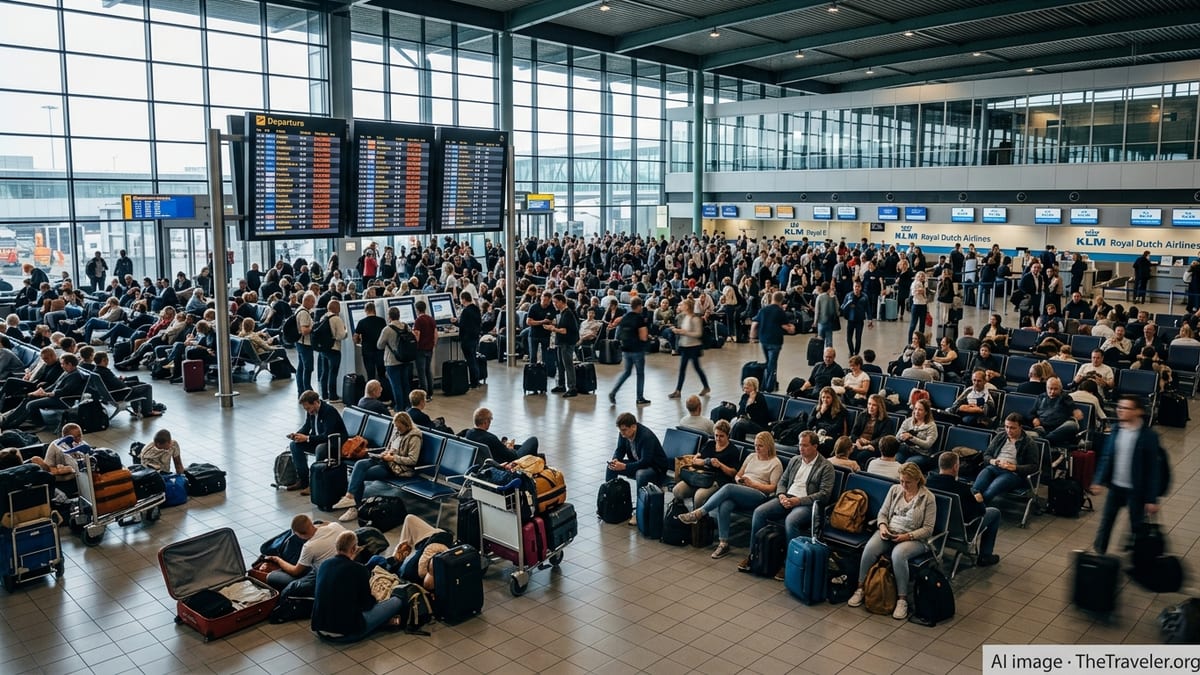
Passengers connecting through these hubs have been particularly exposed, with misaligned arrival and departure windows leading to missed onward flights and overnight stays. Travel forums and social media posts from across Europe describe crowded terminals, long lines at customer service desks and uncertainty over rebooking options.
Air France, British Airways, Vueling And Others Affected
The disruptions have touched a broad range of European and international carriers, including Air France, British Airways and Spanish low cost airline Vueling. Publicly available status boards for flagship routes such as Paris to Athens on Air France show schedule changes and delays, even where flights technically remain “on time” in timetables.
For British Airways, services linking London with key European cities have experienced cancellations and rescheduling, including early morning departures from Spain to London that were removed from operating schedules. Passenger rights services listing disrupted flights in real time have flagged specific British Airways and Vueling services as cancelled today, alongside a larger pool of delayed flights for other operators.
Vueling, which maintains a significant presence at Paris Orly and Barcelona, appears among the most visible low cost carriers in today’s disruption statistics. Recent listings on compensation advisory sites and airport trackers show several Vueling flights to and from destinations such as Ibiza, Barcelona and other Mediterranean airports cancelled or heavily delayed, adding to pressure on already busy terminals.
Legacy carriers and codeshare partners have not been immune. Flights marketed by larger brands but operated by partner airlines have seen schedule shifts between Paris and Lisbon, as well as on transatlantic services feeding into European hubs. For passengers, this has sometimes complicated efforts to identify which airline is responsible for handling rebooking and support.
Causes Range From Weather To Congested Airspace
While no single factor appears to explain the 2,031 delays and 51 cancellations recorded today, reports from aviation data providers and recent briefings on European airspace performance point to a mix of weather, congestion and operational constraints. Earlier in the season, poor weather across northern Europe and around London Heathrow demonstrated how fast localized storms or low visibility can reverberate throughout the continent, and similar patterns are emerging again.
Eurocontrol performance summaries published in recent months have highlighted Paris, Athens and Lisbon among airports that periodically experience above average air traffic flow management delays. These can stem from limited runway capacity at peak hours, restrictions in surrounding airspace, or staffing constraints that reduce the number of movements an airport can safely handle in a given period.
Operational decisions by individual airlines also contribute to the current picture. Adjustments to schedules, aircraft rotation challenges and late incoming aircraft can push departure times back even when weather is relatively stable. When aircraft arrive late into a busy hub such as Paris Charles de Gaulle or London Heathrow, recovery options are limited, leading to a build up of delays as the day progresses.
In some instances, industrial action or previous strike activity continues to have residual effects. Recent information about work stoppages involving ground or cabin crew for certain carriers, including low cost airlines based in Spain and France, has been linked to clusters of cancellations earlier in May. Even after strikes formally end, aircraft and crew positioning can remain out of sync, affecting subsequent days of operation.
Travelers Face Missed Connections And Overnight Stays
For individual travelers, today’s numbers translate into missed holidays, disrupted business trips and extended airport stays. Passengers transiting through Paris, Athens, Lisbon, London and Madrid report spending hours in lines seeking alternative routings, while some have chosen to abandon same day travel plans and request refunds instead.
Families heading to Mediterranean destinations from northern Europe have described being held on board delayed aircraft or waiting at crowded gates as airlines work through backlogs. Others have turned to rail connections or last minute hotel bookings near airports after evening departures were cancelled or delayed beyond midnight.
Consumer advocates note that under European passenger protection rules, travelers flying within, to or from the European Union may be entitled to assistance such as meals, refreshments and hotel accommodation during long delays. Compensation payments can sometimes apply when disruptions are linked to technical or operational issues within an airline’s control, although bad weather and certain air traffic control restrictions are typically treated as extraordinary circumstances.
Advisory sites are encouraging passengers affected by today’s wave of disruption to keep all boarding passes, booking confirmations and expense receipts, and to check later whether specific flights qualify for compensation. Many travelers are turning to online tools that compare flight numbers and dates against known disruption events to assess eligibility.
Prospects For Recovery In The Coming Days
Aviation analysts observing today’s disruptions suggest that most of the immediate backlog could ease within the next 24 to 48 hours if weather and air traffic conditions remain stable. However, high spring and early summer demand across Europe means that spare capacity to absorb displaced passengers is limited, particularly on popular leisure routes.
Because many flights during this period are already heavily booked, rebooking disrupted passengers onto same day alternatives can be challenging. Travelers facing cancellations out of Paris, London, Athens, Lisbon and other hubs may find that the earliest available options are one or more days later, especially for services to island destinations and long haul routes outside Europe.
Some airlines have issued general travel advisories recommending that passengers check flight status frequently on the day of travel, arrive earlier than usual at airports where disruption is concentrated, and consider more generous connection times when traveling through major hubs. Travel experts also highlight the value of flexible tickets or itineraries with protected connections, which can simplify rebooking when problems arise.
With the peak summer season approaching, today’s disruption serves as a reminder that Europe’s aviation network remains sensitive to a combination of weather, staffing levels and intense demand. Passengers planning multi leg journeys through Paris, Athens, Lisbon, London or other major airports in the coming weeks are being encouraged to build in extra time and to monitor airport conditions closely before departure.